A waste heat recovery turbine almost never announces its own decline. There is no alarm for a slowly fouling condenser, no trip for a bearing that has drifted half a degree warmer than last quarter, no red flag for a working fluid that has been picking up trace lubricating oil for the past eighteen months. What happens instead is quieter and more expensive: the same exhaust gas comes off the kiln, the same steam or organic vapor gets generated, and the turbine simply converts a little less of it into power every month than it did the month before. A plant that installed WHR to cover 25 to 30% of its electricity demand can watch that number erode toward 20% without a single work order being raised, because nothing about a slow efficiency slide looks like a maintenance event until someone finally reconciles power output against fuel input and asks where the difference went — which is exactly the gap iFactory's WHR monitoring closes, and you can book a demo to see it against your own turbine's generation history.
Every WHR Turbine Is Losing Output Right Now — The Only Question Is How Much
Steam turbines and ORC turbines degrade for entirely different physical reasons, but both lose power output the same way: gradually, silently, and almost always well before any protection system trips. iFactory tracks isentropic efficiency, vibration, and condenser performance continuously so the loss shows up as a trend line weeks before it shows up as a shortfall on the monthly generation report.
The Degradation Nobody Catches Until the Reconciliation Report
A one percent efficiency loss on a WHR turbine, spread across a month, changes no single shift's numbers enough for an operator to notice. A dust-fouled heat exchanger loses effectiveness a fraction of a percent at a time. A bearing wears in over months, not hours. Working fluid in an ORC system picks up trace lubricating oil contamination continuously, with the resulting output loss only becoming obvious after it has already compounded for a year or more. None of these show up as an alarm, because none of them are failures in the traditional sense — the turbine is still running, still generating power, just less of it per unit of heat captured.
The financial exposure compounds because the lost output isn't just foregone green power — it is electricity the plant now has to buy back from the grid or generate through another route, at a cost that only becomes visible once someone runs the comparison against the original design curve. A turbine quietly running 10% below its isentropic efficiency baseline for a year has not failed anything, and it has also not delivered a meaningful fraction of the return the WHR investment was built to produce.
Two Turbine Types, Two Different Maintenance Profiles
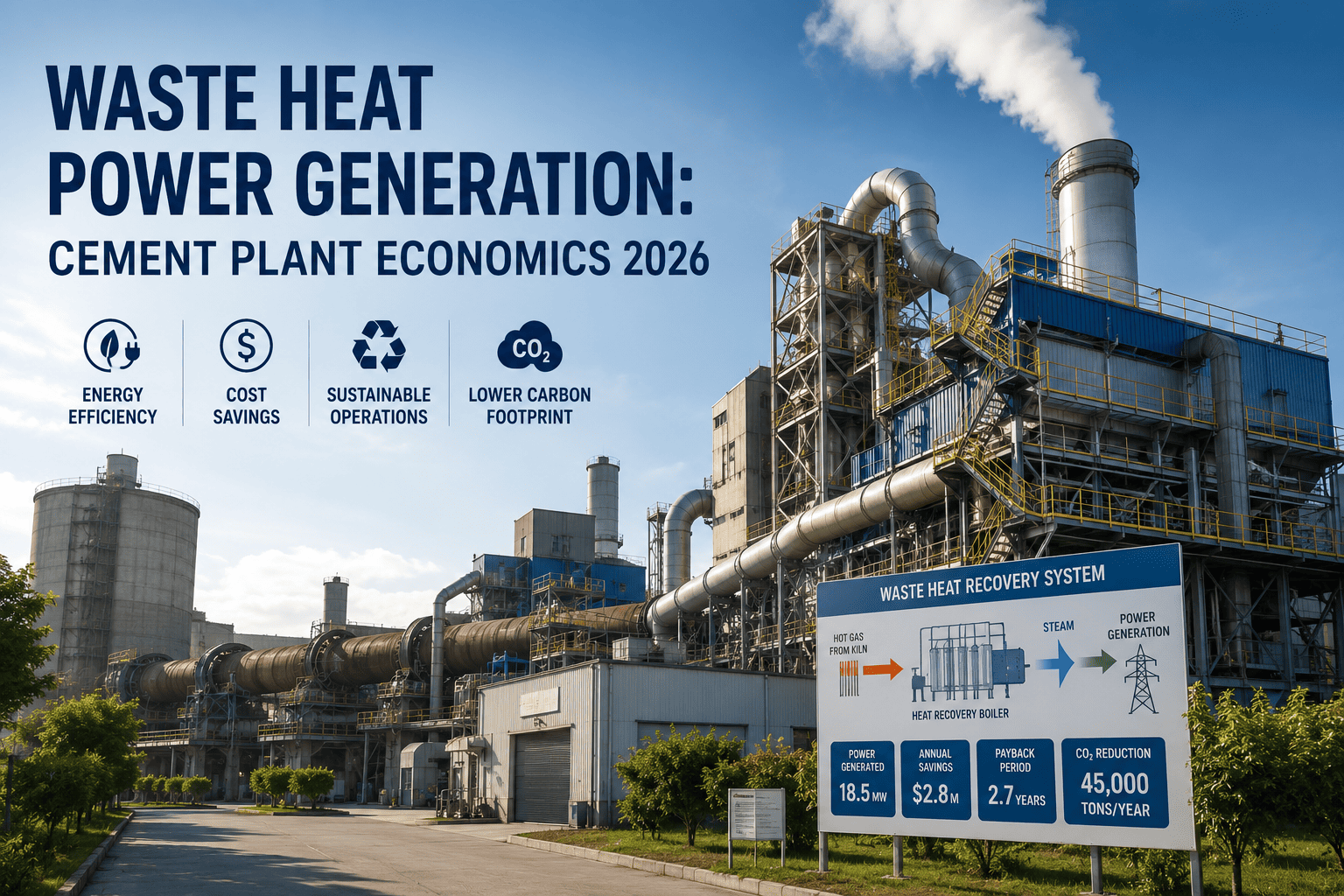
Cement plants increasingly run both technologies on the same site — a steam turbine fed by the higher-temperature preheater exhaust and an ORC turbine fed by the lower-temperature clinker cooler vent air — because each is matched to a different quality of waste heat. That split also means a plant's maintenance and monitoring program has to speak two different technical languages at once.
| Attribute | Steam Turbine (SRC) | ORC Turbine |
|---|---|---|
| Working fluid | Water / steam | Organic fluid, low boiling point |
| Best-suited heat source | Higher-temperature preheater exhaust | Lower-grade clinker cooler vent heat, 150-350°C |
| Typical thermal efficiency | Above 40% | 5% to 20%, depending on source temperature |
| Primary degradation driver | Blade fouling, seal wear, water chemistry deviation | Working fluid contamination from lubricating oil carryover |
| Water requirement | Requires treated water and condensate management | Water-free, closed-loop operation in most designs |
| Overhaul cadence | Major overhaul typically every 3-5 years | Major overhaul typically every 3-5 years |
The overlap in overhaul cadence hides a real difference in what happens between those scheduled events. A steam turbine's water chemistry can be tested and corrected almost immediately once a deviation is caught, while ORC working fluid contamination is a slow, cumulative process that is far harder to reverse once it has progressed — which makes early detection considerably more valuable on the ORC side than the SRC side, even though both technologies reward continuous monitoring over calendar-based inspection alone.
The Four Stages Where a WHR Cycle Loses Power
Every WHR turbine, steam or organic, moves through the same four-stage cycle — heat capture, expansion through the turbine, condensation, and return to the heat source — and each stage has its own efficiency signature. Reading them as one connected loop, rather than four separate systems, is what turns raw sensor data into an actual diagnosis.
Heat Capture
Dust fouling on waste heat boiler tubes insulates the heat transfer surface, reducing the heat delivered to the working fluid before the turbine ever sees it. Tracking the heat transfer coefficient and the temperature delta across the boiler catches fouling before it shows up as a turbine-side shortfall.
Turbine Expansion
Isentropic efficiency, vibration spectrum, and bearing temperature together describe the mechanical health of the turbine itself. A slow isentropic efficiency decline combined with a rising vibration trend at a specific bearing housing usually points to blade fouling or early seal wear well before either becomes a forced outage.
Condensation
Condenser vacuum and cooling water or air temperature set the pressure differential the turbine expands across, and that differential drives a meaningful share of total cycle efficiency. A degraded condenser vacuum silently narrows the useful pressure drop even while the turbine itself remains mechanically healthy.
Return to Source
Feedwater quality on steam systems and working fluid purity on ORC systems determine whether the cycle starts its next pass clean or already carrying the contamination that will erode output over the coming months. This is the stage most often skipped in a calendar-based inspection routine.
See All Four Cycle Stages in One View, Not Four Separate Logs
iFactory connects heat capture, turbine, condenser, and working fluid data into a single WHR efficiency trend, so a decline at any stage is traceable to its source.
What a Sustained-Generation Maintenance Calendar Actually Looks Like
Sustained WHR output depends less on any single major overhaul and more on a small set of routine checks performed at the right frequency. Plants that treat WHR turbines as "energy utility" equipment rather than production-critical assets tend to under-resource exactly this routine layer, which is where most of the slow, unnoticed efficiency loss originates.
None of these tasks are unusual or expensive on their own. What determines whether they actually protect generation is whether the readings are compared against a live rolling baseline or simply filed as a pass/fail checklist entry. A vibration reading that is "within spec" but trending upward for six consecutive weeks is a very different signal than the same reading taken once in isolation, and only a system built to trend continuously will surface that difference before it becomes a bearing replacement instead of a bearing adjustment.
What Plants Report After Moving to Continuous WHR Monitoring
Questions Plant Teams Ask About WHR Turbine Maintenance
Stop Letting WHR Output Erode Between Overhauls
iFactory tracks steam and ORC turbine performance continuously so your WHR system keeps delivering the power output it was designed for.