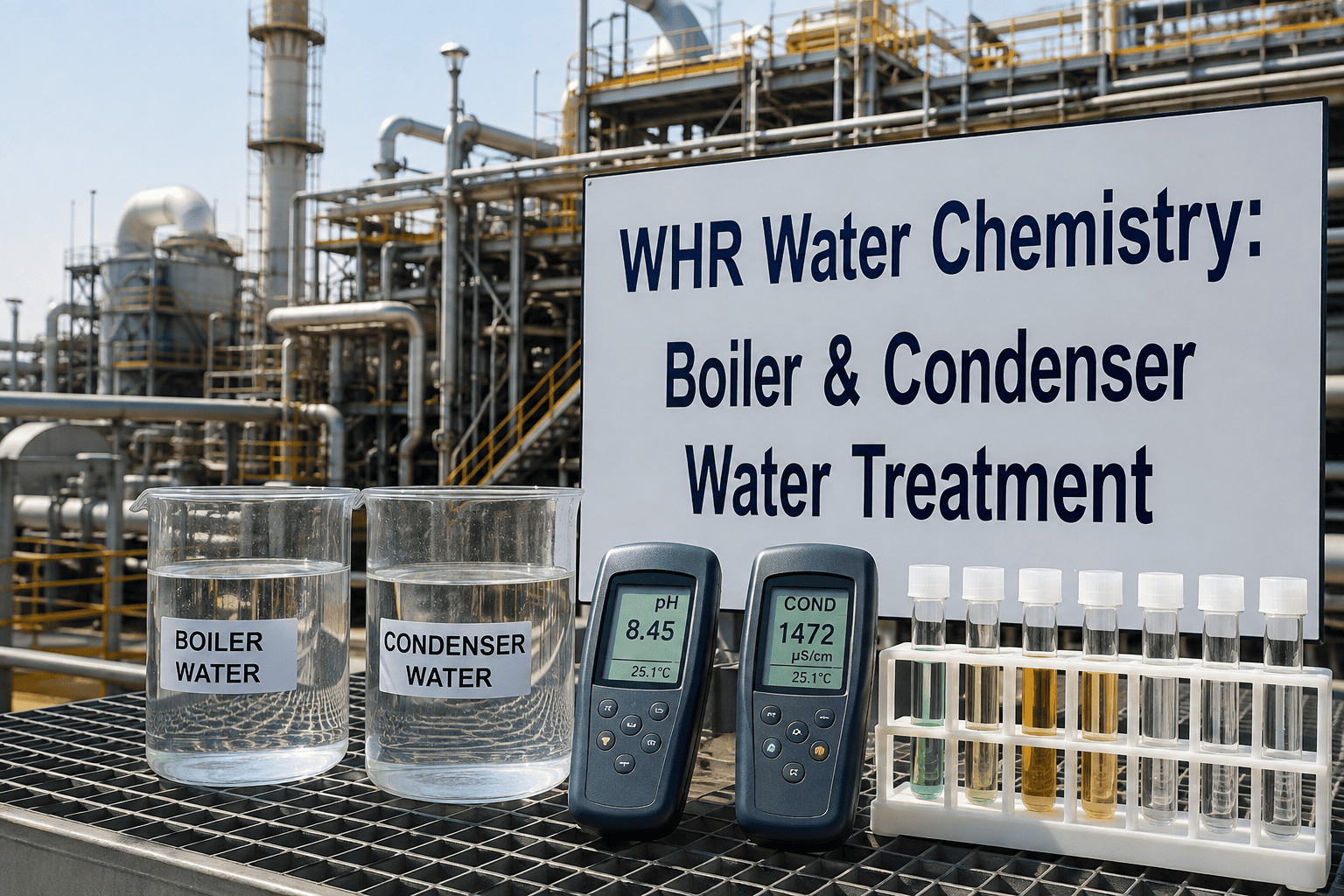
A steam-based waste heat recovery system is only as reliable as the water running through it, and that water is doing two very different jobs at once. On one side, feedwater is being boiled into high-pressure steam inside tubes that were never designed to tolerate scale or corrosion. On the other, condenser water is absorbing rejected heat and cycling back through tubes that foul, scale, and corrode by a completely different set of mechanisms. Most WHR reliability problems that get blamed on the turbine or the boiler design actually start as a slow drift in water chemistry that nobody caught early enough, and a working session with our team can show what continuous chemistry tracking looks like against your own boiler and condenser data.
Cement WHR · Water Chemistry Management
WHR Water Chemistry: Boiler and Condenser Water Treatment That Protects Equipment Life
Feedwater treatment, blowdown management, and condenser tube protection for a steam-based waste heat recovery system, built around the chemistry parameters that decide whether your boiler and turbine last the full design life or fail early.
<0.007 ppm
target dissolved oxygen in feedwater on many industrial boilers
2
separate water loops, each with its own chemistry failure modes
$0.5B+
estimated annual industry cost of condenser tube fouling and failures
Why This Gets Overlooked
Water Chemistry Rarely Causes a Dramatic Failure, It Causes a Slow One
A WHR boiler tube rupture or a turbine blade failure almost always makes it into the incident report as a mechanical event, but trace the root cause back far enough and a large share of these failures started months or years earlier as an unmanaged chemistry drift. Dissolved oxygen left uncontrolled pits boiler tubes from the inside. Silica that isn't kept below the limit for your operating pressure volatilizes into the steam and deposits on turbine blades, quietly eroding output long before anyone traces the efficiency loss back to a water test. Condenser tubes scale and foul on a completely separate timeline driven by cooling water hardness and biological growth, and a bad enough tube leak lets raw cooling water straight into the condensate, carrying contamination into the boiler and turbine that a routine visual inspection will never catch in time. None of this looks urgent on any single day, which is exactly why it tends to get deprioritized until a shutdown forces the issue. And because a WHR system is often treated as a secondary asset next to the kiln line itself, water chemistry testing on it can slip further down the priority list than it would on a plant's primary steam generation equipment, even though the boiler tubes and turbine internals are exactly the same metallurgy facing exactly the same chemistry risks.
Two Loops, Two Sets of Rules
The Boiler Loop and the Condenser Loop Fail in Completely Different Ways
A steam Rankine WHR system runs two water circuits that share a turbine but almost nothing else chemically. Treating them with a single generic water treatment plan is one of the most common reasons plants end up managing an unplanned outage on one side while assuming the other side is fine.
Boiler Feedwater Loop
High-purity, closed-loop water pushed to high pressure and boiled inside the waste heat boiler tubes. Failure modes are driven by dissolved oxygen corrosion, scale-forming hardness, and silica carryover into the steam.
Key risks: oxygen pitting, caustic gouging, silica deposition on turbine blades
Primary controls: deaeration, demineralization, chemical dosing, blowdown
Condenser and Cooling Loop
Open or recirculating cooling water rejecting heat from the turbine exhaust steam. Failure modes are driven by scale crystallization, under-deposit corrosion, and microbiological fouling working together.
Key risks: calcium carbonate scaling, tube pitting, biofilm-driven corrosion
Primary controls: scale inhibitors, biocides, corrosion inhibitors, tube cleaning
Feedwater Chemistry Targets
What the Boiler Side Actually Needs to Stay Within
Industrial boiler feedwater standards tighten sharply as drum operating pressure increases, since higher-pressure steam is far less forgiving of impurities. The table below summarizes the parameters that matter most and why each one is tracked, drawn from the ranges published by ASME and ABMA for industrial watertube boilers.
| Parameter | Typical Target Range | Why It's Controlled |
|---|---|---|
| Dissolved oxygen | Below roughly 0.007 ppm before scavenger dosing | Oxygen pitting is one of the fastest ways to perforate a boiler tube |
| pH | Roughly 8.3 to 10, often held near 9.5 | Prevents both acidic corrosion and caustic-driven metal attack |
| Total dissolved solids | Falls sharply as pressure rises, per ABMA pressure bands | Excess TDS drives scale, carryover, and foaming inside the boiler drum |
| Silica | Tightens from under 150 ppm at low pressure to under a few ppm at high pressure | Volatilizes into steam and deposits on turbine blades at high pressure |
| Total hardness | Near zero at higher operating pressures | Calcium and magnesium are the primary scale-forming minerals |
| Total alkalinity | Set relative to TDS and silica solubility limits | Excess alkalinity relative to conductivity can trigger foaming and carryover |
See Your Boiler and Condenser Chemistry on One Dashboard
Most WHR teams are checking feedwater and cooling water chemistry from separate lab sheets on separate schedules. A short session shows what tracking both loops together looks like against your own trend data.
Managing Blowdown
Blowdown Is the Release Valve That Keeps Boiler Water Within Limits
As a boiler continuously evaporates water into steam, the dissolved solids left behind in the boiler water concentrate over time, since only pure water leaves as vapor while minerals stay behind. Blowdown removes a controlled portion of that concentrated boiler water to keep total dissolved solids and silica within the allowable limits for the operating pressure, and the required rate is calculated directly from the feedwater's raw silica or TDS level against the boiler's maximum allowable concentration. Continuous blowdown is typically run at a small, steady percentage of feedwater flow rather than as an occasional manual dump, since a steady rate keeps chemistry stable instead of letting concentration climb between manual blowdown events. Too little blowdown lets solids climb toward the scaling and carryover limit; too much wastes treated water and the heat energy carried with it, which is exactly the kind of trade-off that benefits from continuous conductivity monitoring rather than a fixed daily schedule.
Condenser Side
Corrosion, Scale, and Biofouling Reinforce Each Other, Not Just Coexist
Cooling water treatment specialists describe condenser chemistry as a triangle for a reason: corrosion, scale formation, and microbiological fouling are so tightly linked that controlling only one or two of the three rarely holds for long, and a treatment aimed at one side can quietly make another side worse. Calcium carbonate scale is inversely soluble with temperature, meaning the hottest part of the condenser tube is exactly where it wants to crystallize out of solution. Once scale or biofilm forms, it creates the sheltered conditions where under-deposit corrosion and microbiologically influenced corrosion take hold, and a tube pitted or leaking from that corrosion is what eventually lets raw cooling water contaminate the condensate returning to the boiler. The mineral makeup of the deposit itself often points back to the water source, since inland plants drawing on hard groundwater tend to see calcium carbonate dominate their fouling profile, while plants on softer or more variable makeup water are more likely to see biological fouling take the lead instead, which is part of why a generic treatment program rarely performs the same way at two different sites.
Scale Formation
Calcium carbonate and other minerals crystallize out of cooling water once their saturation point is exceeded, insulating tube surfaces and cutting heat transfer.
Corrosion
Under-deposit corrosion forms beneath scale and biofilm, while microbiologically influenced corrosion attacks bare metal directly, both leading toward tube pitting and leaks.
Microbiological Fouling
Naturally occurring bacteria form biofilms on tube surfaces, trapping deposits, accelerating corrosion underneath, and providing food for further microbial growth.
Testing Cadence
How Often Each Chemistry Parameter Actually Needs Checking
Not every water chemistry parameter needs the same testing frequency, and running a full laboratory panel daily wastes lab time on parameters that barely move between shifts. A tiered testing cadence keeps the fast-moving parameters under close watch while reserving deeper analysis for a weekly or monthly cycle.
Daily / Per Shift
Feedwater pH and conductivity, boiler water conductivity, condenser cooling water pH and conductivity, visual clarity checks
Weekly
Dissolved oxygen verification, silica testing on both feedwater and boiler water, hardness spot checks on makeup water
Monthly
Full laboratory chemistry panel, chemical dosing rate review, condenser tube inspection scheduling based on trend data
Applied Example
How a Drifting Oxygen Scavenger Dose Got Caught Before It Became a Tube Failure
Consider a WHR boiler running steady chemical dosing for months without incident, until a change in makeup water supplier subtly shifted the raw water's dissolved oxygen load beyond what the existing scavenger dosing rate was calibrated to handle. On a manual testing schedule limited to daily grab samples, that drift could easily sit unnoticed for weeks while oxygen pitting slowly worked into tube walls, since a single daily reading rarely captures a gradual trend early enough to act on it. With continuous chemistry monitoring in place, the dissolved oxygen trend line shows the shift within days rather than weeks, well before pitting has a chance to start, and the dosing rate gets recalibrated as a routine adjustment instead of becoming the root cause investigation behind a tube failure two years later. The same pattern holds on the condenser side, where a slow rise in cooling water hardness or a drop in biocide effectiveness shows up as a trend long before it shows up as a fouled tube bundle or a corrosion-driven leak. In both cases, the cost of catching the drift early is a minor dosing adjustment logged during a routine shift check, while the cost of missing it is an unplanned outage, a tube replacement, and lost WHR generation for however many days the repair ends up taking.
Before You Tighten Your Water Treatment Program
What to Confirm Before Reworking Your WHR Water Chemistry Program
Answering these questions first turns a water treatment review into a focused fix instead of a generic overhaul of a program that may already be working in most areas.
| Question | Why It Matters |
|---|---|
| What is your current boiler operating pressure and its matching chemistry limit table? | Every parameter's allowable range shifts with drum pressure |
| How is dissolved oxygen currently tracked between lab samples? | Oxygen pitting is one of the fastest-acting failure modes on the boiler side |
| What is the makeup water source and how consistent is its hardness? | Directly shapes scaling risk in both the boiler and condenser loops |
| How is blowdown rate currently set — fixed schedule or chemistry-driven? | A chemistry-driven blowdown rate avoids both under- and over-blowdown waste |
| When was the condenser tube bundle last inspected for scale or corrosion? | Establishes a baseline for how fast fouling is progressing on your cooling loop |
Common Questions
WHR Water Chemistry — Frequently Asked
These are the questions cement plant WHR operations and reliability teams tend to raise first when reviewing their boiler and condenser water treatment program.
How quickly can bad feedwater chemistry actually damage a WHR boiler?
Faster than most operators expect, particularly with dissolved oxygen, which begins pitting carbon steel tube surfaces almost immediately once oxygen levels rise above target and the protective oxide layer breaks down. A single chemistry excursion lasting a few days rarely causes a failure on its own, but repeated undetected excursions accumulate pitting damage that eventually perforates a tube wall, often well before the boiler reaches its expected design life. That accumulation is exactly why continuous tracking matters more than a strong average across periodic grab samples. Book a review to see how continuous oxygen and pH trending would look against your boiler's history.
Why does silica specifically get so much attention at higher boiler pressures?
Silica behaves differently from most other boiler water impurities because it can volatilize directly into the steam phase at higher pressures rather than staying behind in the liquid boiler water the way most dissolved solids do. Once carried into the steam, it deposits on turbine blades as the steam expands and cools, forming a hard glassy coating that reduces turbine efficiency and can eventually require a costly blade cleaning or replacement outage. This is why silica limits tighten so sharply as operating pressure increases, dropping from a fairly generous allowance at low pressure to just a few parts per million on higher-pressure systems. Contact our team to review silica limits specific to your boiler's operating pressure.
Can a condenser tube leak really contaminate the whole steam cycle?
Yes, and it is one of the more serious failure paths in a steam-based WHR system precisely because the condenser sits at the point where cooling water and condensate are separated by nothing more than a thin tube wall. If that wall develops a leak, raw cooling water containing hardness, dissolved solids, and sometimes biological contamination can migrate directly into the condensate stream, which then travels back through the feedwater system into the boiler itself. A contamination event of that kind can undo months of careful feedwater chemistry control in a matter of hours, which is why condenser tube integrity monitoring is treated as part of the water chemistry program rather than a separate mechanical concern. Book a demo to see how tube-leak detection fits alongside chemistry monitoring.
Is it possible to over-treat boiler or condenser water?
It is, and over-treatment carries its own risks alongside the more commonly discussed problem of under-treatment. Excess alkalinity relative to conductivity in boiler water can trigger foaming and carryover into the steam, while over-dosing certain corrosion inhibitors or biocides on the condenser side can create their own deposit or discharge compliance issues. Chemistry management works best as a targeted response to what the water is actually showing on a given day, dosed to the minimum level needed to hold each parameter within its target range rather than treated as a fixed recipe applied regardless of conditions. Ask our team about tuning dosing programs against real-time trend data instead of fixed schedules.
Does water chemistry monitoring reduce blowdown-related water and energy waste?
It generally does, since a large share of excess blowdown happens because a plant is blowing down on a conservative fixed schedule rather than on actual measured chemistry, effectively discarding treated, heated water more often than the boiler chemistry actually requires. Continuous conductivity and silica trending lets blowdown rate track the real concentration level in the boiler rather than a worst-case assumption, which recovers both water and the thermal energy that blowdown carries away with it. On a WHR system where every unit of thermal energy is already being captured for a reason, unnecessary blowdown is a direct and avoidable efficiency loss. Book a session to see blowdown optimization modeled against your own boiler's chemistry data.
Track Both Water Loops Before They Cost You a Boiler or Turbine Outage
iFactory brings feedwater and condenser cooling water chemistry onto one continuous dashboard, flagging dissolved oxygen, silica, and TDS drift early enough to correct dosing before pitting, scaling, or carryover ever reaches the turbine.