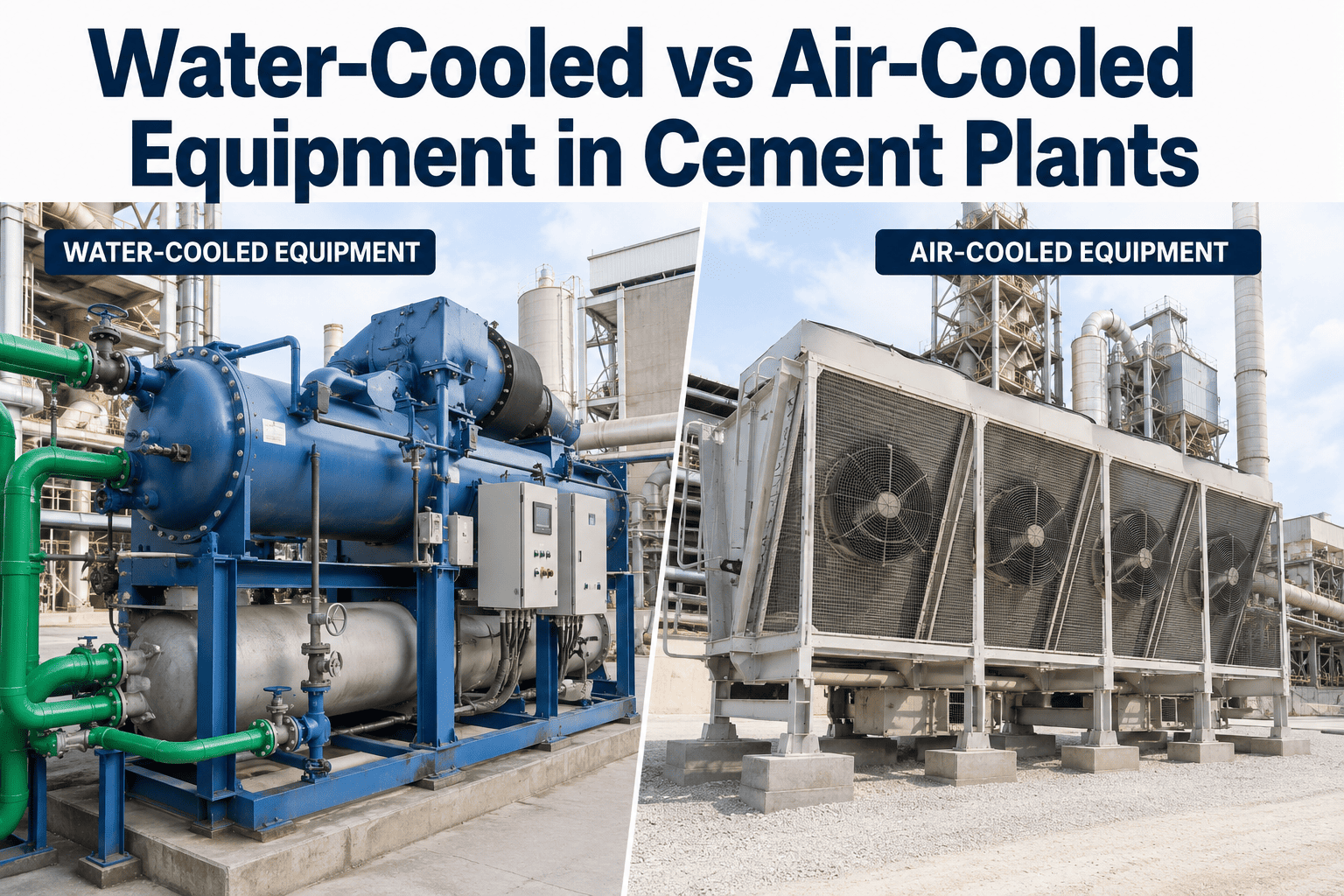
The cooling system spec sheet for a new compressor or gearbox usually lists two options side by side with barely any explanation, and the plant engineer picks whichever one matches what's already installed nearby. That habit works fine until water becomes scarce, or a water-cooled unit's treatment costs quietly exceed the equipment's own maintenance budget. The right choice depends on water availability, ambient temperature, and long-term maintenance load, not on what's convenient to plumb. Book a demo to see this comparison run against your plant's actual utility and maintenance data.
One Cooling Choice, Two Very Different Cost Curves
Water-cooled and air-cooled configurations for coolers, compressors, and gearboxes carry different capital, water treatment, and maintenance costs over the life of the equipment. This comparison lays out both sides plainly.
Cooling Is Chosen Once, Then Forgotten
Cooling configuration is usually locked in at procurement and rarely revisited, even as water costs, ambient conditions, or maintenance staffing change.
Water-Cooled vs Air-Cooled at a Glance
Neither option is universally better — the right one depends on which cost curve your plant can absorb.
Better Heat Transfer, Higher Water Dependency
Water-cooled systems handle higher heat loads in a smaller footprint and perform consistently regardless of ambient air temperature. The trade-off is a continuous water treatment program to control scaling, corrosion, and biological growth in the loop, plus higher maintenance attention on pumps and exchangers.
Lower Water Use, Higher Ambient Sensitivity
Air-cooled units eliminate water treatment costs entirely and simplify plumbing, but their cooling capacity drops as ambient temperature rises, which matters in hot climates or during summer peak loads. Fan motors and blades also add a different maintenance profile than pumps and heat exchangers.
Four Questions That Actually Decide This
Walk through these in order before defaulting to whatever the plant already has installed.
What Does Water Actually Cost Here?
Factor in treatment chemicals, softening, and makeup water together, not just the utility rate, since treatment often costs more than the water itself.
What Is Peak Ambient Temperature?
Air-cooled capacity is rated against a design ambient temperature, and plants running well above that design point see real derating on hot days.
Who Maintains This Equipment?
Water-cooled loops need a water treatment routine on top of mechanical maintenance, while air-cooled units shift that load toward fan and motor upkeep instead.
What Is the Footprint Constraint?
Water-cooled exchangers are typically more compact, which matters in retrofits where floor space around the compressor or gearbox is already tight.
Cooling Cost Isn't Just the Utility Bill
Treatment chemicals, fan motor replacement, and unplanned downtime from fouling or overheating all belong in the same comparison as the upfront equipment quote.
Where the Real Cost Difference Shows Up
A fair comparison spreads cost across the full equipment life, not just the purchase price.
| Cost Category | Water-Cooled | Air-Cooled |
|---|---|---|
| Upfront capital | Generally lower for equivalent capacity | Generally higher for equivalent capacity |
| Ongoing water treatment | Continuous chemical and softening cost | None |
| Ambient sensitivity | Minimal | Capacity drops as ambient temperature rises |
| Footprint | Compact | Larger, needs open airflow space |
| Maintenance focus | Pumps, exchangers, water chemistry | Fan motors, blades, airflow blockage |
How Regional Conditions Shift the Answer
The same equipment spec can favor different cooling choices depending on where the plant sits.
Hot, Dry Climates
High ambient temperature derates air-cooled capacity, but low humidity also reduces water-cooled fouling risk, making water cooling often the stronger fit.
Hot, Humid Climates
Cooling towers face higher fouling and biological growth risk in humid conditions, which raises water treatment cost and narrows the water-cooled advantage.
Cold Climates
Air-cooled units perform well in low ambient temperatures, though freeze protection becomes a design consideration for any water-based loop left idle.
Water-Restricted Regions
Local water permitting and discharge rules can make air-cooled the only practical option regardless of the underlying cost comparison.
When a Mixed Approach Makes Sense
Cooling doesn't have to be all one type across every asset in the plant.
Hybrid Wet-Dry Cooling
Some systems switch between water and air cooling based on ambient conditions, using water cooling only during peak heat load periods to limit treatment costs.
Asset-by-Asset Assignment
High-duty compressors near the kiln may justify water cooling while auxiliary gearboxes elsewhere run air-cooled, balancing cost against criticality per asset.
Phased Conversion
Plants transitioning away from water cooling due to scarcity often phase the change in during scheduled equipment replacement rather than a single capital project.
Cooling System Selection — Common Questions
What plant engineers ask most before finalizing a cooling spec for new or replacement equipment.
Q: Is air-cooled always the safer choice in water-scarce regions?
Not automatically — air-cooled removes water treatment cost, but if peak ambient temperatures are high, the equipment may need to be significantly oversized to hit the same cooling capacity, which raises capital cost and footprint. In water-scarce regions with moderate ambient temperatures, air-cooled is usually the stronger choice. In hot, water-scarce regions, the trade-off needs a proper capacity study rather than a default assumption. Book a demo to model this against your site's climate data.
Q: Can an existing water-cooled system be converted to air-cooled later?
It's possible but rarely simple, since air-cooled units generally need more space and different ductwork or airflow clearance than the piping a water-cooled system uses. Retrofits are more feasible during a broader equipment upgrade than as a standalone conversion project. The mechanical rework cost should be weighed against the ongoing water savings before committing. Our support team can help scope what a retrofit would involve on your equipment.
Q: Does water quality affect which option makes more sense?
Yes — plants drawing from hard or mineral-heavy water sources face higher treatment costs to prevent scaling in a water-cooled loop, which shifts the total cost comparison toward air-cooled even where water is not scarce. Conversely, plants with access to clean, low-cost water may find water-cooled remains cheaper over the equipment's life. Water quality testing should be part of the initial cooling decision, not an afterthought discovered after installation.
Q: How much does ambient temperature actually derate an air-cooled unit?
The derating curve depends on the specific unit and its design ambient rating, but capacity loss becomes noticeable once actual temperatures exceed the design point by a meaningful margin, and can be significant during extended summer peaks. Plants in consistently hot climates should size air-cooled equipment against their actual peak temperature, not an average annual figure. This is one of the most common causes of underperforming air-cooled installations.
Q: Should gearboxes and compressors use the same cooling approach across a plant?
Standardizing on one cooling approach simplifies spare parts and maintenance training, but it can also mean applying a suboptimal choice to equipment with very different heat loads or duty cycles. High-duty compressors may justify water cooling even in a plant that runs mostly air-cooled elsewhere. The decision is worth making per asset class rather than as a blanket plant-wide standard.
Pick the Cooling System, Not the Habit
Water and air cooling both work — the wrong one just costs more over time in ways the purchase order never shows. Run the comparison against your plant's real water cost, ambient conditions, and maintenance capacity before the next replacement cycle.