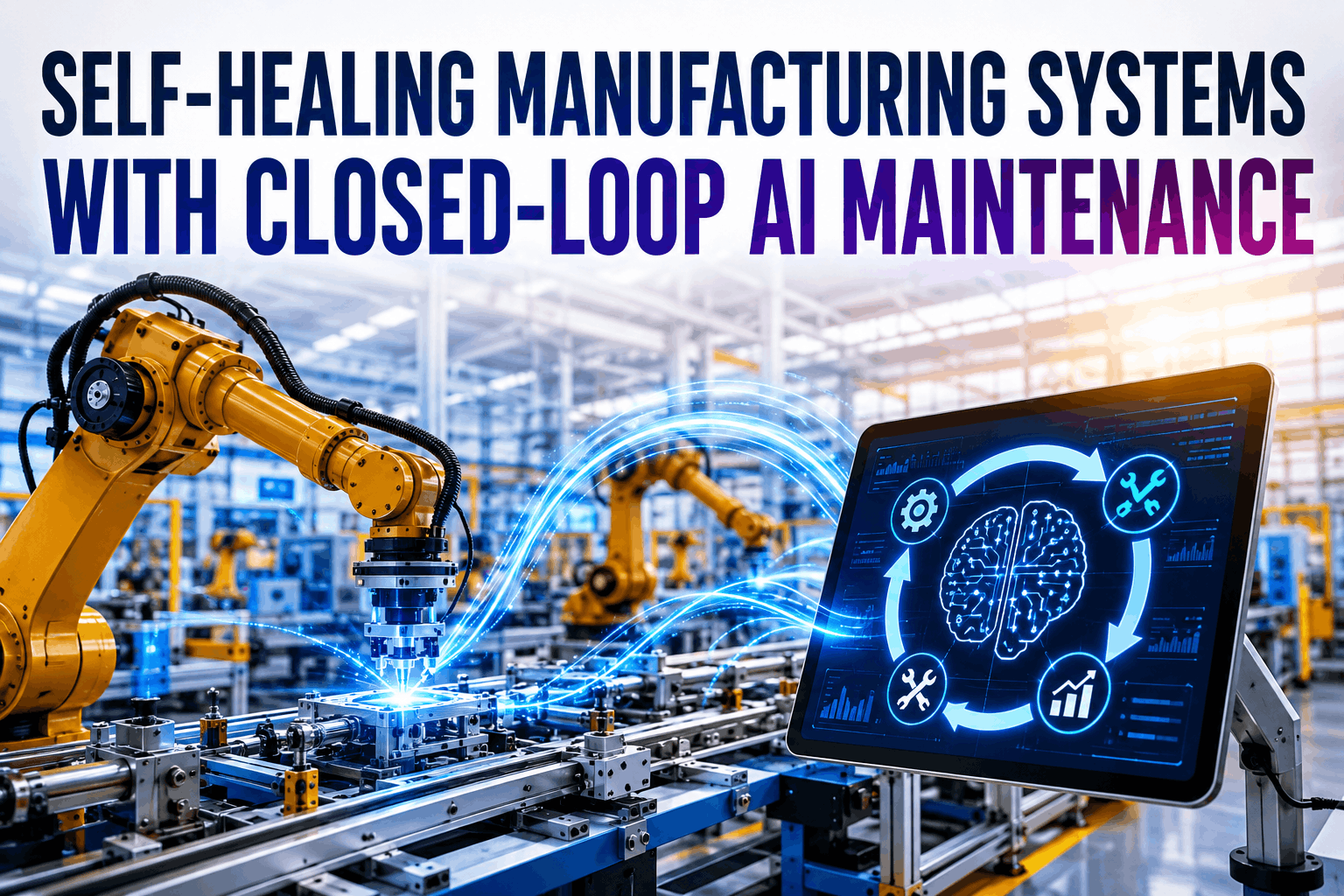
AI detects anomalies, adjusts operating parameters automatically, and dispatches maintenance only when self-correction cannot resolve the issue — automating up to 80% of routine decisions without human intervention. Start Trial Free to see how iFactory gives manufacturing operations the closed-loop AI infrastructure needed to detect, respond to, and resolve equipment anomalies before they become production stoppages.
Automate 80% of Routine Maintenance Decisions with Closed-Loop AI
iFactory monitors equipment continuously, adjusts parameters when anomalies appear, and escalates to human maintenance only when autonomous correction cannot resolve the condition — closing the loop between detection and response.
Why Closed-Loop AI Replaces Reactive Maintenance Decision-Making
Traditional maintenance operates in open loop — sensors detect a condition, an alert reaches a technician, a work order is created, a technician responds. Each handoff introduces lag, and in high-throughput manufacturing that lag is where unplanned downtime originates. Closed-loop AI compresses this sequence by placing autonomous decision logic between detection and response: the system identifies the anomaly class, determines whether a parameter adjustment can resolve it, executes the correction, and only escalates when correction fails. Manufacturing teams that Book a Demo with iFactory see how autonomous response architecture changes the economics of equipment availability without increasing maintenance headcount.
-
Anomaly Detection and Classification
iFactory monitors sensor streams continuously and classifies detected anomalies by type, severity, and likely root cause — distinguishing between conditions that warrant autonomous correction and those requiring human escalation.
-
Autonomous Parameter Adjustment
For anomaly classes within predefined safe operating envelopes, iFactory adjusts equipment parameters — speed, pressure setpoints, feed rates — automatically, logging the intervention and monitoring outcome without requiring a work order.
-
Correction Outcome Monitoring
iFactory tracks sensor response after each autonomous correction — confirming whether the adjustment resolved the anomaly or whether the condition is progressing toward a threshold that requires human maintenance dispatch.
-
Escalation Logic and Work Order Dispatch
When autonomous correction fails or an anomaly class exceeds safe-adjustment boundaries, iFactory generates a prioritized work order and routes it to the appropriate maintenance team with full anomaly context attached.
-
Decision Audit Trail
Every autonomous decision — detection event, correction action, outcome assessment, escalation trigger — is logged in iFactory with timestamps and sensor data snapshots, creating a complete audit record for compliance and model improvement.
-
Adaptive Response Learning
iFactory improves autonomous correction accuracy over time by correlating intervention outcomes with anomaly classifications — updating decision boundaries as the model accumulates equipment-specific response data.
Core Layers of a Self-Healing Manufacturing System
-
Continuous Anomaly Detection and Classification Engine
Foundation LayerSelf-healing begins with detection that is fast enough and specific enough to act upon. iFactory's anomaly detection layer processes sensor streams in near real-time, applying multivariate statistical models trained on equipment-specific normal operating envelopes — flagging deviations that single-threshold alarm systems miss because no individual sensor has crossed a limit. Classification assigns each anomaly to a known category: lubrication-related, thermal excursion, load imbalance, process deviation, or mechanical wear signature — providing the decision layer with the context needed to select a correction response. Teams that Start Trial can connect existing sensor infrastructure to iFactory's detection engine without replacing installed instrumentation.
Detection Method
Multivariate statistical models on equipment-specific baselines
Classification Output
Anomaly type, severity, and probable root cause category
iFactory Record
Detection event logged with sensor snapshot and classification
-
Autonomous Correction Decision Layer
Response IntelligenceThe decision layer determines whether a detected anomaly is within the safe autonomous correction envelope — a boundary defined by equipment type, operating context, and the reversibility of the proposed adjustment. For conditions within envelope, iFactory selects and executes the appropriate correction: adjusting a speed setpoint, modifying a lubrication cycle interval, reducing load on an overheating drive, or changing a process parameter to move the operating point away from a resonance zone. For conditions outside envelope — structural defects, progressive failures, safety-relevant anomalies — the decision layer bypasses autonomous response and routes directly to escalation. Teams that Book a Demo can review how correction envelopes are configured for each equipment class.
Envelope Definition
Equipment-specific safe adjustment boundaries per anomaly class
Decision Output
Autonomous correction execution or escalation routing
iFactory Record
Decision rationale and envelope reference logged per event
-
Closed-Loop Outcome Verification
Feedback IntelligenceA correction that is not verified is not a closed loop — it is a one-way intervention with unknown effect. iFactory monitors sensor data for a configurable window after each autonomous correction, comparing post-correction readings against the expected response trajectory for the correction type. Corrections that produce the expected normalization are logged as resolved. Corrections that do not produce normalization within the monitoring window trigger a secondary decision: attempt an alternative autonomous correction, or escalate to human maintenance. This verification step is what converts autonomous parameter adjustment from a best-effort action into a documented, outcome-confirmed intervention.
Verification Window
Configurable post-correction monitoring period per correction type
Outcome States
Resolved, partially resolved, escalation triggered
iFactory Record
Correction outcome and post-correction sensor data archived
-
Human Escalation and Work Order Integration
Escalation LayerSelf-healing systems do not eliminate human maintenance — they ensure that human intervention is deployed only for conditions that genuinely require it, with complete diagnostic context already assembled. iFactory's escalation output generates a work order pre-populated with the anomaly classification, autonomous correction attempts and outcomes, current sensor readings, and recommended next action based on the failure mode — reducing the time a technician spends diagnosing before beginning physical work. Work orders routed from the autonomous system carry a higher diagnostic confidence rating than manually created orders because they originate from multi-sensor event records rather than single-sensor alarm triggers.
Escalation Trigger
Correction failure, envelope breach, safety-relevant classification
Work Order Content
Anomaly history, correction attempts, sensor snapshot, recommendation
iFactory Record
Full autonomous decision chain linked to generated work order
-
Industry 5.0 Human-Machine Collaboration Architecture
Operational ModelIndustry 5.0 concepts position autonomous systems not as replacements for human judgment but as amplifiers of it — handling the high-frequency, low-complexity decision volume so that skilled technicians and engineers can focus on the low-frequency, high-complexity events that require experience and contextual understanding. iFactory's closed-loop architecture embodies this model: autonomous response handles the 80% of routine conditions that follow known patterns, while human expertise is reserved for the 20% of conditions where pattern-matching is insufficient. The result is a maintenance operation where technician time is concentrated on decisions that genuinely benefit from human judgment. Teams that Start Trial can configure human oversight thresholds for each autonomous decision class.
Automation Target
80% of routine anomaly decisions handled autonomously
Human Role
Complex diagnosis, safety decisions, envelope boundary review
iFactory Record
Automation rate and human intervention frequency tracked per asset
-
Adaptive Model Improvement from Outcome Data
Learning LayerA self-healing system that does not improve over time is a static rule set — not a learning architecture. iFactory uses correction outcome data, escalation patterns, and human technician feedback from resolved work orders to refine anomaly classification boundaries and correction selection logic. Equipment classes where autonomous corrections repeatedly fail before escalation trigger model review — identifying gaps in the correction envelope that require either boundary adjustment or new correction action types. Over 12 to 18 months of operation, this improvement cycle measurably increases the autonomous resolution rate on equipment classes where the model has accumulated sufficient outcome data. Teams that Book a Demo can review model improvement metrics from deployed installations.
Learning Input
Correction outcomes, escalation patterns, technician feedback
Improvement Output
Updated classification boundaries and correction selection logic
iFactory Record
Model version history and improvement rate tracked per equipment class
Self-Healing System Performance Indicators
Autonomous Resolution Rate Over Time
Autonomous resolution rate climbs from 52% at deployment to 82% by month 12 as the model accumulates equipment-specific outcome data.
Mean Time to Response by Method
Autonomous correction responds in under 4 minutes versus 4.2 hours for manual alert-to-response — a 60x improvement in time-to-action for in-envelope anomalies.
Decision Automation Split
80% of routine anomaly decisions handled autonomously by iFactory — human technician time concentrated on the 20% requiring expert judgment.
Unplanned Downtime Reduction
Facilities running closed-loop AI maintenance report 47% reduction in unplanned downtime events by month 12 compared to pre-deployment baseline.
Self-Healing System Capabilities: Reference Specifications
Scroll for more
| System Layer | Function | Decision Scope | iFactory Mechanism | Review Frequency |
|---|---|---|---|---|
| Anomaly Detection | Classify deviations from normal operation | All monitored assets | Multivariate sensor analysis | Continuous |
| Autonomous Correction | Adjust parameters within safe envelope | In-envelope anomaly classes | Closed-loop parameter control | Per anomaly event |
| Outcome Verification | Confirm correction resolved anomaly | Post-correction monitoring window | Sensor response comparison | Per correction action |
| Human Escalation | Route unresolved anomalies to maintenance | Out-of-envelope and failed corrections | Prioritized work order generation | Per escalation trigger |
| Model Learning | Improve classification and correction selection | All outcome data per equipment class | Outcome-driven boundary update | Quarterly model review |
How iFactory Implements Self-Healing Manufacturing Architecture
Self-healing is not a single feature — it is an architecture that connects detection, decision, action, verification, and learning into a continuous loop around each monitored asset. iFactory provides the infrastructure for each layer: multivariate anomaly detection tuned to equipment-specific baselines, configurable correction envelopes that define the autonomous action boundary, outcome monitoring that closes the verification loop, work order generation with full diagnostic context for human escalation, and model learning that improves resolution rates as outcome data accumulates. When iFactory autonomously corrects a lubrication anomaly in under four minutes, confirms normalization through sensor response monitoring, and logs the complete event chain without generating a work order, maintenance managers have evidence that autonomous response is functioning — and a data record that supports the case for expanding autonomous boundaries on additional asset classes. Facilities can Start Trial and configure the first closed-loop detection and correction cycle on a priority asset class within the initial deployment session.
Multivariate Anomaly Detection
iFactory monitors multiple sensor channels simultaneously per asset — detecting deviations that no individual threshold alarm would trigger, with anomaly classification that provides the decision layer with actionable context.
Configurable Correction Envelopes
iFactory allows reliability engineers to define per-asset autonomous action boundaries — specifying which anomaly classes permit autonomous parameter adjustment and which require immediate human escalation.
Closed-Loop Outcome Monitoring
iFactory verifies each autonomous correction by monitoring sensor response against expected normalization trajectories — converting one-way interventions into confirmed, documented resolution events.
Outcome-Driven Model Learning
iFactory uses correction outcome data and escalation patterns to continuously refine anomaly classification boundaries — measurably increasing the autonomous resolution rate over successive quarters of operation.
Deploying Closed-Loop AI Maintenance: Implementation Steps
01
Connect Sensor Infrastructure to Detection Layer
Configure iFactory's sensor ingestion to receive real-time data from existing instrumentation — establishing the continuous monitoring baseline from which anomaly detection operates without requiring new sensor installations.
02
Build Equipment-Specific Normal Operating Envelopes
Use iFactory's baseline configuration tools to define normal operating envelopes for each priority asset class — the multivariate reference state that anomaly detection compares incoming sensor readings against.
03
Define Autonomous Correction Boundaries
Work with reliability engineers to configure which anomaly classes permit autonomous parameter adjustment in iFactory — specifying correction types, adjustment magnitude limits, and the escalation triggers for each equipment class.
04
Enable Outcome Verification Monitoring
Configure post-correction monitoring windows in iFactory for each correction type — defining the sensor response criteria that confirm resolution and the timeout conditions that trigger secondary decision or escalation.
05
Review Autonomous Decision Logs Weekly
Schedule weekly reviews of iFactory's autonomous decision logs — examining correction outcomes, escalation rates, and any out-of-envelope events to validate that autonomous boundaries remain appropriate for current operating conditions.
06
Expand Autonomy Based on Outcome Data
Use quarterly model performance reviews in iFactory to identify anomaly classes where autonomous correction success rate exceeds threshold — expanding correction envelopes to new classes where outcome data supports increased autonomy. Book a Demo to see the full deployment workflow.
Frequently Asked Questions
What is a self-healing manufacturing system?
A self-healing manufacturing system uses closed-loop AI to detect equipment anomalies, execute autonomous corrections within safe operating boundaries, verify correction outcomes, and escalate to human maintenance only when autonomous resolution fails — automating the high-frequency, routine end of the maintenance decision spectrum.
What does 80% decision automation mean in practice?
It means that 80% of anomaly events detected by iFactory are resolved without generating a human work order — the system detects, corrects, verifies, and closes the event autonomously. The remaining 20% that require human intervention receive higher-quality diagnostic context because the autonomous layer has already characterized the anomaly before escalation.
How does iFactory define the boundary between autonomous and human decisions?
Correction envelopes are configured per equipment class and anomaly type by reliability engineers — specifying the parameter adjustment types, magnitudes, and operating context conditions that qualify for autonomous response. Anything outside these boundaries routes directly to escalation without autonomous attempt.
How long does it take to see autonomous resolution rate improvement?
Facilities typically see measurable improvement in autonomous resolution rates within three to six months of deployment as the model accumulates outcome data for each equipment class. The largest gains typically occur between months 6 and 12 as correction boundary calibration matures.
Is self-healing AI aligned with Industry 5.0 principles?
Yes. Industry 5.0 positions autonomous systems as amplifiers of human capability rather than replacements for it. iFactory's closed-loop architecture automates routine decision volume so skilled technicians focus on complex, judgment-intensive events — matching the human-machine collaboration model that defines Industry 5.0 operational philosophy.
Automate Routine Maintenance Decisions and Free Your Team for What Matters
iFactory gives manufacturing operations the closed-loop AI infrastructure to detect anomalies, respond autonomously within safe boundaries, and escalate with full diagnostic context — turning self-healing from a research concept into measurable uptime improvement.