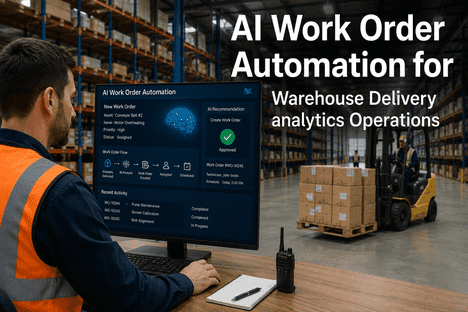
Warehouse analytics technicians are among the most skilled workers in any logistics operation and the most poorly utilized. Industry studies consistently show that field technicians spend only 40–55% of every shift on actual repair, diagnostics, or analytical work. The remaining 45–60% is consumed by walking to log work orders at a fixed terminal, returning to the parts crib for missing components, and rekeying notes into desktop CMMS after the fact. Across a 40-technician warehouse, that lost time represents roughly $1.6M in unrealized labor capacity per year. Mobile AI closes this gap by bringing work order context, voice-driven logging, parts visibility, and AI-guided diagnostics directly to the technician on the floor converting dead time into productive wrench time without adding headcount. Book a Demo to see how iFactory AI deploys across warehouse field operations within 4 weeks.
30%
Field technician productivity gain reported with mobile AI workforce optimization
70%
Reduction in administrative logging time with voice and photo capture
47%
Fewer empty parts crib trips with pre-dispatch inventory verification
4 wks
Deployment timeline from baseline audit to live mobile AI field operation
What Mobile AI Actually Means for Warehouse Delivery Technicians
Mobile AI for warehouse field operations is not simply a CMMS app running on a tablet. It is an intelligent layer between the technician's handheld device and the warehouse's WMS, CMMS, SCADA, and inventory systems that automates the work that traditionally requires walking back to a desk. The platform sequences a technician's shift by zone and priority, transcribes voice observations into structured work order entries, verifies that the required spare part is in the closest bin before dispatching the technician there, and surfaces past resolutions for similar issues at the moment they are needed.
Conventional mobile work order apps replace paper with a screen but preserve every existing inefficiency — the technician still navigates manually, types entries with gloved hands, and walks to the parts crib hoping the bin is stocked. iFactory's mobile AI platform eliminates these failure modes by treating field productivity as a real-time optimization problem rather than a digitized form-filling exercise. The result is a measurable shift in wrench time, first-time fix rate, and shift throughput within the first 30 days of deployment.
Voice-to-Log Work Order Capture
Technicians dictate observations while walking the floor. AI transcribes, tags, and links each note to the active work order — eliminating the desk return required by traditional logging.
AI Shift Route Sequencing
The platform pulls open work orders, technician skills, parts on hand, and zone geography to build an optimal route per technician — cutting walking distance by 35%.
Pre-Dispatch Parts Verification
Before sending a technician to a task, AI verifies the required part exists in the closest bin. Empty trips to the parts crib drop by 47% — and replenishment triggers automatically.
Past Resolution Surfacing
When a technician opens a work order, AI shows the last five times a similar issue occurred, what fixed it, and which part numbers were used — making institutional knowledge searchable.
Offline-First Field Operation
Full functionality in dead zones behind racking or in cold storage. Voice notes, photos, scans, and updates queue locally and sync the moment connectivity returns.
WMS and CMMS Native Integration
Bi-directional sync with SAP EWM, Manhattan, Blue Yonder, Maximo, and standard CMMS platforms. One source of truth — no parallel data entry between mobile and back-end systems.
Why Traditional Mobile Apps Fall Short of What Field Operations Need
Most warehouses have already deployed some form of mobile tool — handheld scanners, basic CMMS apps, or mobile-responsive web portals. Yet wrench time still sits in the 55–75% range. The reason is that these tools digitize tasks without intelligently reorganizing the technician's day. The following comparison shows where conventional mobile setups leave productivity on the table versus what AI-driven field operation delivers.
| Field Operation Parameter |
Traditional Mobile Work Order App |
iFactory AI Mobile Field Platform |
| Work Order Sequencing |
Technicians self-select tasks or follow dispatcher assignments based on ticket arrival time. Zigzag routes across the warehouse are common. |
AI sequences each technician's shift by zone density, priority, and parts availability — reducing walking distance by 35% on the same workload. |
| Field Logging Method |
Manual typing on a tablet, often with gloves removed. Many technicians defer logging to the end of shift, losing context and accuracy. |
Voice transcription and photo capture at the point of work. AI tags entries automatically and links them to the active work order in real time. |
| Parts Crib Workflow |
Technician walks to the crib hoping the required bin is stocked. Empty trips are a common cause of 15–25 minute productivity losses per task. |
Pre-dispatch inventory verification confirms part location. Low-stock bins trigger replenishment automatically before the technician arrives. |
| First-Time Fix Rate |
Technicians rely on personal experience or paging a supervisor. Recurring issues are often re-diagnosed from scratch. |
AI surfaces the last five resolutions for similar issues — including parts used and time-to-fix — directly on the technician's screen at the moment of work. |
| Offline Reliability |
Many mobile CMMS tools degrade significantly without connectivity. Dead zones behind racking or in cold storage cause data loss or workflow stalls. |
Truly offline-first architecture. All capture works without signal; sync resumes automatically with conflict resolution for overlapping entries. |
| Supervisor Visibility |
Status updates lag by minutes to hours. Supervisors track work via phone calls, radios, or end-of-shift summaries. |
Live field operations dashboard shows every active technician, task status, wrench time, and first-time fix rate in real time. |
Every Hour Your Technicians Spend Walking Is an Hour They're Not Fixing.
iFactory AI gives warehouse field operations live route sequencing, voice-driven logging, real-time parts verification, and AI-surfaced past resolutions — fully integrated with your existing WMS, CMMS, and inventory systems within 4 weeks.
Book a Demo to see wrench time impact against your current shift profile.
How iFactory AI Deploys Across Warehouse Field Operations
iFactory follows a structured 4-week deployment process that delivers live mobile work order capture within the first week and full AI route sequencing by week four. Each phase has defined deliverables, so warehouse operations see measurable output from week one — not months of consulting before any change reaches the floor.
Week 1
Field Operations Baseline Audit
Existing CMMS records, work order history, technician movement patterns, and parts crib activity logs are ingested. AI establishes a baseline wrench time per technician and identifies the highest-impact workflow bottlenecks. Integration with WMS (SAP EWM, Manhattan, Blue Yonder) and CMMS (Maximo, Infor EAM) is initiated.
Week 2
Mobile Device Rollout and Voice Logging Activation
Rugged tablets, standard Android, iOS, or Zebra handhelds are provisioned with the iFactory mobile app. Voice-to-log capture and photo-based diagnostics go live. Technicians complete a 30-minute orientation; first wrench time gains typically appear within 3–5 shifts.
Week 3
AI Route Sequencing and Parts Verification
AI route optimization is activated, sequencing each technician's shift by zone, priority, and parts availability. Pre-dispatch inventory verification goes live, reducing empty parts crib trips. Past resolution surfacing begins delivering historical fix data to technicians on open work orders.
Week 4
Full Field Operations Dashboard and Reporting
Network-wide supervisor dashboards live across all shifts and zones. Wrench time, first-time fix rate, work orders per technician, and parts efficiency tracked in real time. Automated shift reports and KPI scorecards delivered to operations leadership weekly.
MEASURABLE OUTCOMES FROM WEEK 2: WRENCH TIME GAINS BEGIN IMMEDIATELY
Warehouse operations completing iFactory's 4-week deployment report measurable wrench time gains within the first two weeks of mobile rollout — recovering roughly 90 minutes of productive time per technician per day. For a 40-technician operation, that equates to 60 productive technician-hours added daily, with full ROI typically realized within 6–9 months.
90 min
Productive time recovered per technician per shift
+12 pts
First-time fix rate improvement post-deployment
6–9 mo
Typical payback period from reclaimed wrench time alone
Mobile AI for Warehouse Field Operations: Use Cases from Live Deployments
The following outcomes are drawn from iFactory deployments at operating warehouses across third-party logistics, e-commerce fulfillment, and manufacturing distribution centers. Each use case reflects post-deployment performance after the first 90 days of live operation.
A high-volume e-commerce fulfillment center with 38 analytics and maintenance technicians was operating at 52% wrench time, with the remainder lost to walking back to fixed terminals for work order entry and chasing parts across a 240,000 sq ft floor. iFactory deployed mobile AI across all three shifts in four weeks, with voice-to-log capture and AI route sequencing as the priority workflows. Within 30 days, wrench time climbed to 78% and held above 85% by day 90. The operation closed 22% more work orders per shift with the same headcount, eliminating a planned third-shift hiring round.
Book a Demo to see how this applies to your fulfillment center.
52% → 85%
Wrench time improvement within 90 days of mobile AI deployment
+22%
Work orders closed per shift with the same technician headcount
$1.4M
Annual avoided hiring cost from reclaimed productive capacity
A national 3PL operator running six regional distribution centers struggled with a first-time fix rate of 71% — meaning nearly one in three field interventions required a follow-up visit, often because the technician arrived without the correct part or lacked context on prior repairs to the same asset. iFactory's mobile AI activated past resolution surfacing on every open work order and integrated parts crib availability into the dispatch workflow. First-time fix rate climbed to 91.7% across all six sites within 90 days, eliminating roughly 380 follow-up visits per month and recovering significant technician capacity.
71% → 91.7%
First-time fix rate improvement across six distribution centers
380
Monthly follow-up visits eliminated post-deployment
47%
Reduction in empty trips to the parts crib network-wide
A manufacturing distribution hub was struggling with a 14-week ramp time for new analytics technicians — driven largely by the time required to absorb tribal knowledge about asset history, common failure modes, and parts location across a 320,000 sq ft facility. iFactory's mobile AI converted that tribal knowledge into searchable on-device guidance: every open work order surfaced past resolutions, every part lookup showed the closest stocked bin, and every guided procedure walked new technicians through SOPs step by step. New technician ramp time was cut from 14 weeks to under 7 weeks, doubling the operation's hiring throughput and reducing supervisor coaching load.
14 → 7 wks
New technician ramp time cut in half with AI-guided procedures
2x
Hiring throughput increase enabled by faster ramp cycles
90%+
Daily active mobile app usage within first month of rollout
Expert Perspective: What Operations Leaders Get Wrong About Mobile Field Tools
Industry Review — Warehouse Field Operations Perspective
"The biggest mistake operations leaders make is assuming a mobile work order app is the same as a mobile productivity platform. Putting a CMMS form on a tablet just moves the typing from a desk to the floor — the technician is still doing administrative work instead of repair work. What actually moves the needle is removing the administrative work entirely through voice capture, sequencing the shift intelligently so technicians stop zigzagging, and verifying parts availability before dispatch. Those three changes are where the real wrench time gains live, and they require AI — not just mobility."
Field Operations Director — National 3PL Network (provided via iFactory deployment reference)
This view aligns with what iFactory's deployment teams consistently observe: the operations that realize the largest productivity gains are not the ones with the newest hardware, but the ones that treat mobile as an intelligent control layer rather than a data entry channel. AI converts the technician's device from a passive form into an active workflow partner. Book a Demo to speak with iFactory's warehouse field operations specialists about your current mobile setup.
Frequently Asked Questions About Mobile AI for Warehouse Field Operations
How is mobile AI different from a standard mobile work order app?
A mobile work order app replaces paper with a screen — the technician still has to type everything, navigate manually, and figure out the next task. Mobile AI sequences the shift, transcribes voice notes, surfaces past resolutions, verifies parts availability, and routes the technician intelligently. The technician spends time fixing, not navigating.
Will technicians actually adopt it, or will it sit unused on the shelf?
Adoption is driven by whether the tool makes the technician's day easier or harder. iFactory's mobile AI is voice-first, glove-friendly, and removes walk-backs to the supervisor desk. Field operations consistently report 90%+ daily active use within the first month of rollout.
Does it work in dead zones behind racking or in cold storage?
Yes. The platform is offline-first by design. Technicians complete work orders, capture voice notes, take photos, and scan parts without any connection. Everything syncs automatically when the device reconnects, with conflict resolution for overlapping entries from other technicians.
How long does it take to integrate with our existing WMS and CMMS?
Most integrations complete within 2 to 4 weeks. iFactory supports bi-directional connections with SAP EWM, Manhattan, Blue Yonder, Oracle WMS, IBM Maximo, and major CMMS platforms. Technicians can begin using the mobile app with manual entries on day one while integrations finalize in the background.
What kind of ROI do warehouses typically see, and how fast?
Most operations recover their investment within 6 to 9 months through reclaimed wrench time alone. A 40-technician warehouse that gains 90 minutes of productive time per technician per day adds roughly 60 productive technician-hours daily without hiring. First-time fix improvements and parts efficiency compound the return.
Turn Lost Walking Time Into Productive Wrench Time. Deploy Mobile AI in 4 Weeks.
iFactory gives warehouse field operations real-time route sequencing, voice-driven logging, parts verification, and AI-guided diagnostics — integrated with your existing WMS, CMMS, and inventory systems in 4 weeks.