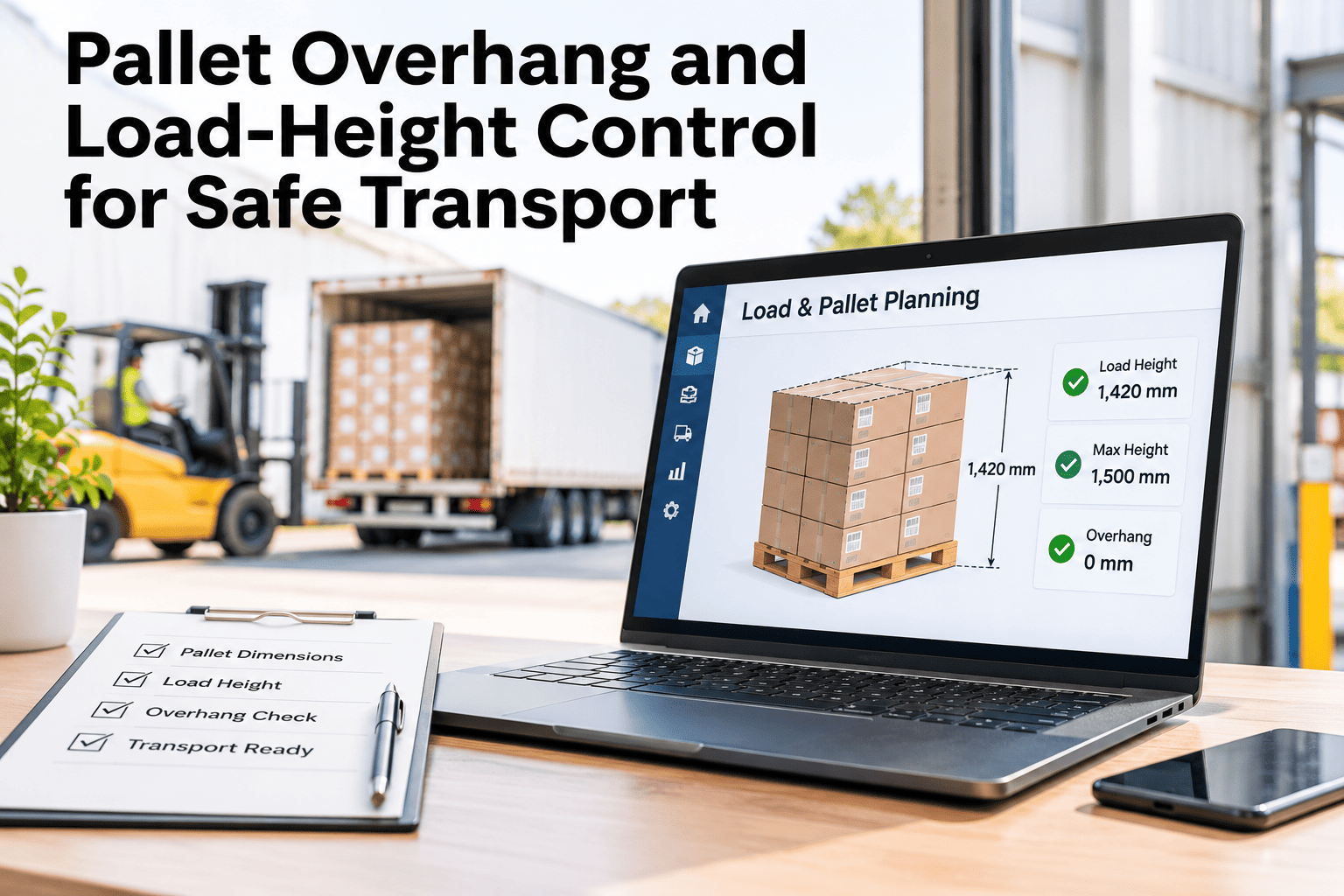
Most pallet overhang and load-height problems are not caught by a rule, they are caught by a person deciding in the moment whether to let a borderline pallet go. The rule says overhang past the deck edge weakens the carton below, and the rule says the loaded height has to clear the trailer door. What the rule rarely says is what to do when a pallet is one inch over, the dock is backed up, and the next truck leaves in ten minutes. That gap between the rule and the decision is where most damaged freight and most rejected loads actually originate. Operations that want their own exception path reviewed can walk through an overhang and height exception workflow built around their own dock routine with the iFactory AI team.
The Measurement Is Easy. The Decision at the Dock Is Where Pallets Actually Fail.
iFactory AI turns overhang and load-height limits into a documented decision at the pallet, not a judgment call made under time pressure.
Two Measurements, One Shared Problem: What Happens at the Border
Overhang and load height are physically unrelated, but they fail the same way operationally. Both have a hard engineering limit, both get measured at the palletizing station, and both eventually produce a pallet that sits right at the edge of acceptable, where the written rule stops being enough on its own.
What the Overhang Limit Is Actually Protecting Against
Overhang is when a carton extends past the pallet deck edge, leaving its corners unsupported. Independent testing from Virginia Tech's Center for Packaging and Unit Load Design, conducted for the Fibre Box Association, found that effective box compression strength loss from overhang ranges from 0 to 40 percent, with the exact loss driven by the overhang amount, the carton's perimeter, and the board type, not by carton height.
Score Your Own Overhang Exceptions Against This Data
Bring a sample of borderline pallets to a 30-minute session and see where your current threshold actually sits.
What the Height Limit Is Actually Protecting Against
The number that actually matters for load height is rarely the trailer's full interior height. Dry van interiors commonly run 108 to 110 inches, but the rear door opening is frequently lower, often landing in the 90 to 108 inch range depending on the trailer. A pallet that clears the ceiling can still fail to clear the door it has to pass through.
The Decision Each Exception Actually Requires
A borderline pallet is not one decision, it is three, made in sequence. Skipping any one of them turns the exception into a guess dressed up as a judgment call.
Why Stretch Wrap Cannot Be the Exception's Safety Net
A common reflex under time pressure is to wrap a borderline pallet more aggressively and treat that as the fix. Stretch wrap stabilizes a load, holding its shape together, but it does not secure a load against the forces of transit the way strapping or banding does. Over-wrapping a pallet that is genuinely over the overhang or height limit does not resolve the exception, it just hides it under more film.
A Composite Scenario: The Exception That Was Never Written Down
A warehouse's written policy capped overhang at one inch per side and required every pallet to clear a 106-inch door opening. For most of a year, both limits held without incident, because most pallets were comfortably within them.
On a high-volume shift, a supervisor let a pallet ship with roughly 1.5 inches of overhang on one side because the dock was behind schedule and the carton type looked sturdy enough. No record was made of the decision, because there was no form for it, only a policy that said not to. Three similar pallets shipped the same way over the following weeks, each decided independently by whoever was at the dock that hour, with no visibility into how often it was happening or whether the carton type actually tolerated it. The policy had been correct. What was missing was anywhere to put the exception when reality did not match it.
Where iFactory AI Fits
Measured Against the Real Constraint
Height is checked against the specific trailer's door opening, not a generic interior-height figure.
Carton-Specific Overhang Tolerance
Overhang limits can be set per carton and board type, reflecting that strength loss is not uniform across products.
Named, Logged Overrides
Every borderline approval is recorded with who approved it and why, instead of disappearing once the truck leaves.
Hard Stop Enforcement
A measurement past the hard stop cannot be overridden at the dock, regardless of schedule pressure.
Frequently Asked Questions
How much overhang is actually safe before compression strength becomes a real risk?
Independent testing shows the effective strength loss from overhang ranges from 0 to 40 percent, driven mainly by how much overhang exists, the carton's perimeter, and its board type rather than a single universal number. Treating every carton the same way at the same overhang amount misses that variation. See this modeled against your own carton types in a short session.
Why measure against the door opening instead of the trailer's full interior height?
The interior ceiling is often taller than the rear door opening the pallet actually has to pass through, so a pallet that clears the ceiling can still be rejected at the door. Using interior height as the limit routinely approves pallets that were never going to fit through the opening that matters. Check your own trailer fleet's door clearances against current load heights.
Can extra stretch wrap compensate for a pallet that is over the overhang or height limit?
No. Stretch wrap stabilizes a load's shape during handling, it does not restore lost compression strength or make an over-height pallet fit through a door it is too tall for. An exception has to be decided on its own terms, not wrapped out of sight. Ask support how wrap and securement rules are separated from the overhang and height checks.
Who should be allowed to approve a borderline pallet?
Authority to approve a borderline pallet should sit with a named role, such as a shift supervisor, rather than whoever happens to be at the dock, and every approval should be logged with that name attached. This keeps the exception visible and reviewable instead of becoming an informal habit nobody can account for. See how approval routing is set up for your dock structure.
Should there be a point where no override is allowed at all?
Yes. A documented hard stop, set past the borderline zone, protects against the moment when schedule pressure makes an exception feel reasonable even though the measurement genuinely is not. Everything below that line can go through a review path; nothing above it should be able to ship regardless of who is asking. Ask how hard-stop thresholds are configured in the system.
Give the Borderline Pallet a Documented Path, Not a Judgment Call
iFactory AI checks overhang against carton-specific tolerances and height against actual door clearance, then logs every exception by name. Book a walkthrough with your own dock routine.