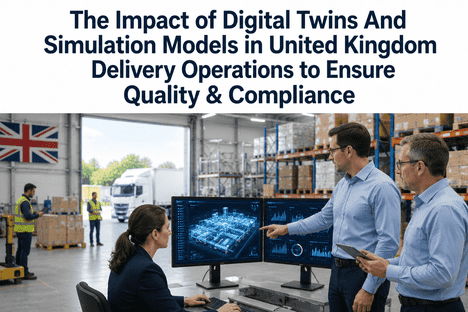
United Kingdom's delivery operations are under dual pressure. E-commerce parcel volume is projected to exceed 5.2 billion shipments annually by 2028, while the UK's net zero commitments require logistics operators to reduce delivery-related emissions 68% by 2035 against 2020 baselines. Simultaneously, urban congestion charging schemes in London, Birmingham, Bristol, and Manchester are raising the cost of every delivery vehicle mile in city centres. Digital twins and simulation models offer a way out of this bind — enabling operators to test layout changes, route optimisations, fleet configurations, and quality inspection workflows in a virtual environment before deploying them in physical operations. iFactory AI's delivery operations management platform integrates digital twin simulation with real-time quality inspection data, creating a continuous feedback loop between the virtual model and the physical operation — enabling UK delivery operators to reduce cost, improve quality, and meet compliance targets without disrupting live operations. Book a Demo to see the platform applied to a UK delivery operation.
What Digital Twins Mean for UK Delivery Operations
A digital twin is a real-time virtual replica of a physical delivery operation — encompassing the warehouse layout, conveyor systems, robotic pickers, autonomous mobile robots, dock scheduling, and delivery route networks. Unlike a static 3D model, a digital twin is live: it ingests data from IoT sensors, warehouse management systems, telematics platforms, and quality inspection systems to mirror the current state of the physical operation. Changes made in the physical world — a conveyor belt speed adjustment, a new robot deployment, a route reconfiguration — appear in the digital twin within seconds. Conversely, changes tested in the digital twin — a racking reconfiguration, a fleet size adjustment, a new inspection gate position — can be validated for throughput, cost, and quality impact before any physical modification is made.
For UK delivery operations, this capability is particularly valuable because the margin for error in physical trials is shrinking. Urban delivery windows are tightening. Congestion charges are rising. Labour availability for warehouse reconfiguration projects is constrained. A digital twin enables operators to test twenty layout scenarios, thirty fleet configurations, or fifty route optimisation algorithms in a single afternoon — identifying the optimal combination for each delivery depot, each customer zone, and each season — without disrupting a single live shipment. iFactory AI's platform provides the data integration layer that keeps the digital twin synchronised with the physical operation — ingesting real-time quality inspection data, warehouse sensor data, and delivery route performance data into the simulation model. Book a Demo to see the digital twin integration architecture.
Delivery Operations: Before and After Digital Twin Integration
- Layout changes tested by reconfiguring racks and measuring throughput over weeks — expensive and disruptive
- Route optimisation based on historical data and dispatcher experience — no ability to simulate demand scenario impacts
- Quality inspection gates positioned based on convention rather than data — no simulation of inspection point placement on throughput
- Fleet sizing decisions based on peak-day estimates — no ability to model fleet composition trade-offs across depots
- Commissioning time of 4-8 weeks for layout or automation changes — production disrupted during the entire period
- Capital expenditure decisions based on vendor proposals rather than simulated ROI across multiple configurations
- Layout changes simulated in hours, tested against peak-season demand profiles, and validated before any rack is moved
- Route optimisation models ingesting live traffic, congestion charge data, and delivery time windows — enabling dynamic re-optimisation per shift
- Quality inspection gate placement optimised via simulation — maximising defect capture while minimising throughput impact
- Fleet composition modelled across all depots simultaneously — identifying the optimal mix of electric vans, cargo bikes, and micro-hubs per urban zone
- Commissioning time reduced to 1-2 weeks for automation changes — changes validated in simulation before touching physical operations
- Capital expenditure decisions backed by simulated ROI across fleet, layout, and technology scenarios — reducing investment risk by up to 40%
Simulation Models for Warehouse Optimisation and Delivery Route Planning
The simulation layer of a digital twin enables UK delivery operators to test operational decisions in a risk-free environment before committing resources. Two categories of simulation models are particularly relevant to delivery operations: warehouse logistics simulation and delivery route simulation. Warehouse logistics simulation models the internal movement of goods — from goods-in to put-away to picking to packing to dispatch — testing the impact of racking layout changes, pick path reconfiguration, AMR fleet size adjustments, and conveyor system modifications on total throughput, labour productivity, and order cycle time. Delivery route simulation models the external movement of vehicles — testing the impact of fleet composition changes, depot location adjustments, time window modifications, and congestion charge avoidance strategies on total miles driven, on-time delivery rate, and cost per delivery.
The power of these simulation models multiplies when they are connected. A change in the warehouse picking process affects the dispatch window, which affects the route plan, which affects the on-time delivery rate. A digital twin that simulates both internal and external operations simultaneously enables operators to optimise the entire system rather than sub-optimising individual components. iFactory AI's platform provides this end-to-end simulation capability — connecting warehouse simulation outputs to route simulation inputs, and feeding actual delivery performance data back into both simulation models for continuous improvement. Book a Demo to see the integrated simulation models in a live demonstration.
Quality Inspection Integration: From Physical Inspection Gates to Digital Quality Twins
The integration of quality inspection data into the digital twin is what transforms a simulation model from a planning tool into an operational intelligence system. A digital twin that includes real-time quality inspection data — from AI vision cameras at inspection gates, automated weighing systems at packing stations, and document scanners at dispatch — can do more than simulate future scenarios. It can detect emerging quality problems in the current operation by comparing actual inspection outcomes against the expected outcomes predicted by the simulation model. When actual defect rates diverge from simulated expectations, the digital twin flags the discrepancy and identifies the most likely root cause — a picker error rate increase, a packaging seal failure, a document mismatch pattern — enabling corrective action before the defect reaches the customer.
For UK delivery operators, this capability addresses a structural challenge: quality inspection in delivery operations has historically been reactive. Goods are inspected at defined hold points, non-conformances are recorded, and corrective actions are taken after the fact. The digital twin flips this model by creating a continuous quality simulation that predicts, for each shipment, the expected inspection outcome based on the current state of the warehouse, the picker, the packing station, and the delivery route. When a shipment's actual inspection outcome differs from its predicted outcome, the system learns from the discrepancy and updates the simulation model — improving the accuracy of future predictions. Over time, the digital twin becomes a quality early-warning system that identifies process degradation before it produces defective shipments. Book a Demo to see the quality twin in operation.
Four Pillars of Digital Twin-Enabled Quality Inspection
The integration of digital twin simulation with AI-powered quality inspection rests on four interdependent capabilities that together create a continuous quality improvement loop across the delivery operation.
UK-Specific Considerations: Congestion, Net Zero, and Urban Delivery Compliance
United Kingdom delivery operations face regulatory and operational constraints that make digital twin simulation particularly valuable. London's Ultra Low Emission Zone, Birmingham's Clean Air Zone, Bristol's Clean Air Zone, and Manchester's Greater Manchester Clean Air Zone impose daily charges on delivery vehicles that do not meet emission standards — adding £12.50 to £35.00 per vehicle per day to urban delivery costs. The UK's net zero commitments require logistics operators to transition fleets to zero-emission vehicles, with the Committee on Climate Change recommending that 100% of new urban delivery vehicle sales be zero-emission by 2030. These regulatory pressures interact with operational constraints — delivery time windows set by retailers, customer availability for attended deliveries, and the physical limitations of electric vehicle range in urban stop-start driving conditions.
Digital twin simulation enables UK delivery operators to model the interaction between these regulatory and operational constraints — testing fleet electrification scenarios, micro-hub deployment strategies, cargo bike substitution rates, and delivery time window reconfiguration options against cost, emission, and service level targets. The simulation identifies the optimal transition path for each depot and each urban zone, accounting for the specific congestion charge regime, customer density, and delivery profile of each area. iFactory AI's platform integrates UK-specific regulatory data — congestion zone boundaries, emission standards, ULEZ charge rates, and planned clean air zone expansions — directly into the simulation model, ensuring that every scenario tested is compliant with current and planned regulations. Book a Demo to see the UK-specific simulation capabilities.
Frequently Asked Questions: Digital Twins and Quality Inspection for UK Delivery Operations
Conclusion: From Physical Trial-and-Error to Simulation-Driven Delivery Operations
United Kingdom's delivery operators face a convergence of pressures — rising parcel volumes, tightening emission regulations, expanding clean air zones, and customer expectations for faster, more reliable delivery with zero defects. The traditional approach of testing layout changes, route configurations, and quality inspection workflows through physical trial-and-error is too slow, too expensive, and too risky for the current operating environment. Digital twin simulation offers a fundamentally different approach: test every change in a risk-free virtual environment, validate the optimal configuration against actual operational data, and deploy with confidence that the change will deliver the projected outcome before a single rack is moved or a single vehicle is re-routed.
iFactory AI's delivery operations management platform provides the digital twin infrastructure that makes this approach practical — connecting warehouse IoT sensors, AI-powered quality inspection systems, telematics platforms, and UK regulatory databases into a single simulation and quality intelligence layer. The platform enables operators to model warehouse layout changes, optimise pick paths and packing workflows, simulate fleet composition and route configurations, predict quality inspection outcomes, and validate regulatory compliance — all within a unified simulation environment that updates continuously with live operational data. The transition from physical trial-and-error to simulation-driven operations does not require replacing existing systems. It requires connecting them to a digital twin layer that extracts the full value of the data they already generate. Book a Demo to see the platform connected to your delivery operation's data within a 30-minute live demonstration.