Mid-Size FMCG Plant Goes Paperless: 65% Reduction in Administrative Overhead
By Seren on June 20, 2026
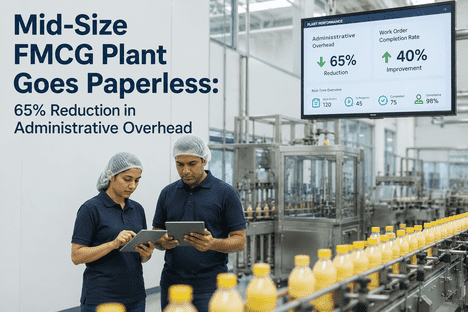
The maintenance manager at a mid-size FMCG plant in the Midwest reviewed the previous month's administrative metrics and saw a pattern that had persisted for years: the maintenance team of 28 technicians spent an estimated 340 hours per month on paper-based activities filling out work order forms by hand, walking completed paper orders to the admin office for data entry, manually updating inventory count sheets in the parts storeroom, compiling shift handover reports on carbon-copy logbooks, and chasing signed approvals for purchase requests. That was 340 hours the team could have spent on preventive maintenance, root cause analysis, or skills training. When the plant production director calculated the fully loaded cost of that administrative overhead including the data entry clerk whose entire role existed because the paper system required manual transcription the annual impact exceeded $187,000 in direct labor alone, not counting the delayed maintenance, lost work order data, and compliance documentation gaps that paper systems inevitably produce. Eight months after deploying iFactory's mobile-first, paperless operations platform, this plant had eliminated 95% of its paper-based maintenance workflows, reduced administrative overhead by 65%, and improved work order completion rates by 40% while giving the maintenance team back more than 250 hours per month for productive work. FMCG operations leaders evaluating paperless transformation regularly Book a Demo to review the mobile deployment architecture for their plants.
Paperless Operations · Mobile Work Orders · Digital Shift Logbook · Automated Compliance
Every Hour a Technician Spends on Paper Is an Hour They Cannot Spend on Maintenance. Mobile AI-Driven Operations Eliminate That Trade-Off.
iFactory gives FMCG maintenance teams a single mobile platform for paperless operations — digital work orders that technicians complete on the floor, automated data capture that eliminates manual transcription, and real-time analytics that replace clipboard-based reporting.
Reduction in administrative overhead achieved by eliminating paper-based work order processing, data entry, and manual reporting workflows
40%
Improvement in work order completion rates through mobile assignment, real-time status updates, and automated technician notifications
250+
Hours per month returned to productive maintenance work by eliminating paper-based administrative tasks across a 28-person team
95%
Of paper-based maintenance workflows eliminated within eight months of deploying iFactory's mobile-first paperless platform
The Paper Burden — How Manual Maintenance Workflows Drain FMCG Plant Productivity
This mid-size FMCG plant produces 12 million cases annually across three production lines — beverages, sauces, and dry blends — operating 24 hours per day, six days per week. The 28-person maintenance team supports 47 critical assets including fillers, labelers, conveyors, pasteurizers, and packaging machines. Before deploying iFactory's paperless platform, every maintenance workflow depended on paper forms that moved through a slow, error-prone chain of manual steps. The following breakdown shows how the paper burden accumulated across the plant's core maintenance processes.
01
Work Order Creation and Assignment
Production operators filled out paper work request forms when a machine issue arose — writing the problem description by hand, leaving the form in a tray at the maintenance office, and hoping a technician would pick it up. The maintenance manager reviewed the paper stack three times per day, manually assigned each request to a technician, and wrote the assignment on a whiteboard in the break room. Average time from request initiation to technician assignment: 4.5 hours. Average time from assignment to technician awareness: another 1.5 hours because technicians had to return to the break room to check the board between tasks.
02
Work Order Execution and Documentation
Technicians carried paper work orders to the job site, completed the repair, and wrote down labor hours, parts used, and observations on the form. If the paper form was lost or damaged — which happened approximately 8% of the time — the work had no documentation trail. Completed forms were placed in a bin for the data entry clerk, who transcribed the information into the legacy maintenance system. The transcription lag averaged 3.7 days, meaning maintenance history was never current and parts consumption data was always at least a week behind real inventory.
03
Parts Inventory and Requisition
When a technician used a part from the storeroom, they wrote the part number and quantity on a paper sign-out sheet. The data entry clerk reconciled these sheets weekly against the inventory system — a process that took 6 to 8 hours per week and frequently revealed discrepancies. Emergency parts requisitions required a paper purchase request form with three approval signatures, each requiring the technician to physically locate the approver. Average time from requisition submission to purchase order generation: 2.3 days.
04
Shift Handover and Reporting
Each shift ended with the maintenance lead writing a handover report in a carbon-copy logbook — noting open work orders, equipment issues that required attention, and parts ordered. The incoming shift lead read the book at the start of their shift and copied critical items onto a personal notepad. Information was frequently missed or misinterpreted. The plant had no centralized record of how equipment issues evolved across shifts, making recurring failure patterns invisible to the maintenance management team.
05
Compliance and Audit Documentation
The plant operates under SQF and FDA compliance requirements that mandate complete maintenance documentation including equipment service records, parts traceability, and corrective action histories. Preparing for an audit required the maintenance manager to pull paper work order files, cross-reference parts sign-out sheets, and compile binders of documentation — a process that consumed 40 to 60 hours per audit cycle. In the year before iFactory deployment, a third-party auditor flagged incomplete maintenance records as a finding that required corrective action.
Mobile Paperless Operations — From Paper Request to Digital Work Order in Under 60 Seconds
iFactory's mobile-first platform replaced every paper-based maintenance workflow with digital processes that technicians access from smartphones or tablets carried on the production floor. The transformation touched every step of the maintenance lifecycle — from work request initiation through completion documentation and parts replenishment. FMCG teams exploring mobile paperless deployment regularly Book a Demo to see the technician mobile interface and deployment configuration for their plant environment.
Workflow
Paper Process (Pre-Deployment)
Mobile Process (Post-Deployment)
Work Request
Paper form filled by operator, placed in tray. Avg 4.5 hrs to reach technician.
Operator scans asset QR code and submits request via mobile. Technician receives instant push notification with full details. Avg 45 seconds to assignment.
Work Execution
Paper form carried to job. Data entry clerk transcribes 3.7 days later. 8% of paper forms lost or damaged.
Technician views assignment on mobile, completes digital checklist, captures photos, logs labor and parts. Data recorded in real time. Zero lost records.
Parts Requisition
Paper sign-out sheets reconciled weekly. Emergency PR requires 3 physical approvals. Avg 2.3 days to PO generation.
Mobile parts consumption logged in real time. Digital approval chain with push notifications. Avg 15 minutes to emergency PO generation.
Shift Handover
Carbon-copy logbook. No centralized history. Critical details frequently lost between shifts.
Digital shift logbook with structured fields. Complete shift history searchable by asset, issue type, or date range. Incoming shift lead sees full context before starting.
Audit Readiness
40–60 hours of binder compilation per audit cycle. Incomplete records cited as finding in third-party audit.
Complete maintenance history available on demand. Audit reports generated in 5 minutes. Zero documentation findings in subsequent SQF and FDA audits.
Paperless FMCG · Mobile Maintenance · Digital Shift Logbook · Automated Compliance Reporting
Paper Work Orders Create a 4.5-Hour Delay Before Maintenance Even Starts. Mobile Digital Work Orders Reduce That to 45 Seconds.
iFactory's mobile-first paperless operations platform replaces every paper workflow with real-time digital processes — from work request to work completion, parts requisition to shift handover, compliance report to audit documentation.
Five Capabilities That Eliminated Paper at This FMCG Plant
The iFactory mobile platform deployed across this FMCG plant includes five integrated capabilities that together cover every paper-based workflow the maintenance team previously depended on. Each capability was configured during a two-week implementation phase and went live with a single day of technician training.
Capability 01
Mobile Work Order Management
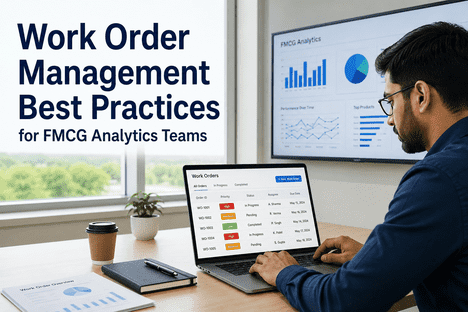
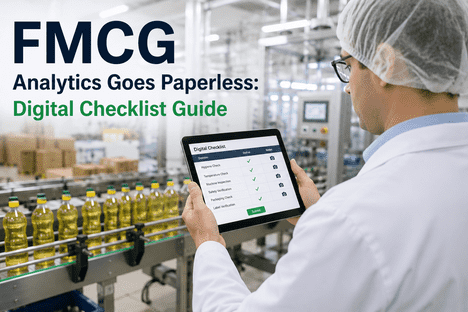
Technicians receive work orders as push notifications on their mobile devices with full details — asset information, problem description, priority level, required parts, and recommended procedures. Digital checklists guide completion and ensure no step is missed. Labor hours and parts consumption are logged with a few taps, eliminating the paper form and the data entry backlog. Completed work orders are closed in real time with digital signatures and photo evidence attached.
Result: Work order completion rate improved 40%
Capability 02
Digital Shift Logbook
The paper logbook was replaced with a structured digital shift handover that captures open work orders, equipment status, safety issues, and parts on order — all organized by asset and production line. Incoming shift leads review the full context of the previous shift on their mobile devices before stepping onto the floor. Shift history is searchable across any date range, asset, or issue category, enabling the maintenance manager to identify recurring patterns that were invisible in the paper logbook.
Result: Shift handover information loss eliminated
Capability 03
Mobile Parts Inventory Control
Every part in the storeroom is barcoded. Technicians scan parts when withdrawing for a work order, and consumption is logged in real time against both the work order and the inventory record. Low-stock alerts are automated, and purchase requests are submitted through the mobile interface with digital approval chains. The weekly inventory reconciliation that previously consumed 6 to 8 hours of data entry time is eliminated because inventory records are always current.
Result: Inventory accuracy improved to 98%
Capability 04
Digital Preventive Maintenance
All PM schedules moved from a paper calendar and spreadsheet tracker to iFactory's automated scheduling engine. PM work orders are generated automatically based on calendar intervals or equipment runtime hours and assigned to the appropriate technician. The platform tracks PM completion rates in real time and escalates overdue items. In the first six months, PM compliance improved from 62% to 94% — a direct result of automated assignment and visibility.
Result: PM compliance improved from 62% to 94%
Capability 05
Automated Compliance Reporting
With all maintenance data captured digitally in real time, compliance reports for SQF, FDA, and internal audits are generated in minutes rather than the 40 to 60 hours previously required for manual binder compilation. The platform compiles asset service histories, parts traceability records, corrective action documentation, and PM completion reports for any date range with a single request. The plant passed its first post-deployment SQF audit with zero documentation findings.
Result: Zero documentation findings in subsequent audits
Measurable Impact — Administrative Overhead and Operational Performance
Within eight months of deploying iFactory's mobile paperless platform, the plant documented measurable improvements across every dimension of maintenance operations. The following table compares key metrics before and after deployment.
Metric
Before Deployment
After Deployment
Improvement
Admin Overhead
340 hrs/month
119 hrs/month
–65%
Work Order Completion Rate
56% on time
78% on time
+22 pts
Data Entry Lag
3.7 days average
Real-time
Eliminated
PM Compliance
62%
94%
+32 pts
Requisition-to-PO Time
2.3 days avg
15 min avg
–99%
Audit Prep Time
40–60 hrs per audit
< 5 min per request
–99%
"
I had been watching the maintenance team spend the first hour of every shift sorting through paper work orders from the previous day. Technicians would stand at the whiteboard copying down their assignments, then walk to the storeroom to sign out parts on a paper sheet, then complete the work and write their report on a carbon-copy form that someone would transcribe into the system three days later. It was not that the team was unwilling to adopt digital tools — it was that nobody had shown them how much faster the mobile workflow could be. When we deployed iFactory, the turning point came on day three. A technician who had been with the plant for 17 years completed his first mobile work order, looked up from his phone, and said, 'I just did in 90 seconds what used to take me 15 minutes of walking and writing.' That was the moment the paper system started dying at this plant.
— Maintenance Manager, Mid-Size FMCG Plant — 3 Production Lines, 47 Critical Assets, 28-Person Maintenance Team
Conclusion — The Paperless Maintenance Advantage for Mid-Size FMCG Plants
This mid-size FMCG plant's paper-to-digital transformation demonstrates that administrative overhead in maintenance operations is not a fixed cost — it is a consequence of workflow design. When every work request, parts transaction, shift handover, and compliance report depends on paper forms moving through manual handoffs, the hours accumulate silently behind the maintenance team's visible work. The 340 hours per month this plant was spending on paper-based activities represented 21% of the total available maintenance labor — lost not to equipment breakdowns or preventive tasks, but to the administrative overhead of running a paper system in a digital-capable environment.
The measurable results — 65% administrative reduction, 40% improvement in work order completion, PM compliance rising from 62% to 94%, audit prep collapsing from 40 hours to 5 minutes — came not from adding headcount or increasing budgets, but from removing the paper friction that had been silently constraining the maintenance team's productivity for years. FMCG operations leaders evaluating paperless transformation can Book a Demo to see the mobile deployment configured for their plant environment, or talk to an expert about a free paper burden assessment that quantifies the administrative overhead in your current maintenance operations.
Frequently Asked Questions
The core platform deployment — including mobile device provisioning, user account configuration, work order template setup, and basic integration with existing asset registers — can be completed within 2 to 3 weeks for a single plant. Technician training requires one half-day session covering the mobile interface, work order completion workflow, parts scanning, and shift logbook entry. Most technicians are fully proficient within 3 to 5 shifts. The plant in this case study achieved full paperless adoption across all 28 maintenance team members within 30 days of the deployment start date. Talk to an expert about scheduling a deployment assessment for your plant.
Yes. The iFactory mobile app caches work order data, asset records, and parts inventory locally on the device. Technicians can complete work orders, log labor hours, scan parts, and capture photos while offline. The data synchronizes automatically when the device reconnects to the network. This offline capability was critical at this plant where the filler room and packaging mezzanine areas had inconsistent Wi-Fi coverage. Technicians completed work orders offline throughout their shift, and data synced seamlessly when they returned to the maintenance office or break room where connectivity was available. Book a Demo to see the offline workflow in action.
Yes. iFactory provides pre-built connectors for SAP, Microsoft Dynamics 365, and Oracle ERP systems, along with an API framework for custom integrations. Purchase requests created through the mobile interface can flow automatically into the ERP for PO generation and approval. Parts consumption data syncs with inventory modules in real time. Labor hours captured on work orders can be exported to payroll and cost accounting systems. This plant integrated iFactory with their existing ERP within the first two weeks of deployment, enabling automated PO generation and eliminating the manual data entry that previously bridged the maintenance and accounting systems. Talk to an expert about integration requirements for your existing systems.
The digital shift logbook improves on paper in three critical ways. First, entries are structured — open work orders, equipment status items, safety issues, and parts orders each have dedicated fields rather than being buried in freeform notes. Second, the logbook is searchable across any date range, asset, or issue type, enabling the maintenance manager to identify recurring patterns that the paper book's linear format concealed. Third, the logbook persists indefinitely and is accessible from any device — no more lost or filled logbooks, no more trying to read faded carbon copies from six months ago. The plant's maintenance manager now reviews cross-shift trends on the dashboard each morning, something that was impossible when data was trapped in sequential paper pages. Book a Demo to see the digital shift logbook interface and reporting capabilities.
The plant in this case study achieved full ROI within 6 months of deployment. The primary drivers were: elimination of the data entry clerk role (saving $38,000 annually), reduction in technician administrative time (recovering 250+ hours per month valued at approximately $156,000 annually), reduction in emergency parts purchasing through improved inventory accuracy (saving approximately $42,000 annually), and elimination of overtime caused by delayed work order processing. The combined annual savings exceeded $236,000 against a platform and deployment cost of approximately $72,000 for the first year. Multi-year ROI increases as the platform becomes embedded in daily operations and the plant expands paperless workflows to additional departments. Book a Demo to receive a customized ROI projection based on your plant's current administrative overhead baseline.
Paper-Based Maintenance Consumes 21% of Your Technician Labor Without Adding Any Value. Mobile Paperless Operations Eliminates That Waste and Recovers Thousands of Productive Hours Every Year. Get a Free Paper Burden Assessment for Your Plant.
iFactory's mobile-first paperless operations platform — digital work orders, mobile parts inventory, automated PM scheduling, digital shift logbook, and real-time compliance reporting — deployed across mid-size FMCG plants in 2 to 3 weeks with no downtime and measurable ROI within 6 months.