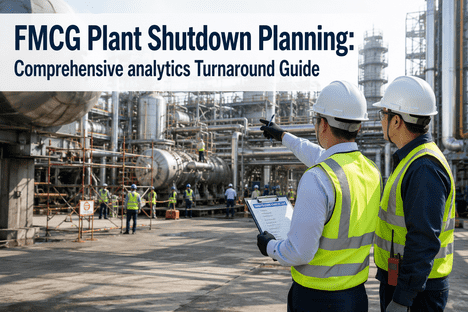
Every hour of planned downtime in an FMCG manufacturing plant carries a direct revenue cost — a mid-size food production facility running at $500,000 per day in output loses $20,800 for every hour the lines are stopped. The paradox is that this expensive downtime is unavoidable: regulatory inspections, deep maintenance, equipment overhaul, CIP sanitation, and food safety system validation cannot be completed while production is running. According to Deloitte, FMCG plants with digital turnaround management reduce unplanned shutdown extension by 63% and contractor coordination costs by 28% compared to paper-based planning. The difference between a shutdown that costs $1.2 million and one that costs $2.8 million is almost entirely planning quality. iFactory AI's shutdown management module gives FMCG maintenance teams a single platform to define scope, assign work orders, track contractor progress, and validate food safety compliance — before, during, and after every turnaround. Book a Demo to walk through your facility's specific shutdown structure with our FMCG team.
Your FMCG Plant's Most Expensive Week Doesn't Have to Be
iFactory's AI-powered shutdown management platform connects your CMMS, work orders, contractor resources, and food safety compliance into a single intelligence layer — delivering real-time progress tracking, critical path optimization, and post-shutdown validation purpose-built for FMCG manufacturing.
Legacy FMCG Shutdowns vs. AI-Enabled Turnaround Management
Most FMCG plants still plan shutdowns on spreadsheets, track progress via daily walkrounds, and discover missing parts when crews are already standing idle. The difference between a plant that completes a 7-day turnaround on schedule and one that extends to 11 days is not luck — it is the quality of digital infrastructure supporting the planning and execution process. Here is exactly what changes when iFactory's shutdown management platform goes live.
Without iFactory
- Work orders scattered across spreadsheets, emails, and verbal handoffs — no single source of truth
- Scope defined by memory and tribal knowledge — discovered work during execution extends critical path
- Parts staging verified via manual checklists — missing items found when crews are already on site
- Contractor coordination handled through phone calls and paper permits — idle time undetected
- Food safety sign-offs collected on paper — HACCP and BRC audit trails assembled manually post-restart
- Daily progress tracked through physical walkrounds — schedule deviations spotted 24 to 48 hours late
With iFactory
- Every work order lives in a unified CMMS with owner, parts list, permit links, and safety procedures attached
- Scope frozen at T-60 days via digital change control — discovered work routed through formal MOC workflow
- Parts kitted and staged with QR-code verification — zero missing-item delays confirmed before Day 0
- Contractor qualifications, permits, and crew assignments managed through iFactory's vendor portal
- Food safety sign-offs (ATP swabs, allergen clean, CIP validation) completed and timestamped in iFactory
- Live progress dashboards updated from mobile — critical path deviations flagged within 1 hour
What Undisciplined Shutdown Planning Costs Your FMCG Plant Every Cycle
Each gap in shutdown visibility is a direct margin leak. The numbers below reflect documented performance data from published 2024–2025 industry benchmarks — not estimates. Operations ready to benchmark their own shutdown performance can Book a Demo for a side-by-side walkthrough with an iFactory FMCG specialist.
No Digital Work Order Management
Without a unified CMMS, work orders exist in spreadsheets, emails, and paper binders. Field supervisors lose visibility of assigned tasks, parts readiness, and permit status within 48 hours of shutdown start. Each lost work order on the critical path extends the schedule by hours — at $20,800 per hour of lost production.
lost production
Late Scope Freeze and Uncontrolled Scope Creep
Every work order added after scope freeze compresses procurement, disrupts contractor schedules, and creates field congestion. Plants freezing scope at T-30 days average 18% scope growth vs. 6% for those freezing at T-60 days. Scope creep accounts for 40–60% of all turnaround cost overruns.
cost overrun cause
Missing or Late-Delivery Parts and Materials
An idle craft worker costs $85–$120 per hour fully loaded. When materials arrive late or the wrong parts are staged, the cost compounds rapidly. Plants without digital parts-kitting and staging verification consistently report 15–20% of labor hours lost to material delays.
lost labor hours
Paper-Based Contractor and Permit Management
Contractor crews waiting for permits, materials, or access approvals while the shutdown clock runs. Without digital permit-to-work and vendor management, coordinator visibility is limited to physical walkrounds that miss gaps until they are already expensive. Contractor idle time and re-mobilization charges are the third most common cost overrun driver.
contractor delays
No Digital Food Safety and Compliance Sign-Off
Paper-based sanitation sign-offs, ATP swab results, and allergen clean documentation get lost or completed after restart. Without timestamped digital records, HACCP, BRC, and FDA GMP compliance relies on memory and retrospective filing — creating regulatory exposure in the event of an audit or product quality incident.
post-restart exposure
How iFactory Delivers AI-Powered FMCG Shutdown Management
The iFactory platform surrounds your existing CMMS, ERP, and production systems with six integrated shutdown management capabilities — each one independently valuable, and collectively transformative for FMCG turnaround operations.
Digital Scope Definition and Change Control
Define shutdown scope directly from CMMS work order backlog, asset condition scores, and regulatory compliance due dates. Scope freeze at T-60 days with formal change control workflow — every addition requires cost and schedule impact analysis before approval.
Critical Path Scheduling with Resource Leveling
Built-in CPM scheduler identifies the longest chain of dependent tasks and calculates float for parallel work streams. Resource leveling smooths labor demand across shifts — preventing the peaks and valleys that create overtime costs and crew congestion.
Parts Kitting, Staging, and QR Verification
Every parts requirement is cross-referenced against warehouse stock at planning time. Long-lead items get delivery milestones on the schedule. Parts are kitted per work package, staged at point of use, and QR-verified before Day 0 — zero missing-item delays.
Contractor Qualification and Permit Management
Pre-qualify vendors, verify insurance and safety records, assign named crew leads to specific work packages. Digital permit-to-work covers LOTO, confined space, hot work, and food-zone access — all tracked in iFactory with electronic signatures.
Food Safety and Regulatory Sign-Off Workflows
HACCP CCP verification, ATP swab results, allergen clean documentation, CIP validation, and equipment hygiene inspections completed and timestamped in iFactory. Restart authorization requires all food safety sign-offs before lines can be cleared for production.
Live Dashboards and Post-Shutdown Analytics
Real-time progress tracking via mobile updates — critical path deviations flagged within 1 hour. Post-shutdown actual vs. planned analysis captures schedule performance, cost variance, discovered work catalog, and lessons learned that feed directly into the next turnaround scope.
Five Steps From Data Handoff to Live Shutdown Management
Deploying digital shutdown management in an FMCG plant requires structured integration — not just software installation. iFactory's deployment roadmap connects your existing CMMS, ERP, and production databases to a unified turnaround platform in 4 to 6 weeks without disrupting operations.
Audit & Prioritize
Map every shutdown process point: work order intake, scope definition, parts procurement, contractor coordination, safety permitting, and compliance sign-off. Identify data sources and integration points across your existing CMMS and ERP systems.
Connect & Ingest
Layer iFactory's integration gateway on top of your existing CMMS, ERP, and production databases via standard APIs. Your current systems keep running — iFactory consumes their data and amplifies it with AI-driven scheduling, tracking, and compliance workflows.
Configure & Validate
Configure shutdown work order templates, scope freeze workflows, parts kitting checklists, contractor qualification forms, and food safety sign-off flows in iFactory. Validate each workflow against your facility's specific regulatory and operational requirements.
Pilot & Refine
Run a pilot shutdown (single line or mini-shutdown) with iFactory's platform to validate the workflows, train the team, and capture configuration feedback. Refine templates, dashboards, and approval chains based on live pilot results before scaling across the full turnaround.
Scale & Optimize
Roll iFactory across all shutdown scopes — annual turnarounds, mini-shutdowns, and single-line maintenance windows. Post-shutdown analytics and lessons learned feed into the next cycle, creating a continuous improvement loop that reduces cost and duration with every successive turnaround.
Your FMCG plant already generates every data point needed for digital shutdown management — work order backlogs, asset condition scores, parts inventory levels, contractor records, and food safety inspection results. The question is whether that data is connected to a platform that can act on it. Book a 30-minute walkthrough and we will show you how much cost and duration your current shutdown process is leaving on the table.
FMCG Shutdown Management: The Numbers Behind the Shift
The 5-Phase FMCG Shutdown Lifecycle — From Planning to Post-Mortem
Every successful FMCG turnaround follows a structured phase model. Failures in early phases compound into cost and duration overruns during execution. iFactory's platform supports every phase with purpose-built workflows and live visibility.
iFactory Shutdown Management Platform — Every Capability, No Surprises
Here is exactly what comes with an iFactory FMCG shutdown management deployment — no hidden modules, no rip-and-replace of your existing CMMS, no 12-month implementation timeline.
All Six Shutdown Management Modules, Pre-Built
Scope definition, CPM scheduling, parts kitting, contractor management, food safety compliance, and post-shutdown analytics — included. No custom development required.
4 to 6 Week Deployment to Live Shutdown Platform
From CMMS data handoff to live work order tracking, parts kitting, and compliance workflows in under 6 weeks. We handle all integration; your team provides read-only access to existing systems.
CMMS and ERP Compatible
Integrates with SAP, Oracle, Infor, Microsoft Dynamics, and all major CMMS platforms via standard APIs. Your existing systems keep running — iFactory amplifies them with AI-driven scheduling and compliance workflows.
HACCP, BRC, FSSC 22000 & FDA GMP Compliance, Native
Food safety sign-offs, ATP swab records, allergen clean documentation, and CIP validation captured with timestamps and digital signatures. Audit-ready records generated automatically — not assembled manually post-restart.
Mobile-First Field Access
Work order assignment, progress updates, parts verification, and safety sign-offs all available on mobile devices — so field supervisors and contractors update the platform in real time without returning to the planning office.
Continuous Improvement Loop Built In
Post-shutdown analytics compare actual vs. planned for every work order. Lessons learned are captured and auto-populated into the next shutdown scope. Asset condition scores update with every finding — so each turnaround gets smarter than the last.
What FMCG Maintenance Leaders Ask About Shutdown Management
Your Next Turnaround Will Be the Measure of Your Planning Infrastructure
Every FMCG plant faces the same operational reality: production lines generate revenue every hour they run, but critical equipment demands periodic deep maintenance that only a shutdown can deliver. The difference between a plant that loses $380,000 in extended downtime and one that completes a turnaround on time and under budget comes down to planning infrastructure — specifically, whether that infrastructure is digital, connected, and purpose-built for FMCG food safety and regulatory requirements.
The documented performance gains — 63% reduction in unplanned extensions, 28% reduction in contractor coordination costs, 94% first-time startup success — are not projections. They come from FMCG plants that have deployed structured digital turnaround management. The plants capturing the most value from every shutdown cycle are the ones where the planning platform runs as a continuous improvement layer — not a binder that gathers dust between turnarounds.
iFactory delivers that platform on your existing CMMS and ERP infrastructure, in under 6 weeks, without replacing the systems your team already depends on. The question is not whether digital shutdown management improves turnaround outcomes. The question is how many more cycles your plant can afford to run without it.
Turn Your Next FMCG Shutdown Into a Controlled, Audit-Ready Operation
iFactory gives FMCG maintenance teams a single, integrated platform to plan, execute, and validate plant turnarounds — scope management, CPM scheduling, parts kitting, contractor coordination, food safety compliance, and post-shutdown analytics. On your existing infrastructure, in under 6 weeks, without replacing your CMMS.