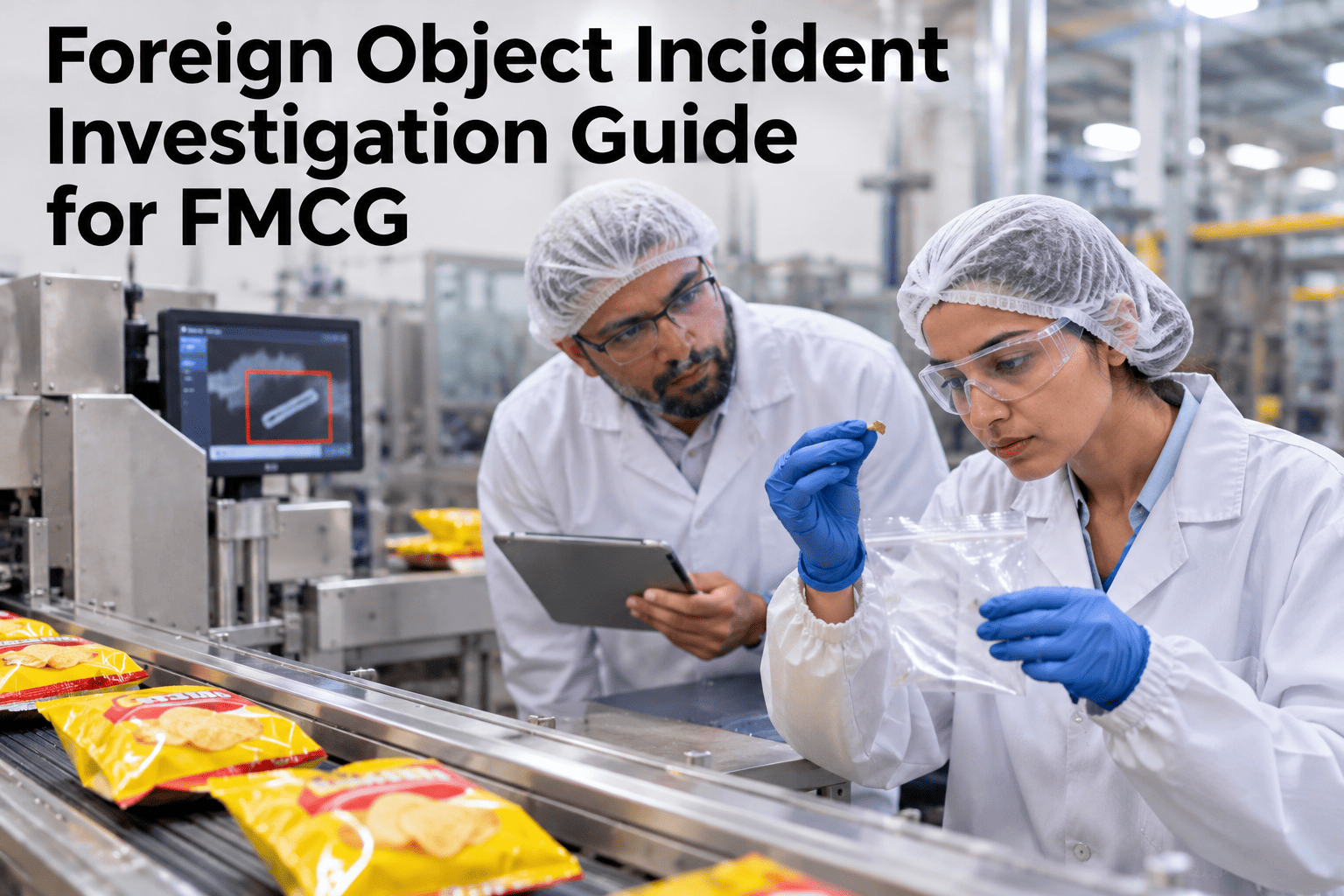
A foreign object complaint rarely arrives with its cause attached — a consumer reports a fragment, a line stops on a reject, or an auditor pulls a record, and from that single data point a team has to work backward to where it actually came from. Too many investigations stop at "we retested and it passed," which regulators have repeatedly flagged as no investigation at all. A real foreign object investigation preserves the evidence, traces the source across every stage the product passed through, and closes with a corrective action that is actually verified to work. Quality teams reviewing their own investigation process can walk through a source-back trace on a recent finding with our team.
Trace the Source Before You Write the Corrective Action
iFactory, an on-premise AI platform for FMCG quality, keeps evidence, source-back trace and CAPA status on one connected record, so an investigation can actually be reopened and checked rather than only filed.
Why Isn't "We Retested and It Passed" an Investigation?
FDA warning letters have repeatedly cited firms that released product after a failing result was followed by a passing retest, without ever determining why the first result happened. A passing retest tells you the next sample was fine — it says nothing about whether the condition that caused the original finding is still present on the line. Ask our team how your current closure criteria compare to what auditors expect to see.
Securing the Evidence Chain Before Anything Else
A root cause investigation is only as good as the physical evidence behind it. Once a finding is confirmed, the object and its context need to be preserved before the line moves on or the moment is lost.
The Three Threads Every Investigation Has to Examine
A foreign material complaint can originate at any of three stages, and auditors expect evidence that all three were actually examined, not just the one that seems most obvious first.
| Thread | What gets checked | Typical evidence |
|---|---|---|
| Incoming material | Supplier lot, incoming inspection records, certificate of analysis | Supplier lot number, receiving inspection log |
| In-process | Equipment condition, changeover records, detection layer status on the affected line | Maintenance log, detection system sensitivity check |
| Finished product | Packaging line, storage and handling after final inspection | Packaging run record, warehouse handling log |
See Where Your Last Investigation Would Have Stopped Short
Share a recent complaint and we will show which of the three threads was and was not examined.
The Object Is Evidence, Not the Root Cause
From Confirmed Finding to a Verified Fix
Affected product is held and the evidence chain is secured.
All three source threads are examined, not just the first plausible one.
The confirmed entry point is documented with the evidence that supports it.
Corrective action addresses the entry point; preventive action addresses the wider condition.
The fix is checked against a follow-up period before the case is closed.
The Second Fragment That Reopened a Closed Case
A plant closed a foreign object case after a plastic fragment was found and a worn conveyor guide was replaced on the affected line. A second, similar fragment was reported from a different line six weeks later.
One Connected Record From Finding to Verified Closure
Evidence Chain Logging
Every handoff of the physical object is timestamped and attached to the case record.
Three-Thread Trace
Supplier lot, equipment history and packaging records are pulled automatically against the affected batch.
CAPA Effectiveness Tracking
A case stays open until its follow-up check is logged, not until the action is merely implemented.
Turnkey On-Premise Deployment
Case and evidence data stay on your own server, with no outside cloud dependency.
What Quality Teams Ask About Foreign Object Investigations
Why is a passing retest not considered a closed investigation?
A retest confirms the next sample was fine, but it does not explain why the original finding occurred, and regulators have specifically flagged release decisions based only on a passing retest as inadequate investigation. Review your closure criteria against this standard with our team.
Do we always need to check all three source threads?
Auditors expect evidence that incoming material, in-process conditions and finished-product handling were all examined for a foreign material complaint, even when one source seems obvious from the start. Ask support how to document all three threads consistently.
How long should evidence be preserved before it can be discarded?
Retention depends on your HACCP plan, customer agreements and applicable regulations, so confirm the specific period with your quality and legal teams rather than assuming a standard timeframe. Discuss evidence retention requirements for your plant.
What counts as verification of CAPA effectiveness?
A follow-up check, conducted after the corrective action is in place, confirming the original condition has not recurred over a defined period — not simply confirming the action was implemented. See how effectiveness checks are scheduled on a short walkthrough.
How does source-back trace connect to FSMA traceability requirements?
Tracing a finding back through supplier lot and forward through packaging and distribution uses the same lot-level records that food traceability rules require in both directions, so the two efforts reinforce each other. Ask how trace data supports your traceability plan.
Close the Case the Way Auditors Expect to See It
See evidence, source-back trace and CAPA effectiveness connected on one record, from your own recent finding.