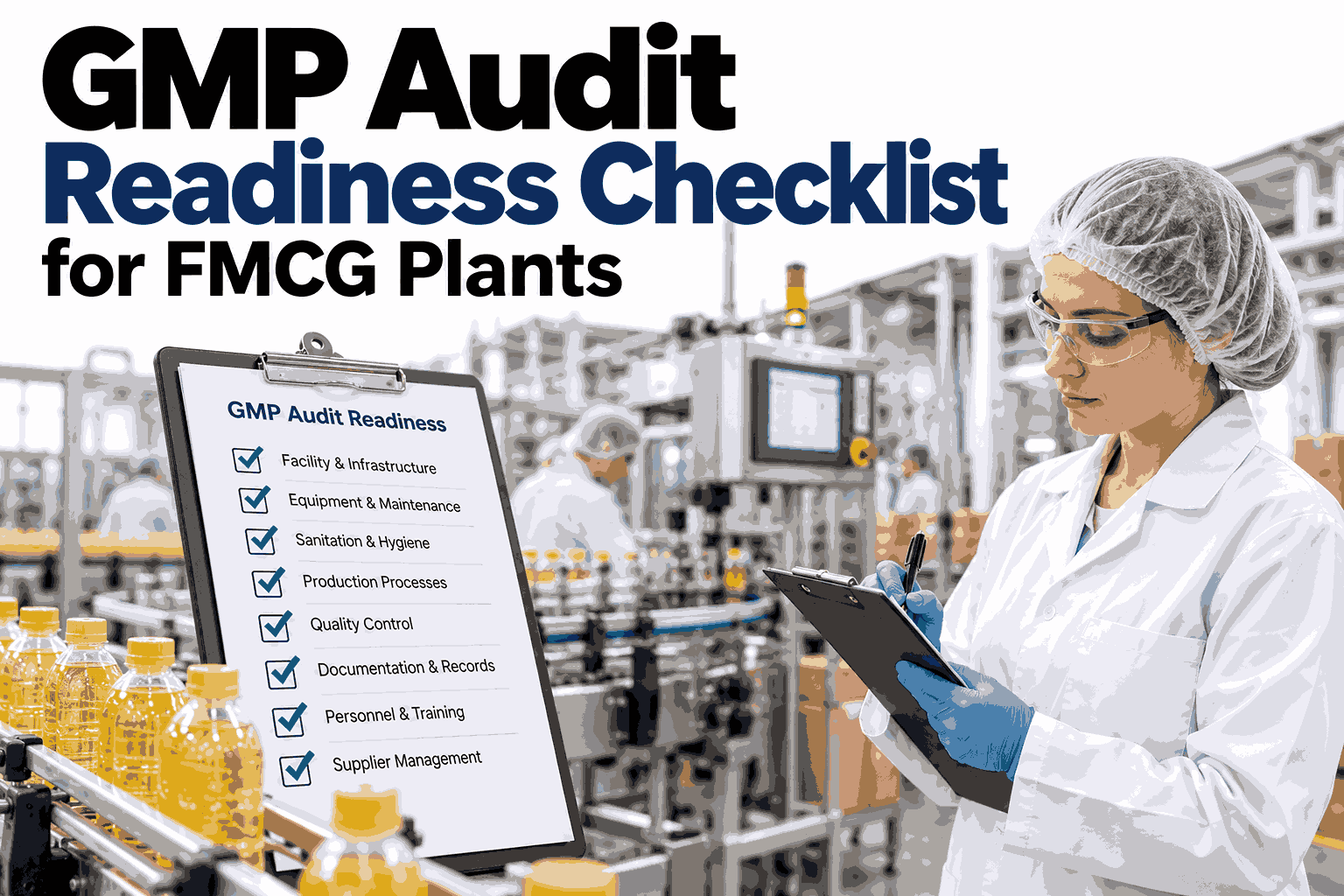
Most plants do not fail an audit because they ignore hygiene. They fail because they cannot prove it on the day. An auditor from FDA, BRCGS or SQF asks a simple question and expects a record within minutes. When the answer is in a binder somewhere, confidence drops fast. This checklist gives FMCG teams 50 items across five areas to test before the auditor does. Teams that want records ready without the scramble can book a walkthrough of audit-ready digital records.
Digital GMP and Audit-Ready Records
The 50-Point GMP Audit Readiness Checklist for FMCG Plants
Walk your plant through records, training, controls, sanitation and pest management, then fix the gaps while there is still time.
10
Records and Documents
10
Training and Competence
10
Process Controls
10
Sanitation and Hygiene
10
Pest Management
How to Use This Checklist
Treat each item as a question you must be able to answer with evidence. If you can only answer with a promise, mark it open.
1
Walk the Floor
Check each item with a QA lead and a line supervisor together.
2
Ask for Proof
Pull the record behind every tick. No record means no tick.
3
Score and Rank
Count ticks, then rank open items by food safety risk.
4
Close and Retest
Assign owners, set dates and recheck before the audit.
1
Records and Documents
Auditors start with paper because paper shows how the plant really behaves when nobody is watching.
Batch records are complete, signed and timed at the point of work
Corrections use a single line, initials and date, never overwriting
Only current SOP versions are available at the point of use
Deviations are logged and closed with a stated root cause
CAPA actions have an owner and a due date
Calibration is current for scales, thermometers and detectors
One finished lot can be traced back to its raw materials quickly
Mock recall records are dated and reviewed by management
Supplier approvals and certificates are in date
Any record can be retrieved in minutes, not hours
Paper records that live in binders are slow to search. See digital audit-ready records in a live demo and compare retrieval time.
2
Training and Competence
A signed attendance sheet is not proof of competence. Auditors watch people work and compare it to the record.
Every new starter completes GMP induction before first shift
A training matrix links each role to required courses
Refresher dates are tracked and overdue items are flagged
Critical tasks have a competency sign-off by a trainer
Temporary staff and contractors are trained before they start
Visitors receive a hygiene briefing and sign in
Allergen awareness is covered for all production staff
Food defense and fraud awareness are covered
Records are signed by both trainer and trainee
Floor observations confirm training changed behavior
Replace Binders With Records That Are Always Ready
Book a 30 minute session to see how iFactory Digital GMP captures signed, timed records at the point of work.
3
Process Controls
Controls are where the food safety plan meets the line. Each check must happen when the plan says it should.
Critical limits are monitored and recorded on schedule
Monitoring frequencies match the written plan
Metal detection or X-ray is tested with test pieces
Allergen changeovers are verified before restart
Label checks happen at line start and each changeover
Hold and release status is clear on every pallet
Rework rules are documented and followed
Line clearance is signed off before each run
Temperature and humidity limits are tracked where required
Preventive maintenance records match the schedule
Spot checks on the floor catch drift early. Book a walkthrough of digital line checks to see timestamps captured automatically.
4
Sanitation and Hygiene
A clean line on audit day proves little. Auditors look for a schedule that runs every day with evidence behind it.
A master sanitation schedule covers every area and item
Cleaning is verified by visual sign-off or swab testing
Chemicals are labeled and stored apart from product
Cleaning chemical concentrations are checked and logged
Hygiene zones are marked and respected
Hand wash stations are stocked and working
Changing rooms and lockers are clean and orderly
Waste is removed and handled without crossing product paths
Condensation and standing water are controlled
A post-clean inspection is signed before startup
5
Pest Management
Pest control is one of the easiest areas to fail on paperwork alone, even when the plant itself is clean.
The pest control contract and contractor credentials are current
A trap map matches the traps actually installed
Trap checks are logged on the agreed schedule
Activity is trended, not just counted
Door seals and building gaps are proofed
Exterior bait stations are maintained and numbered
Pesticide use is recorded by licensed personnel
Outside storage and waste areas are tidy
Sightings trigger a documented corrective action
QA reviews every pest control report
Need help turning findings into tracked actions? Ask support about corrective action tracking or request a demo of the full workflow.
Score Your Readiness
Count the items you can prove with a record today. These bands are an internal guide, not a certification standard.
45 to 50
Audit Ready
Keep reviewing monthly so evidence never goes stale.
35 to 44
Minor Gaps
Close open items and rehearse a mock audit within weeks.
Below 35
Priority Fixes
Start with food safety critical items, then records.
Low score and short timeline? Contact support for help prioritizing your gaps, or book a demo to see the fastest route to ready records.
What Audit Day Looks Like
Knowing the rhythm of the day helps your team stay calm and answer with evidence.
Opening
Scope, plant tour plan and document requests are agreed.
Floor Walk
Auditors watch hygiene, controls and staff behavior live.
Records Review
Batch, training, sanitation and pest files are sampled and traced.
Closing
Findings are shared and corrective action dates are expected.
Paper Versus Digital Records
| Audit Request | Paper Binder | iFactory Digital GMP |
|---|---|---|
| Show last month sanitation | Search shelves and folders | Open the schedule and sign-offs |
| Prove who was trained | Cross-check sheets and matrix | Filter by role and date |
| Trace a lot | Piece together several records | Follow linked batch data |
| Show open corrective actions | Review a manual log | View owners and due dates |
Want to test this against your own audit requests? Book a session and bring your toughest audit question.
Where iFactory Fits
iFactory Digital GMP with Audit-Ready Records captures checks, signatures and evidence as work happens, so the file is complete before anyone asks for it.
Point-of-Work Capture
Operators record checks with a timestamp and name, removing end-of-shift catch-up.
Overdue Alerts
Missed checks, expired training and late actions are flagged before an auditor finds them.
Fast Retrieval
Search by batch, line, date or person and open the full record trail.
Linked Corrective Actions
Deviations connect to root cause, owner and closure evidence.
Frequently Asked Questions
How early should we start audit preparation?
Treat readiness as a monthly habit, not a last-month sprint. Run this checklist at least quarterly, and again about six weeks before a planned audit so gaps can be closed properly. Book a demo to build a standing readiness routine.
Does this checklist replace my certification standard?
No. It is a practical self-check built around common audit themes. Your FDA, BRCGS or SQF requirements remain the authority, so map each checklist item to the clauses that apply to your plant and site type.
What is the most common reason plants lose confidence on audit day?
Records that exist but cannot be found quickly, or that do not match what staff describe. Evidence gaps hurt more than isolated cleaning lapses. Ask our support team how digital records close that gap.
Can digital records satisfy auditors?
Auditors care that records are accurate, attributable, timely and retrievable, whatever the format. Digital systems make those qualities easier to show consistently. See audit-ready records in a live demo and judge the evidence trail yourself.
Who should own the checklist internally?
QA usually leads, but each area needs a named owner such as production, sanitation, maintenance or training. Shared ownership with clear due dates prevents open items from sitting unnoticed between audits.
Walk Into Your Next Audit With Evidence Ready
Book a demo and see how iFactory keeps GMP records complete, searchable and audit-ready every day of the year.