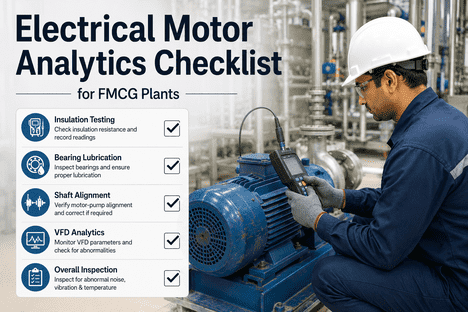
Electrical and Motor analytics Checklist for FMCG Plants
By Seren on June 19, 2026
An electric motor does not announce its failure in advance — the bearing develops micro-fractures you cannot hear, the insulation resistance quietly degrades for months, and the VFD capacitor ages invisibly until a production-stopping fault code appears at the worst possible moment. In an FMCG plant running 18–24 hours a day across filling lines, packaging systems, conveyors, compressors, and cold storage, electrical failures are responsible for 35–45% of all unplanned downtime events. A structured Electrical and Motor analytics Checklist changes that equation: IEEE reliability data shows that facilities with maintenance intervals under 12 months have motor failure rates nearly seven times lower than those without structured inspection protocols. This complete checklist covers every critical inspection point for electrical panels, motors, VFDs, and power distribution systems — from daily observations through annual analytics testing — giving your maintenance team the framework to protect uptime, extend asset life, and keep your FMCG plant running with confidence. Maintenance and reliability managers evaluating their electrical PM programme Book a Demo to see how iFactory digitises these checklists with automated scheduling, mobile execution, and analytics-driven compliance tracking.
7×
Lower motor failure rate in facilities with structured electrical PM intervals under 12 months vs. no structured programme — IEEE reliability data
5:1
ROI ratio — every $1 invested in electrical preventive maintenance saves $5 in emergency repairs, unplanned downtime, and expedited parts
80%
Of motor failures show detectable warning signs — thermal, vibration, or electrical anomalies — weeks before catastrophic breakdown occurs
50%
Of insulation life is lost for every 10°C above rated motor temperature — making thermal monitoring the single most cost-effective predictive technique
The Average FMCG Plant Loses $1.2M+ Annually to Electrical Failures. A Structured Electrical and Motor analytics Checklist Changes That Equation.
iFactory's Preventive analytics Scheduling platform digitises your entire electrical and motor PM programme — automated scheduling based on runtime and calendar triggers, mobile checklists with photo capture and signature, real-time compliance dashboards, and analytics-driven condition tracking that catches degradation before failure. Every inspection becomes data. Every data point improves reliability.
The Four Enemies of Electrical and Motor Reliability in FMCG Plants
Every electrical and motor failure in an FMCG plant traces back to one or more of four root causes. Understanding which enemy is attacking which component transforms your maintenance checklist from a compliance exercise into a precision reliability tool. Each enemy has a specific countermeasure — and each countermeasure maps directly to a checklist item in the iFactory Preventive analytics Scheduling platform.
Heat — Insulation Life Halves Every 10°C
Motor insulation life is reduced by 50% for every 10°C above rated temperature. A motor rated for 20 years at 40°C ambient lasts only 5 years at 60°C. Heat is silent, cumulative, and irreversible. In FMCG plants, heat buildup is accelerated by dust accumulation on motor fins, clogged ventilation paths, and continuous high-speed operation during peak production.
Checklist countermeasure: Clean vents, verify airflow, log winding and bearing temperature trends daily or per shift.
Contamination — Dust, Moisture and Chemical Vapour Attack
Dust, moisture, and chemical vapours attack motor insulation and bearing surfaces. In FMCG environments, washdown procedures, ingredient dust, and humidity create conditions where insulation resistance degrades 3–5x faster than in controlled environments. VFD circuit board corrosion from moisture causes intermittent faults that degrade performance long before a fault code appears.
Checklist countermeasure: Seal motor housings, inspect VFD enclosures, maintain IP-rated panels, verify desiccant breathers.
Vibration — Misalignment and Unbalance Destroy Bearings
Misalignment and unbalance generate vibration that destroys motor bearings, loosens VFD terminal connections, and eventually causes shaft fracture. Bearing failures account for 51% of all motor failures according to IEEE data. In FMCG lines with frequent changeovers, coupling misalignment introduced during reassembly is a leading cause of post-maintenance motor failures.
Checklist countermeasure: Vibration analysis at bearing points, shaft alignment verification, foundation bolt torque check.
Power Quality — Harmonics, Transients and Voltage Imbalance
Poor power quality — voltage imbalance, harmonic distortion, and transient spikes — accelerates motor heating, degrades VFD DC bus capacitors, and causes nuisance tripping. A 2% voltage imbalance can reduce motor life by 30%. In FMCG plants with multiple VFDs, non-linear loads create harmonic currents that circulate in motors and transformers, causing additional heating.
Checklist countermeasure: Power quality analysis, voltage imbalance measurement, harmonic distortion logging, transient capture.
Complete Electrical and Motor analytics Checklist — 7 Inspection Categories
This comprehensive checklist covers every critical inspection point across seven categories. Each category includes daily, weekly, monthly, quarterly, and annual tasks that map to specific failure modes. The iFactory platform digitises every item with automated scheduling, mobile checklists, and analytics-driven condition tracking. Book a Demo to see the full digital checklist library configured for your FMCG facility's electrical asset inventory.
Category 01
Motor Visual & Mechanical Inspection
Daily: Listen for unusual noise (grinding, humming, clicking). Check for visible vibration. Verify cooling fan operation and airflow. Inspect for oil or grease leakage around bearing housings.
Weekly: Measure and record bearing temperature (infrared or contact thermometer). Check shaft seal condition. Verify coupling alignment visually. Inspect foundation bolts for tightness.
Monthly: Grease bearings per manufacturer specification (type and quantity). Inspect motor mounting for cracks or corrosion. Check shaft end-play.
Quarterly: Perform vibration analysis at DE and NDE bearing points. Record velocity and acceleration spectra. Trend against baseline.
Annual: Motor shaft alignment check with laser alignment tool. Coupling inspection and replacement if worn. Bearing replacement based on runtime hours vs. L10 life.
Bearing failures = 51% of all motor failures. This category is the highest-impact checklist.
Category 02
Electrical Testing — Insulation & Winding
Monthly: Measure insulation resistance (IR) phase-to-phase and phase-to-ground using a 500V or 1000V megohmmeter (depending on motor voltage rating). Record readings at 1 minute. Flag any reading below 10 MΩ per kV.
Quarterly: Calculate Polarization Index (PI) — ratio of 10-minute IR to 1-minute IR. PI below 2.0 indicates contamination or moisture ingress requiring investigation.
Semi-Annual: Perform step-voltage test to detect insulation weakness. Measure winding resistance phase-to-phase for DC resistance balance. Any phase imbalance above 5% warrants winding inspection.
Annual: Surge test for turn-to-turn insulation integrity. High-potential (hi-pot) test where safety permits. Dielectric absorption ratio analysis.
Winding insulation failure is the second leading cause of motor failure (16%). IR trending catches degradation 4–8 weeks before failure.
Category 03
Thermographic Survey — Electrical Panels & Motors
Monthly: Scan MCC buckets, motor terminal boxes, and panel main breakers with thermal camera. Record hotspot temperatures. Flag any delta-T above 10°C between phases or between similar components.
Quarterly: Full thermal scan of all motor control centres — bus bars, contactors, relays, fuses, overloads, and terminal blocks. Identify loose connections (hot spots), overloaded circuits, and failing components.
Semi-Annual: Transformer thermal scanning — winding temperature, bushing connections, cooling system effectiveness. VFD heat sink temperature verification.
Annual: Comprehensive thermographic audit of every electrical component in the facility. Generate thermal baseline report with trendable data for next year's comparison.
Thermal anomalies precede electrical failures by 4–6 weeks on average. Loose connections account for 25% of panel failures.
Category 04
VFD & Soft Starter Analytics
Weekly: Check VFD display for fault code history. Verify DC bus voltage within spec. Inspect cooling fan operation and clean air filters.
Monthly: Download and trend VFD parameters: output current, DC bus voltage, heat sink temperature, motor load percentage. Compare against baseline values. Check for harmonic distortion exceeding 5% THD.
Quarterly: Verify VFD parameter settings against motor nameplate. Check cable insulation integrity between VFD and motor. Inspect DV/DT filter and common mode choke if installed.
Annual: Capacitor bank ESR measurement. Soft starter SCR/MCT testing. Firmware version review and update. Full VFD functional test with motor disconnected.
DC bus capacitor aging is the leading VFD failure mode. ESR trending predicts failure 4–8 weeks in advance.
Category 05
Power Distribution — Switchgear & Panelboards
Monthly: Visual inspection of panelboards — signs of overheating (discoloration, melting), pest infestation, moisture ingress. Verify cover integrity and lock/tag provisions. Check for unused openings.
Quarterly: Torque check on critical connections — main breaker lugs, bus bar joints, branch breaker terminations. Thermal scan of all panelboard interiors under load.
Semi-Annual: Insulation resistance test on main bus bars (phase-to-phase and phase-to-ground). Check ground fault protection device operation. Verify arc flash warning labels are legible and accurate.
Annual: Full switchgear maintenance — contact inspection, cleaning, lubrication, timing tests for breakers. Protective relay calibration verification.
Loose connection hotspots are the most common thermographic finding — 40% of panelboard issues detected first by thermal scan.
Category 06
Power Quality & Energy Monitoring
Monthly: Review power quality analyser data — voltage imbalance (target <1%), total harmonic distortion (target <5%), power factor. Flag any readings exceeding thresholds.
Quarterly: Track motor load profiles against motor nameplate FLA. Identify motors running consistently above 95% FLA (overload risk) or below 40% FLA (energy waste).
Semi-Annual: Verify power factor correction capacitor bank operation. Check harmonic filter tuning. Review demand profile for peak shaving opportunities.
Annual: Comprehensive power quality audit — transient capture, sag/swell logging, flicker measurement. Update power system study model with current load data.
A 2% voltage imbalance reduces motor life by 30% and increases energy consumption by 8%.
Category 07
Electrical Safety & Compliance Verification
Monthly: Verify RCD/GFCI operation (test button). Check emergency stop functionality on all motor-driven equipment. Inspect portable tool condition and test tags.
Quarterly: Inspect arc flash PPE inventory — condition, size availability, expiry dates. Verify confined space electrical safety equipment. Review lockout/tagout procedures for all motor circuits.
Semi-Annual: Earth fault loop impedance testing on all motor circuits. Check equipotential bonding on metallic enclosures. Verify surge protection device status indicators.
Annual: Update arc flash study with current fault current data. Verify all electrical labelling — arc flash boundaries, shock hazard, emergency disconnect locations. Conduct electrical safety training and competency assessment.
NFPA 70E and local electrical regulations require annual arc flash study updates and documented electrical safety compliance.
7 Inspection Categories · 42+ Checklist Items · Daily to Annual Frequency · Automated Scheduling via iFactory
A Complete Digital Electrical PM Programme — Scheduled, Tracked, and Verified — Without a Single Paper Checklist.
iFactory Preventive analytics Scheduling gives your electrical maintenance team a complete digital library of everything above — automated PM schedules based on calendar and runtime triggers, mobile checklists with photo capture and signature, real-time compliance dashboards for plant management, and analytics-driven condition tracking that catches motor and panel degradation before failure. Every inspection becomes a data point. Every data point improves your reliability programme.
Reactive vs. Preventive Electrical Maintenance Economics in FMCG
The economics of electrical maintenance in FMCG plants follow a predictable pattern: reactive repairs cost 5–10x more than preventive interventions, and the gap widens when downtime costs are included. The table below contrasts the two approaches across the metrics that matter to plant managers and reliability engineers evaluating their electrical PM programme. Book a Demo to see a cost comparison model for your facility's motor and electrical asset population.
Factor
Failures prevented Intervention timing Parts cost Labour cost Downtime impact Secondary damage Safety risk Cost per event
Reactive Electrical Repair
0% — failure must occur before action After catastrophic failure Premium pricing + expedited shipping Overtime + call-out premiums 4–8 hours per incident Coupling damage, shaft scoring, driven equipment damage Arc flash risk, fire risk during failure $8,000–$50,000+ per motor failure
Preventive Electrical PM — iFactory
85%+ — IR trend, vibration, thermal data catches degradation early Before failure — scheduled during planned downtime Standard pricing, planned procurement Regular time, scheduled in advance 0 (scheduled) or <1 hour (PM window) None — stopped before damage chain starts Controlled environment — proper LOTO, verified isolation $500–$2,000 per scheduled PM cycle
The iFactory Preventive analytics Scheduling Platform: Digitising Your Electrical PM Programme
The iFactory platform transforms the electrical and motor analytics checklist from a paper document into a live, automated, analytics-driven reliability programme. Three capabilities define its operational value for FMCG maintenance teams.
Capability 01
Automated PM Scheduling with Runtime & Calendar Triggers
Every checklist item in the seven categories above is configurable with automated scheduling — by calendar frequency (daily, weekly, monthly, quarterly, annual) or runtime hours (every 500 hours, every 2000 hours, etc.). The platform triggers PM work orders automatically when either condition is met, ensuring no inspection interval is missed regardless of production schedule changes. Overdue PMs escalate through configurable notification chains — technician, supervisor, plant manager — until the inspection is completed and verified with photo evidence and electronic signature.
FMCG plants using iFactory achieve 85–95% electrical PM compliance vs. 55–65% with paper-based systems.
Capability 02
Mobile Checklist Execution with Condition Data Recording
Technicians execute electrical and motor checklists on mobile devices — iOS or Android — with guided step-by-step inspection workflows. Each checklist item includes the acceptable range or threshold for the measurement being taken. When a reading falls outside the acceptable range (IR below 10 MΩ, delta-T above 10°C, vibration above 4.5 mm/s), the platform flags it as a finding and prompts the technician to capture corrective action or generate a follow-up work order. Measurement values — IR, temperature, vibration, current — are recorded as structured data, not free-text notes, enabling trend analysis across inspection cycles.
Structured data capture enables 4–8 week advance warning through trending vs. single-point pass/fail inspection.
Capability 03
Compliance Dashboard & Condition Trend Analytics
Plant managers and reliability engineers see a live dashboard showing PM compliance percentage by asset, category, and technician — colour-coded green (on track), amber (approaching overdue), red (overdue). Condition trends for each motor are plotted over time: insulation resistance declining from 200 MΩ to 50 MΩ over six months, bearing temperature rising from 45°C to 62°C, vibration velocity increasing from 2.1 mm/s to 5.8 mm/s. The trend view distinguishes between stable readings (normal aging) and accelerating degradation (intervention required). Automated reports are generated for weekly maintenance reviews and monthly reliability meetings.
Condition trend analytics reduces emergency electrical repairs by 60–70% within 12 months of deployment.
"
We had 480 motors across three production facilities and we were running electrical PM on a paper system that depended on one maintenance planner who knew every motor by heart. When he retired, our electrical PM compliance dropped from 78% to 41% in two months and our motor failure rate doubled. We deployed iFactory's Preventive analytics Scheduling platform with the full electrical checklist library. Within 90 days, PM compliance was back above 90% and we had condition trend data on every motor. The platform flagged 14 motors with declining IR trends that we would have missed until they failed. We replaced those motors during planned shutdowns at a total cost of $28,000 instead of waiting for emergency failures that would have cost an estimated $210,000 in repairs and lost production. The platform paid for itself on those 14 motors alone.
Electrical and motor failures are the single largest category of preventable downtime in FMCG plants — and they are also the most detectable before failure. Insulation resistance declines measurably for weeks before winding failure. Bearing temperature rises for days before seizure. Loose connections generate heat for months before arc flash events. Every one of these failure modes has a specific checklist item and a specific measurement threshold that signals the need for intervention.
The seven-category checklist in this guide covers every critical inspection point — from daily motor listening checks through annual power quality audits — and maps directly to the iFactory Preventive analytics Scheduling platform for digital execution, automated scheduling, and condition trend analytics. The gap between plants that run structured electrical PM programmes and plants that react to failures is not a technology gap — it is a checklist gap, a scheduling gap, and a compliance visibility gap.
iFactory's Preventive analytics Scheduling platform closes all three gaps. Book a Demo to see the complete digital electrical and motor checklist library configured for your FMCG facility's asset inventory, or Talk to an Expert about a free electrical PM programme assessment covering up to 50 motors in your plant.
Stop Reacting to Electrical Failures. Get a Complete Digital PM Programme for Your Motors, Panels, and VFDs — Deployed in 2 Weeks.
iFactory's Preventive analytics Scheduling platform digitises your entire electrical and motor PM programme — automated scheduling, mobile checklists with structured data capture, real-time compliance dashboards, and condition trend analytics that catch degradation 4–8 weeks before failure. Full integration with existing CMMS, EAM, and SAP PM systems.
For critical motors (filling lines, conveyors, compressors), IR should be measured monthly using a 500V or 1000V megohmmeter depending on motor voltage rating. For non-critical motors, quarterly measurement is sufficient. Each reading should be recorded at 1 minute and trended over time — a declining trend is more significant than any single reading. Minimum acceptable IR is typically 10 MΩ per kV of motor voltage. The Polarization Index (10-minute IR / 1-minute IR) should be calculated quarterly — values below 2.0 indicate contamination or moisture. iFactory's mobile checklist captures IR readings as structured data with automatic pass/fail evaluation based on configurable thresholds. Talk to an Expert about setting up IR trending for your motor population.
A delta-T (temperature difference) of 10°C or more between similar components under similar load — phase-to-phase on a motor terminal box, phase-to-phase on a panelboard breaker, or between identical motors on the same line — warrants investigation. A delta-T of 20°C or more requires immediate corrective action. For individual components, any temperature above 90°C on a panelboard interior or above 130°C on a motor winding (Class F insulation) should be flagged. iFactory's mobile thermographic checklist records hotspot temperatures and automatically compares them against configurable thresholds, generating a work order when delta-T exceeds the alarm limit. Book a Demo to see the thermal data capture workflow.
Greasing frequency depends on bearing type, motor speed, operating temperature, and environment. As a general guideline for FMCG motors running continuously: fractional to 10 HP motors — every 2,000 hours or 6 months; 10–40 HP motors — every 1,500 hours or 4 months; 40+ HP motors — every 1,000 hours or 3 months. The quantity is calculated as: Q (grams) = Bearing OD (mm) x Bearing width (mm) / 2. Over-greasing is as damaging as under-greasing — excess grease causes overheating and premature bearing failure. iFactory's PM scheduler triggers greasing tasks based on runtime hours and records the grease type, quantity, and date for each bearing. Talk to an Expert about setting up bearing greasing schedules for your motor population.
iFactory integrates with existing CMMS, EAM, and SAP PM systems through standard REST APIs, OData, and direct database connectors. PM schedules created in iFactory synchronise work orders to the connected CMMS or SAP system. Completed checklists with measurement data, photo evidence, and electronic signatures are written back to the maintenance history record in the host system. For facilities running SAP PM, iFactory's integration manages the equipment master, functional locations, maintenance plans, and measuring point data synchronisation bidirectionally. Integration is typically completed within two to four weeks and does not require modification to the existing CMMS or SAP configuration. Book a Demo to see the integration architecture for your current maintenance management platform.
ROI is calculated from three quantified benefit streams: (1) avoided emergency repairs — the cost differential between scheduled motor replacement and emergency failure repair, typically 5:1; (2) unplanned downtime reduction — electrical failures cause 4–8 hours of downtime per event at a cost of $10,000–$50,000 per hour in lost production; and (3) extended motor life — structured PM programmes extend motor life by 30–50% by catching degradation before it causes winding or bearing failure. Most FMCG facilities achieve full payback within 4 to 8 months of deployment. The primary variable affecting ROI is the pre-deployment electrical PM compliance level — facilities below 60% compliance typically achieve the fastest payback because the opportunity for improvement is largest. iFactory's platform includes a built-in ROI calculator that uses your facility's motor count, failure rate, and production cost data to project payback before deployment. Book a Demo to generate a site-specific ROI projection.