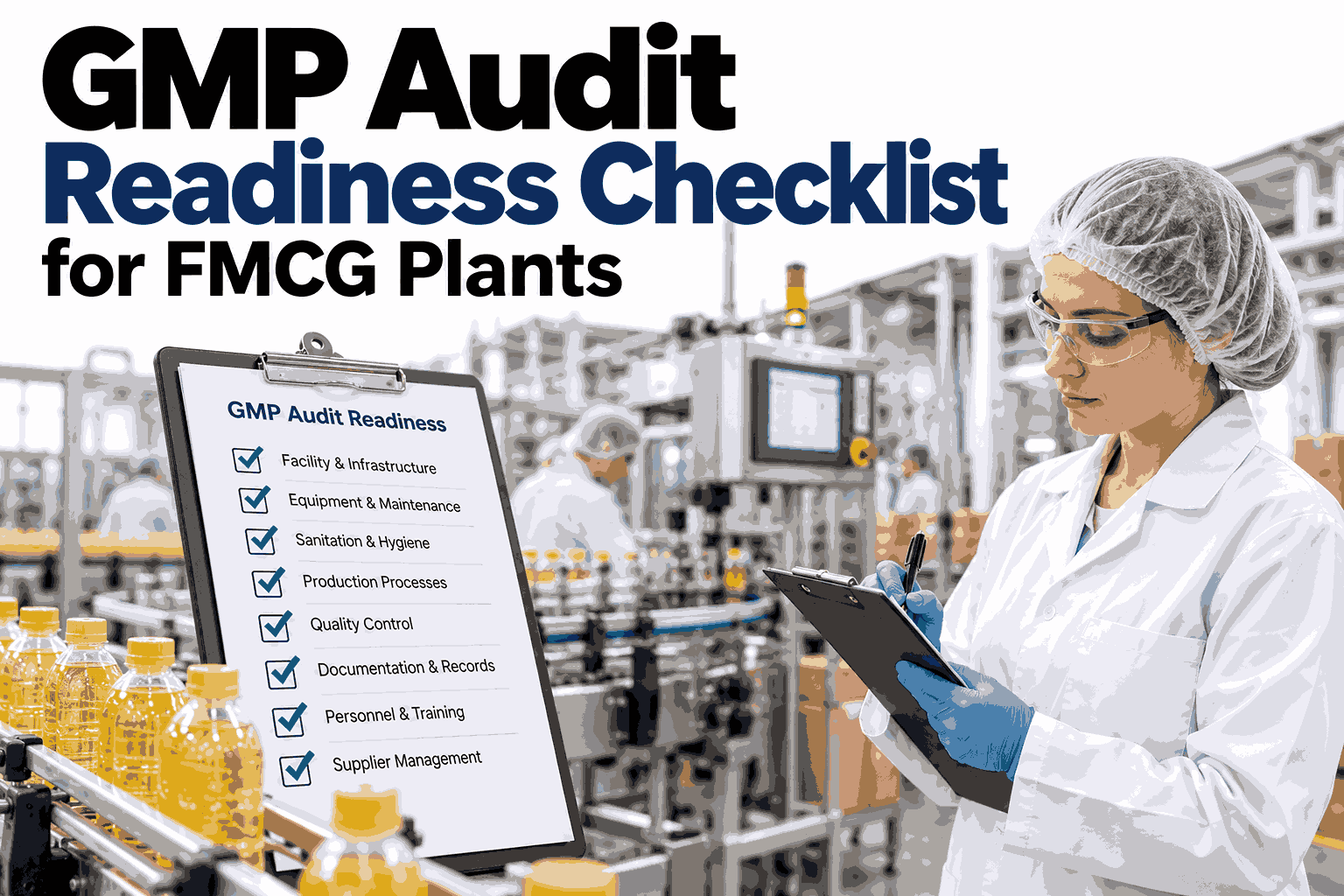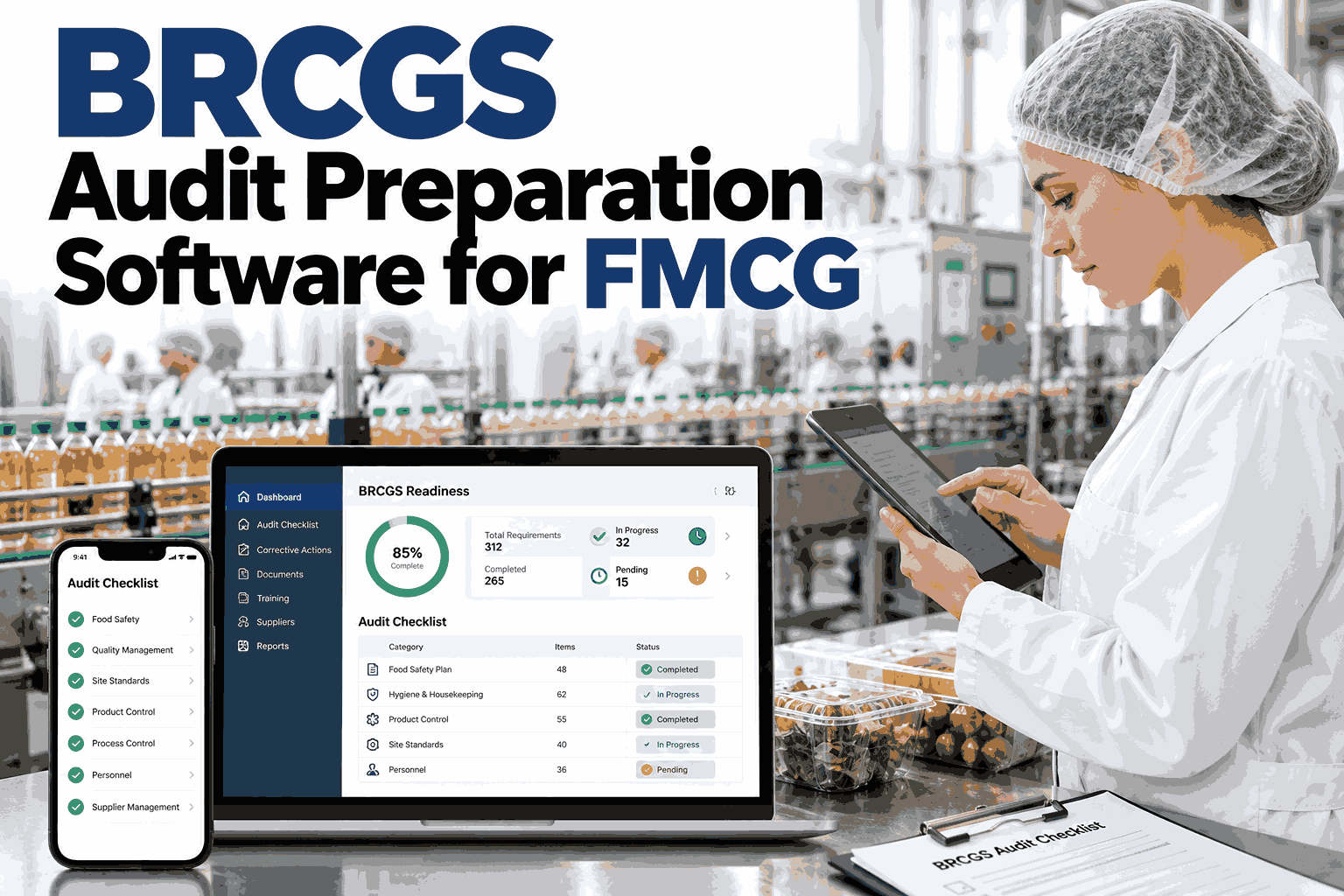
Ask any quality manager how BRCGS audit preparation feels and the answer is usually the same: binders, chasing signatures, and a weekend lost before the auditor arrives. For FMCG plants running multiple lines, allergen changeovers, and daily GMP checks, the evidence already exists but it is scattered across clipboards, drives, and inboxes. This article shows how audit preparation software packages that evidence, tracks non-conformance history, and prepares you for unannounced visits, and you can see it in action when you book a live walkthrough with the iFactory AI team.
BRCGS Audit Preparation Software for FMCG: Be Ready Every Day, Not Just the Week Before
iFactory AI keeps GMP records, non-conformances, and corrective actions audit-ready all year, so audit week becomes a review instead of a rebuild.
Why the Weekend Before an Audit Disappears
Audit preparation rarely fails because the work was not done. It fails because the proof of that work lives in a dozen places, and gathering it is a manual job that lands in the final days.
By the weekend the team is no longer improving food safety. They are searching for it. Every hour spent hunting for a signed record is an hour not spent fixing the gap that record might reveal.
What an Evidence Pack Really Contains
An auditor does not only ask whether a procedure exists. They ask you to show it working. A strong evidence pack therefore has four layers, and a gap in any one of them weakens the rest.
The requirement
The procedure, specification, or HACCP control the record belongs to, in its current approved version.
The routine record
Completed checks for the dates the auditor samples, showing who did the task, when, and the result.
The exception record
Any deviation, failed check, or non-conformance, with the immediate action taken at the time.
The proof of closure
Root cause, corrective action, verification that it worked, and a check that the problem did not return.
Most plants are strong on layer two and weak on layers three and four. Routine checks get signed, but the story of what happened when a check failed is buried in an email or never written down.
Non-Conformance History: The Part Auditors Remember
BRCGS audit findings are graded by severity, and your history of non-conformances tells an auditor how well the system learns from its own mistakes.
The finding on the day matters less than the pattern behind it. A minor issue that appears three audits in a row suggests that corrective action is closing tickets without fixing causes.
When this history is a tidy list inside one system, corrective action evidence after the audit takes hours, not days. Watch how non-conformance history is tracked from finding to verified closure in a short demo.
Unannounced Audit Readiness: The Four-Hour Test
BRCGS offers an unannounced audit option, and many retailers value it. There is no weekend to prepare, so readiness has to be a daily state. Picture the first four hours of an unannounced visit.
Each request is reasonable, and each one is a search problem. With paper and scattered files, the answer depends on who is on shift. With a searchable record system, the answer depends on a filter.
Give Your Team Their Weekends Back
Book a 30-minute session and the iFactory AI team will show how GMP records, non-conformance history, and evidence packs stay audit-ready on your own plant data.
The Preparation Effort Curve
Manual preparation is back-loaded. Effort stays low for weeks, then spikes as the audit nears. The chart shows an illustrative pattern of weekly preparation hours for a mid-sized FMCG plant.
The second pattern is flat because the work happens during the year, as checks are completed and exceptions are closed. Nothing waits for a deadline.
What Auditors Sample in Each Part of the Standard
The BRCGS Food Safety standard is organized into seven sections. This table shows the kinds of records an auditor typically samples and what your system should be able to produce quickly.
| Section | Records Often Sampled | What to Keep Ready |
|---|---|---|
| 1. Senior management commitment | Management review minutes, food safety culture plan | Dated reviews with actions and owners |
| 2. Food safety plan (HACCP) | Hazard analysis, critical limits, monitoring logs | Current plan plus monitoring results by date |
| 3. Food safety and quality management system | Internal audits, supplier approval, corrective actions, traceability tests | Closed-loop corrective action history |
| 4. Site standards | Cleaning schedules, pest control, maintenance and hygiene checks | Completed GMP checks searchable by area |
| 5. Product control | Allergen management, labeling checks, product testing | Changeover and label verification records |
| 6. Process control | Calibration, metal detection, weight and quantity checks | Calibration status and failed-check responses |
| 7. Personnel | Training records, protective clothing, medical screening procedures | Training matrix linked to role and date |
Auditors follow the evidence they find interesting, so a table of clauses is not a checklist to satisfy one by one. It is a map of where proof must be quick to retrieve.
Digital GMP Records That Stay Audit-Ready
Audit-ready records are not a separate project. They are what you get when daily GMP work is captured properly from the start.
None of this replaces a competent quality team. It removes the clerical work, so that team spends its time on the judgment calls that need a human. A short product demo for your quality team is the fastest way to judge the fit.
Self-Assessment: How Ready Are You Today?
Answer yes or no to each statement as if the auditor walked in this morning. Give yourself one point for every yes.
Scramble risk
Evidence depends on individuals. An unannounced audit would be stressful and results uncertain.
Gaps to close
The foundation exists, but retrieval and closure proof need structure to hold up under sampling.
Nearly ready
Focus on consistency and trend review so readiness lasts through staff changes and growth.
Whatever your score, the gaps point to a starting place. Bring your answers to a readiness conversation with iFactory AI and the session can focus on the lowest-scoring areas.
Where iFactory AI Fits for FMCG Plants
iFactory AI is smart manufacturing and industrial software, and its Digital GMP and Audit-Ready Records capabilities are built for plants that run on daily compliance routines.
Digital GMP checks
Replace paper clipboards with guided checks at the line, complete with required fields and owners.
Audit-ready records
Records are organized so they can be found by clause, line, product, or date.
Non-conformance tracking
Findings move from detection to root cause to verified closure, with history kept in one place.
Evidence packaging
Compile the proof for a section or lot, ready to share when an auditor asks.
iFactory AI arrives pre-configured on an NVIDIA server, racked and ready with software pre-loaded. Scope covers cabling, network, system integration, team training, and 24x7 remote monitoring.
Seeing your own record types in the system is the strongest test. Reserve a walkthrough using your check sheets and judge for yourself.
Frequently Asked Questions
Can software guarantee a better BRCGS grade?
No software can guarantee a grade, because grades depend on what the auditor finds in your site and systems. What it does is make records complete, retrievable, and consistent, which removes avoidable findings. To see how that applies to your plant, you can book a demo and review your last audit report together.
How does this help with an unannounced audit?
An unannounced audit leaves no time to assemble records, so retrieval speed matters most. When checks, exceptions, and closures live in one searchable system, any shift manager can answer an auditor's request quickly. That reduces dependence on one person and keeps the visit calm and predictable.
Will our existing check sheets and procedures work?
Yes, the starting point is your own procedures and check sheets, not a generic template. They are loaded into the system and turned into guided digital checks. The iFactory AI team can review your current documents with you before the project begins.
How does corrective action tracking work after an audit?
Each finding becomes a tracked record with an owner, a due date, a root cause, and a verification step. You can see what is open, what is overdue, and what has been verified. That makes the evidence you send back to your certification body quicker to compile and easier to trust.
How long does it take to go live?
A typical turnkey rollout takes between six and twelve weeks, covering setup, a pilot on one line, and training before wider go-live. Timing depends on how many lines and record types you include. A planning session with the team gives you a timeline for your site.
Make Every Audit Week a Calm Week
Bring your last audit report and your current check sheets. The iFactory AI team will show how digital GMP records, non-conformance history, and evidence packs would work in your plant. Book a walkthrough and see it on your own data.