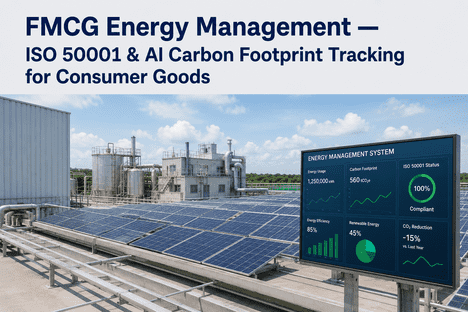
ISO 50001 certification promises a lot on paper — a structured energy management system, documented performance indicators, and a framework for continuous improvement — but the plants that actually get through the audit smoothly are the ones that treat the standard as an operating discipline rather than a documentation exercise assembled in the weeks before the auditor arrives. The standard's core requirements, an energy review, a defined set of energy performance indicators, and a documented action plan, only hold up under audit scrutiny when they are backed by real data collected consistently over time, not reconstructed from memory once certification becomes a priority. FMCG plants beginning or renewing an ISO 50001 program can start with a conversation with iFactory's support team about connecting energy data collection directly into the documentation the standard requires.
Certification Is the Byproduct of a Real Energy Management Discipline
Energy review, EnPI selection, and action plan structure only survive an audit when they are built on data collected continuously, not assembled the week before the auditor arrives.
Why Certification Attempts Stall or Fail
The standard itself is not especially complicated, but implementing it against real plant operations exposes gaps that a documentation-only approach cannot paper over. An energy review built from estimates rather than actual sub-metered data, EnPIs chosen because they are convenient to report rather than because they reflect genuine energy drivers, and an action plan with no real budget or ownership behind it are the three most common reasons a certification attempt stalls during the internal audit stage, well before an external auditor is ever involved.
The Four Pillars of an ISO 50001 System
Each pillar of the standard depends on the one before it, and building them out of sequence is the most common reason implementation projects run longer than planned.
Energy Review
A documented analysis of where and how energy is used across the plant, identifying significant energy uses that will anchor everything the management system focuses on going forward.
EnPI Selection
Specific, measurable indicators tied to the significant energy uses identified in the review, chosen for statistical relevance rather than convenience of existing reporting.
Action Plan Structure
Specific projects and initiatives tied to each EnPI, with named ownership, budget, and a timeline, rather than a generic list of good ideas with no accountability attached.
Audit Readiness
Ongoing internal audits confirming the system operates as documented, catching the gaps between paper procedure and actual practice before an external auditor finds them instead.
Build EnPI Tracking on Real Sub-Metered Data
Book a 30-minute walkthrough of how iFactory connects energy review data and EnPI tracking directly into audit-ready documentation.
Common EnPI Choices for FMCG Plants Compared
The right EnPI for a given process area depends on what actually drives energy consumption there, and the table below outlines common choices across typical FMCG plant areas.
| Process Area | Common EnPI | Primary Energy Driver |
|---|---|---|
| Refrigeration / Cold Storage | kWh per ton of product stored | Ambient temperature and door-open frequency |
| Compressed Air | kWh per standard cubic meter delivered | Leak rate and system pressure setpoint |
| Steam / Boiler Systems | kWh per ton of steam generated | Combustion efficiency and blowdown rate |
| HVAC / Production Areas | kWh per square meter conditioned | Setpoint discipline and occupancy scheduling |
The PDCA Cycle in Practice, Not Just on Paper
ISO 50001 is built around the Plan-Do-Check-Act cycle, and an auditor is specifically looking for evidence that this cycle runs continuously rather than existing as a diagram in the management system documentation with no operational counterpart.
Plan
The energy review and EnPI selection define what will be measured and improved, setting the baseline every later comparison will be checked against.
Do
Action plan items are executed with assigned ownership and budget, generating the operational data the next stage will need to evaluate.
Check
EnPI performance is reviewed against target on a defined cadence, using the same traceable, process-level data the initial energy review was built on.
Act
Findings from the check stage feed back into revised targets or new action plan items, closing the loop rather than letting the review sit unactioned.
A Composite Scenario: The Certification Attempt That Restarted Twice
An FMCG plant pursuing ISO 50001 certification for the first time completed its energy review and selected EnPIs largely based on data already available in existing monthly utility reports, since building new sub-metering felt like an unnecessary expense for a first attempt. The internal audit surfaced a serious gap: several of the chosen EnPIs could not be traced back to verifiable source data at the level of detail the standard required, since the monthly utility totals aggregated multiple process areas together.
Restarting the energy review with proper sub-metering at the process level took several additional months beyond the original timeline, but it also revealed that the plant's original EnPI choices had been tracking the wrong things entirely — a compressed air EnPI based on total plant electricity rather than actual compressed air delivery had been masking a significant leak problem the whole time. The second certification attempt, built on the corrected data, passed both the internal and external audit without further gaps identified.
Mistakes That Undermine Certification Readiness
Building EnPIs From Aggregated Utility Data
Plant-wide totals cannot support process-level EnPIs, exactly the gap that forced a restart in the scenario above, and process-level sub-metering has to exist before meaningful EnPIs can be defined.
Treating the Action Plan as a Wish List
An action plan item without a named owner, budget, and timeline rarely survives contact with competing operational priorities, and an auditor will ask for evidence of actual progress against each item.
Compiling Documentation Only Before the Audit
A management system that only produces documentation in the weeks before certification cannot demonstrate the ongoing operating discipline the standard actually requires between audit cycles.
Skipping a Genuine Internal Audit Before the External One
A thorough internal audit is what should surface data gaps like the aggregated EnPI problem in the scenario above, before an external auditor finds the same gap and forces a more visible setback.
Is Your Plant Actually Ready for Certification
EnPIs are built on process-level, not aggregated, energy data
Process-level sub-metering is what allows an EnPI to actually reflect the specific energy use it claims to track, rather than a plant-wide figure diluted by everything else running at the same time.
Every action plan item has a named owner and budget
An action item without clear ownership rarely gets executed, and an auditor reviewing progress against the plan will look for evidence of actual accountability, not just a documented intention.
Data collection has been running continuously, not assembled recently
A track record of continuous data collection demonstrates the ongoing management system discipline the standard requires, rather than a documentation exercise compiled just before certification.
Frequently Asked Questions
How long does ISO 50001 implementation typically take for an FMCG plant?
Implementation timelines vary considerably depending on existing data infrastructure, but a plant starting without process-level sub-metering should expect a longer runway than one already collecting granular energy data, since building that data foundation properly, as the scenario above illustrates, cannot be skipped without risking a failed or restarted certification attempt. A realistic implementation plan accounts for this data-readiness gap explicitly rather than assuming existing utility billing data will suffice.
How many EnPIs should a plant track under ISO 50001?
The standard does not specify a fixed number, and the right count depends on how many significant energy uses the energy review identifies, but most FMCG plants find that a focused set of EnPIs tied to their largest and most controllable energy uses, such as refrigeration, compressed air, and steam systems, is more manageable and more defensible under audit than an overly broad set spread thin across every possible process area.
Does ISO 50001 certification require continuous energy monitoring technology?
The standard itself does not mandate a specific technology, but it does require EnPIs backed by verifiable, process-level data collected consistently, and in practice this is very difficult to achieve reliably without some form of continuous or near-continuous sub-metering, particularly for plants with multiple significant energy uses that would otherwise be indistinguishable in aggregated utility data. This is exactly the gap that forced the restart described in the scenario above.
What happens during an ISO 50001 external audit?
An external auditor reviews the documented energy management system against actual practice, checking whether EnPIs are tracked as claimed, whether action plan items show genuine progress, and whether the organization can demonstrate the PDCA improvement cycle is genuinely operating rather than existing only on paper. Auditors typically ask to trace specific EnPI figures back to their source data, which is exactly where an aggregated or estimated data foundation, rather than genuine process-level metering, becomes a visible weakness. Book a demo to see how iFactory maintains this kind of traceable audit trail automatically.
Can a plant maintain ISO 50001 certification without ongoing effort after the initial audit?
No, certification requires periodic surveillance audits, typically annually, that check whether the management system continues to operate as documented, and a plant that treats the initial certification as a finish line rather than the start of an ongoing discipline often struggles at the surveillance audit stage once the initial documentation push fades from memory. Building the data collection and review cadence into standard operating routine, rather than a special project, is what keeps certification maintained without a scramble before each surveillance audit. Plants building this ongoing routine can reach iFactory support for guidance.
Build the Data Foundation Certification Actually Depends On
iFactory connects process-level energy data directly into EnPI tracking and action plan documentation, so certification is backed by real data from day one. Book a walkthrough to see it running on a live FMCG plant.