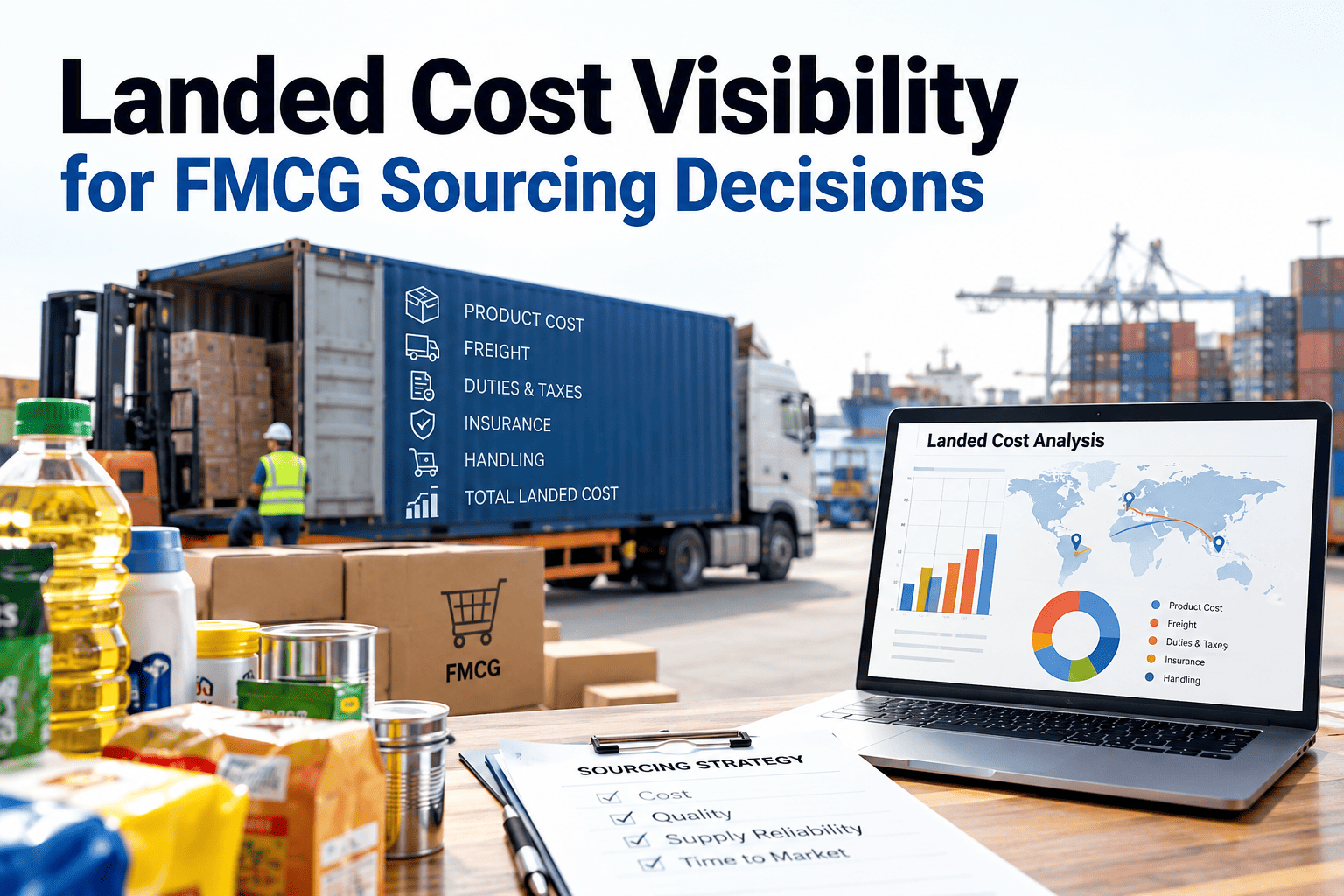
A sourcing decision made on unit price alone looks straightforward right up until the shipment arrives, because the number on the quote sheet almost never matches what that case of product actually costs once freight, duty, insurance, and the quality-related rework it triggers are added back in. Two suppliers quoting the same unit price can land at meaningfully different total costs once one of them sits three ports further from your DC or carries a defect rate that quietly adds a rework line to every batch. Most FMCG procurement teams know landed cost matters in theory but calculate it manually, inconsistently, or not at all when a sourcing decision needs to move fast. Seeing the full stack before you commit changes which supplier actually wins, and booking a demo shows how that stack gets built for your specific sourcing comparisons.
COST VISIBILITY · SOURCING DECISIONS · FMCG
The Cheapest Quote Isn't Always the Cheapest Case
iFactory builds the full landed cost stack, unit price, freight, duty, insurance, and quality-related cost, so your sourcing team compares what a supplier actually costs, not just what they quote.
THE VISIBLE VS HIDDEN COST
What the Quote Sheet Shows and What It Leaves Out
Unit price is the number everyone negotiates over, but it's a fraction of what actually determines the true cost of a sourced product once it's sitting in your distribution center ready to ship.
WHAT'S QUOTED
Unit Price Per Case
WHAT'S USUALLY MISSING
Freight and Fuel Surcharges
Import Duty and Tariff Classification
Cargo Insurance and Customs Fees
Quality-Related Rework and Rejection Cost
Currency Fluctuation Exposure
The gap between the quoted price and the true landed cost is rarely small, and it's almost never the same gap from one supplier to the next, which is exactly why comparing quotes side by side without this stack leads to sourcing decisions that look right on paper and cost more in practice.
THE FULL STACK
Every Component That Belongs in a Real Landed Cost Number
Building an accurate landed cost figure means pulling together data that usually lives in separate systems and separate teams, procurement, logistics, finance, and quality, none of which typically talk to each other during a sourcing evaluation.
01
Unit Price
The quoted per-unit or per-case cost from the supplier, the starting point but never the full picture on its own.
02
Freight
Ocean, air, or ground freight cost from origin to your DC, including fuel surcharges that fluctuate independently of the base rate.
03
Duty and Tariffs
Import duty calculated against the correct tariff classification, which varies by product category and country of origin.
04
Insurance and Fees
Cargo insurance, customs brokerage, and port handling fees that get billed separately from the freight invoice itself.
05
Quality Cost
Historical defect and rejection rate for this supplier translated into an expected rework or replacement cost per unit.
06
Currency Exposure
Expected currency fluctuation risk over the sourcing contract period, factored in as a cost range rather than a fixed number.
Run your current supplier shortlist through the full landed cost stack
iFactory can build the comparison against your actual sourcing options so you see the true cost gap before signing anything.
A REAL COMPARISON
How Two Suppliers Can Flip Once the Stack Is Built
The scenario below reflects a pattern that shows up repeatedly across FMCG sourcing evaluations, where the supplier with the lower unit price isn't actually the lower total cost once the full stack is calculated.
| Cost Component |
Supplier A |
Supplier B |
| Unit Price |
Lower quoted price per case |
Higher quoted price per case |
| Freight Distance |
Longer transit, higher freight and fuel surcharge |
Shorter transit, lower freight cost |
| Duty Classification |
Higher tariff bracket for country of origin |
Preferential trade agreement reduces duty |
| Historical Defect Rate |
Higher rejection rate adds rework cost per unit |
Lower rejection rate, minimal added cost |
| True Landed Cost |
Total cost ends up higher once stack is applied |
Total cost ends up lower despite higher quote |
Neither supplier is wrong to quote what they quote, the point is that unit price alone tells you almost nothing about which one actually costs less once the case lands at your DC ready to ship.
THE QUALITY COST FACTOR
Why Defect Rate Belongs in a Cost Calculation, Not Just a Scorecard
Quality is usually tracked separately from cost, scored on a supplier scorecard that procurement reviews but doesn't necessarily translate into dollars during a sourcing decision, which is a missed connection given how directly defect rate affects total cost.
STEP 1
Pull the supplier's historical defect and rejection rate from quality records
→
STEP 2
Calculate the average rework, replacement, or write-off cost per defective unit
→
STEP 3
Apply that cost across the expected order volume as a per-unit quality cost addition
→
STEP 4
Add it to the landed cost stack alongside freight, duty, and insurance
TURNKEY DELIVERY
How iFactory Builds Landed Cost Visibility Into Your Sourcing Process
iFactory connects to your procurement, logistics, and quality systems to pull the data each component needs, then builds a standing comparison model your sourcing team can run against any current or prospective supplier.
What Gets Built
Automated freight, duty, and insurance cost pulls from connected logistics data
Quality cost model built from your historical defect and rejection records
Side-by-side supplier comparison view for any active sourcing decision
Currency exposure modeling across the contract period you're evaluating
Deployment Timeline
Weeks 1-3: Data integration across procurement, logistics, and quality systems
Weeks 4-6: Cost model build and calibration against known historical sourcing decisions
Weeks 7-8: Comparison tool go-live and sourcing team training
FREQUENTLY ASKED QUESTIONS
What Procurement Teams Ask Before Adding Landed Cost Visibility
How accurate can duty and tariff estimates really be before a shipment actually clears customs?
Duty estimates are built against the correct tariff classification for your specific product category and country of origin, which is the single biggest driver of accuracy, since misclassification is the most common source of landed cost estimates being wrong. Combined with current trade agreement data and historical clearance records for similar shipments, the estimate typically lands very close to the actual assessed duty, with any variance flagged as a range rather than presented as false precision.
Book a demo to see the classification logic applied to your product categories.
We don't have clean historical defect data for every supplier, does that break the quality cost calculation?
Incomplete quality history is common, especially for newer supplier relationships, and the model handles this by using category-level benchmarks where supplier-specific data is thin, clearly flagging which suppliers have a fully data-backed quality cost figure versus an estimated one. As more shipments and quality records accumulate, the estimate for that supplier sharpens automatically without requiring a manual rebuild of the comparison.
Contact our support team to discuss how partial data gets handled for your current supplier base.
How does this account for currency fluctuation over a multi-year sourcing contract?
Currency exposure is modeled as a range rather than a single fixed cost, using historical volatility for the relevant currency pair applied against your expected order volume and contract duration, so the comparison shows both a base case and a stress case for how currency movement could affect total landed cost over time. This lets your team weigh a supplier that looks cheaper today against one with more currency stability if the contract runs multiple years.
Book a demo to see the currency modeling applied to a real multi-year comparison.
Can we use this for a one-off sourcing decision or does it require a standing integration?
Both are supported, a one-off comparison can be built quickly against a specific set of supplier quotes without a full system integration, which is a common starting point for teams evaluating this for the first time. A standing integration becomes valuable once your team wants landed cost visibility available continuously across every active sourcing evaluation rather than rebuilding the analysis manually each time a new decision comes up.
Contact our support team to scope the right starting approach for your current sourcing volume.
Does this replace our procurement team's negotiation process, or support it?
It supports the negotiation rather than replacing it, giving your procurement team a defensible, data-backed total cost figure to bring into supplier conversations instead of negotiating on unit price alone while hoping the other cost factors work out favorably. Several sourcing teams have used the landed cost comparison directly in supplier negotiations to push back on a quote that looks competitive on price but carries a materially higher total cost once freight or quality history is factored in.
Book a demo to see how the comparison output is typically used in supplier conversations.
SEE THE FULL COST, NOT JUST THE QUOTE
Compare Suppliers on What They Actually Cost, Not What They Quote
iFactory builds the full landed cost stack, unit price, freight, duty, insurance, and quality cost, so your sourcing decisions are based on the total number, not a partial one.