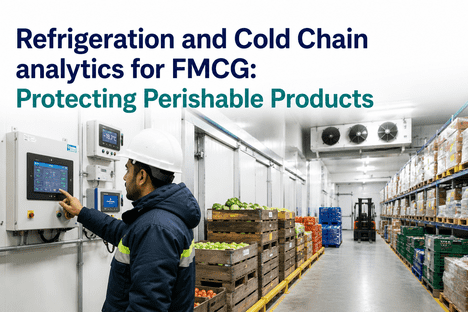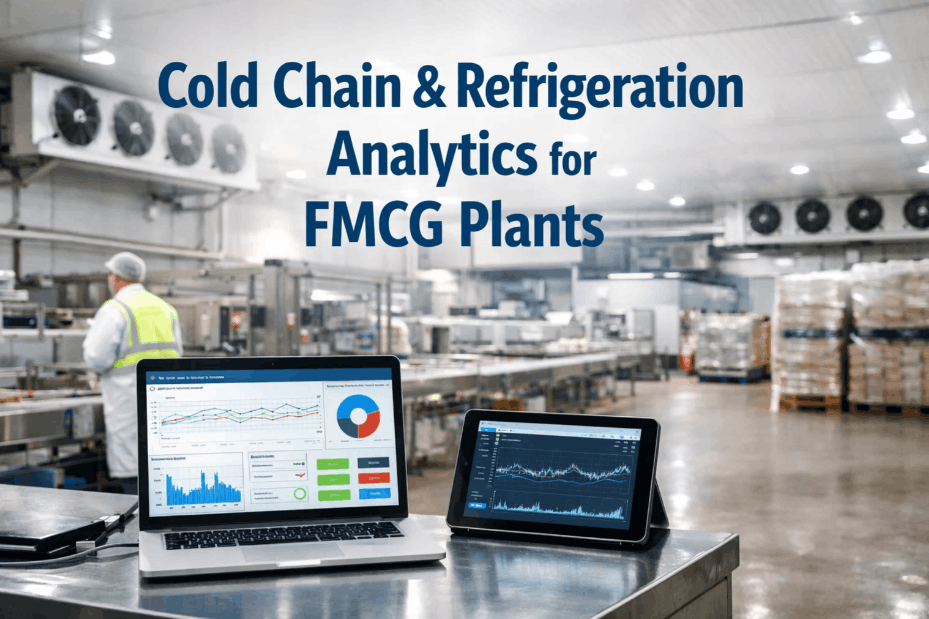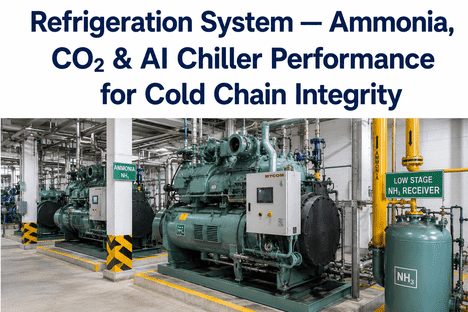
The global industrial refrigeration market exceeded USD 42 billion in 2025, with ammonia and CO2 systems representing the fastest-growing segment as food and beverage processors transition from synthetic refrigerants to natural alternatives. In FMCG cold chain operations, a single refrigeration system failure can compromise hundreds of thousands of kilograms of perishable product within hours and the average cost of a cold chain break event exceeds USD 350,000 in product loss, disposal fees, and brand damage. Maintenance managers responsible for ammonia, CO2, and chiller-based refrigeration systems face a persistent challenge: how to detect compressor degradation, refrigerant leaks, condenser fouling, and temperature zone drift before they create cold chain violations. The complexity of modern refrigeration systems with multiple compressors in parallel, variable-speed drives, electronic expansion valves, and dynamic load demands exceeds the capability of traditional thermostat-and-timer control. AI-driven refrigeration performance monitoring has emerged as the most effective response, converting the cold chain from a reactive temperature management system into a predictive integrity assurance platform that maintains product safety while reducing energy consumption by 15 to 25 percent.
Why Industrial Refrigeration Systems Need AI-Driven Cold Chain Monitoring
From ammonia compressor performance to cold storage temperature mapping — every link in the cold chain depends on data you cannot see with manual rounds.
Traditional refrigeration system management relies on periodic temperature logging, manual compressor inspections, and reactive response to high-temperature alarms. The problem is that these approaches miss the early indicators of system degradation — the subtle rise in compressor discharge temperature that signals valve wear, the slow accumulation of non-condensable gases that reduces heat exchanger efficiency, the gradual fouling of condenser coils that forces the system to work harder, and the creeping temperature drift in cold storage zones that precedes a full cold chain violation. Maintenance managers operating ammonia and CO2 refrigeration systems face particularly high stakes: an undetected ammonia leak can create a safety incident requiring evacuation, while a CO2 system failure during peak production can halt an entire processing line. The cold chain in modern FMCG operations spans multiple temperature zones from blast freezing at -40°C to chilled storage at 2-4°C each with its own equipment configuration and risk profile. AI refrigeration performance monitoring addresses these challenges by creating a continuous digital model of the entire refrigeration system, learning the normal operating patterns for each component, and detecting anomalies at the earliest possible moment typically 48 to 96 hours before a conventional alarm would trigger.
The Science of AI Refrigeration Performance Monitoring
How machine learning transforms raw sensor data into actionable cold chain intelligence for ammonia, CO2, and chiller systems.
AI refrigeration performance monitoring operates at the intersection of thermodynamics, mechanical engineering, and data science. The fundamental principle is that every refrigeration system component generates characteristic sensor signatures during normal operation — specific relationships between suction pressure, discharge pressure, temperature differentials, current draw, and ambient conditions. When a component begins to degrade, these signatures shift in subtle but measurable ways, often days or weeks before the degradation results in a performance failure or cold chain violation. The AI model learns the normal operating envelope for each refrigeration component across all operating conditions — low load, high load, summer ambient, winter ambient, defrost cycles, and product loading events — and continuously evaluates current readings against the expected range. When a measurement falls outside the predicted envelope, the system generates an early warning with the specific component identified and the probable failure mode indicated. This predictive capability transforms the maintenance manager's relationship with the refrigeration system: instead of reacting to temperature alarms and compressor trips, the team can plan interventions during scheduled maintenance windows, order parts before failures occur, and maintain continuous cold chain integrity without emergency shutdowns.
1. Ammonia Refrigeration Compressor Monitoring — Predicting Valve Wear, Bearing Failure, and Oil Degradation
Ammonia reciprocating and screw compressors represent the highest-value and highest-risk components in industrial refrigeration. A single screw compressor failure in a large cold storage facility can cost USD 80,000 to 150,000 in replacement parts and labour, plus the cost of lost product from the resulting temperature excursion. AI monitoring of ammonia compressors focuses on several key parameters that correlate with specific failure modes. Discharge temperature trending is among the most powerful indicators: a gradual increase in discharge temperature at constant suction pressure and compression ratio signals valve leakage or clearance pocket wear, typically detectable 4 to 7 days before the compressor begins to short-cycle or fail to pull down. Vibration spectrum analysis with AI pattern recognition detects early bearing degradation, eccentric rotor movement, and oil film instability — each with its own characteristic frequency signature that the AI model learns to distinguish from normal operating vibration. Oil condition monitoring, when combined with continuous oil pressure and temperature tracking, enables the AI to detect dilution, acid formation, or particle contamination before these conditions cause catastrophic bearing or rotor damage. For ammonia screw compressors, the AI model specifically monitors the relationship between slide valve position, discharge temperature, and oil differential pressure — a set of parameters that together provide an early indicator of rotor wear or capacity control mechanism degradation. The result is a refrigeration monitoring system that gives maintenance managers 5 to 10 days of advance warning for the most common ammonia compressor failure modes, enabling planned interventions during production off-hours rather than emergency shutdowns during peak cold chain demand.
2. CO2 Refrigeration System Monitoring — Transcritical Operation, Gas Cooler Performance, and Leak Detection
CO2 (R-744) refrigeration systems present unique monitoring challenges due to their operation at extremely high pressures — typically 80 to 130 bar in transcritical mode — and the complex behaviour of CO2 near its critical point (31°C, 73.8 bar). In transcritical operation, the system's efficiency depends critically on the gas cooler outlet temperature and pressure, with even small deviations causing significant COP reduction. AI monitoring of CO2 refrigeration systems continuously tracks the relationship between gas cooler approach temperature, ambient dry bulb temperature, and system high-side pressure, building a performance model that predicts optimal operating conditions for current ambient conditions. When the approach temperature begins to rise above the expected value for the current ambient condition, the AI detects the early onset of gas cooler fouling, non-condensable gas accumulation, or refrigerant charge loss. For CO2 booster systems — increasingly common in supermarket and cold storage applications — the AI monitors interstage pressure, flash gas bypass valve position, and medium-temperature compressor discharge conditions to detect degradation in the cascaded refrigeration stages. Leak detection in CO2 systems is particularly important because CO2 leaks (while non-toxic at typical concentrations) create asphyxiation risk in confined spaces and cause gradual system performance degradation. The AI model detects leaks by analysing pressure decay rates during standstill periods, comparing refrigerant mass flow estimates with expected values, and identifying the characteristic pressure-temperature signature of a CO2 system losing refrigerant charge — typically providing 24 to 48 hours of warning before the system triggers a low-pressure alarm.
3. Chiller Performance Monitoring — Centrifugal and Screw Chiller Optimisation for Process Cooling
Industrial chillers — whether centrifugal, screw, or reciprocating — provide critical process cooling for FMCG manufacturing operations including dairy processing, beverage production, meat processing, and confectionery manufacturing. A chiller performance degradation that raises chilled water temperature by just 2-3°C can force production rate reductions, cause product quality issues, or trigger full production line stops. AI chiller monitoring builds a digital performance model for each chiller, tracking the relationship between entering condenser water temperature, leaving chilled water temperature, refrigerant suction and discharge pressures, compressor current draw, and chiller load. The coefficient of performance (COP) is calculated continuously and compared against the expected COP for the current operating conditions — a COP deviation of more than 5 percent from the model prediction triggers an early warning with the most likely cause identified. For centrifugal chillers, the AI model specifically monitors surge margin — the relationship between compressor pressure ratio and inlet guide vane position — detecting conditions that could lead to surge cycles and impeller damage days before they become critical. For screw chillers, the AI tracks oil separator efficiency, slide valve position versus capacity, and motor current signature to detect refrigerant carryover, oil degradation, or capacity control mechanism wear. The chiller monitoring platform also includes condenser and evaporator fouling prediction, using heat transfer coefficient trending and approach temperature monitoring to schedule cleaning at the optimal interval — eliminating both unnecessary cleaning and the performance penalty of operating a fouled chiller. The combined result is a 12 to 20 percent improvement in chiller plant energy efficiency and a 40 to 60 percent reduction in unplanned chiller downtime.
4. Cold Storage Temperature Mapping — Multi-Zone Cold Chain Integrity with AI Pattern Recognition
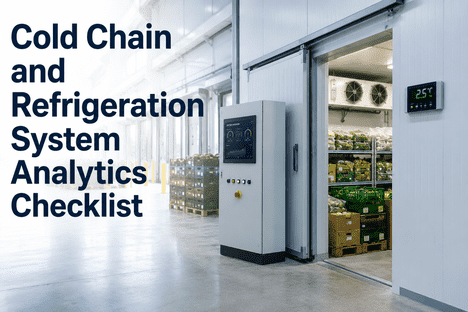
Cold storage facilities in FMCG operations typically include multiple temperature zones blast freezing (-30°C to -40°C), frozen storage (-18°C to -25°C), chilled storage (0°C to 4°C), and processing areas (10°C to 15°C) each with its own refrigeration load profile and compliance requirements. Traditional temperature monitoring relies on a limited number of fixed sensors that may not detect localised temperature excursions caused by door openings, evaporator fan failures, defrost cycles, or product loading patterns. AI-driven temperature mapping addresses this limitation by creating a spatial temperature model of each cold storage zone, correlating data from multiple wireless temperature sensors with door status, occupancy, ambient conditions, and refrigeration system operation. The AI model learns the normal temperature distribution pattern for each zone under various operating conditions — identifying, for example, that a specific corner of the frozen storage area typically runs 1.5°C warmer during summer afternoons when the loading dock door is in use. When the temperature pattern deviates from the expected distribution, the system generates a targeted warning indicating the likely cause: evaporator coil frost accumulation, door seal degradation, defrost heater failure, or insulation degradation. This spatial intelligence transforms cold chain management from a binary "within range / out of range" approach to a continuous integrity assessment that can detect a developing temperature excursion 2 to 6 hours before any single sensor reaches the alarm threshold — providing critical time for corrective action before product safety is compromised.
5. Refrigerant Leak Detection and Charge Optimisation — Preventing Refrigerant Loss and Environmental Impact
Ammonia and CO2 refrigerant leaks represent both safety risks and significant operating costs. An ammonia leak of just a few kilograms can force an evacuation, require HAZMAT response, and result in regulatory fines of USD 50,000 or more under EPA and OSHA regulations. CO2 leaks, while less toxic, can gradually degrade system performance by 15 to 25 percent as the system operates on a partial charge. AI refrigerant monitoring continuously evaluates system tightness by analysing multiple data streams: pressure decay rates during compressor-off periods (for both standstill and pumped-down conditions), liquid receiver level trends, subcooling and superheat relationships, and the mass balance between estimated refrigerant charge and expected charge based on system operating conditions. For ammonia systems, the AI model also monitors the ventilation system, ammonia-in-air detectors, and the relationship between mechanical room temperature and ammonia concentration levels to detect micro-leaks that might not trigger conventional alarms. For CO2 systems, the AI tracks the ratio of flash gas bypass flow to total refrigerant mass flow — a ratio that increases as the system loses charge providing early warning of gradual refrigerant loss. The charge optimisation capability extends beyond leak detection to active refrigerant management: the AI model continuously evaluates whether the current refrigerant charge is optimal for the current operating conditions, and can recommend charge adjustments to improve system COP by 5 to 8 percent while maintaining full capacity.
6. Compressor Sequencing and Capacity Control AI-Optimised Refrigeration System Operation
Most industrial refrigeration installations use multiple compressors in parallel with variable-speed capability, creating a complex optimisation problem: which compressors to run, at what speed, with what slide valve position, to meet the current cooling demand at minimum energy consumption while maintaining equipment longevity. Traditional compressor sequencing uses fixed pressure set points and simple rotation schedules that do not account for compressor-specific efficiency, oil management, or wear patterns. AI compressor sequencing continuously evaluates the efficiency of each compressor at various load points — considering motor efficiency, compressor volumetric efficiency, oil pump power consumption, and valve performance — and determines the optimal combination of compressors and speeds for the current cooling demand and ambient conditions. The AI model also incorporates compressor health data: if a compressor shows early signs of valve wear (elevated discharge temperature trend), the sequencing algorithm can reduce its load or use it only when needed, extending its operating life until the next planned maintenance intervention. For systems with variable-speed drives, the AI optimises the speed range to avoid operating at frequencies that cause resonant vibration or poor oil return — conditions that accelerate mechanical wear and reduce compressor life. The combined optimisation typically delivers a 12 to 18 percent reduction in refrigeration system energy consumption compared to conventional pressure-based sequencing, while simultaneously extending compressor service intervals by 15 to 25 percent.
7. Heat Exchanger Performance Monitoring — Condenser, Evaporator, and Intercooler Fouling Prediction
Heat exchangers — condensers, gas coolers, evaporators, intercoolers, and oil coolers — are the most maintenance-intensive components in industrial refrigeration systems. Fouling of heat exchanger surfaces from scale, biofilm, oil film, or frost accumulation gradually reduces heat transfer efficiency, forcing compressors to work harder and consume more energy. A fouled condenser, for example, can increase compressor power consumption by 15 to 25 percent while reducing system capacity by 10 to 15 percent — a double penalty that directly impacts operating costs and cold chain integrity. AI heat exchanger monitoring continuously calculates the overall heat transfer coefficient (U-value) for each heat exchanger, comparing the current value against the clean baseline and the expected value for current operating conditions. When the U-value trend shows a decline that exceeds the normal fouling rate for that specific heat exchanger, the AI generates a cleaning recommendation with the predicted energy cost savings from cleaning, enabling maintenance managers to prioritise interventions based on economic return. For evaporators, the AI monitors the approach temperature and air-side pressure drop to predict frost accumulation, transitioning from time-based defrost to demand-defrost operation that reduces defrost energy consumption by 20 to 30 percent while maintaining full evaporator capacity. For ammonia intercoolers and oil coolers, the AI tracks the temperature approach and pressure drop to detect fouling from oil degradation byproducts or corrosion products, scheduling cleaning before the fouling causes compressor discharge temperature to reach alarm limits.
8. Energy Optimisation and Demand Response — AI-Driven Refrigeration System Efficiency Management
Industrial refrigeration systems offer some of the largest energy saving opportunities in any FMCG facility, often representing 30 to 50 percent of total plant electricity consumption. The energy optimisation potential spans multiple control strategies: suction pressure floating (raising suction pressure when loads allow), condenser pressure floating (allowing discharge pressure to follow ambient conditions), compressor speed optimisation, defrost scheduling optimisation, and thermal energy storage integration. AI energy optimisation for refrigeration coordinates these strategies holistically, recognising that changes in one parameter affect others in complex ways. For example, raising suction pressure reduces compressor power consumption but increases evaporator size requirements and may affect product cooling rates — the AI model evaluates these trade-offs continuously, adjusting the suction pressure set point to the optimal value for current product load and ambient conditions. The AI also integrates with facility energy management systems and utility demand response programmes, pre-cooling cold storage zones before peak demand periods and reducing refrigeration load during high-tariff intervals. For ammonia systems with variable-speed compressor drives, the AI optimises the speed profile to minimise combined compressor and condenser fan energy consumption — a multi-variable optimisation problem that conventional control systems cannot solve in real time. The typical energy saving achieved through AI-driven refrigeration optimisation ranges from 12 to 22 percent of total refrigeration energy consumption, representing hundreds of thousands of dollars in annual operating cost savings for a medium-to-large FMCG facility.
The Business Case for AI Refrigeration Performance Monitoring
How AI-driven ammonia, CO2, and chiller monitoring delivers measurable financial returns across cold chain operations.
How iFactory Implements AI Refrigeration Monitoring
A step-by-step approach to deploying AI-driven ammonia, CO2, chiller, and cold storage monitoring in FMCG facilities.
Refrigeration Monitoring Use Cases Across FMCG Operations
How AI-driven ammonia, CO2, chiller, and cold storage monitoring delivers value across different FMCG processing applications.
Comparing Refrigeration Monitoring Approaches
How AI-driven performance monitoring compares with traditional and manual approaches to ammonia, CO2, and chiller management.
Selecting Your AI Refrigeration Monitoring Partner
Key considerations when evaluating AI-driven ammonia, CO2, chiller, and cold storage monitoring solutions.
Selecting the right AI refrigeration monitoring platform requires careful evaluation of the provider's domain expertise in industrial refrigeration, sensor integration capabilities, AI model accuracy, and ability to deliver measurable results. The most effective platforms combine deep refrigeration engineering knowledge with advanced machine learning capabilities — understanding both the thermodynamic fundamentals of ammonia and CO2 systems and the practical realities of FMCG cold chain operations. Look for providers with demonstrated experience across multiple refrigeration types (ammonia, CO2, chiller) and the ability to integrate with existing control systems including PLC, SCADA, BMS, and IoT sensor networks. The platform should offer configurable dashboards and alerts tailored to different user roles — maintenance manager, refrigeration engineer, cold chain compliance officer — with mobile access for off-hours monitoring. Model accuracy and validation methodology are critical: the provider should share independent validation data showing detection accuracy, false positive rates, and advance warning times for common refrigeration failure modes. Integration with existing maintenance management systems (CMMS/EAM) enables automated work order generation from AI-detected anomalies, closing the loop from detection to intervention. Finally, evaluate the provider's support model — including refrigeration domain expertise in their support team, response time commitments, and the process for continuous model retraining and optimisation as the refrigeration system and operating conditions evolve.