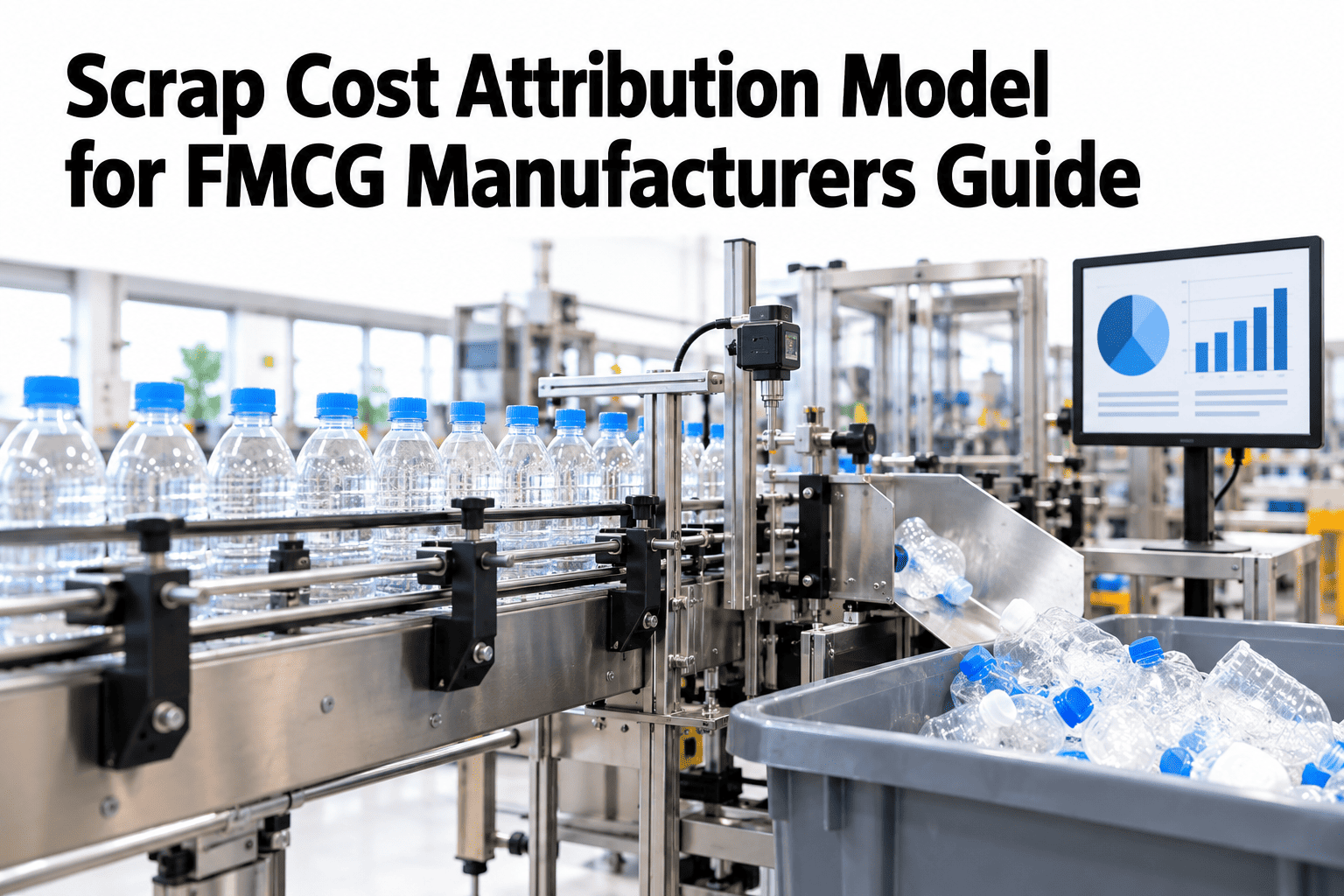
Most plants cost scrap by the material alone: a pound of product wasted times its raw material price. That number is real, and it's also only a fraction of what the scrap actually cost. Labor already spent making the unit, overhead allocated to that production time, and the opportunity cost of the line capacity used to make something that was thrown away all stack on top of the material figure, often doubling or tripling it. A full attribution model is what turns a scrap report into a number finance actually trusts. FMCG finance and operations leaders can build a full scrap cost stack with iFactory AI using their own numbers instead of the material-only estimate.
Material Cost Is Only the Bottom of the Stack
iFactory AI stacks material, labor, overhead and opportunity cost per unit of scrap, so the real dollar impact reaches the finance review.
Four Layers Most Scrap Reports Skip
Material
The raw ingredient or packaging cost of the scrapped unit, usually the only line already tracked.
Labor
Operator and line labor already spent producing the unit before it became scrap.
Overhead
A share of utilities, maintenance and facility cost allocated to that production time.
Opportunity cost
The line capacity spent making scrap instead of sellable product.
Where Each Layer Is Pulled From
| Layer | Typical Data Source | Common Gap |
|---|---|---|
| Material | Bill of materials, purchase cost | Usually already tracked accurately |
| Labor | Labor rate times time in process at point of scrap | Scrap point in the process rarely recorded |
| Overhead | Standard overhead allocation rate | Allocated at a plant average, not line-specific |
| Opportunity cost | Line rate times time lost to scrap production | Almost never included in a standard scrap report |
See Your Own Scrap Cost With All Four Layers Included
Bring a recent month of scrap data to a 30-minute session and build the full cost stack.
Material-Only vs Fully Stacked Cost
A Composite Scenario: The Scrap Line Finance Never Questioned
Picture a monthly scrap report showing a material cost that looks manageable, year after year, never prompting a serious improvement investment. A full attribution exercise reveals the same scrap, once labor, overhead and opportunity cost are added, costs several times the reported figure.
The improvement project that couldn't get budget approved against the material-only number clears the hurdle easily once the full stack is the number finance actually sees.
Where iFactory AI Fits
Captures scrap point in process
Records when in the production flow a unit became scrap, enabling labor cost allocation.
Applies line-specific overhead
Uses actual line overhead rather than a blended plant average.
Calculates opportunity cost
Converts lost line time into a dollar figure based on actual line rate.
Reports the full stack
Presents material, labor, overhead and opportunity cost together, by line and period.
Expert Review
A manufacturing cost accounting perspective, reviewed for accuracy before publication: the gap between a material-only scrap figure and a fully stacked one is almost always larger than finance expects, and it's usually the difference between a scrap reduction project that struggles to get funded and one that's an easy approval. Building the full stack on your own recent scrap data is worth doing before the next budget cycle.
Frequently Asked Questions
Why isn't material cost alone a good enough measure of scrap impact?
Material cost only reflects the raw ingredient or packaging value lost, ignoring the labor already spent producing the unit, the overhead allocated to that production time, and the line capacity used that could have made sellable product instead. These additional layers often represent a larger share of the true cost than material alone. See how much of your own scrap cost sits outside the material layer in a short session.
How is labor cost attributed to a specific unit of scrap?
This generally requires knowing where in the production process the unit became scrap, since labor cost accumulated up to that point is what's lost; a unit scrapped at the final packaging step carries more labor cost than one scrapped right after mixing. Capturing the scrap point accurately is what makes this calculation meaningful. Ask for a review of how scrap point data is currently captured on your lines.
How is opportunity cost calculated for scrap?
Opportunity cost is typically calculated as the line's production rate, in units or value per minute, multiplied by the time spent producing the scrapped units, representing what the line could have produced instead. This is the layer most frequently left out of a standard scrap report, despite often being significant. Explore an opportunity cost calculation for your specific line rates.
Should overhead be allocated at a plant average or a line-specific rate?
A line-specific rate generally produces a more accurate picture, since different lines can have meaningfully different overhead intensity, such as energy use or equipment maintenance cost, and a blended plant average can over- or under-state the true cost for any individual line. Try a comparison of plant-average versus line-specific overhead for your scrap.
How do we use a full scrap cost model to justify an improvement project?
Present the fully stacked cost, not just material, as the baseline the project is reducing, since this gives finance an accurate picture of what's at stake and makes the return on investment calculation more compelling and more honest. Many projects that struggle to clear a funding hurdle on material cost alone look very different once the full stack is used. Join a session that builds a funding case from your own full cost stack.
Give Finance the Scrap Number That's Actually Complete
iFactory AI stacks material, labor, overhead and opportunity cost per unit of scrap. Book a walkthrough with your own production data.