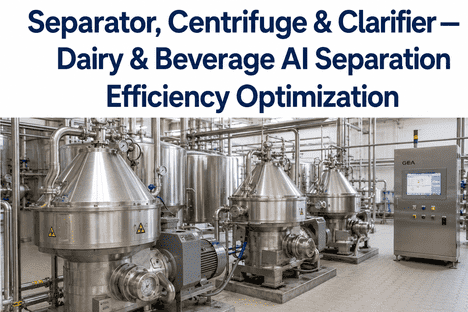
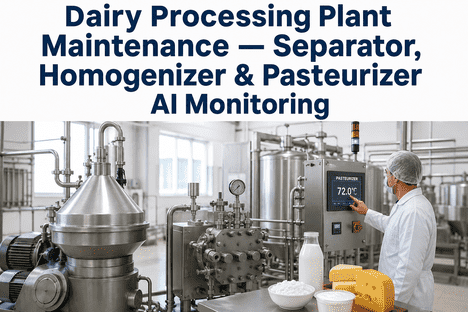
The global centrifugal separator market is projected to reach USD 11.2 billion by 2030, driven by demand for higher product recovery, stricter quality standards, and energy efficiency improvements across dairy, beverage, and food processing operations. In dairy processing alone, a typical cream separator processes over 40,000 litres per hour — and a 0.5 percent efficiency loss in that separation means more than USD 200,000 in lost product value annually per machine. Process engineers responsible for separators, centrifuges, and clarifiers face a persistent challenge: how to maintain optimal separation efficiency across varying feed quality, flow rates, and product types while minimising discharge losses, energy consumption, and unplanned maintenance. The efficiency of a centrifugal separator depends on the precise balance of bowl speed, differential speed, feed rate, and discharge timing — variables that shift with feed composition changes, nozzle wear, and bowl fouling. AI-driven separation efficiency optimisation has emerged as the most effective response, converting the separator from a fixed-parameter machine into an adaptive separation system that continuously adjusts its operating parameters to maximise product recovery and minimise waste.
Stop Losing Product to Inefficient Separation. Start Optimising Every Bowl, Nozzle, and Discharge Cycle in Real Time.
iFactory's AI separation optimisation platform monitors bowl speed, differential speed, feed rate, discharge timing, and product clarity — giving process engineers the tools to maximise product recovery and minimise energy waste across every separator, centrifuge, and clarifier in the processing line.
Annual product loss per separator from just 0.5% efficiency reduction — recovered product value that AI optimisation directly captures
15-22%
Energy reduction achieved by AI-optimised bowl speed and discharge timing compared to fixed-speed, timer-based separator operation
85%
Of nozzle blockages and bowl fouling events detected by AI vibration and pressure trend analysis before they cause a separation efficiency drop or unplanned stop
3-7%
Yield improvement in cream separation and juice clarification when AI optimises discharge timing and differential speed based on real-time feed quality measurements
The Three Performance Levers That Determine Separation Efficiency — and How AI Optimises Each One
Centrifugal separation efficiency is determined by the interaction of three primary levers — bowl speed, differential speed, and discharge timing — each of which must be continuously adjusted as feed composition, flow rate, and machine condition change. AI-driven optimisation closes the loop between these levers and real-time product quality measurements, converting the separator from a fixed-set-point machine into an adaptive separation system.
Bowl Speed Optimisation
Bowl speed directly determines the centrifugal force applied to the product — too slow and separation is incomplete, too fast and product shear damages quality while energy consumption rises exponentially. AI bowl speed optimisation models the relationship between bowl RPM, feed rate, and product density in real time, adjusting speed to maintain the target G-force while minimising energy input. When feed composition shifts — for example, when milk fat content varies between seasonal batches — the AI recalculates the optimal bowl speed within seconds, maintaining separation efficiency without operator intervention. Facilities using this approach report a 12 to 18 percent reduction in energy consumption per litre processed while maintaining or improving separation clarity.
Differential Speed Control
In decanter centrifuges and scroll discharge separators, the differential speed between the bowl and the scroll determines how quickly solids are conveyed to the discharge ports. Too high a differential speed causes excessive wear on the scroll and increases product moisture in the solids discharge. Too low a differential speed allows solids to accumulate, reducing separation volume and eventually causing blockage. AI differential speed control uses torque feedback from the scroll drive and pressure sensors at the solids discharge to continuously optimise the differential ratio. When the AI detects increasing scroll torque — indicating that solids are building up — it incrementally increases differential speed to clear the bowl before the accumulation affects separation efficiency, then reduces it again to minimise wear.
Discharge Timing Optimisation
In self-cleaning separators and clarifiers, the timing of solids discharge cycles is the single largest variable affecting both product loss and separation consistency. A discharge that occurs too late causes solids build-up that reduces separation efficiency and forces more frequent CIP cycles. A discharge that occurs too early expels usable product with the solids, directly reducing yield. AI discharge timing optimisation uses turbidity sensors on the liquid discharge line, pressure sensors in the solids holding space, and bowl vibration monitoring to predict the optimal discharge interval. When the AI detects the solids holding space approaching capacity — indicated by a characteristic pressure rise and vibration pattern — it triggers a discharge cycle timed to eject only the accumulated solids while retaining maximum product in the bowl. This precision typically recovers 3 to 5 percent of product that would otherwise be lost in timer-based discharge cycles.
The iFactory AI Separation Optimisation Stack — Four Layers From Feed to Discharge
iFactory's separation optimisation platform is built on four integrated layers that give process engineers continuous visibility and control over every variable that affects separation efficiency — from feed quality sensing at the inlet to product clarity measurement at the discharge.
L1
Sensing
Multi-Parameter Feed & Discharge Sensor Array
In-line sensors measure feed flow rate, density, temperature, and turbidity at the separator inlet plus product clarity, solids moisture, and discharge pressure at each outlet. Bowl vibration, scroll torque, bearing temperature, and motor current are monitored continuously. The sensing layer creates a real-time fingerprint of separation performance that captures the effect of every parameter change on product recovery and machine condition.
L2
Modelling
AI Separation Efficiency Engine
Machine learning models trained on historical separation data correlate feed parameters, machine settings, and product quality outcomes. The AI predicts the optimal bowl speed, differential speed, and discharge interval for the current feed conditions and updates its predictions as feed quality shifts. Each model is calibrated to the specific separator model, product type, and operating regime of the machine it controls.
L3
Control
Autonomous Optimisation Loop
The AI control layer writes optimised set points directly to the separator's PLC — adjusting bowl speed via VFD, differential speed via scroll drive control, and discharge timing via solenoid valve actuation. The autonomous loop makes micro-adjustments every 30 to 60 seconds, maintaining separation efficiency within ±0.3 percent of target while compensating for feed variations, nozzle wear, and fouling progression.
L4
Analytics
Separation Performance & Condition Dashboard
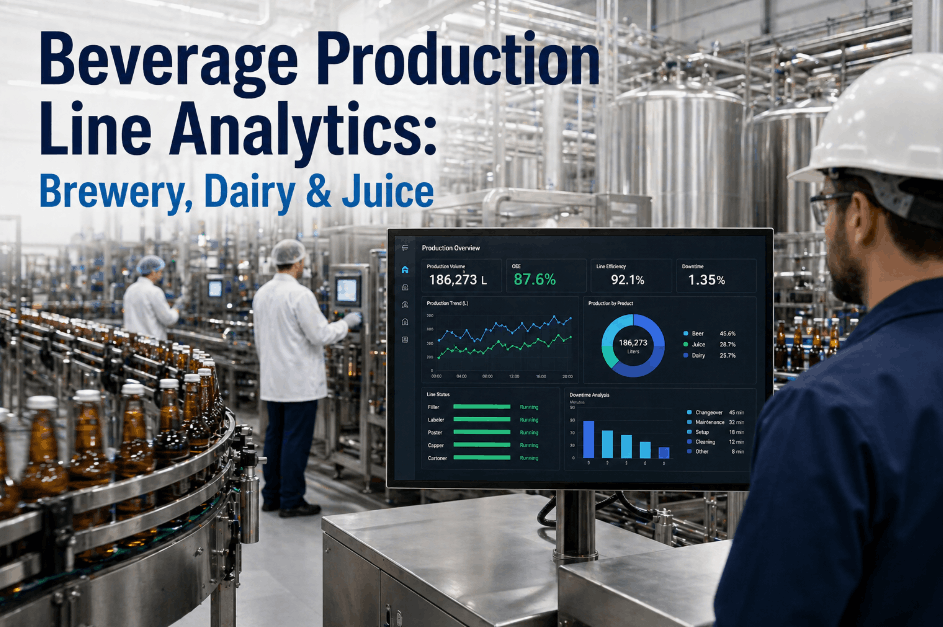
A unified dashboard presents process engineers with real-time separation efficiency, product recovery rate, energy consumption per litre, and machine condition indices. Trend analytics identify nozzle wear progression, bowl fouling accumulation, and bearing degradation weeks before they cause efficiency loss or unplanned stops. Comparative reports show efficiency and yield across product runs, shifts, and separator models.
Your Separator Runs on Fixed Set Points. iFactory Turns It Into an Adaptive Machine That Optimises Itself.
From feed sensing to AI efficiency modelling to autonomous bowl and discharge control — iFactory's separation optimisation platform gives process engineers the adaptive intelligence that turns fixed-parameter separators into yield-maximising machines.
Separation Efficiency Optimisation by Machine Type — Six Applications, Six AI Approaches
Different separation equipment types require different AI optimisation strategies. The table below maps six common separator, centrifuge, and clarifier types to the AI approach that delivers the highest yield and efficiency improvement for each — so process engineers can prioritise optimisation deployment based on which machines contribute most to product recovery and operating cost in their specific processing lines.
Machine Type
AI Optimisation Strategy
Primary Performance Outcome
Cream Separator
Dairy, milk, whey
Bowl speed modulation + discharge timing based on feed fat content. AI adjusts G-force to match cream fat percentage target and optimises discharge interval to minimise skim milk loss.
Cream fat content within ±0.1% of target with 98%+ fat recovery rate
Decanter Centrifuge
Juice, starch, vegetable oil
Differential speed optimisation via scroll torque feedback. AI adjusts conveyor differential to maintain optimal solids discharge dryness while preventing scroll wear and bowl blockage.
Solids moisture content reduced by 3-5% with 15% longer scroll life
Self-Cleaning Clarifier
Beverage, wine, beer
Discharge cycle prediction based on turbidity and bowl pressure. AI triggers discharge only when solids accumulation reaches the optimal ejection point, eliminating timer-based product loss.
Product loss in discharge reduced by 60-70% with consistent clarity
Nozzle Disc Separator
Starch, yeast, fish oil
Nozzle block detection via differential pressure and vibration. AI identifies partially blocked nozzles from the vibration signature and adjusts backflush timing to clear them before separation efficiency drops.
Nozzle block detection with 92% accuracy before efficiency loss occurs
Horizontal Decanter
Fruit juice, coconut milk
Feed rate and bowl speed co-optimisation. AI models the settling velocity of suspended solids under varying feed conditions and adjusts both feed rate and bowl speed to maintain clarity while maximising throughput.
Throughput increased by 8-12% with no reduction in discharge solids dryness
CIP Recovery Centrifuge
Cleaning chemical recovery
CIP effectiveness verification via discharge clarity trending. AI tracks the clarity of CIP discharge over successive cycles to detect when cleaning efficiency degrades and schedule deep cleaning before separation performance is affected.
CIP chemical recovery improved by 20% with separator availability above 98%
Process Engineer KPI Framework — Measuring Separation Optimisation Impact
The value of AI-driven separation optimisation is not measured in algorithm complexity or dashboard visualisations — it is measured in whether the system improves product recovery, reduces energy consumption, and extends separator service life. The KPIs below are designed for process engineers who need to track whether their separation optimisation investment is delivering measurable operational and financial returns.
Product Recovery
Separation efficiency — percentage of target component recovered in the product stream, measured continuously via in-line analysers and compared to AI-optimised baseline
Discharge loss per cycle — volume or value of product ejected during solids discharge, tracked per cycle and compared before and after AI discharge timing optimisation
Yield trend by product run — percentage yield improvement tracked per product type, season, and separator model to identify which combinations deliver the highest AI ROI
Energy Efficiency
Energy per litre processed — kWh consumed per litre of feed processed, tracked in real time with AI-optimised bowl speed compared to fixed-speed operation baseline
Bowl speed variance — standard deviation of bowl RPM around the AI-optimised set point, indicating control stability and wear-induced drift
CIP cycle frequency — number of CIP cycles triggered by solids accumulation vs. scheduled cycles, with AI optimisation reducing unnecessary cleaning events
Machine Reliability
Unplanned stops per separator — number of unplanned stops caused by nozzle block, bowl fouling, or bearing failure per quarter, with AI predictive alerts tracked separately
Bearing condition index — rolling trend of bearing vibration and temperature, with AI-predicted remaining useful life compared to scheduled replacement intervals
Nozzle wear trend — cumulative wear index per nozzle set, with AI predicting replacement timing based on differential pressure and vibration signature changes
Process Quality
Product clarity consistency — standard deviation of turbidity or clarity across the production run, tracking whether AI optimisation maintains consistent separation quality
CIP-to-production ratio — time spent in CIP cycle vs. productive separation, with AI optimisation reducing cleaning frequency by up to 30% through condition-based discharge
Changeover time per product — minutes required to transition from one product to another, with AI-assisted recipe recall reducing transition time by 20-30%
"
We operate fourteen separators across three dairy facilities producing cream, skim milk, and whey protein concentrates. Before iFactory's AI optimisation, every separator ran at fixed bowl speed with timer-based discharge cycles. Our cream fat content had a standard deviation of 0.3 percent across a shift — acceptable by industry standards, but every deviation below target was lost revenue and every deviation above was yield inefficiency. The AI platform changed our approach in three ways. First, it optimised bowl speed in real time based on feed fat content, reducing cream fat variance to 0.08 percent. Second, it switched discharge timing from fixed interval to condition-based, reducing product loss in discharge by 62 percent. Third, it detected nozzle wear patterns that our weekly inspections were missing — we found one separator operating at 83 percent efficiency for three weeks before we would have caught it. In the first year, the AI platform delivered a 4.2 percent yield improvement across our cream separation lines. At our production volume, that is USD 1.1 million in additional product revenue.
— Process Engineering Manager, Dairy Cooperative — 20 Years Dairy Processing
Conclusion
Separators, centrifuges, and clarifiers are among the most energy-intensive and yield-critical machines in dairy, beverage, and food processing lines — yet their bowl speed, differential speed, and discharge timing have historically been set once and adjusted only when visible quality issues appear. AI-driven separation optimisation changes this paradigm by continuously adjusting every performance lever in response to real-time feed quality measurements, machine condition data, and product clarity feedback. With yield improvements of 3 to 7 percent, energy reductions of 15 to 22 percent, and 85 percent of nozzle and fouling events detectable before they cause efficiency loss, the case for AI separation optimisation is proven across cream separators, decanter centrifuges, self-cleaning clarifiers, and every other centrifugal separation machine in the FMCG processing line.
iFactory's separation optimisation platform gives process engineers continuous visibility into bowl speed efficiency, discharge timing accuracy, and product recovery rates — all within a single AI-powered system that learns each separator's unique performance characteristics and optimises them continuously. Book a Demo to see how iFactory's separation efficiency modelling predicts and prevents yield loss, or Talk to an Expert to discuss which separator in your processing line will deliver the highest product recovery improvement from AI optimisation.
Frequently Asked Questions
iFactory's platform is designed to integrate with existing PLC and control systems via OPC UA, Modbus TCP, or Profinet — reading bowl speed, differential speed, feed flow, motor current, bearing temperature, and discharge valve status directly from the separator's existing sensors. For most modern separators with digital control systems, no additional sensors are required to begin AI optimisation. For older machines without in-line turbidity, density, or product clarity sensors, iFactory can recommend a minimal retrofit sensor package targeting the highest-value parameters for your specific product and process. The platform can begin generating value with as few as four parameters: bowl speed, feed flow rate, motor current, and discharge pressure. Talk to an Expert to review your current separator instrumentation and determine the fastest path to AI optimisation.
iFactory's AI platform stores the complete optimal parameter profile for every product that runs through each separator — including bowl speed, differential speed, discharge interval, and feed rate targets — and recalls them automatically when the product is selected for production. The AI also adapts the stored profile to current conditions, adjusting parameters to compensate for seasonal feed composition changes, ambient temperature effects, and machine wear progression since the last run of that product. Over time, the AI learns how each product's optimal parameters shift with feed variability and refines the profile with every production run. Process engineers report that changeover time is reduced by 20 to 30 percent with AI-assisted recipe recall and adaptation. Talk to an Expert to see how AI recipe management works across your specific product range.
Yes. iFactory's platform operates in three modes that the process engineer selects per machine. In advisory mode, the AI displays optimised parameter recommendations — such as "increase bowl speed by 75 RPM to improve cream fat recovery" — and the operator adjusts manually. In semi-autonomous mode, the AI adjusts parameters within a configurable range while requiring operator confirmation for changes beyond the safe operating envelope. In fully autonomous mode, the AI writes optimised set points directly to the PLC and adjusts all parameters in real time. Most facilities begin in advisory mode for 30 to 60 days while the process engineer validates the AI's recommendations against actual quality outcomes, then transition to semi-autonomous or fully autonomous mode as confidence in the model grows. Talk to an Expert to discuss which control mode is appropriate for your specific separators and quality requirements.
The AI model is trained on historical data that spans seasonal feed variations, supplier changes, and product transitions. It learns to distinguish between predictable seasonal patterns — such as the shift in milk fat content between summer and winter grazing — and unexpected feed quality events that require a different response. When the model detects a feed parameter combination it has not seen before, it uses its understanding of the underlying physics — feed density to bowl speed relationships, solids loading to discharge timing — to calculate the optimal parameter set for the novel condition. This adaptive capability means the AI does not require retraining for every seasonal shift or supplier change; it continuously updates its parameter recommendations based on the current feed signature. Book a Demo to see how the AI adapts to feed variation across a full seasonal production cycle.
The typical timeline from platform deployment to measurable yield improvement is 45 to 90 days. The first 30 days cover integration with the separator's PLC, AI model calibration using historical operating data, and establishment of baseline separation efficiency and yield metrics. During this period, the platform operates in advisory mode and the process engineer validates the AI's parameter recommendations against actual product quality measurements. By day 45, the AI model has sufficient data to begin making autonomous adjustments, and most installations show measurable improvement in separation efficiency and discharge loss reduction within this window. By day 90, the full optimisation loop — including bowl speed modulation, differential speed control, and condition-based discharge — is operational, and the process engineer has a complete dashboard of yield, energy, and reliability KPIs. Talk to an Expert to review deployment timelines and yield improvement case studies from similar dairy and beverage processing operations.
Every Separator Has an Optimal Operating Point. iFactory Finds It in Real Time and Holds It There.
From bowl speed optimisation to discharge timing precision to product clarity analytics — iFactory's separation optimisation platform gives process engineers the adaptive intelligence that turns fixed-parameter separators into yield-maximising, energy-minimising machines.