Solar & Renewable Energy Integration for FMCG Plants
By Seren on June 6, 2026
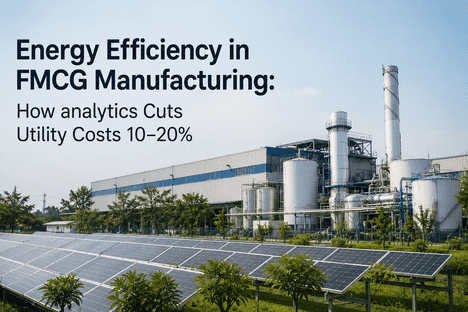
FMCG manufacturing plants consume energy 24 hours a day across refrigeration systems, processing lines, packaging equipment, HVAC, and lighting — making them among the most energy-intensive facilities in the industrial sector. Solar and renewable energy integration transforms this energy profile from a fixed operating cost to a managed, predictable, and increasingly self-generated resource. For an FMCG plant producing dairy, beverages, or packaged foods, a rooftop solar array combined with battery storage and intelligent energy management can reduce grid electricity consumption by 30-60%, hedge against volatile utility rates, and contribute directly to corporate net-zero commitments without disrupting production throughput. The transition requires more than installing panels and inverters. It requires analytics that monitor panel degradation, inverter efficiency, storage cycle life, and load-match optimisation — all managed as assets within a single operational platform.
Solar & Renewable Energy · FMCG Manufacturing 2026
Solar & Renewable Energy Integration for FMCG Plants
Panel analytics · Inverter monitoring · Battery storage management · Load-match optimisation · Energy trading readiness · All managed through iFactory's asset management and energy monitoring platform.
Grid electricity reduction achievable with rooftop solar + battery storage in FMCG plants
0.5-1%
Annual solar panel efficiency degradation tracked by iFactory analytics per manufacturer specification
$0.12
Average per-kWh savings when FMCG plants shift load to self-generated solar vs grid purchase
3-5 yr
Payback period for solar + storage integration in mid-to-large FMCG manufacturing facilities
Why FMCG Plants Need Dedicated Solar and Renewable Energy Analytics
Solar panel efficiency does not remain constant over a 25-year system life. Manufacturer degradation warranties guarantee 80-92% of rated capacity at year 25, but actual degradation varies by panel quality, installation angle, ambient temperature, soiling frequency, and inverter matching. An FMCG plant operating a 2 MW rooftop array loses $6,000 to $18,000 per year in foregone generation for every 0.5% of additional unmonitored degradation. Inverter efficiency, battery round-trip loss, and load-match error compound these losses. Without panel-level analytics, a plant manager sees only the monthly utility bill reduction — not the divergence between actual and expected generation that signals a cleaning need, a failing microinverter, or a string-level mismatch. iFactory's energy monitoring and asset management platform registers every solar panel, inverter, battery module, and energy meter as a managed asset with generation tracking, degradation trending, and maintenance scheduling — giving FMCG plants visibility into every kilowatt-hour their renewable infrastructure should be producing versus what it is actually delivering.
FMCG Solar & Renewable Energy Analytics — The iFactory Monitoring Architecture
Sensing
Energy Data Layer
Solar generation · inverter data · battery SOC · consumption meters · weather
Three Critical Solar and Renewable Energy Asset Categories iFactory Monitors and Manages
01
Solar Panel Array Performance & Degradation Analytics
A 1.5 MW rooftop solar array on an FMCG beverage plant contains approximately 3,750 panels across multiple strings, each feeding into string inverters or microinverters. Panel performance varies by string due to partial shading from adjacent equipment, soiling accumulation from manufacturing emissions, temperature coefficient effects during peak summer production hours, and connector degradation over time. iFactory registers every panel string as an asset group with expected generation curves derived from manufacturer STC ratings, site-specific irradiance data, and historical production. When actual generation diverges from expected by more than 5% over a rolling 7-day window, the platform flags the string for inspection and generates a work order for panel cleaning, connector inspection, or IR thermography. Over a 25-year system life, recovering just 2% of lost generation through early degradation detection pays for the analytics platform multiple times over.
Inverters are the single point of failure with the highest financial impact in any solar installation. A string inverter failure stops generation for all panels on that string — potentially 20-30 kW of lost capacity per inverter during peak sun hours. In an FMCG plant running two production shifts, a single inverter failure during a summer production day can cost $150-250 in lost generation per day, plus the emergency service call. iFactory monitors inverter efficiency in real time by comparing DC input to AC output, tracking thermal performance, fan speed, and MPPT tracking accuracy. When efficiency drops below 96% or thermal cycling exceeds design specifications, the platform generates a predictive alert 1-4 weeks before inverter failure, enabling planned replacement during scheduled maintenance windows. The same analytics identify underperforming MPPT channels caused by string mismatch, partial shading, or connector faults before they trigger inverter derating.
Battery Energy Storage Health & Dispatch Optimisation
Battery storage enables FMCG plants to shift solar generation to evening production hours, arbitrage time-of-use rates, and provide backup power for critical refrigeration and processing loads. Each battery module has a finite cycle life — typically 4,000-10,000 cycles at 80% depth of discharge — and cycle life is directly impacted by operating temperature, charge/discharge rate, and average state of charge. iFactory tracks every battery module as a managed asset with cycle counters, depth-of-discharge histograms, round-trip efficiency trends, and thermal data. When a module's round-trip efficiency drops below 85% or cell imbalance exceeds manufacturer thresholds, the platform schedules a balance cycle or flags the module for warranty assessment. The same data feeds iFactory's load-match optimisation engine, which coordinates solar generation forecasts, production schedules, and utility rate periods to dispatch stored energy at maximum financial value — typically 15-25% higher ROI than fixed schedule dispatch.
What FMCG Plants Achieve with Integrated Solar and Renewable Energy Analytics
Documented FMCG manufacturing deployments confirm that integrated solar and renewable energy analytics, combined with automated asset management, delivers measurable financial and operational outcomes. A 400,000 sq ft dairy processing plant in the Midwest installed a 2.8 MW rooftop solar array with 4 MWh of battery storage and deployed iFactory's energy monitoring and asset management platform across the entire renewable energy infrastructure. Within the first 12 months, the plant achieved a 47% reduction in grid electricity consumption, recovered 3.2% of expected solar generation that was being lost to undetected soiling and string mismatch, and reduced inverter-related downtime by 82% through predictive alerts. Annual energy savings totalled $318,000 against a renewable infrastructure investment of $3.2 million — representing a 9.9% year-one return before tax incentives. A second deployment across three FMCG beverage production sites with combined 6.5 MW of solar capacity eliminated 1,840 metric tons of CO2 emissions in the first 18 months while reducing aggregate energy costs by 22%.
Renewable Asset
iFactory Monitoring Method
iFactory Output
Operational Impact
Solar panels (per string)
Generation vs expected curve · soiling loss
Cleaning WO · string mismatch alert
Recovers 2-5% lost generation
Inverters
DC/AC efficiency · thermal · MPPT tracking
Failure prediction · service WO
82% reduction in unplanned inverter downtime
Battery storage modules
Cycle count · round-trip eff · thermal
Balance cycle · warranty flag · RUL
Extends module life 15-20%
Energy meters
Consumption · generation · grid import/export
Cost allocation · carbon reporting
Verifiable scope 2 reduction data
Load controllers
Production schedule · solar forecast · rates
Auto-dispatch optimisation
15-25% higher storage ROI
iFactory AI Use Cases for Solar and Renewable Energy in FMCG
Solar PdM
Solar Panel Array Performance Analytics & Automated Maintenance
Continuous
iFactory registers every solar panel string and inverter as a managed asset with manufacturer specifications, warranty terms, and expected generation curves. The platform ingests generation data from inverters, string-level current sensors, and weather station data to calculate expected vs actual generation in 15-minute intervals. When a string underperforms by more than 5% over a rolling 7-day window, iFactory evaluates potential causes — soiling, partial shading, connector degradation, or microinverter failure — and generates a priority-ranked work order with the suspected failure mode and recommended inspection method. Panel cleaning schedules are optimised based on soiling rate analytics rather than fixed calendar intervals, reducing cleaning costs by 30-40% while maintaining generation within 2% of clean-panel baseline.
Battery Storage Health Analytics & Dispatch Optimisation
Continuous
iFactory tracks every battery module as a managed asset with cycle life counters, depth-of-discharge histograms, round-trip efficiency trends, and thermal operating data. The battery health model calculates remaining useful life based on actual operating conditions versus manufacturer warranty assumptions — enabling FMCG plants to validate warranty claims and optimise dispatch strategy for maximum cycle life. The load-match optimisation engine coordinates solar generation forecasts, production schedule data from the MES, utility time-of-use rate periods, and battery state of charge to automatically dispatch stored energy at maximum financial value. In documented deployments, this optimised dispatch increases battery storage ROI by 15-25% compared to fixed schedule or manual dispatch approaches while maintaining production continuity.
ROI Improvement15-25% vs fixed schedule dispatch
CoverageModule-level tracking across entire BESS
Energy Ops
Energy Cost Allocation & Carbon Reporting for Renewable-Powered FMCG Plants
Continuous
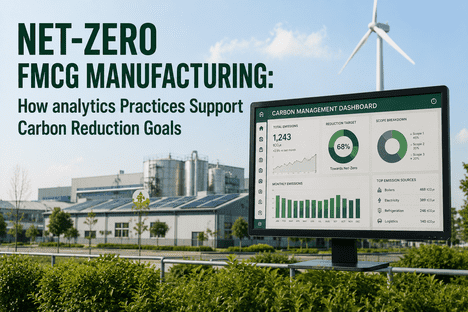
FMCG plants with on-site solar and storage generate a complex energy mix: self-consumed solar, stored solar discharged during peak hours, and grid import during low-solar periods. iFactory allocates every kilowatt-hour consumed across production lines, refrigeration systems, and facility loads — attributing each kWh to its generation source with timestamps and carbon intensity factors. The platform generates verifiable scope 2 emissions reports aligned with GHG Protocol standards, using actual generation data rather than grid average factors. For FMCG companies with net-zero commitments, this granular attribution enables accurate carbon accounting, supports renewable energy certificate retirement, and provides the data required for CDP, SBTi, and EcoVadis reporting — all generated automatically from the same asset register that manages panel cleaning and inverter PM schedules.
ReportingGHG Protocol · CDP · SBTi · EcoVadis
AttributionPer-line · per-process · per-source
What iFactory AI Delivers for Solar and Renewable Energy in FMCG
30-60%
Grid electricity reduction with solar + storage + analytics
Across documented FMCG manufacturing deployments
82%
Reduction in unplanned inverter downtime
Predictive alerts enable planned service
$318K
Annual energy savings in dairy plant deployment
2.8 MW solar + 4 MWh storage + analytics
15-25%
Higher battery storage ROI with optimised dispatch
vs fixed schedule or manual dispatch
The Shift Handover Gap in Energy Operations — And How iFactory Closes It
The American Fuel & Petrochemical Manufacturers report that over 40% of industrial incidents occur during shift handover periods — despite accounting for less than 5% of operating time. In FMCG plants with on-site renewable energy systems, this risk applies equally to energy operations. When an incoming shift supervisor does not know that inverter 3 on the south array dropped to 94% efficiency during the previous shift, or that battery module 12 triggered a cell imbalance alert at 3 AM, that developing fault continues unaddressed for another 8-12 hours — costing generation and accelerating battery degradation.
iFactory's AI-powered digital shift logbook closes this gap. The platform analyses energy system data and shift entries to auto-generate shift summaries highlighting the top 5 critical items for incoming crews — solar generation anomalies, inverter efficiency alerts, battery health flags, pending energy-related work orders, and recurring fault patterns. Every incoming operations crew starts with a structured briefing that ensures no critical renewable energy equipment issue falls between shifts. Most FMCG plants go live with iFactory's digital shift logbook in 1-2 weeks, with full energy monitoring and CMMS integration completing in 3-5 days.
FAQ
iFactory integrates with inverter manufacturer APIs from SolarEdge, Enphase, Fronius, SMA, and Huawei — plus string-level current sensors, pyranometer or reference cell irradiance data, and on-site weather stations. For plants without existing monitoring infrastructure, iFactory connects to utility-grade revenue meters at the point of common coupling and production meters on each manufacturing line. The platform is an AI software intelligence layer that connects to your existing renewable energy monitoring infrastructure via Modbus TCP, SunSpec, REST API, and OPC UA.
iFactory's load-match optimisation engine combines three data streams to forecast solar generation and optimise storage dispatch: numerical weather prediction models providing 72-hour irradiance forecasts at 15-minute resolution, historical generation curves calibrated to each panel string's actual degradation trend, and production schedule data from the plant MES or ERP system. The engine runs a constrained optimisation every 30 minutes that maximises self-consumption of solar generation while minimising peak demand charges and time-of-use energy costs. The dispatch schedule is automatically adjusted when cloud cover or production schedule changes are detected, ensuring that battery storage is always deployed at the highest-value available window.
Yes. iFactory is designed for multi-site FMCG manufacturing operations with centralised energy management. Each plant's solar array, inverters, battery storage, and energy meters are registered as asset groups within the same platform, with site-level dashboards for local operations teams and an aggregate portfolio view for corporate energy managers. The platform rolls up generation, consumption, cost, and carbon data across all sites into a single portfolio report — enabling FMCG companies to track renewable energy penetration, grid independence, and net-zero progress at corporate level while individual plant teams manage panel cleaning, inverter maintenance, and storage dispatch locally. Multi-site deployment typically completes in 4-8 weeks with dedicated implementation support.
Solar panel and battery storage warranties require documented proof of operating conditions, maintenance history, and failure timing. iFactory maintains a complete audit trail for every renewable energy asset — including daily generation logs, inverter efficiency records, battery cycle counters, thermal operating data, and all maintenance work orders. When a panel or battery module underperforms relative to warranty specifications, iFactory generates a warranty claim package containing the asset's full operating history, performance deviation charts, and maintenance records — eliminating the documentation burden that causes many legitimate warranty claims to be denied or delayed. For solar panel linear power warranties, the platform tracks annual degradation against the manufacturer's warranted curve and automatically flags any panel string that exceeds the warranted degradation rate.
iFactory deploys in 1-2 weeks against pre-built templates covering solar panel strings, inverters, battery storage, energy meters, and production load controllers. Template configuration and asset registration takes 2-3 days. Integration with inverter APIs, weather data sources, and existing energy meters takes 3-5 days. Operator training and pilot testing takes 1-2 days. Initial generation baselines and degradation curves are calibrated using 3-6 months of historical inverter data already available in most solar monitoring platforms. Full enterprise rollout across multiple FMCG plant sites completes in 4-8 weeks with dedicated implementation support. Book a Demo to discuss your deployment timeline.
Deploy iFactory AI for Solar & Renewable Energy Analytics in FMCG Plants
AI-powered energy monitoring and asset management platform connecting solar arrays, inverters, battery storage, and production loads — with real-time generation analytics, inverter efficiency tracking, battery health monitoring, load-match optimisation, and automated carbon reporting for FMCG manufacturing operations.