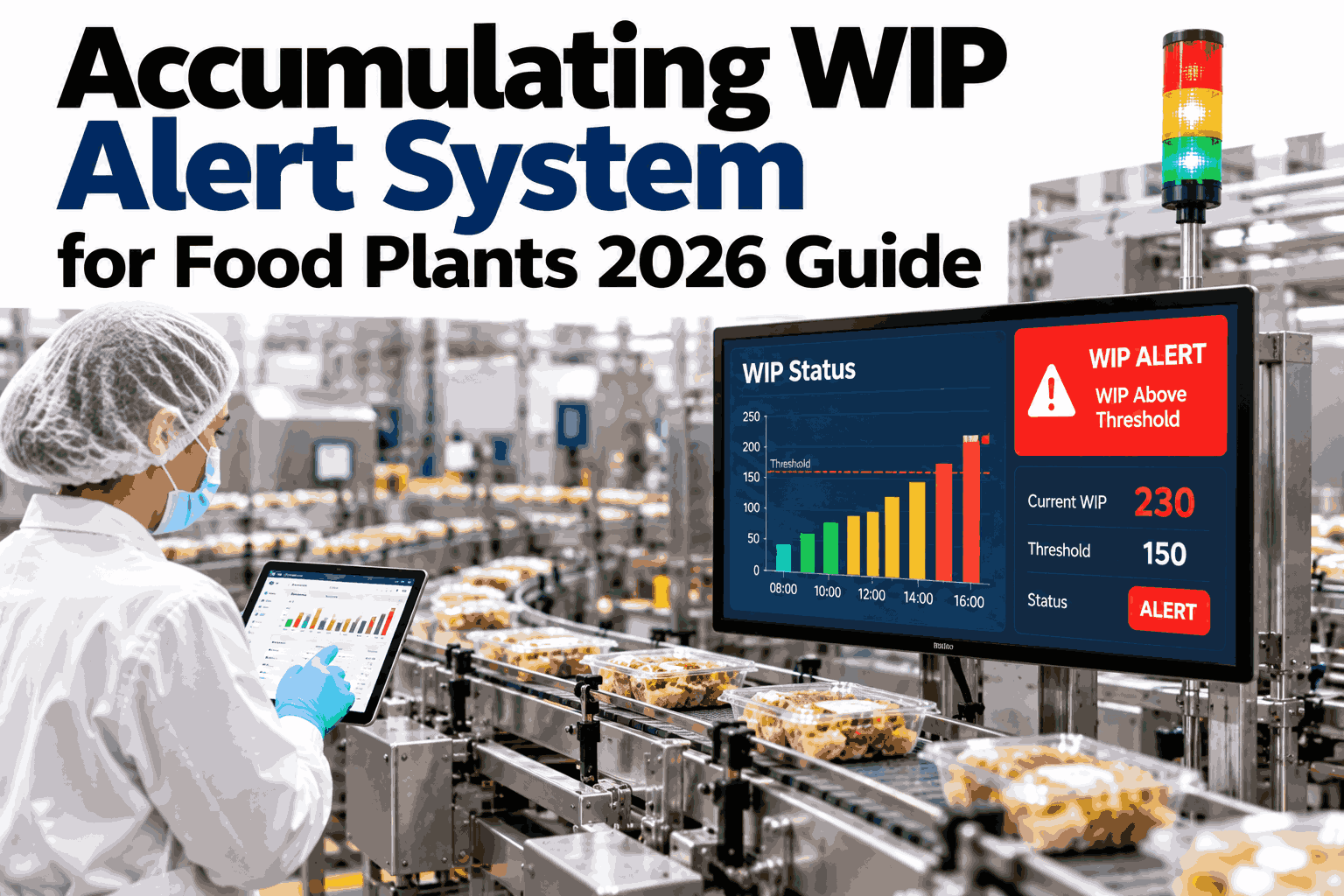
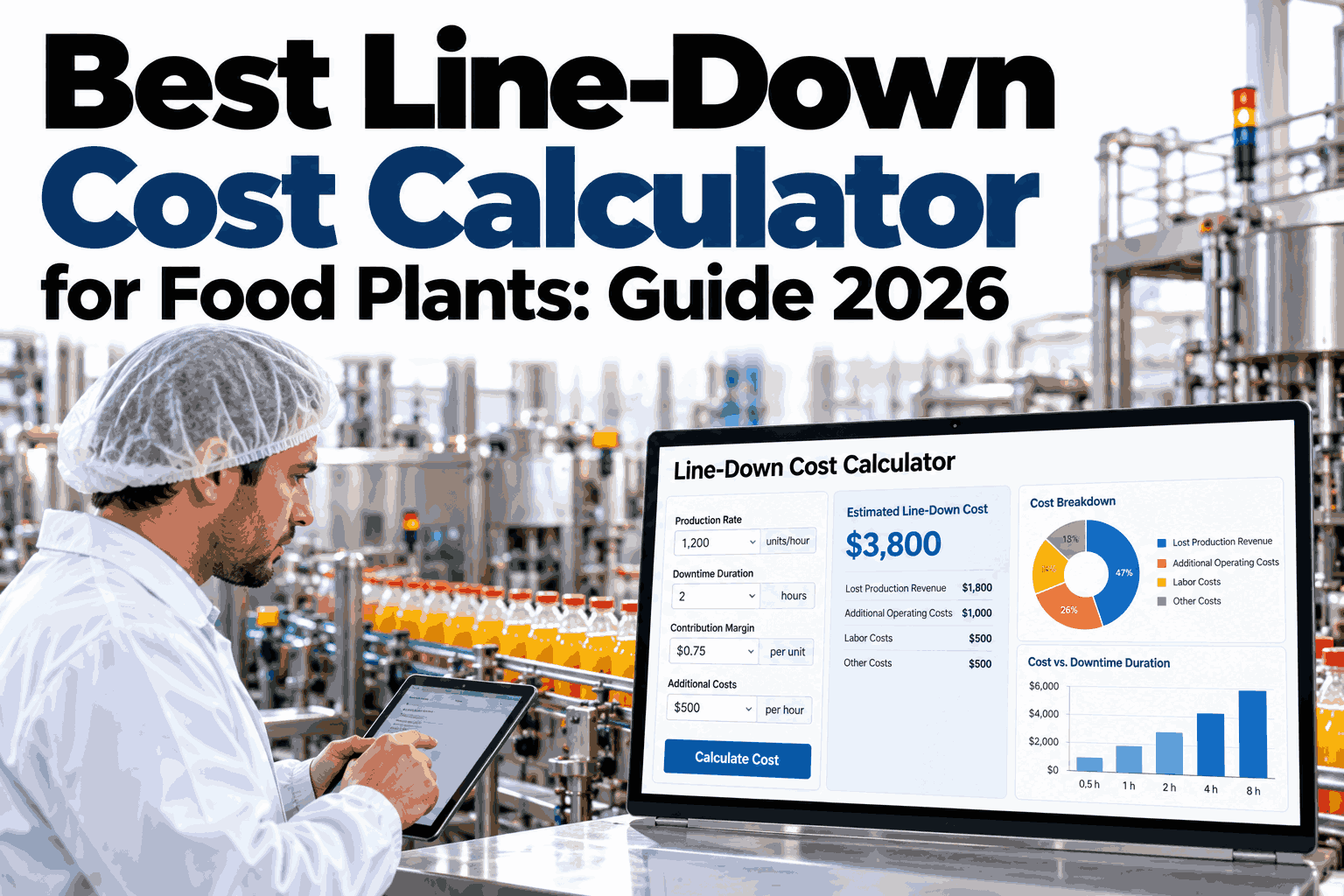
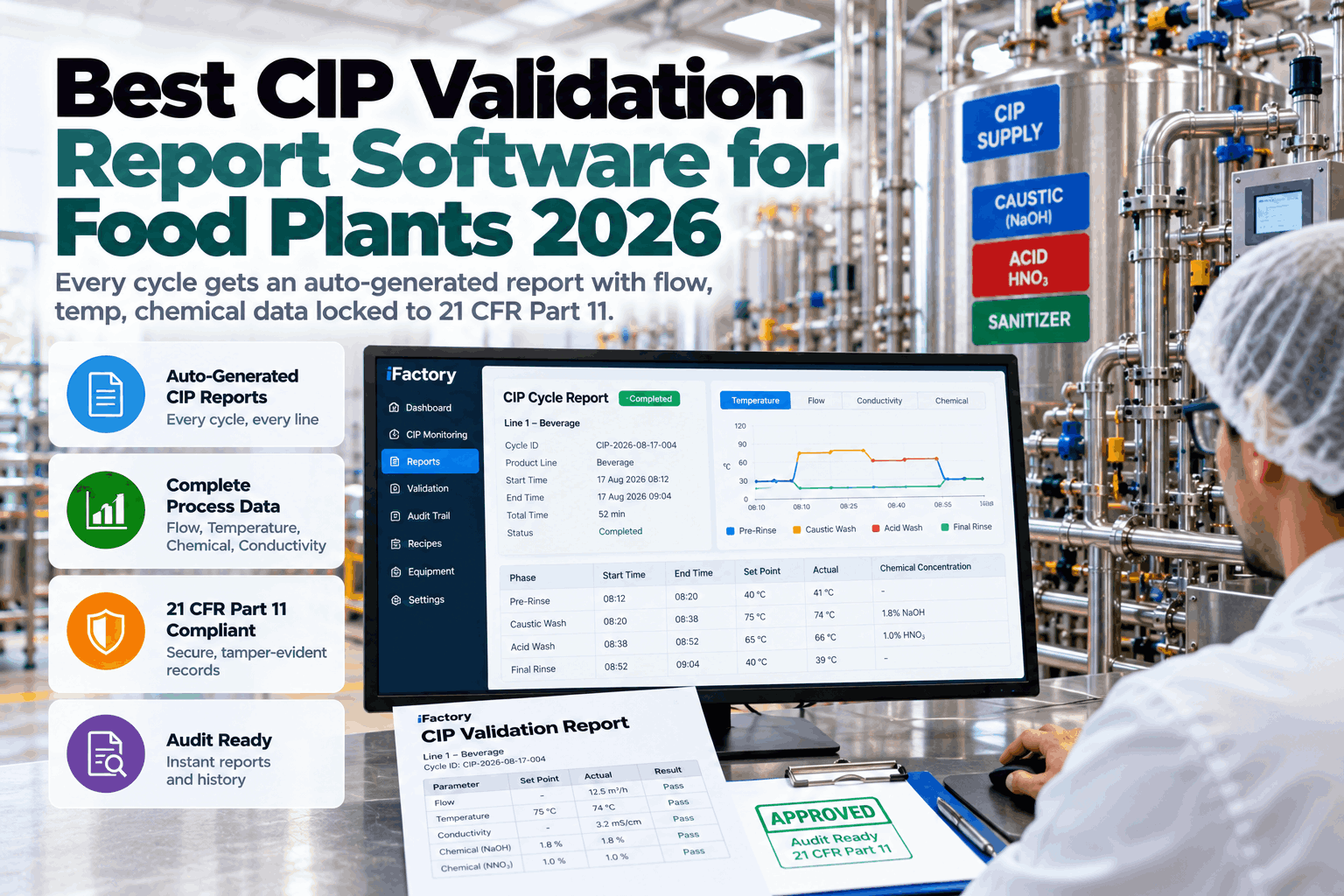
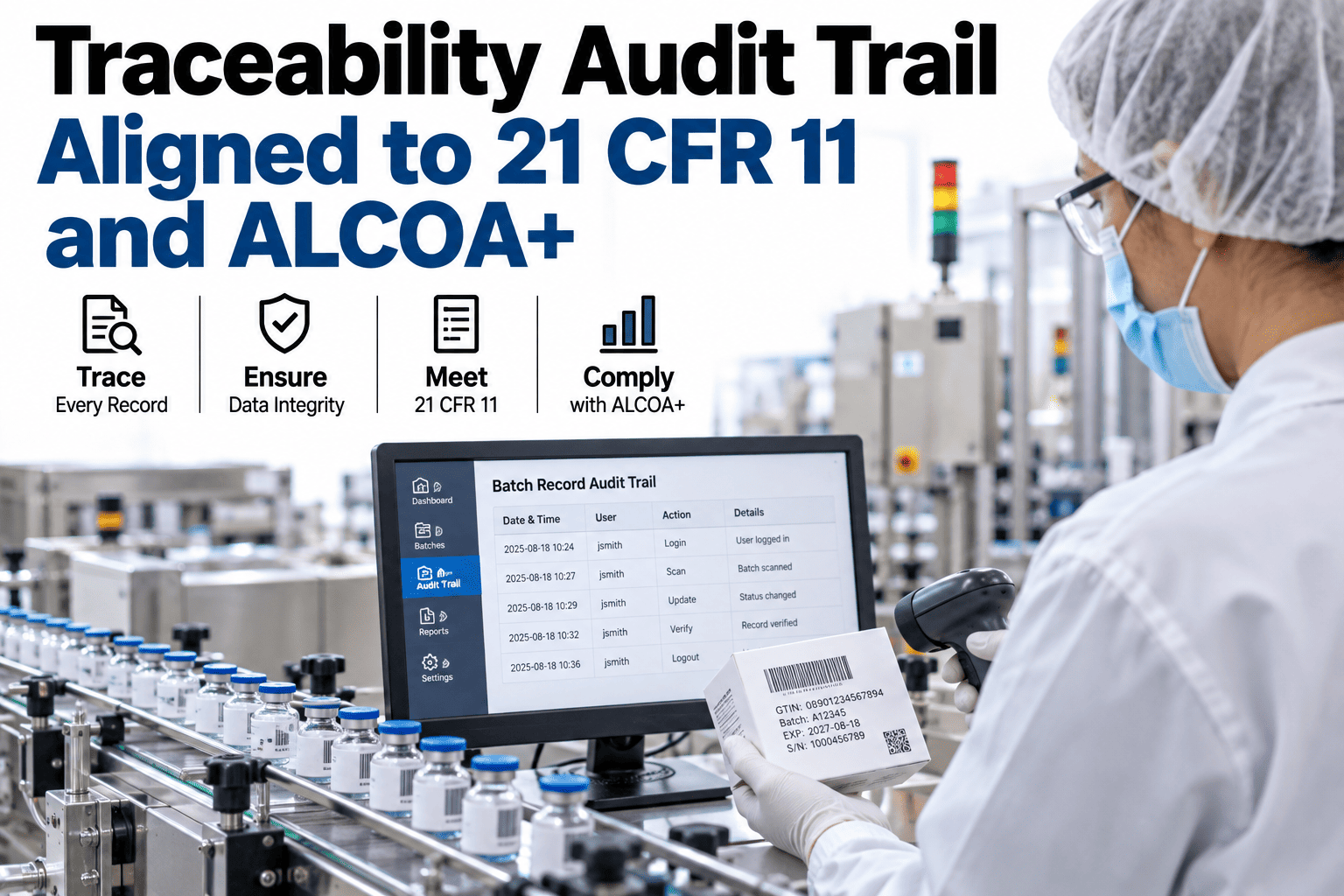
Rising product levels in a line accumulator are the earliest warning sign of a downstream slowdown, yet most food plants only react when the buffer hits its physical limit and the entire line faults out. An accumulating WIP alert system tracks the rate of buffer fill rather than just the static level, giving operators minutes of advance warning instead of seconds. Upgrading your line visibility to catch these early accumulation signals prevents micro-stops from cascading into full production halts, and you can map your accumulator alert thresholds with our team to prevent future buildup.
2026 WIP Alert Guide
Accumulating WIP Alert System for Food Plants
How tracking the rate of accumulator fill instead of static buffer levels gives food plants early downstream slowdown warnings and prevents full line crashes.
12xFaster Reaction
40%Less Line Downtime
98%Alert Accuracy
The 90 percent trap
Why Static Buffer Alarms Fail Food Plants
Most plant SCADA systems trigger an accumulator alarm only when the buffer reaches ninety percent capacity. By that point, the downstream issue has already cascaded and operators have almost no time to intervene.
01
Too Late to React
At ninety percent full, product is mere seconds from hitting the physical limit. Operators are forced into emergency mode rather than controlled adjustment.
02
Ignores Fill Speed
A buffer at sixty percent filling at ten percent per second is a critical emergency. A buffer at eighty percent draining is fine. Static alarms cannot tell the difference.
03
Cascading Line Stops
When the accumulator faults, upstream machines starve and downstream machines choke. One missed slowdown turns into a full line restart requiring dozens of minutes of recovery.
Velocity over level
Tracking the Rate of Accumulation
The key to early WIP alerts is monitoring the velocity of buffer change. Accumulation rate exposes the severity of the downstream blockage long before the physical buffer capacity is threatened.
Slow Fill Rate
Low Threat
Moderate Fill Rate
Warning
If an accumulator is filling at five percent per second, the system knows the line will lock out in twelve seconds even if the current level is only forty percent. Calculate your critical fill rates with iFactory AI specialists.
Stop Guessing When Downstream Issues Will Cascade
Deploy accumulation rate alerts on your most bottlenecked food lines and give operators the lead time they need to prevent full line crashes.
Alert anatomy
How a 2026 WIP Alert System Works
Modern WIP alert systems layer rate-of-change logic over traditional level monitoring to create graduated responses that match the severity of the accumulation event.
1
High-frequency sensor polling captures the exact product count or volume entering and exiting the accumulator every second, establishing the baseline flow differential.
2
The system calculates the net accumulation rate by subtracting the outflow speed from the inflow speed, determining the exact velocity of buffer fill.
3
Dynamic thresholds compare the current rate against the remaining buffer capacity. If the time-to-full drops below the operator reaction window, an early warning fires.
4
The alert routes to the nearest operator station with the exact downstream machine causing the slowdown, eliminating diagnostic search time and enabling immediate corrective action.
Reaction time impact
Seconds Saved Versus Product Recovered
The faster operators respond to an accumulating buffer, the less product is damaged or rejected, and the higher the line overall equipment effectiveness remains during the disruption.
| Accumulator Size |
Fill Rate |
Traditional Alarm React Time |
Rate Alert React Time |
Product Saved per Event |
| Small Buffer (30 sec) |
Fast (10% per sec) |
3 seconds |
15 seconds |
12 kg |
| Medium Buffer (60 sec) |
Moderate (5% per sec) |
6 seconds |
30 seconds |
25 kg |
| Large Buffer (120 sec) |
Slow (2% per sec) |
12 seconds |
60 seconds |
40 kg |
Early alerts transform accumulators from panic triggers into strategic time buffers that actually give operators the runway needed to resolve downstream micro-stops gracefully.
Line compatibility
Food Lines That Benefit Most From WIP Alerts
Certain food production environments are far more susceptible to cascading line stops due to the nature of their product handling and buffer design.
High-Speed Packaging
Flow wrappers and cartoners running over two hundred units per minute have tiny accumulators. A one-second downstream jam instantly fills the buffer, making rate alerts critical for preventing upstream starving.
Thermal Processing
Lines feeding ovens or freezers cannot stop without ruining product quality. Accumulation alerts must trigger product diversion routes long before the buffer threatens to back up into the heat seal zone.
Bottling and Filling
Liquid filling lines use surge tanks as buffers. Overfilling a surge tank causes messy spills and safety hazards. Rate-of-change monitoring prevents overflow events before they happen.
Conveyor Merging
Multiple upstream lanes merging into a single downstream lane create natural bottlenecks. Smart WIP alerts detect when one lane begins dominating the merge and throttles it automatically.
The iFactory advantage
How iFactory AI Tracks Accumulator Health
iFactory AI ingests high-speed accumulator data directly from line PLCs to calculate real-time fill velocities and project time-to-full warnings with absolute precision.
Data Polling
1-Second
Captures inflow and outflow deltas fast enough to detect micro-accumulation trends that standard SCADA scans miss entirely.
Alert Latency
Under 200ms
Pushes rate warnings to operator dashboards the moment the time-to-full threshold crosses the configured reaction window.
Root Cause Link
Auto-Mapped
Identifies the specific downstream machine causing the slowdown and attaches it directly to the alert payload for instant triage.
Auto-Throttle
Closed Loop
Optionally writes speed limits back to the upstream PLC to slow the inflow and prevent the accumulator from hitting its physical limit.
Frequently asked questions
WIP Alert System Questions for Food Plants
Do we need new sensors to track accumulation rates?
Most food plants already have the necessary sensors in place. iFactory AI typically uses existing encoder counts, photo-eye inputs, or load cell data from the line PLCs to calculate the accumulation velocity without requiring physical hardware upgrades.
Ask support about your specific hardware compatibility.
How is this different from the alarms already in our SCADA?
SCADA alarms trigger on static thresholds like buffer level reaching ninety percent. iFactory AI triggers on the rate of change, alerting you when the buffer will fill in thirty seconds regardless of its current level, giving operators vastly more reaction time.
See the difference in a live demo on your line data.
Can the system automatically slow down the upstream machine?
Yes, in controlled scenarios iFactory AI can write a reduced speed command back to the upstream PLC to throttle product inflow, preventing the accumulator from crashing while the downstream blockage is cleared by operators.
Discuss closed-loop control options with our engineers.
What lines should we prioritize for WIP alert deployment?
Prioritize lines with the highest speed differentials between upstream and downstream machines, and lines feeding thermal processes like ovens or freezers where an unscheduled stop ruins the entire product batch in the buffer.
Get a line prioritization assessment from our team.
How long does it take to deploy accumulation rate monitoring?
If PLC data is already accessible via OPC-UA or a similar protocol, iFactory AI can map the accumulator tags, calibrate the rate logic, and push live alerts to dashboards within a few days per production line.
Book a deployment timeline review for your plant.
Prevent the cascade
Deploy Accumulating WIP Alerts on Your Bottleneck Lines
Book a session with iFactory AI to map your accumulator capacities, define rate thresholds, and stop downstream slowdowns before they crash your production.