AI Alert Prioritization Software for Food Plants in 2027

By James Smith on November 2, 2026

ai-alert-prioritization-software-for-food-plants-in-2027

Ask any food plant operator what their alarm panel feels like on a busy shift and the honest answer is usually "noise." Forty alerts in an hour, all demanding attention, all displayed the same size, same color, same urgency — until the operator's brain does the only thing it can and starts tuning most of them out. That coping mechanism is exactly how the one alert that mattered gets lost in the thirty-nine that did not. AI alert prioritization exists to undo that, ranking every alarm by what it actually costs the plant rather than when it fired. You can book a short review of your own alarm history before reading on.

Food Plant Alert Management — 2027

Forty Alarms Fired. Only One Mattered. Which One?

iFactory, an on-premise AI platform for production monitoring, scores every alarm by business impact instead of raw volume, so operators act on the one alert that changes their next ten minutes — not the one that happened to fire most recently.

Critical — stop production now
Urgent — act within the hour
Watch — log and monitor
Noise — pattern says it resolves itself
What it is

What Is AI Alert Prioritization?

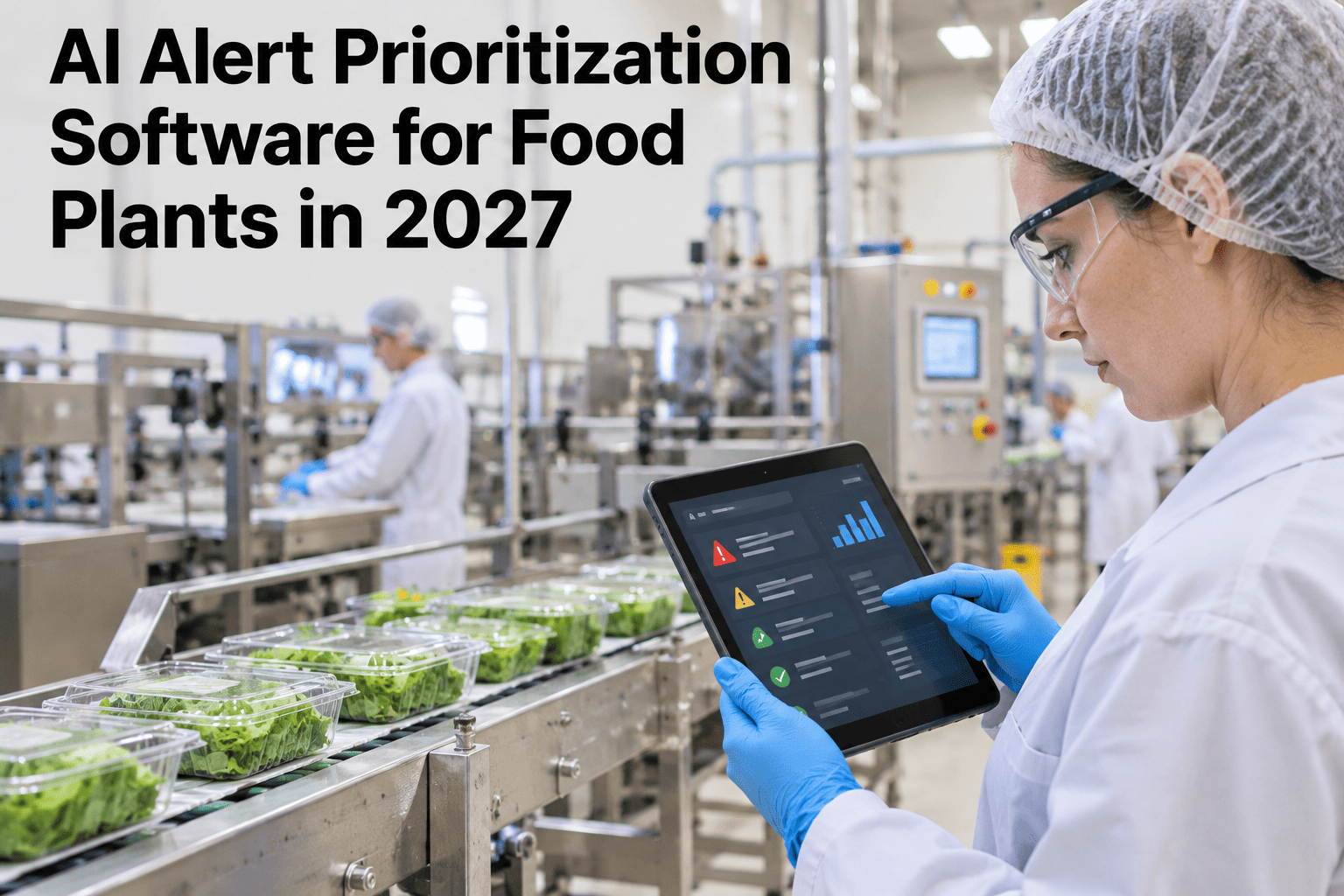
AI alert prioritization is a scoring layer sitting above raw alarms from PLCs, SCADA and sensors, ranking each one by estimated business impact instead of arrival order. The operator sees one ranked queue, with the alert most likely to cause yield loss, a quality hold or a safety issue at the top.

The real problem is never too few alarms — it is too many undifferentiated ones. A system that treats a two-degree drift the same as an imminent jam quietly trains operators to ignore the panel, including the one signal that mattered.
In their own words

What Alert Fatigue Actually Sounds Like on the Floor

Line operator
"Half the alarms clear themselves before I even reach the panel. I've learned to wait and see."
Shift supervisor
"By hour six, every alert looks the same color to me. That's the problem, not me."
Plant director
"I don't need fewer alarms. I need to know which one is actually worth stopping the line for."
The method

How AI Scores an Alert's Real Business Impact

1
Estimate units or batches at risk if the condition triggering the alert continues uncorrected.
2
Factor in asset criticality — whether the equipment is a bottleneck or has downstream redundancy.
3
Check for safety or food-safety exposure, which raises priority regardless of production impact.
4
Weight by how often this exact pattern has historically preceded a real failure versus resolving on its own.

See Your Alarm History Ranked by Impact

Share a week of alarm logs from one line and see which alerts actually preceded a real problem, versus which were noise.

Book an Alarm Ranking Review Ask About Alarm Setup
Comparison

Flat Alarm List vs a Ranked Priority Queue

DimensionFlat Alarm ListRanked Priority Queue
Order shownBy time receivedBy estimated business impact
Operator decisionGuess which matters mostAct on the top-ranked alert first
Repeat false alarmsTreated the same every timeWeighted down based on history
Safety-relevant alertsMixed in with routine onesAlways surfaced regardless of score
A composite scenario

The Alert Buried Under Thirty-Nine Others

A snack food line was running normally by every visible measure when a single alert — a slow current-draw drift on a conveyor motor, ranked low among dozens of other alarms that shift — sat unread for two hours. By the time anyone noticed, the motor had failed, taking four hours of downtime with it. A ranked queue would have put that specific pattern near the top, since current-draw drift of that shape has historically preceded motor failure far more often than the more frequent, louder alarms around it. This is an illustrative pattern, not a specific customer result, but it is the exact failure mode prioritization is built to prevent.

Getting it right

What to Get Right Before Trusting a Priority Score

A ranking system is only as good as the history it learns from. A plant that has not logged which alarms actually led to downtime or scrap gives the model little to weight impact from. The fix is to start capturing outcomes now, not to wait for perfect data.

iFactory, an on-premise AI platform for manufacturing execution (MES) and quality control, keeps that history on-site, so the model trains on your plant's own failure patterns, not a generic industry template.
Expert review

What a Plant Manager Would Check First

Holds up
Ranking alerts by consequence rather than order of arrival is sound operations-engineering principle, independent of any specific vendor.
Watch for
A ranking that silently buries a safety-relevant alert under a production-impact score — safety signals should always surface regardless of rank.
Do next
Pilot on the line with the highest alarm volume first, since that is where operator fatigue is worst and the gain will be clearest.
FAQ

What Plant Teams Ask About AI Alert Prioritization

How does AI decide which alert matters most?
It scores each alert on units at risk, asset criticality, safety or food-safety exposure, and how often that exact pattern has historically led to a real failure, then ranks the full alarm list by that combined score. See the scoring model applied to your own alarm data.
Will safety alerts ever be ranked below a production alert?
No. Safety and food-safety alerts are flagged to surface regardless of their production-impact score, so a lower-consequence production issue never buries a safety-relevant signal — this is a fixed rule, not a tunable weight. Ask how safety rules are enforced in the system.
How much alarm history is needed before ranking is reliable?
A few months of alerts logged alongside their actual outcomes gives the model enough pattern to work from, and ranking improves steadily as more history accumulates rather than needing a fixed dataset upfront. Discuss your current alarm logging with our team.
Does this replace the existing SCADA alarm system?
No, it sits above it. The SCADA or PLC system still generates raw alarms; the prioritization layer re-orders that stream by impact before it reaches the operator's screen, so existing alarm configuration does not need to be rebuilt.
Can priority rules be adjusted per line or per shift?
Yes, criticality weighting can differ by line, since a bottleneck line and a line with downstream redundancy should not be scored identically. Walk through line-specific weighting for your plant's layout.

Stop Treating Every Alarm the Same

Book a session with iFactory AI to see your plant's alarm history ranked by actual business impact, not just the order it arrived.

Book an Alert Prioritization Demo Contact Our Support Team

Share This Story, Choose Your Platform!