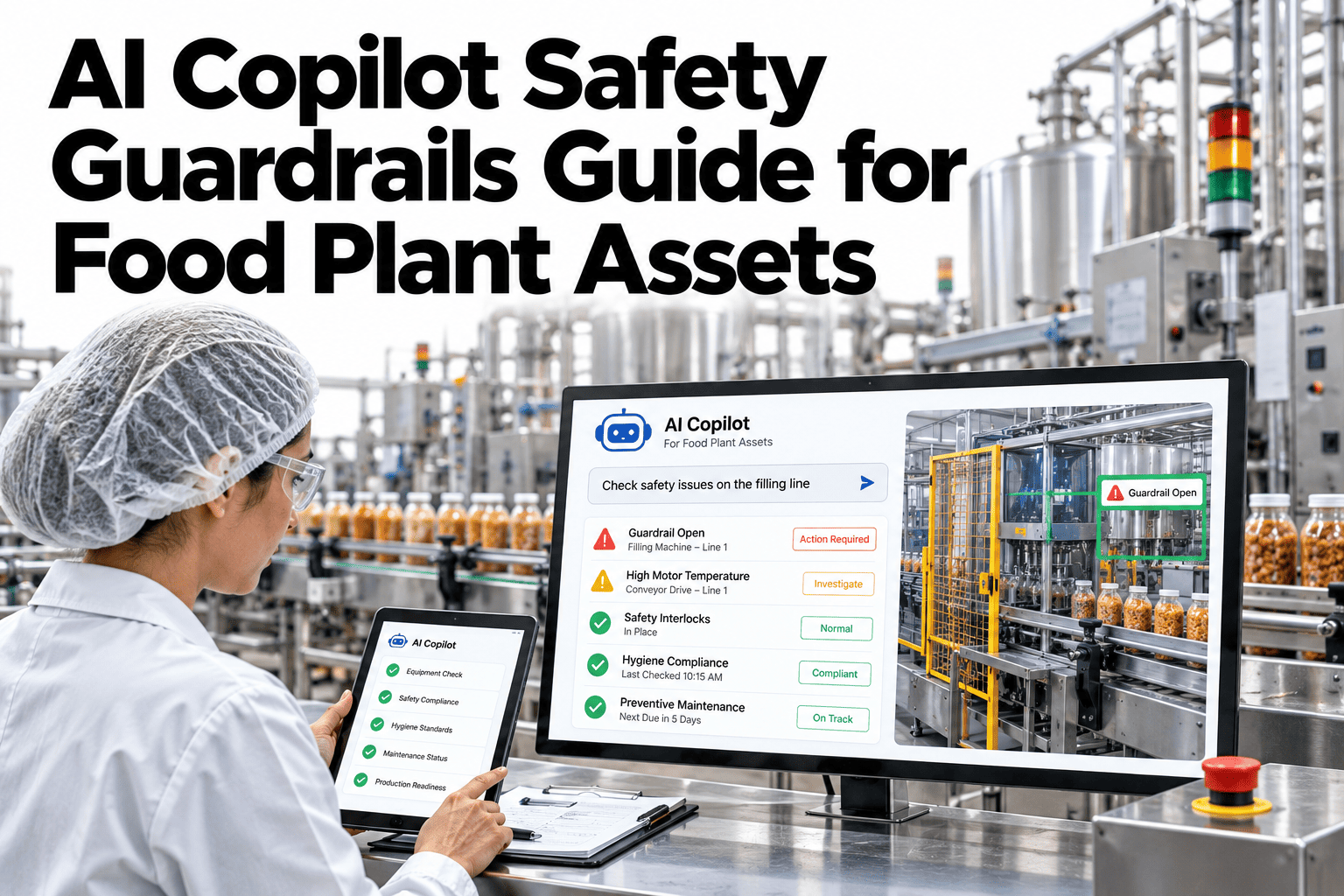
An AI copilot that gives a confident, wrong answer about a food plant asset is worse than one that admits it does not know. A suggestion that skips a lockout step, ignores an OEM pressure limit, or overlooks an allergen changeover rule can turn a helpful tool into a liability in seconds. This guide covers how layered guardrails keep an AI copilot inside LOTO procedures, food safety rules and OEM operating envelopes, so every answer is checked before it reaches the floor. Teams evaluating an AI copilot for their own assets can book a demo with the iFactory AI team.
AI Copilot Safety Guardrails Guide for Food Plant Assets
Layered rules that keep every AI answer inside LOTO procedure, food safety requirements and the OEM operating envelope.
Why a Single Check Is Not Enough
A single rule engine can catch one kind of mistake, but a food plant asset answer has to clear several very different categories of risk before it is safe to act on.
A step that is mechanically safe might still violate an allergen changeover sequence, and a step that satisfies food safety might still exceed an OEM pressure rating. No single check covers all three.
Three Guardrail Categories
Each layer checks a different kind of risk, and an answer only reaches the user once all three have cleared it.
| Layer | What It Checks | Example Block |
|---|---|---|
| LOTO procedure | Does the suggested step skip a required isolation point? | Refuses a step bypassing a locked valve |
| Food safety and allergen | Does the step violate a changeover or sanitation sequence? | Refuses skipping an allergen flush step |
| OEM operating envelope | Does the step exceed a manufacturer's rated limit? | Refuses a setpoint above rated pressure |
What Happens When a Check Fails
A blocked answer should never be a dead end. The copilot needs to explain why it stopped and point toward a safe alternative.
Make Sure Every Answer Clears Every Rule
Book a 30-minute walkthrough and see how layered guardrails keep AI answers inside LOTO, food safety and OEM limits.
Where the Rules Come From
Guardrails are only as good as the source documents behind them. Each layer should trace back to a document someone can point to during an audit.
LOTO and SOP documents
Isolation points and sequence steps drawn directly from the plant's written lockout procedures.
OEM manuals and ratings
Pressure, temperature and speed limits pulled from the manufacturer's own documentation, not estimated.
Common Guardrail Gaps
The same gaps show up across plants building their first AI guardrail layer.
Plain-Language Glossary
Shared terms keep safety, engineering and operations teams reading the same guardrail design the same way.
Frequently Asked Questions
Can guardrails slow down the copilot's answers?
The checks run in the background as part of generating the answer, so most users never notice added delay. The tradeoff of a brief check is far smaller than the cost of an unsafe suggestion reaching the floor. Book a demo to see response time with guardrails on.
How are OEM limits kept current?
Limits are tied to the manufacturer documentation on file for each asset, so updating the source document updates the guardrail automatically rather than requiring a manual rule rewrite.
Does every plant need the same guardrail set?
No, rules are scoped to each plant's actual assets, procedures and allergen profile, since a generic rule set would either over-block safe answers or miss plant-specific risks.
Can we audit which rule blocked a given answer?
Yes, every block is logged with the rule that triggered it, giving a clear record for safety audits and continuous improvement reviews. Ask support how guardrail logs are structured.
Give Your Team an AI Copilot That Knows the Limits
iFactory AI layers LOTO, food safety and OEM checks into every answer before it reaches the floor. Book a walkthrough built around your plant.