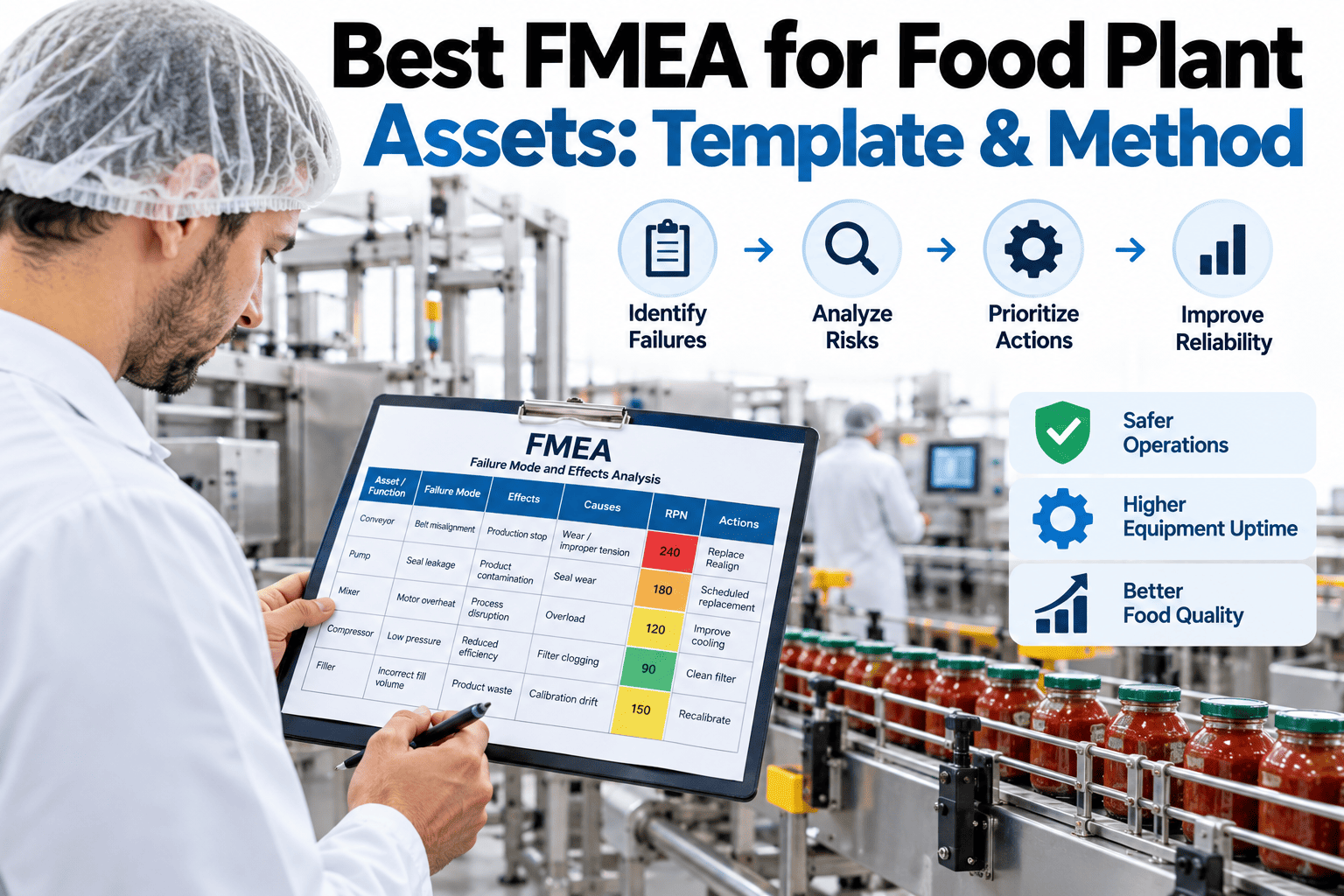
Failure Mode and Effects Analysis has been a staple of reliability engineering for decades, but plenty of food plants either skip it entirely or run through it once as a compliance exercise and never revisit it, treating it as paperwork rather than a living tool that actually shapes maintenance strategy. Done properly, FMEA forces a systematic walk through every plausible way a piece of equipment can fail, how severe each failure would actually be, how likely it is to occur, and how easily it would be detected before causing a problem, producing a risk priority number that helps focus limited maintenance resources on the failure modes that genuinely matter most rather than whichever equipment happened to fail most recently. This page provides a working template and method for running FMEA on food plant assets specifically, covering the scoring criteria that make sense for a food processing context and how to keep the analysis a living document rather than a one-time report that gathers dust. You can book a demo to see how iFactory keeps FMEA data connected to your ongoing maintenance and failure history.
FMEA Only Works If It Stays a Living Document, Not a One-Time Report
iFactory keeps your FMEA risk priority scores connected to real failure and maintenance history, so the analysis actually evolves as your equipment does.
Walking Through the Analysis Systematically
A rigorous FMEA follows a consistent structure for every asset or system under review, ensuring nothing gets skipped and every failure mode gets evaluated against the same criteria, which is what makes the resulting risk priority numbers actually comparable across different equipment.
Define what the asset or component is supposed to do, then systematically brainstorm every way it could fail to perform that function.
For each failure mode, identify what actually happens downstream, whether that's a safety issue, a quality issue, unplanned downtime, or some combination.
Rate each failure mode on a consistent numeric scale for how severe the effect would be, how likely the failure is to occur, and how likely current controls are to detect it before it causes a problem.
Multiply the three scores together to produce a risk priority number, or RPN, that ranks failure modes relative to each other for prioritization purposes.
For the highest RPN failure modes, define specific actions to reduce severity, occurrence, or improve detection, and track whether those actions actually get implemented.
Adapting Generic FMEA Scales to What Actually Matters in Food Processing
Generic FMEA scoring scales, often built for discrete manufacturing or automotive contexts, don't always map cleanly onto food processing priorities, where food safety consequences and sanitation implications need explicit consideration alongside the more universal categories of safety, quality, and downtime.
| Severity Level | Food Plant Example |
|---|---|
| Critical (9-10) | Failure creates a direct food safety hazard, such as a contamination pathway or a critical control point deviation |
| High (7-8) | Failure causes a significant production loss or a quality defect requiring product hold or rework |
| Moderate (4-6) | Failure causes a noticeable but contained production impact without safety or major quality consequence |
| Low (1-3) | Failure has minimal operational impact, easily and quickly addressed without meaningful disruption |
What Each FMEA Row Should Actually Capture
The specific component or subsystem and what it's supposed to do, specific enough to be actionable rather than a vague equipment-level description.
The specific way the component could fail to perform its function, described precisely enough that a technician could recognize it occurring.
What actually happens if this failure occurs, and a consistent numeric severity rating against your defined scale.
The likely root cause, how often it's expected to occur, what controls currently exist to catch it, and how effective those controls are at actually detecting the problem.
Why a One-Time Analysis Loses Value Quickly
An FMEA completed once and filed away becomes stale almost immediately, since occurrence rates should be validated against actual failure history over time, detection scores should improve as new monitoring capabilities get deployed, and new failure modes emerge as equipment ages or process conditions change. Treating FMEA as a periodically revisited, living analysis rather than a one-time project deliverable is what actually keeps it useful for ongoing maintenance strategy decisions.
Periodically compare assumed occurrence ratings against actual recorded failure frequency, adjusting scores where real data diverges from original assumptions.
When new condition monitoring capability is deployed for a specific failure mode, revisit its detection score to reflect the improved capability.
Where FMEA Efforts Typically Go Wrong
A single person estimating occurrence and detection scores without input from technicians who actually see the equipment fail tends to produce less accurate, less trusted scores than a genuinely collaborative session.
An FMEA completed once for a compliance requirement and never revisited quickly becomes disconnected from actual equipment behavior and loses practical value.
A failure mode with low calculated RPN due to rare occurrence can still warrant attention if its severity score is at the extreme end of the scale, particularly for food safety implications.
Identifying high-priority failure modes without actually implementing the corresponding mitigation actions defeats the purpose of running the analysis in the first place.
Turning Risk Priority Into an Actual Maintenance Schedule
The most direct practical application of a completed FMEA is using its output to inform preventive maintenance task frequency and scope. A failure mode with a high risk priority number, particularly one driven by high severity, deserves a more frequent or more thorough preventive maintenance task than one with low severity and low occurrence, yet many plants set preventive maintenance schedules based on generic manufacturer recommendations or historical habit rather than a defensible risk-based rationale.
Reviewing your current preventive maintenance program against your FMEA output often reveals mismatches, tasks that are more frequent than a failure mode's actual risk justifies, and gaps where a genuinely high-risk failure mode has no corresponding preventive task at all. Closing these gaps is typically one of the most valuable immediate outcomes of a well-run FMEA, converting the analysis from a documentation exercise into a direct input for how maintenance resources actually get allocated.
Redirecting Maintenance Focus Based on RPN Rather Than Recency
A plant's maintenance priorities were largely driven by whichever equipment had failed most recently, with a pasteurizer valve receiving significant attention after a recent failure while a higher-consequence but less recently problematic CIP return pump, whose failure mode carried genuine food safety implications, received comparatively little proactive attention.
Running a systematic FMEA across both assets revealed the CIP return pump's failure modes carried a substantially higher risk priority number due to their food safety severity, even though it had failed less recently, redirecting proactive maintenance investment toward the higher-priority risk rather than the most recently visible one.
A Practical Path to Running Your First Structured FMEA
Choose one critical asset or process line to run through the full FMEA method before attempting to scale across the entire plant.
Bring together maintenance, quality, and operations perspectives for the scoring session to produce more accurate, better-trusted results.
Review your existing preventive maintenance tasks against the completed FMEA to identify gaps and mismatches worth addressing.
Set a specific date to revisit and update the analysis, keeping it a living document rather than a one-time deliverable.