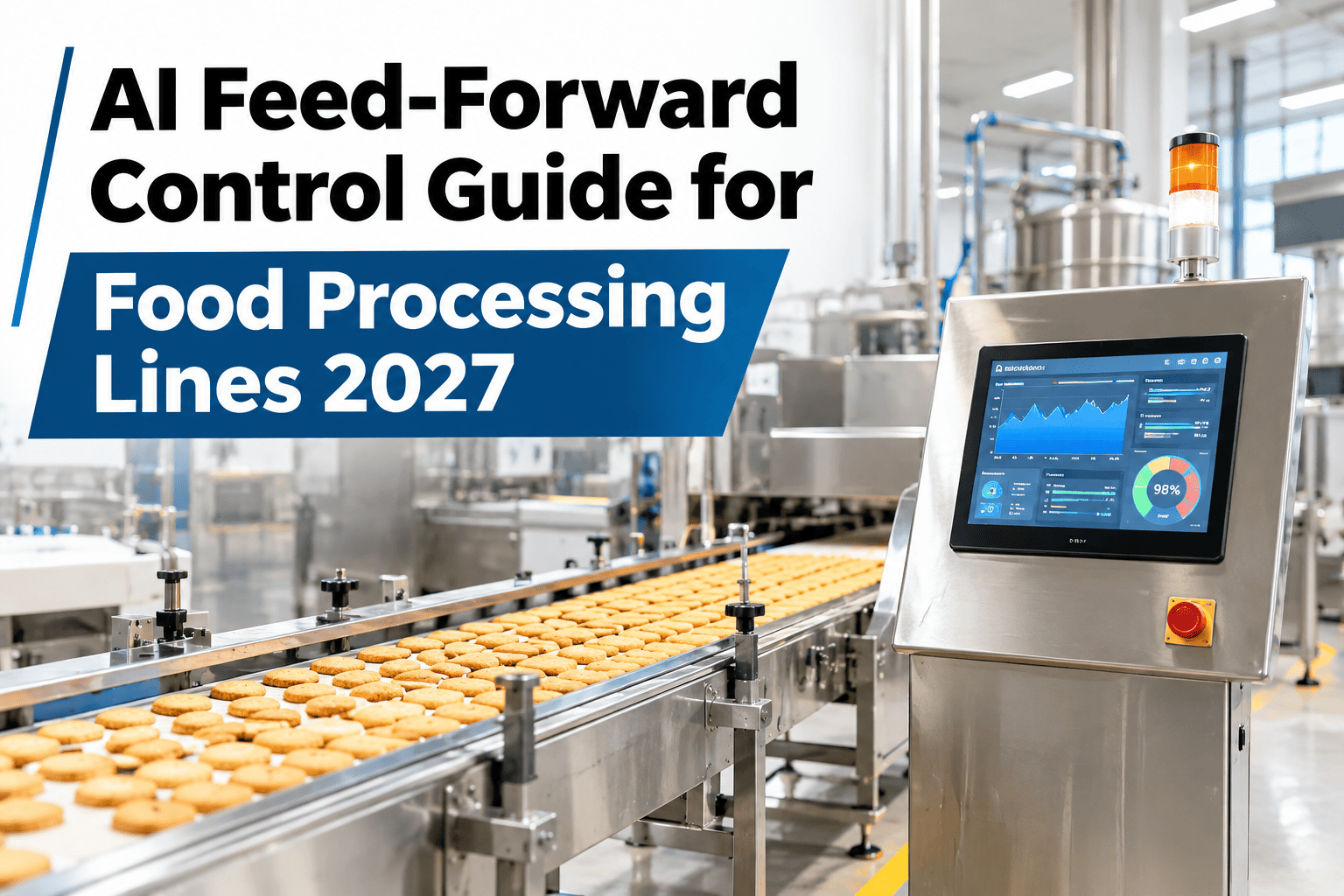
Every food processing line is a chain of compensations. The moisture content of incoming grain is not what the spec sheet says. The fat content of the cream batch that just arrived is two points higher than yesterday's. The ambient temperature in the packing hall has dropped four degrees since the morning shift. Each of these variations will work its way through the process and emerge as an out-of-spec product, a rework batch, or a line stoppage — unless something catches it first. Traditional feedback control catches it after it has already affected output. Feed-forward control catches it before. AI feed-forward control catches it faster, with more variables in play, and updates its compensation model every batch. iFactory AI, an on-premise AI platform for food manufacturing, implements feed-forward process control that reads incoming raw material characteristics and pre-adjusts downstream setpoints before any deviation reaches the product. Teams that want to understand how this applies to their specific process can discuss a feed-forward control design with iFactory AI's food process engineering team.
The Model Reads Incoming Raw Material and Adjusts Downstream Setpoints Before the Deviation Reaches Your Product
iFactory AI's on-premise feed-forward control reads upstream raw material characteristics, ambient conditions, and process state — and pre-adjusts temperature, timing, flow, and mixing setpoints before any variation shows up in the finished product.
What Is Feed-Forward Control and How Is It Different From Feedback?
Feed-forward control is a process control strategy that uses measurements of disturbances entering a process to adjust the process proactively — before the disturbance causes an output deviation. Feedback control measures the output, compares it to the target, and corrects after the deviation has occurred. The two are complementary: feed-forward handles predictable, measurable disturbances; feedback handles residual variation and unmeasured disturbances.
| Characteristic | Feedback control | Feed-forward control | AI feed-forward (iFactory) |
|---|---|---|---|
| When correction happens | After deviation detected in output | Before deviation enters process | Before deviation — updated every batch |
| Variables handled | Output variable only | Measured disturbance variables | Multiple disturbances + learned interactions |
| Model required | No — just a sensor and controller | Yes — process model relating input to output | Yes — AI model trained on batch history |
| Handles unmeasured disturbances? | Yes — by definition | No | Partial — learns residual patterns over time |
| Food plant application | Standard PID on every line | Moisture-compensated baking, fat-adjusted mixing | Multi-variable upstream compensation |
Where Feed-Forward AI Delivers the Most Value in Food Processing
AI feed-forward control is highest-value in processes where: (a) raw material variation is significant and measurable, (b) the process has sufficient lead time between measurement and the critical step to allow setpoint adjustment, and (c) the relationship between input variation and required setpoint change is non-linear or multi-variable — which is where AI outperforms a fixed compensation table.
Pre-Adjust Every Setpoint Before the Batch Enters the Process
iFactory AI deploys feed-forward control on-premise — trained on your batch history, integrated with your existing sensors and PLC setpoints, live within the standard deployment window.
How iFactory AI Builds the Feed-Forward Model for Your Process
The feed-forward AI model is trained on your plant's historical batch data — raw material measurements, process parameter settings, and finished product quality outcomes — to learn the relationships that your process engineers know intuitively but cannot easily encode as a fixed equation.
Feed-Forward Control and Food Safety: What Changes
AI feed-forward control in a food plant has direct food safety implications because it modifies process setpoints. Any system that changes temperature, time, or other CCP parameters must be designed, validated, and documented within the food safety management system before deployment.
Teams preparing to introduce AI feed-forward control into a HACCP-managed process can ask iFactory AI's food safety team about the validation and HACCP documentation process for feed-forward deployments.
Measuring the Impact: What Improves and When
The business case for AI feed-forward control rests on three measurable improvements that appear at different points in the deployment timeline.
Frequently Asked Questions
How is AI feed-forward control different from model predictive control (MPC)?
Model Predictive Control (MPC) is a form of feedback control that uses a process model to optimise setpoints over a future time horizon, accounting for constraints. AI feed-forward control uses measurements of incoming disturbances (raw material variation) to pre-adjust setpoints before the disturbance enters the process. The two are complementary: iFactory AI's feed-forward layer works best alongside existing PID or MPC feedback controllers, not as a replacement. For most food plants, feed-forward AI is the higher-value addition because raw material variation is the larger source of quality inconsistency. Review which control strategy fits your process in a planning session.
What raw material measurements does iFactory AI need to build a feed-forward model?
The minimum useful measurement set depends on the process, but for most food applications includes the variables most correlated with quality variation — typically 2–5 parameters such as moisture content, fat, protein, pH, or viscosity. These may already be measured in your incoming QC lab; if so, iFactory AI integrates with the LIMS or QC database to access them without additional sensors. Where measurements are not available, iFactory AI's team designs a measurement protocol as part of the deployment scope. Ask the support team what measurements your process would need for a feed-forward model.
Can feed-forward control adjust CCP parameters like pasteurisation temperature?
Feed-forward control can operate within the validated range of a CCP parameter — for example, adjusting a pasteurisation hold time within the range that the HACCP study has established as safe — but it cannot reduce a CCP parameter below its critical limit. iFactory AI enforces CCP bounds as hard constraints. Any feed-forward adjustment that would breach a CCP bound is blocked, the event is logged, and the process runs at the standard setpoint. The validation protocol before deployment confirms all scenarios where bounds would be respected. Review the CCP constraint configuration for your process in a planning session.
How much historical batch data does the model need to be useful?
A useful feed-forward model for a food process typically needs 12 months of batch data minimum — enough to capture the seasonal variation in raw material characteristics that drives most food plant quality variation. The data needs to include at least 100–200 batches with both raw material measurements and quality outcomes recorded. If raw material measurements are not currently linked to batch outcomes in your data systems, iFactory AI's deployment team designs the data linkage as part of Phase 1. Models trained on more data are more accurate, but a 12-month minimum is sufficient to demonstrate value. Ask the support team to assess your historical data readiness for a feed-forward deployment.
Will feed-forward control work alongside our existing PLC and SCADA system?
Yes. iFactory AI reads raw material measurements from your QC or LIMS system and writes setpoint recommendations to your PLC or DCS through OPC-UA, Modbus, or the control system's existing engineering interface. The feed-forward model is advisory by default — it generates a setpoint recommendation that the process technician confirms before the control system applies it. The existing PLC retains control authority at all times — iFactory AI is an advisory layer, not a replacement for the control system. Book a session to review the integration architecture for your PLC and SCADA platform.
Stop Chasing Deviations. Start Pre-Empting Them.
iFactory AI's feed-forward control reads your incoming raw material and adjusts downstream setpoints before any variation reaches your product — deployed on-premise, trained on your batch history, live within the standard deployment window.