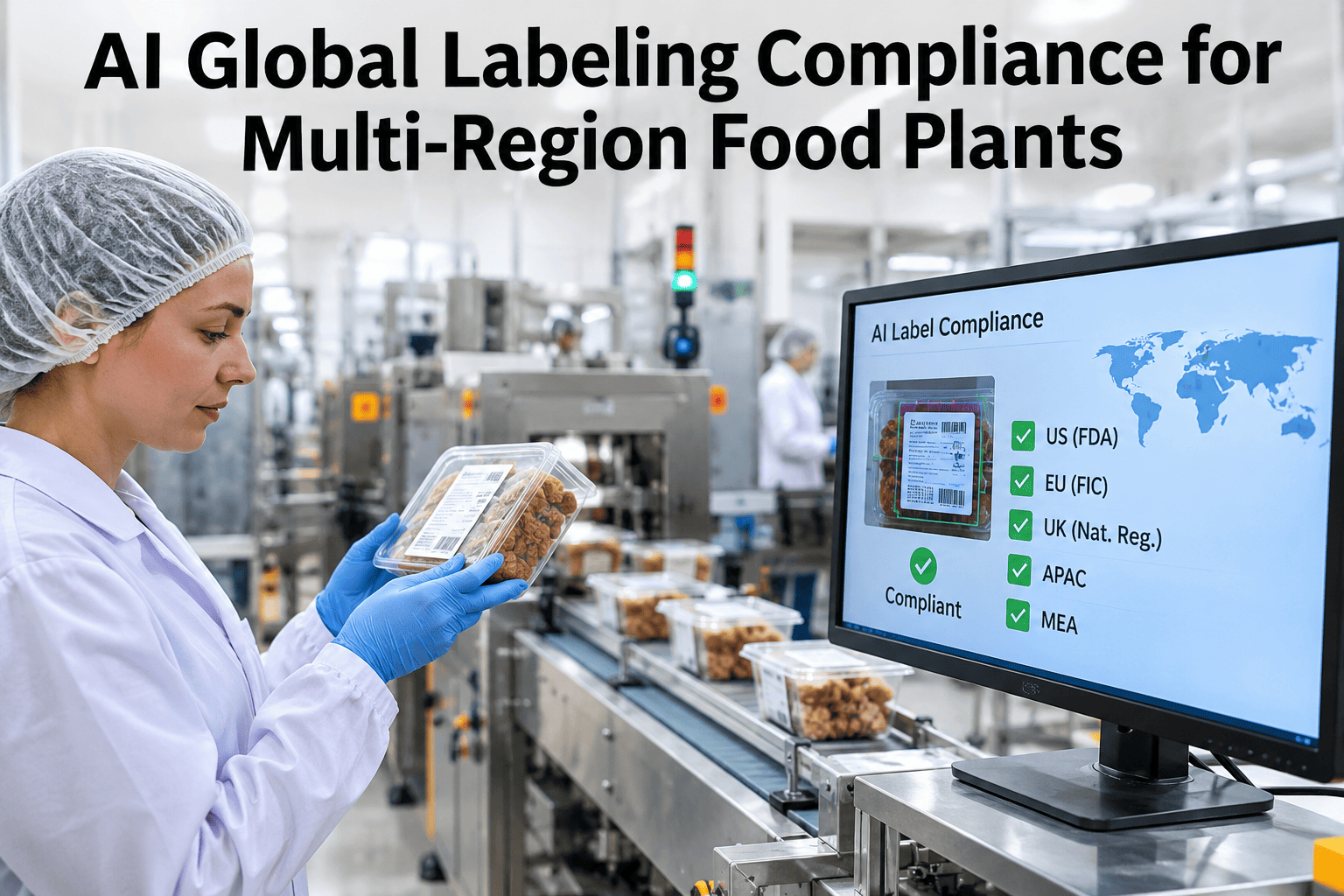
A single SKU exported to the US, EU, UK, and Canada needs four different label formats, and a changeover that applies the wrong one is invisible to a line operator until a customs hold or a retailer rejection catches it. Multilingual labeling errors alone have driven recalls affecting products distributed across more than 30 US states in 2026 (recall tracking reports, 2026). iFactory, an on-premise AI platform with AI Vision Camera built in, enforces US, EU, UK, and Canadian labeling rules from a single platform at the point of changeover. Export-focused QA teams who want this checked on their own lines can request a demo with our team.
Multi-Region Labeling Compliance · Food Export, 2026
One SKU, Four Label Formats, One Line — And Only One of Them Is Correct for This Run
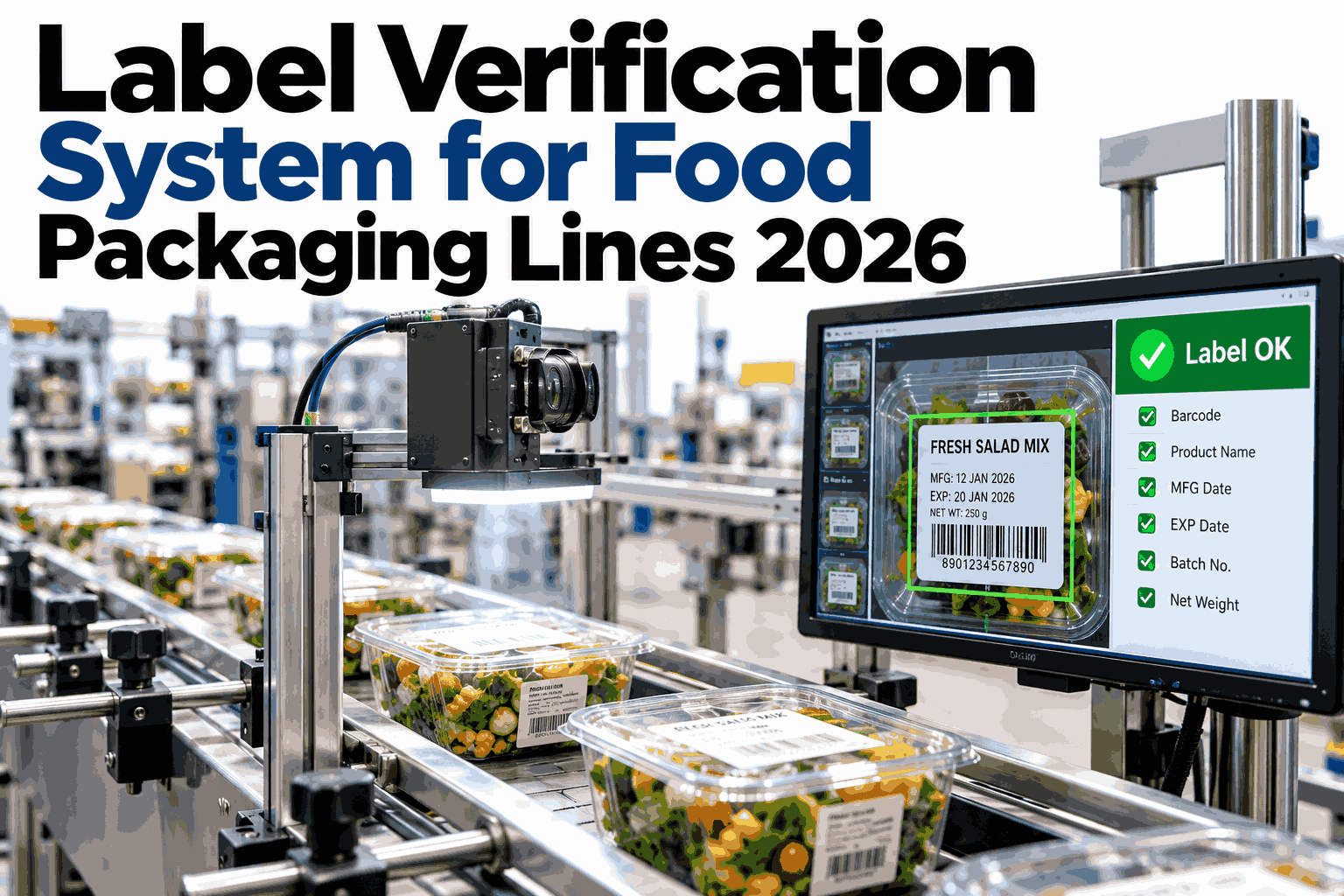
iFactory AI checks the applied label against the destination market's own rules the moment a changeover happens, catching a region mix-up before the pallet is built.
US
FDA Nutrition Facts format
EU
FIC energy-kJ/kcal format
UK
Post-Brexit UKCA labeling rules
CA
Bilingual English/French panel
Why region mix-ups happen
Changeovers Are Where Multi-Region Labeling Breaks
A production run switching from a domestic SKU to an export SKU is exactly the moment a wrong label format gets applied, because the changeover relies on an operator selecting the right print file manually, under time pressure, often for a SKU that looks nearly identical to the one just finished.
What differs by region
Four Regions, Four Different Rule Sets on the Same Panel
| Region | Distinguishing requirement | Common mix-up risk |
|---|
| United States | FDA Nutrition Facts panel format, FALCPA allergen statement | EU-format energy values applied to a US-bound case |
| European Union | EU FIC regulation — energy in kJ and kcal, specific font-size rules | US-format panel missing required EU fields |
| United Kingdom | Post-Brexit UKCA marking, separate from EU CE requirements | EU-format label used where UK-specific marking is required |
| Canada | Bilingual English/French label content | English-only US label applied to a Canada-bound run |
How the check works
Destination-Aware Verification, Not a Generic Label Check
Run order confirms destination
The system reads which market this specific run is destined for from the production order.
Rule set loads automatically
The correct region's labeling rules are applied as the verification standard for that run.
Panel checked against that rule set
The applied label is verified against the destination market's specific requirements, not a generic template.
See What Region-Specific Verification Would Catch on Your Export Lines
Share which markets you currently export to and iFactory AI will walk through what a destination-aware label check would look like for your SKUs.
Single platform vs separate systems
Why Managing Regions Separately Multiplies the Risk
Separate region-by-region process
Each market's rules tracked in a different document or team
No single place to confirm a run is destination-correct
A rule change in one market is easy to miss updating elsewhere
One platform, four rule sets
All destination rules maintained in one system
Every run checked against the rule set for its actual destination
A regulatory update is applied once, everywhere it's needed
Keeping rules current
Regulatory Rules Do Not Stay Still
Labeling requirements shift — a post-Brexit UK marking change, an EU FIC update, a Canadian bilingual threshold adjustment — and a platform that tracks these changes centrally means a QA team is not relying on someone remembering to update four separate documents every time one jurisdiction moves.
Expert review
What an Export QA Lead Checks First
Multi-region compliance holds up when the verification check is tied to the actual production order's destination, not a label format chosen by habit or by what printed last.
Verdict
Strong when destination is pulled automatically from the run order rather than selected manually at the press.
Watch for
Near-identical SKUs for different markets that differ only in panel format — these are the highest mix-up risk.
Do next
List every SKU that ships to more than one region and confirm each has a distinct, correctly mapped label file.
Frequently asked questions
What Export-Focused Plants Ask About Multi-Region Labeling
How serious is the risk from a region mix-up?
Multilingual and region-specific labeling errors have driven recalls affecting products distributed across more than 30 US states in a single event (recall tracking reports, 2026), beyond the customs and retailer rejection risk at the border itself.
Discuss your current export risk exposure.
Does this track regulatory changes automatically or do we need to update the rules ourselves?
Rule sets need to be kept current as regulations change in each jurisdiction — most plants combine a maintained rule library with their own regulatory affairs team's sign-off on updates.
Ask support how rule updates are managed.
Can this handle a SKU that ships to more than two regions?
What happens at a changeover between a domestic and export run?
Does bilingual Canadian labeling need separate verification from US English labels?
One check, every destination market
Verify Every Export Label Against Its Actual Destination Rules
Book a demo to see how iFactory AI enforces US, EU, UK, and Canadian labeling rules on your export lines.
{"@context":"https://schema.org","@type":"FAQPage","mainEntity":[
{"@type":"Question","name":"How serious is the risk from a region mix-up?","acceptedAnswer":{"@type":"Answer","text":"Multilingual and region-specific labeling errors have driven recalls affecting products distributed across more than 30 US states in a single event."}},
{"@type":"Question","name":"Does this track regulatory changes automatically or do we need to update the rules ourselves?","acceptedAnswer":{"@type":"Answer","text":"Rule sets need to be kept current as regulations change, typically combining a maintained rule library with regulatory affairs sign-off."}},
{"@type":"Question","name":"Can this handle a SKU that ships to more than two regions?","acceptedAnswer":{"@type":"Answer","text":"Yes, each SKU can be mapped to multiple destination rule sets, applied based on the specific run's production order."}},
{"@type":"Question","name":"What happens at a changeover between a domestic and export run?","acceptedAnswer":{"@type":"Answer","text":"The system checks the first units of a new run against the destination rule set for that order, catching a leftover domestic label format."}},
{"@type":"Question","name":"Does bilingual Canadian labeling need separate verification from US English labels?","acceptedAnswer":{"@type":"Answer","text":"Yes, Canadian bilingual requirements are checked as their own distinct rule set, separate from the US format."}}
]}