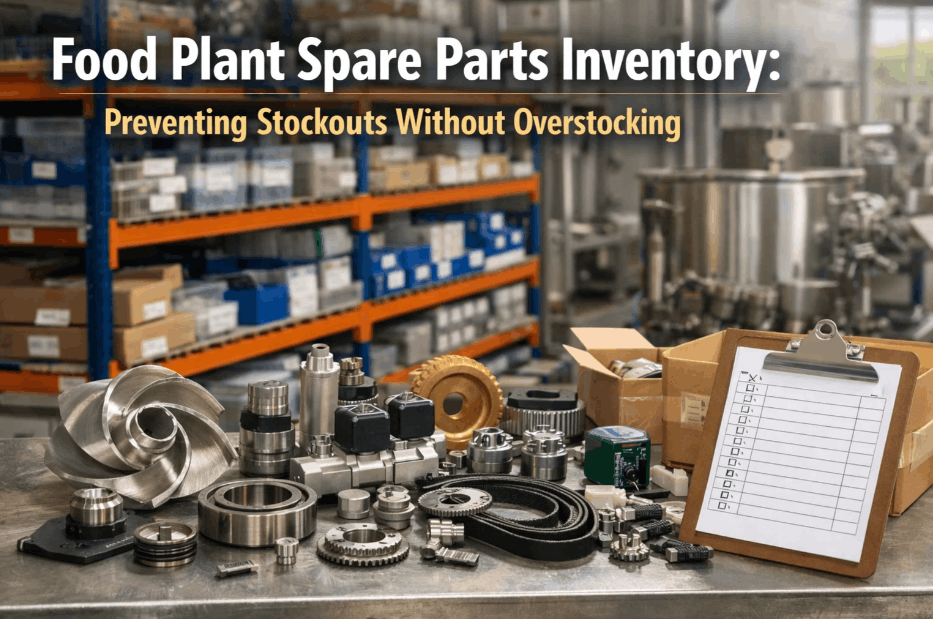
A food plant storeroom often holds a strange contradiction: shelves full of seals, bearings, and gaskets for machines that were retired years ago, sitting next to empty bins for the one pump seal that fails every six weeks on the third shift. Traditional spare parts planning relies on static min-max levels set once and rarely revisited, which means the inventory drifts further from actual failure patterns every quarter that passes. AI-powered spare parts optimization replaces that guesswork with demand forecasting built on real failure history, asset criticality, and vendor lead times, so the parts that matter are always in stock and the ones that don't are finally cleared out. Plants curious what their own inventory data would reveal can reach out to iFactory support for a look at the numbers.
Stop Guessing How Many Bearings You Actually Need
iFactory's AI spare parts engine learns failure patterns, criticality, and supplier lead times for every asset, then recommends stocking levels that cut carrying cost without ever leaving a critical machine waiting on a part.
Static Stocking Levels Versus AI-Modeled Demand
The core difference between traditional spare parts planning and an AI-driven approach comes down to how often the model updates and how many variables it actually considers when recommending a stocking level.
| Planning Factor | Traditional Min-Max | AI-Powered Optimization |
|---|---|---|
| Demand Basis | Fixed reorder point set once, rarely revisited | Continuously updated from real failure and consumption history |
| Criticality Weighting | Same reorder logic for critical and non-critical parts | Safety stock scaled to asset criticality and failure consequence |
| Lead Time Handling | Single average lead time regardless of supplier variability | Vendor-specific lead time modeling including seasonal and disruption risk |
| Obsolete Stock Detection | Identified manually during periodic physical counts | Flagged automatically as usage falls to zero against active assets |
The Categories Of Waste Hiding In Most Storerooms
Excess inventory and stockouts are usually two symptoms of the same underlying problem: a stocking model that was never built to reflect how parts actually fail across a real production environment.
Overstocked Low-Criticality Parts
Common fasteners and low-risk components often carry months of excess safety stock simply because nobody has revisited the original order quantity.
Understocked Critical Spares
The parts tied to your highest-consequence failures frequently carry the same modest safety stock as everything else, leaving no buffer when they're actually needed.
Obsolete Inventory From Retired Equipment
Parts for decommissioned machines continue occupying shelf space and tying up capital long after the equipment itself left the floor.
Emergency Freight Costs
Reactive expedited shipping for stocked-out critical parts routinely costs several times the part's normal price, and it happens more often than most plants track.
Let Failure Data Decide What Sits On The Shelf
iFactory models demand, criticality, and lead time together, so every dollar in your storeroom is protecting against a real risk instead of sitting there out of habit.
How The Optimization Model Actually Builds A Recommendation
Each recommended stocking level is the output of several layers of analysis working together, not a single formula applied uniformly across every part number.
Failure History Mapping
Historical work orders and part consumption are linked to specific assets and failure modes, building a real demand signal instead of a guess.
Criticality Scoring
Each asset is scored on downtime cost and safety impact, and that score directly influences how much safety stock its parts are allowed to carry.
Vendor Lead Time Modeling
Supplier performance history, including delays and seasonal variability, is factored into how much buffer stock each part actually needs.
Continuous Recalculation
Recommendations update automatically as new failures, repairs, and deliveries occur, keeping the model current instead of static after a single planning cycle.
Actionable Reorder Guidance
Planners receive clear reorder and reduction recommendations by part, ready to act on rather than a raw data export to interpret manually.
A Composite Scenario: The Bakery Line That Cut Inventory Without Adding Risk
A multi-line bakery had spent years accumulating spare parts for equipment that had since been upgraded or replaced, while its highest-failure-rate mixer bearing had stocked out twice in one year, forcing costly overnight shipments both times. After running an AI-driven spare parts analysis across its full storeroom, the plant identified a significant share of inventory value tied to obsolete part numbers and reallocated a portion of that freed budget into deeper safety stock on the three parts responsible for the majority of unplanned downtime.
Within two quarters, the plant had reduced total inventory value while eliminating the repeat stockouts on its highest-risk components, and the same model has since been extended to a second production facility in the same network.
Mistakes That Undermine Spare Parts Optimization
Optimizing Cost Without Weighting Criticality
Reducing inventory value across the board without accounting for which parts protect the most critical assets trades a budget win for a downtime risk.
Ignoring Supplier Reliability
Setting reorder points on average lead time alone leaves no buffer for the suppliers who occasionally run weeks behind their quoted delivery window.
Never Retiring Obsolete Part Numbers
Storerooms that never formally decommission parts tied to retired equipment keep paying carrying cost on inventory with zero future demand.
Treating The Model As A One-Time Project
Stocking recommendations generated once and never refreshed drift out of date as quickly as the manual system they replaced.
Is Your Storeroom Ready For AI-Driven Optimization
You can pull historical work orders tied to specific parts
Even a partial history of part consumption against work orders gives the model a meaningful demand signal to start from.
Your critical assets are already identified
A basic criticality ranking, even an informal one from your maintenance team, is enough to weight the initial recommendations correctly.
Supplier lead time data exists somewhere
Purchase order history with delivery dates lets the model account for real vendor performance instead of catalog-quoted lead times.
Leadership wants a defensible reason for every stocking level
An AI-driven model gives procurement and maintenance a shared, data-backed answer for why a part is stocked at its current level.
Frequently Asked Questions
How much historical data do we need before AI stocking recommendations are useful?
Even twelve to eighteen months of work order and consumption history is generally enough to establish meaningful demand patterns for most critical parts, though the model improves as more history accumulates. Parts with very infrequent failures may need a longer window or a criticality-based safety stock approach rather than pure demand forecasting. In practice, most plants find that combining whatever historical data exists with current criticality scoring produces usable recommendations far sooner than waiting to collect a longer, cleaner dataset first.
Will this replace our current CMMS or procurement system?
No, spare parts optimization is designed to feed recommendations into the systems your team already uses for purchasing and inventory management rather than replace them. Reorder points, safety stock levels, and obsolete part flags generated by the model can be pushed into your existing CMMS or ERP so purchasing continues to work from one system of record. This keeps the change focused on smarter numbers rather than a disruptive platform migration.
How does the model handle parts that have never failed yet?
For parts without failure history, the model leans more heavily on asset criticality, manufacturer-recommended service intervals, and comparable part behavior across similar equipment to set an initial conservative stocking level. As real consumption data accumulates, the recommendation shifts from criticality-based estimation toward pattern-based forecasting, so the system becomes more precise over time rather than requiring a perfect starting dataset.
Can this help us identify parts we should stop stocking altogether?
Yes, one of the most immediate wins most plants see is a clear list of parts tied to decommissioned or heavily modified equipment that no longer warrant any stock at all. Because the model continuously checks consumption against active asset records, parts that stop showing demand get flagged automatically rather than surviving years of inertia in the storeroom. Freeing that capital is often enough on its own to fund deeper safety stock on the handful of parts that actually matter.
How do we get started without disrupting current purchasing operations?
Most deployments start with a parallel analysis run against your existing part numbers and history, producing recommendations your team can review and phase in gradually rather than switching stocking levels overnight. This lets purchasing validate the model's logic on a subset of parts before extending it storeroom-wide. Book a demo to see how a phased rollout is typically scoped for a storeroom your size.
Turn Your Storeroom Into A Data-Driven Asset
iFactory models real failure history, criticality, and vendor lead time into stocking recommendations you can actually defend, so critical parts are always there when you need them.