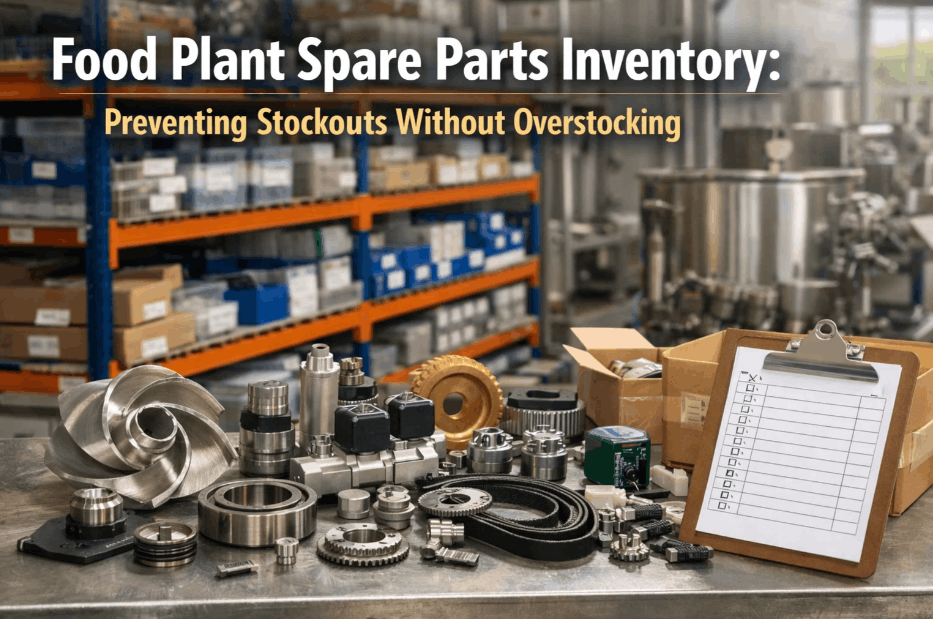
When a bearing arrives nine days late, the invoice is the smallest cost of the delay. Food plants run tight schedules with perishable product, so one missing part can stop a line, spoil a batch and trigger overtime that no spare parts budget ever shows. A critical spares list answers one question before the failure happens: which parts must be on the shelf, and how many of each? The template below builds that list from real failure history, criticality scoring and ABC-XYZ classification instead of guesswork. Teams that want the list built from their own work orders can see a critical spares review run on your failure data with the iFactory AI team.
The Critical Spare Parts List Template Built From Real Failure History
iFactory AI links work orders, downtime and parts usage, so every part on your list carries a score, a class and a stocking decision you can defend.
The Part Is Cheap, the Wait Is Not
Teams often hesitate to stock a part that costs a few thousand dollars and may never be used. The comparison changes once the cost of waiting sits next to the cost of holding.
In this example the wait costs about 148 times more than the shelf space. Carrying cost is commonly estimated at 15 to 25 percent of stock value a year, so even the high end leaves the same conclusion.
Food plants add pressure, since stopped lines can mean spoiled product, missed delivery windows and extra cleaning before restart. Teams often review which failures cost the most downtime before they score a single part.
Start From Failure History, Not From the Manufacturer's Parts List
Manufacturer lists name every part a machine could ever need. Your own records show which ones actually fail, how often and what each failure cost.
Pull at least three years where possible, since rare failures need a long window to show up. A part that failed once in four years may still be your most critical spare.
Score Criticality on Five Questions With a Four-Point Scale
A simple score keeps decisions consistent between machines and between people. Rate each part from 1 to 4 on the five questions below, then add the results.
| Question | 1 point | 2 points | 3 points | 4 points |
|---|---|---|---|---|
| Production impact | No effect on output | Line runs slower | Line stops for under a shift | Line or plant stops for over a shift |
| Food safety impact | None | Housekeeping only | Could affect quality checks | Could affect a food safety or regulatory control |
| Failure history | None in five years | One failure | Two or three failures | Four or more, or repeated |
| Lead time | Same day, local | Within a week | One to four weeks | Over four weeks or single source |
| Workaround | Easy substitute exists | Substitute with effort | Temporary fix only | No workaround |
The total, between 5 and 20, points straight to an action. The example row in the hero scores 17, which lands in the top band.
Classify With ABC-XYZ, Then Let Criticality Overrule the Grid
ABC sorts parts by annual spend, from the few that take most of the money to the long tail of cheap items. XYZ sorts them by how steady the demand is, from regular use to rare and unpredictable.
The Z column is where plants get hurt. Rare parts look like dead stock to an inventory report, yet some of them stop an entire line.
Parts that are high in criticality and rare in use are your insurance spares. They sit on the shelf for years, and their value shows up only on the one day they are needed. A short session can help to identify the insurance spares hiding in your Z column from your own usage history.
Turn Your Failure History Into a Critical Spares List
Share a few machines and see how your work orders, downtime and lead times would score, classify and rank your spare parts.
Test Every Candidate Against Lead Time and Tolerable Downtime
Lead time decides how much cover a part needs. The longer the wait, the more a failure hurts, and the more a single spare on the shelf is worth.
For fast-moving parts, a reorder point keeps the shelf full without much thought.
Rare parts need a different test. If the lead time is longer than the downtime the plant can tolerate, the part belongs on the shelf.
Add the Food Plant Checks a Generic Template Leaves Out
Food plants stock parts that touch food, wet environments and safety controls. These checks keep a spare from becoming a compliance problem when it finally goes in.
Elastomer seals and gaskets age on the shelf, so a spare bought years ago may not be safe to fit. Add a shelf-life column to the list for those parts.
Teams that already track calibrations and cleaning records can connect the same data to spares, and some ask the support desk how parts records link to maintenance history before building the list.
Sample Rows From a Finished Critical Spares List
Here is how the steps come together. Each row carries a score, a class, a lead time and one clear decision.
| Part | Machine | Score | Class | Lead time | Decision |
|---|---|---|---|---|---|
| Drive motor, 7.5 kW | Filler, line 2 | 17 | B-Z | 9 weeks | Stock 1 on site |
| Reject device actuator | Packing line | 18 | B-Z | 6 weeks | Stock 1 on site |
| Pasteurizer temperature probe | Heat treatment unit | 16 | C-Y | 3 weeks | Stock 2, calibrated |
| Gearbox seal kit | Mixer | 13 | B-Y | 2 weeks | Min-max, review supplier stock |
| Conveyor bearing | Case packer | 9 | C-X | 2 days | Reorder point only |
The rows are illustrative, and your list will look different. What matters is that every row ends in a decision someone can explain.
Review Cadence and a Launch Checklist That Keeps the List Honest
A spares list is a living document. Plants change machines, suppliers and products, and each change can move a part up or down the list.
Rescore a part right after any major failure or machine change, instead of waiting for the next review. Then use the launch checklist below to go live.
Starting with the top two production lines is usually enough to prove value, and teams often plan a first-line spares pilot with a specialist before extending the list to the whole plant.
What Food Plant Teams Ask Before Building a Critical Spares List
See a Critical Spares List Built From Your Own Failure History
Book a session with iFactory AI to review your work orders, lead times and machines, and see how a scored, classified spares list can cut the waits that turn small failures into long stops.