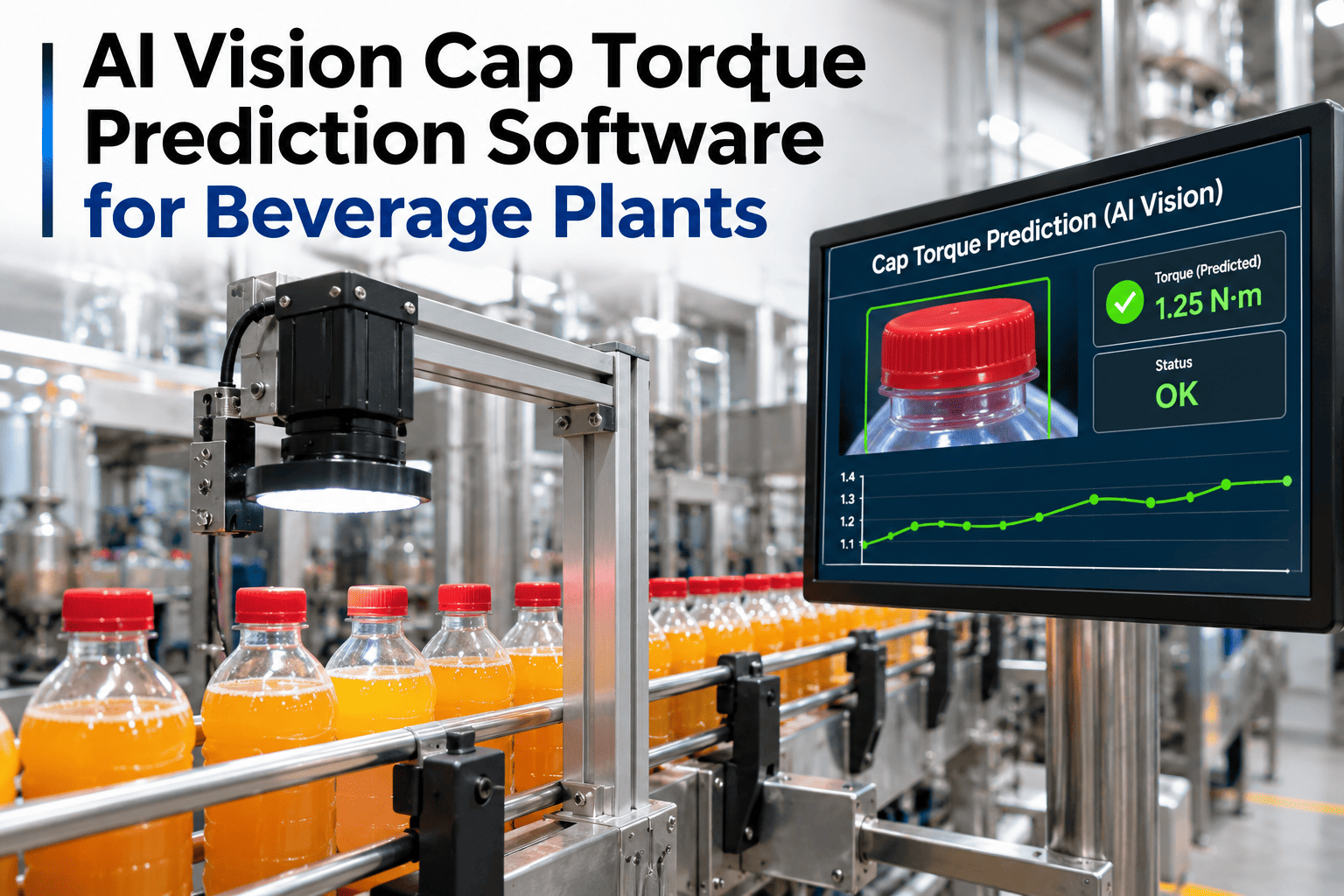
AI vision cap torque prediction software reads cap seating angle, thread engagement and skew on every bottle at line speed, then flags a likely under-torque or over-torque condition before the case packer, without touching the bottle. It is a proxy for torque, not a replacement for a contact torque tester, and that distinction decides how plants should actually use it. Beverage teams relying on a sample-based manual check can see a torque proxy model running on their own capper footage before changing anything on the line.
Catch Torque Drift on Every Bottle, Not Just the Ones a Human Checked
iFactory AI scores cap seating angle, thread engagement and skew on 100% of containers, tagging every reject to its capping head so a drifting station shows up in minutes instead of a customer complaint.
What Is AI Vision Cap Torque Prediction?
Cap torque prediction is a computer-vision model that classifies the visual signatures of correct and incorrect torque — rotation angle, ratchet band engagement and seating depth — against trained defect classes, returning a pass or reject decision before the unit reaches the gate. iFactory, an on-premise AI platform for beverage packaging inspection, runs this at full capper speed across every bottle rather than a sampled subset, a figure beverage quality teams report at roughly 82% at shift start, sliding toward 70% by hour six as manual fatigue sets in, per iFactory's 2026 review of fill-level and cap inspection data.
Vision Proxy vs a Contact Torque Tester
The two methods answer different questions, and neither replaces the other on its own.
See the Correlation on Your Own Caps
Share footage from your capping station and iFactory AI will show how closely the torque proxy tracks your contact tester readings.
Where Torque Drift Actually Shows Up
Drift is rarely random. It tends to follow a capping head, a changeover, or a shift pattern, and the table below shows how that typically breaks down across a bottling line.
| Drift Pattern | Likely Cause | Consumer-Facing Risk |
|---|---|---|
| One head, steady drift | Capping head wear or spring fatigue | Leaks, spoilage before use-by date |
| All heads, after changeover | Torque setpoint not reset for new cap type | Tamper band failure, induction seal loss |
| Rising through a shift | Mechanical heat buildup on the capper | Over-torque cracking on thin-wall bottles |
Rolling Out Torque Vision on a Live Capping Line
Checklist Before Trusting a Torque Proxy Reading
Frequently Asked Questions About AI Cap Torque Prediction
Can vision torque prediction replace our contact torque tester entirely?
No, and it is not meant to. A torque tester measures rotational resistance directly, which a camera cannot observe. Vision inspection adds full-line coverage between periodic contact checks. See both methods run side by side on a short call before changing your QC program.
How accurate is a vision-based torque proxy compared to a direct measurement?
Accuracy depends on how well the proxy is calibrated against your own contact tester readings for your specific cap and bottle combination. It is strongest at catching drift and trend, not at replacing a single precise reading. Ask support about expected correlation for your closure type.
Can this keep up with a high-speed bottling line?
Vision inspection is designed to score every unit at full capper speed, including lines running several hundred bottles per minute, by processing each frame as the bottle passes the inspection point. Confirm your own line speed on a call before committing to a camera position.
What happens to a bottle flagged with a torque defect?
A flagged bottle is automatically diverted before case packing, with the specific defect type and capping head logged for trend review by the quality team. Ask support how the diversion gate is configured for your existing line layout.
Does each new cap or bottle design need retraining?
A new closure or bottle geometry usually needs a short recalibration pass, since seating depth and rotation signatures change with the design, though the underlying model architecture stays the same. Plan a recalibration schedule around your product changeover calendar.
Stop Relying on a Sample That Gets Tired by Hour Six
iFactory AI reads torque proxy signals on every bottle and tags every drift to its capping head. Book a walkthrough on your own capper footage.