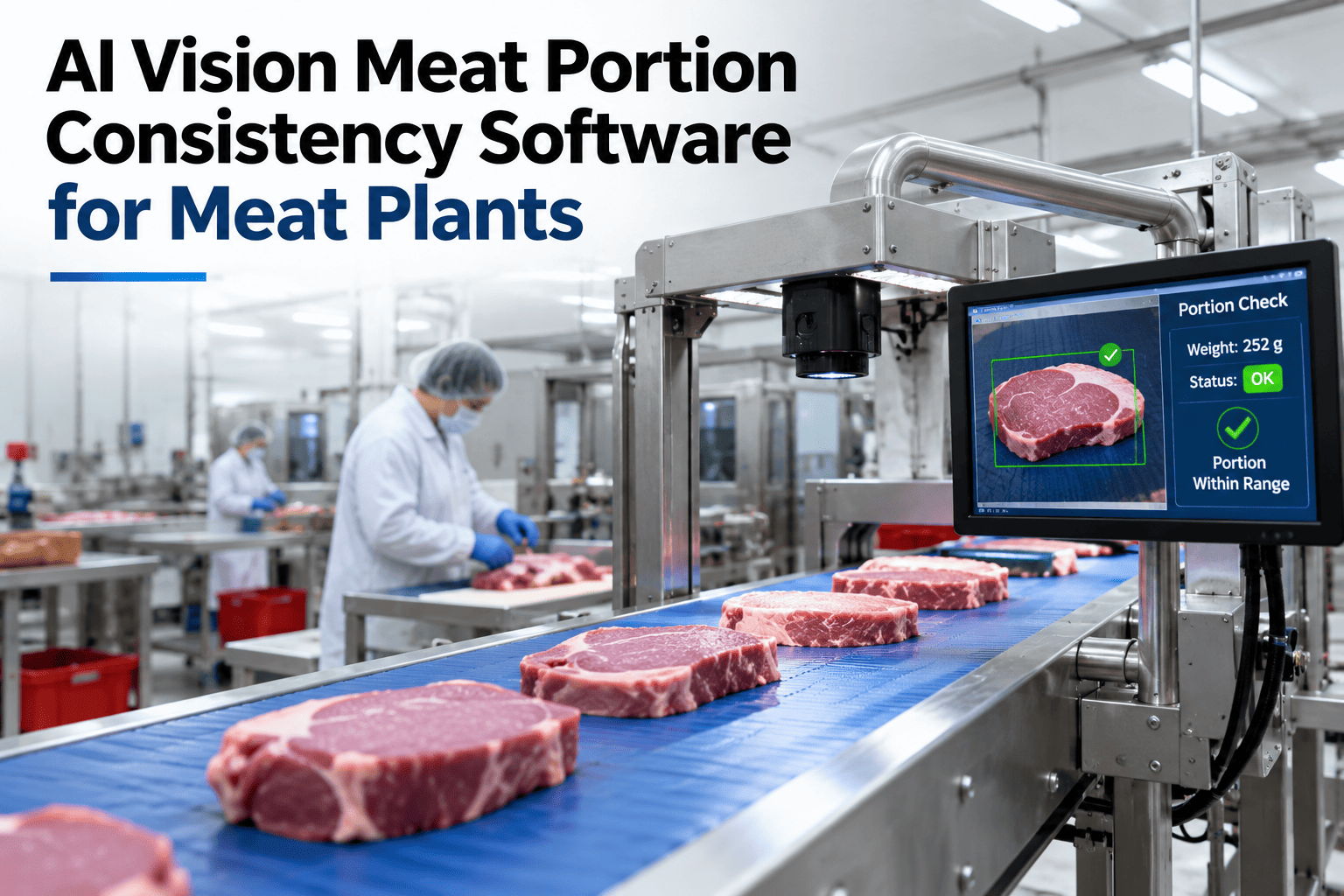
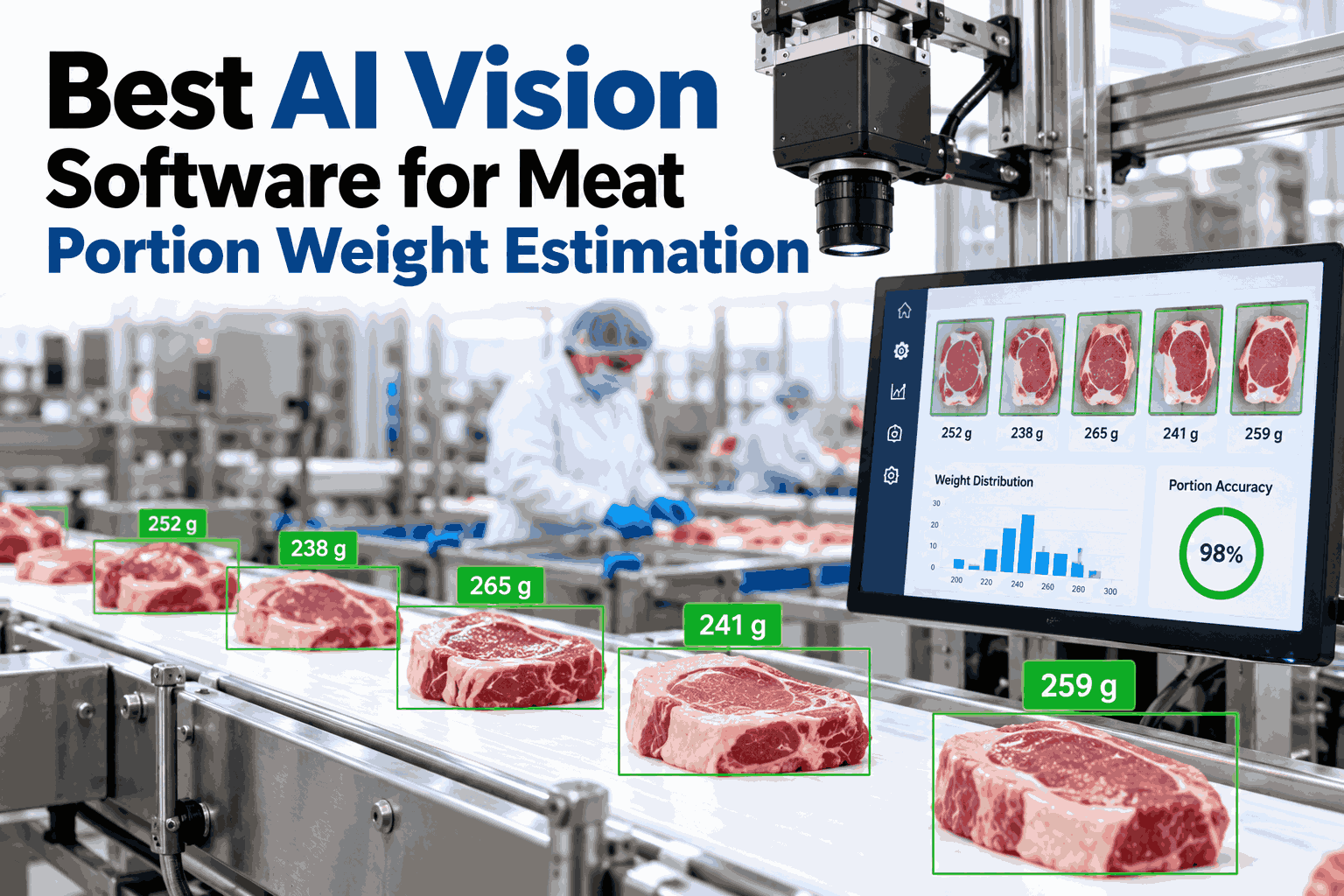
AI vision meat portion consistency software scans every portion in 3D, estimates its weight before it reaches a scale, and lets the line correct the cut while the next portion is still moving. This matters because plants almost always aim high, since a portion under the label is a compliance problem while a portion over it is simply absorbed as cost (iFactory, 2026). That quiet habit is trim giveaway, and it repeats on every shift. 3D vision cutting that targets exact-weight portions is already used in cheese and meat portioning (Rockwell Automation case study, 2026). iFactory, an on-premise AI platform for food manufacturing, brings the same idea to your own lines, and teams can see predicted portion weights compared with scale readings on their own product in a short session.
Meat Portioning · 3D Vision
Know the Portion Weight Before the Blade Finishes the Cut
iFactory AI predicts each portion's weight from its 3D shape, so trim giveaway falls every shift.
Live scan · target 200 g
Illustrative. P-103 is flagged and the cut is adjusted.
The method
How Does 3D Vision Estimate Portion Weight?
A 3D camera measures the volume and shape of each portion. Weight is then estimated by multiplying volume by density, with density learned from scale readings for each product.
3D scan gives volume
times
Learned density
gives
Predicted weight
The scale stays in the loop, because it keeps the density estimate honest. To see the method on your cuts, ask our team how density is calibrated per product.
The giveaway ledger
What Does Trim Giveaway Actually Cost?
Small overshoots look harmless per portion. Multiplied by line speed they become tonnes of product a year.
Target portion weight200 g
Average actual weight203 g
Average giveaway per portion3 g
Portions per hour6,000
Product given away per hour18 kg
Illustrative arithmetic: 3 g times 6,000 portions is 18 kg an hour, or 144 kg over an eight-hour shift.
Put a Number on Your Own Giveaway
Share target weight, line speed and recent scale averages. iFactory AI will show what your overshoot costs a shift.
The comparison
How Is 3D Vision Different From a Checkweigher Alone?
| Question | Checkweigher Alone | 3D Vision Prediction |
|---|
| When is weight known? | After cutting, trimming and packing | From the live scan, before the cut ends |
| What can it correct? | Reject out-of-range packs | Adjust the cut for the next portion |
| What does it show? | Weight of the finished pack | Shape, thickness and where excess sits |
| Legal weight check | Yes | No, it feeds the checkweigher |
Both are needed. The checkweigher proves the result and the vision system improves it. To plan the pairing, review a checkweigher and vision layout with our specialists.
The loop
How Does the Line Correct Itself in Real Time?
2
Predict each portion's weight
5
Learn from the difference
The learning step matters most: each gap between prediction and scale sharpens the next prediction.
The shifts
Where Does Giveaway Differ Across Shifts?
Giveaway often varies by shift, operator and raw material. The bars show an illustrative average overshoot per portion.
Seeing the pattern lets supervisors coach the shift that gives away most, instead of changing the whole line.
The variables
Which Meat Factors Change the Weight Estimate?
Fat content
Fat is lighter than lean, so density shifts with the cut and the lot.
Moisture and purge
Surface liquid changes both look and weight.
Bone-in or boneless
Bone adds density, so each form needs its own calibration.
Temperature
Chilled and partly frozen meat behave differently under the blade.
Calibrating by product and lot is what keeps predictions honest. To set this up, ask support about calibration by product family.
The KPIs
Which Portion KPIs Should Plants Track?
Giveaway
Average grams over target per portion
Spread
Standard deviation of portion weight
Under-weight
Share of portions below the label
Yield
Sellable portions per kilogram of input
iFactory is delivered on an on-premise NVIDIA server, live in 6–12 weeks, with integration, training and 24×7 remote monitoring in scope.
First 90 daysWhat Does a Realistic First 90 Days Look Like?
A portion vision pilot fits in one quarter. The plan below keeps scope small and proof quick.
Days 1–30
Install the 3D camera, scan portions and compare predicted weights with the scale in shadow mode.
Days 31–60
Calibrate density by product family, link predictions to the cut controller and set alert limits.
Days 61–90
Move to live correction, track giveaway and under-weight share by shift, then widen to more lines.
To scope a pilot, discuss a ninety-day portion pilot with our team.
PitfallsWhat Mistakes Limit Portion Weight Programs?
Giveaway programs fail quietly. Six habits are behind most of it.
Skipping scale feedback
Feed scale weights back daily so density estimates do not drift.
One density for all cuts
Calibrate by product family, fat level and bone-in or boneless form.
Lowering the target too fast
Cut the target in small steps and confirm the under-weight share stays near zero.
Ignoring temperature
Record meat temperature, since chilled and partly frozen meat behave differently.
Hiding shift differences
Report giveaway by shift and operator so coaching is targeted.
Treating vision as the legal check
Keep the checkweigher as the final compliance check.
Each fix protects both yield and compliance. For help, ask support about a portion control checklist.
Key termsWhich Terms Matter in Portion Control?
Six terms come up in almost every giveaway review.
Giveaway
Product supplied above the declared or target weight.
Net content
The declared weight a pack must contain.
Density
Mass per unit of volume, used to turn a scan into weight.
Yield
Sellable portions per kilogram of input.
Trim
Meat removed when shaping a portion.
Under-weight share
The percent of portions below the label.
To see them in a live view, review portion KPIs with our specialists.
Fit with planningHow Does Portion Data Support Yield and Planning?
Portion data reaches beyond the cutting line. Operations teams use giveaway by shift to coach crews, planners use real yield per kilogram to set purchase orders, and quality teams use the under-weight share to show compliance. When case counts run below forecast because of giveaway, upstream orders have to be padded and working capital is tied up for no reason.
One record, many teams: the same data answers quality, maintenance and planning questions.
Accurate portion data removes that padding. To see how yield feeds planning, review a yield and planning view with our specialists.
Expert review
Using Portion Vision Responsibly
Holds up
3D scanning for exact-weight portioning is proven in cutting systems, and volume-based estimates improve with scale feedback.
Verify
That predictions are compared with the scale daily and that net content rules are still met by the checkweigher.
Avoid
Lowering the target before the evidence supports it. Reduce giveaway in small, checked steps.
Questions
Frequently Asked Questions
Can vision really predict meat portion weight?
Yes, within limits. 3D vision measures volume precisely, and density is learned from scale readings, which gives a close estimate that improves over time. The scale remains the final check.
See prediction against scale on your product.
Does it replace the checkweigher?
No. The checkweigher stays as the legal weight check, while vision predicts weight earlier and guides the cut.
Ask how the two are linked.
What equipment do we need?
How soon can giveaway fall?
Results depend on starting spread, but a first measure of giveaway is available as soon as scans and scale data are compared. A pilot confirms the gain before wider rollout.
Plan a giveaway pilot with our team.
Does the data stay in our plant?
Cut Every Portion Closer to Target
Book a session to see iFactory AI predict portion weight in 3D and reduce trim giveaway on your own line.
{"@context":"https://schema.org","@type":"FAQPage","mainEntity":[{"@type":"Question","name":"Can vision really predict meat portion weight?","acceptedAnswer":{"@type":"Answer","text":"Yes, within limits. 3D vision measures volume precisely, and density is learned from scale readings, which gives a close estimate that improves over time. The scale remains the final check."}},{"@type":"Question","name":"Does it replace the checkweigher?","acceptedAnswer":{"@type":"Answer","text":"No. The checkweigher stays as the legal weight check, while vision predicts weight earlier and guides the cut."}},{"@type":"Question","name":"What equipment do we need?","acceptedAnswer":{"@type":"Answer","text":"A 3D camera over the conveyor, controlled lighting and a link to the cutting or trimming controller. Many plants reuse existing cutters."}},{"@type":"Question","name":"How soon can giveaway fall?","acceptedAnswer":{"@type":"Answer","text":"Results depend on starting spread, but a first measure of giveaway is available as soon as scans and scale data are compared. A pilot confirms the gain before wider rollout."}},{"@type":"Question","name":"Does the data stay in our plant?","acceptedAnswer":{"@type":"Answer","text":"Yes. iFactory runs on-premise on a plant server, so scans and weights stay on site."}}]}