Spice and herb processing carries a quality risk that is easy to underestimate because the product itself is small, irregular, and visually inconsistent even when it is perfectly clean. A single insect fragment, a fleck of stem material, or a patch of mold discoloration can hide inside a stream of ground or whole spice moving past an inspection point at high volume, and unlike a defect on a large piece of produce, these contaminants are often only a few millimeters across. Regulatory tolerance for this category is also unusually strict, since agencies define specific defect action levels for insect fragments, rodent hair, and mold in spice products, which means a plant's inspection process has to catch defects that are both physically tiny and legally consequential. AI vision systems built for spice and herb lines are now handling both contamination detection and color-based grading at a resolution that manual sorting cannot consistently match.
AI Vision for Spice and Herb Processing: Contamination Detection and Color Grading
Detecting insect fragments, foreign material, and mold contamination while grading color consistency across ground and whole spice products, at a resolution and consistency that manual sorting cannot reliably match.
Three Contamination Risks Spice Processors Face Every Day
Spice and herb products move through the supply chain from field to processing facility with more exposure to environmental contamination than most other food categories, since many spices are grown, harvested, and initially dried in open field conditions before reaching a processing plant. That exposure creates three recurring contamination categories that quality teams have to screen for continuously: insect fragments and whole insect parts introduced during field drying or storage, foreign material such as stones, stems, and packaging debris carried through from harvest, and mold growth that develops when moisture control breaks down during storage or transport. Each of these categories requires a different visual detection approach, and catching all three consistently at processing volume is where manual sorting lines struggle most.
Insect Fragments and Parts
Regulatory defect action levels set specific limits on insect fragment counts per unit weight for many spice categories, requiring detection of fragments that are frequently smaller than the surrounding spice particles themselves.
Foreign Material
Stones, stems, twine fragments, and packaging debris carried through from field harvest or storage handling are a leading cause of customer complaints and recall triggers in spice categories.
Mold and Moisture Damage
Discoloration patterns associated with mold growth develop unevenly across a batch, making spot-check sampling an unreliable method for catching moisture-related quality failures before shipment.
Color Grading: The Other Half of Spice Quality
Beyond contamination, color consistency is one of the primary quality attributes buyers use to grade spice products, since color correlates directly with factors like curcumin content in turmeric, capsaicin concentration in chili powder, and overall freshness in dried herbs. Manual color grading relies on an inspector comparing samples against reference color cards under whatever lighting happens to be available at the inspection point, which introduces the same consistency problems that affect any manual visual assessment performed repeatedly across a shift. AI vision grading captures color values numerically under controlled lighting and compares each sample against a calibrated reference range, producing a grade that does not drift with inspector fatigue or ambient lighting changes across different times of day.
Example color grading scale used for turmeric and chili powder batches, calibrated against reference samples and measured under fixed lighting conditions for every batch rather than ambient inspection light.
How Detection and Grading Work Together on the Line
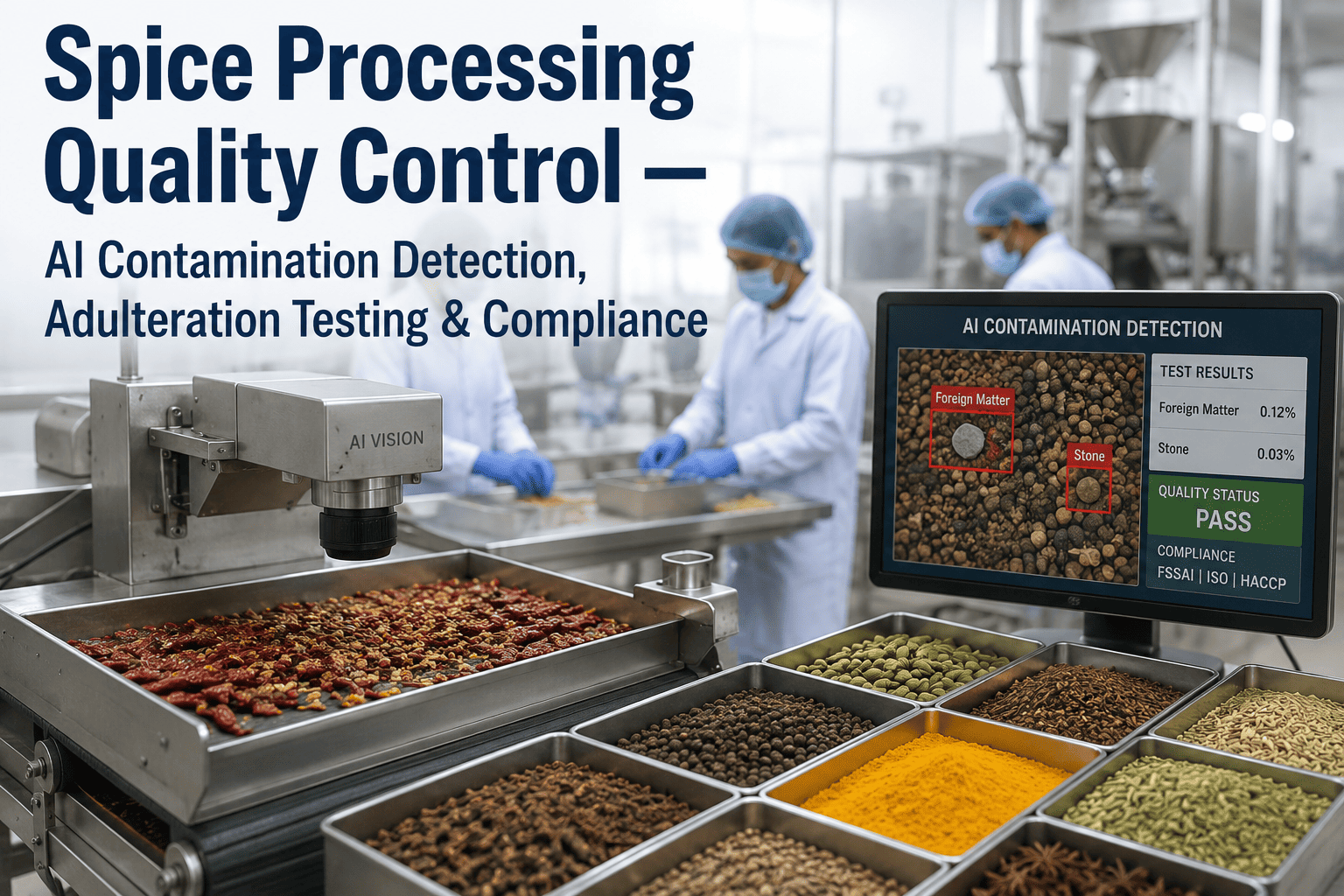
A spice inspection deployment typically combines a high-resolution line-scan camera positioned over a thin, evenly spread product layer with a detection model trained to distinguish spice particles from foreign material and contamination signatures, alongside a separate color analysis module that samples product under controlled lighting at defined intervals. Book a Demo to see both detection layers running against your specific spice or herb product line.
| Detection Layer | What It Catches | Method |
|---|---|---|
| Foreign material detection | Stones, stems, twine, packaging debris | Shape and texture differentiation against spice particle profile |
| Insect fragment detection | Fragments and parts below visible size for manual sorting | High-resolution imaging with trained fragment classification model |
| Mold and discoloration screening | Moisture damage and uneven mold development | Multispectral imaging tuned to discoloration signatures |
| Color grading | Batch color consistency against grade standard | Controlled-lighting colorimetric measurement per sample |
Screen for Contamination and Grade Color Consistently on Every Batch
iFactory's AI vision platform combines foreign material detection, insect fragment screening, and colorimetric grading into a single inspection layer built for spice and herb processing lines.
Connecting Inspection Data to Compliance Documentation
Spice processors selling into regulated markets need inspection records that can be produced quickly when a regulatory body or customer requests documentation of defect action level compliance. Vision-based inspection generates that record automatically as a byproduct of the inspection process itself, rather than requiring quality staff to reconstruct sampling logs after the fact.
Batch-level defect counts are logged automatically against defect action level thresholds, giving compliance teams an audit-ready record for every shipment.
Inspection results are linked to lot and supplier identifiers, helping teams trace a contamination pattern back to a specific harvest lot or supplier source.
Color grade assignments are stored with the measured colorimetric values, removing ambiguity if a buyer disputes a grade assignment after delivery.
Contamination and grading trends across suppliers and seasons help procurement teams identify sourcing patterns that consistently produce lower quality lots.
Spice and Herb AI Vision — Frequently Asked Questions
Yes, this is one of the core detection challenges the system is built to address, since insect fragments in categories like ground pepper or paprika are often physically smaller than the surrounding spice particles and difficult for a human inspector to reliably distinguish at sorting speed. The detection model is trained on reference imagery of confirmed fragments across common insect species associated with each spice category, allowing it to recognize fragment shapes, edges, and texture signatures even when particle size is small. Detection sensitivity is tuned to the defect action level thresholds relevant to each specific spice product being processed.
Color grading models are calibrated against a range of reference samples that reflect the natural variation expected across different harvest regions, growing seasons, and drying methods for a given spice, rather than a single fixed color target. This means the grading system accounts for legitimate variation between, for example, a turmeric lot from one growing region versus another, while still flagging samples that fall outside the acceptable range for a given grade tier. Processors that source from multiple regions can maintain separate calibration profiles per source to keep grading accuracy aligned with expected regional characteristics.
Yes, though the imaging and detection configuration differs between the two product forms since whole spices such as peppercorns or cardamom pods require particle-level contour and shape analysis, while ground powders require a different imaging approach tuned to fine particle texture and surface color distribution. Foreign material and insect fragment detection is generally more visually distinct in whole spice form, while color grading is often more consistent in ground powder form due to the uniform particle size. Most processing lines that handle both forms run separate calibration profiles for each product type.
Inspection results including defect counts, contamination flags, and color grade assignments are logged automatically with batch and lot identifiers, which many processors use as supporting documentation when responding to regulatory inquiries or customer quality audits. The system does not replace a facility's formal quality management or regulatory compliance program, but it does provide a consistent, time-stamped inspection record that reduces the manual documentation burden compared to paper-based sampling logs. Book a demo to review how the reporting format aligns with your specific compliance documentation needs.
Line-scan imaging systems used for spice inspection are designed to operate at the throughput speeds typical of high-volume spice processing lines, capturing continuous imagery of product spread across a conveyor rather than inspecting discrete units one at a time. Actual achievable speed depends on product layer thickness, particle size, and the specific defect categories being screened, since finer contamination detection generally requires a thinner, more evenly spread product layer to maintain accuracy. Plants considering a deployment typically start with a line speed assessment to confirm the configuration that maintains both throughput and detection accuracy for their specific product.
Catch Contamination and Grade Color Consistently on Every Batch
iFactory's AI vision platform brings foreign material detection, insect fragment screening, and colorimetric grading to spice and herb processing lines at production speed.