Allergen changeover management is one of the most high-stakes operations in any food manufacturing facility. A single contamination event during a production line transition—where a peanut-containing product is followed by an allergen-free SKU without validated cleaning—can trigger a Class I recall, destroy customer trust, and expose your facility to FDA enforcement action. In 2026, with FSMA traceability requirements fully active and BRCGS/SQF audit standards tightening, food plants need more than paper checklists and manual supervisor sign-offs to control allergen risk at changeover. AI-driven allergen changeover management systems automate the entire transition workflow: scheduling validated cleaning procedures, assigning equipment-specific tasks, capturing ATP and allergen swab results, and locking production release until every control point is cleared. If your facility still relies on spreadsheets or static SOPs for allergen control, Book a Demo to see how AI-driven work order automation transforms changeover safety across every shift.
Automate Allergen Changeover Protocols Across Every Line
iFactory's AI-driven Work Order Automation digitizes allergen cleaning protocols, validates each transition with swab integration, and generates audit-ready documentation — no paperwork, no gaps.
Why Allergen Changeover Management Fails in Traditional Food Plants
Most food manufacturing facilities have documented allergen control procedures — but documentation alone does not prevent cross-contamination. The failure points in traditional allergen changeover management are almost always operational: cleaning steps skipped under schedule pressure, sign-offs completed before verification is done, and swab results logged in a disconnected system that never blocks production release. When an allergen incident occurs, investigation almost always reveals that the procedure existed on paper but broke down in execution.
The gap between written SOP and actual production practice is exactly where AI-driven allergen management closes the loop. By embedding allergen changeover checklists directly into the work order system — with mandatory digital completion, photo capture, and swab result entry before production authorization — plants eliminate the reliance on memory and manual supervision that causes allergen escapes. Food plants using digital allergen changeover protocols report significantly fewer GFSI audit findings related to allergen control and dramatically lower rates of cross-contamination customer complaints.
Over 40% of Class I food recalls in the US are triggered by undeclared allergens — the majority traceable to inadequate changeover cleaning validation and documentation failures at the production line level.
The Six Components of AI-Driven Allergen Changeover Management
A robust allergen changeover management system is not a single checklist — it is a layered control architecture that spans production scheduling, cleaning execution, verification testing, and compliance documentation. Here are the six core components that define a best-in-class allergen changeover protocol in 2026.
Allergen Matrix Integration
The system reads your allergen matrix and production schedule to automatically determine the required cleaning scope for every changeover — escalating protocols when high-risk allergens like peanuts, tree nuts, or gluten are involved.
Schedule-AwareEquipment-Specific Cleaning Checklists
Each piece of equipment carries its own validated allergen cleaning procedure. Difficult-to-clean surfaces, dead legs, and contact zones are called out with step-level detail — not covered by a single generic SOP.
Equipment-Level ControlATP and Allergen Swab Integration
Swab results enter the work order directly from field devices or manual entry. A positive ATP or allergen swab automatically re-triggers the cleaning procedure and blocks production release — no manual escalation required.
Verification LoopDigital Production Release Authorization
Production cannot restart until every cleaning step is digitally completed, swab results are within limit, and a supervisor sign-off is captured with user authentication and timestamp — creating a tamper-evident compliance record.
Release ControlChangeover Time AI Prediction
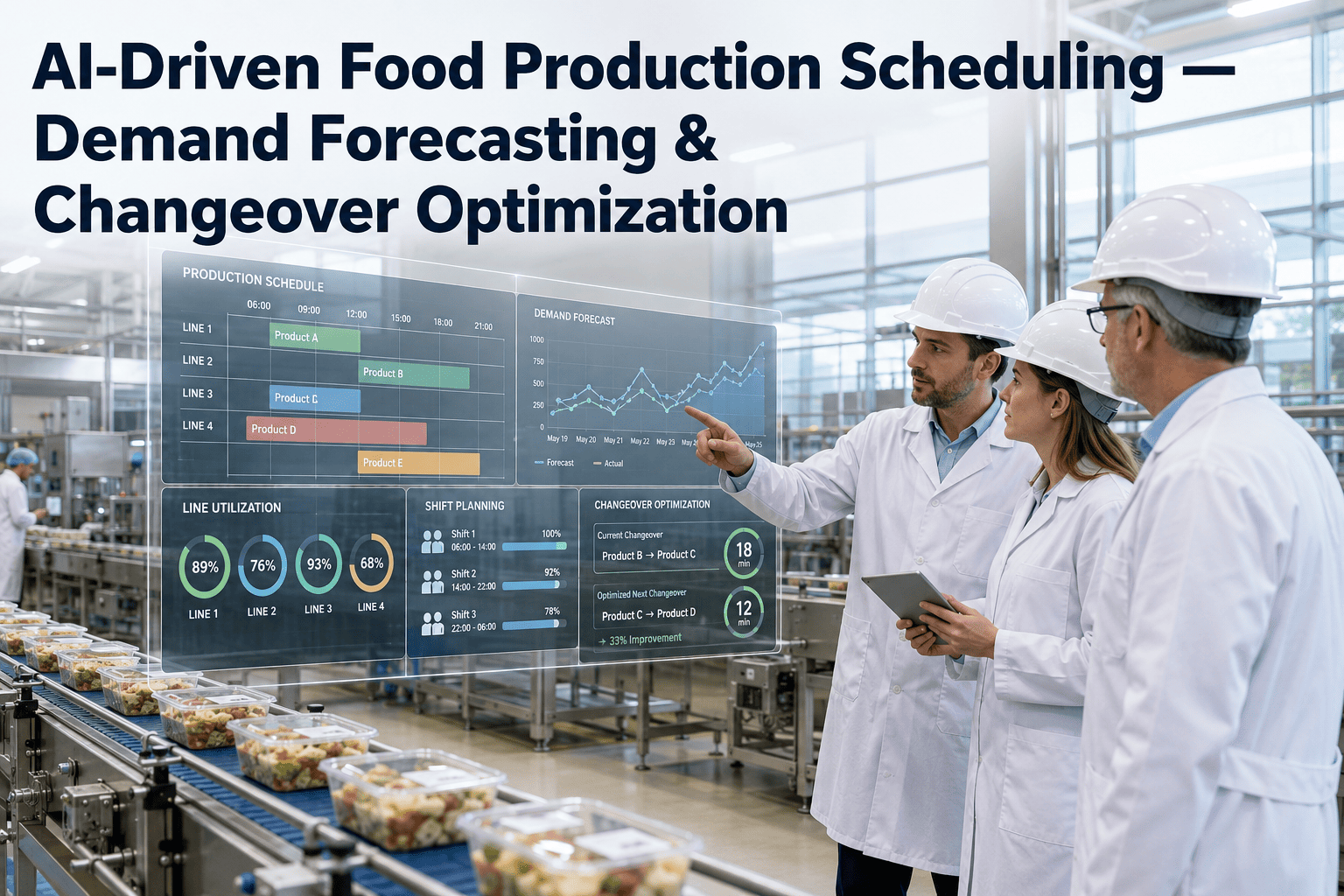
AI models predict cleaning duration based on allergen severity, equipment history, and crew size — giving production schedulers accurate changeover windows and preventing the schedule pressure that drives shortcuts.
AI SchedulingOne-Click Audit Documentation
Every allergen changeover generates a complete compliance record: cleaning steps, timestamps, operator IDs, swab results, and authorization sign-offs — formatted for BRCGS, SQF, and FSMA audit submission on demand.
Audit-ReadyAllergen Cleaning Validation: What "Validated" Actually Means
Allergen cleaning validation is one of the most misunderstood requirements in food safety management. Many facilities have procedures they call "validated" but which have never been tested against actual allergen residue. True validation requires demonstrating — through challenge studies, surface swab sampling, and analytical testing — that the cleaning procedure consistently reduces allergen residue below the safe action limit. BRCGS Issue 9 and SQF Edition 9 both require documented validation evidence, not simply a written procedure. iFactory stores validation study results against each equipment record, links them to the active procedure version, and flags re-validation triggers automatically — plants looking to close their compliance gap can Book a Demo to see this in action.
Allergen Changeover Checklist: Structure for High-Risk Line Transitions
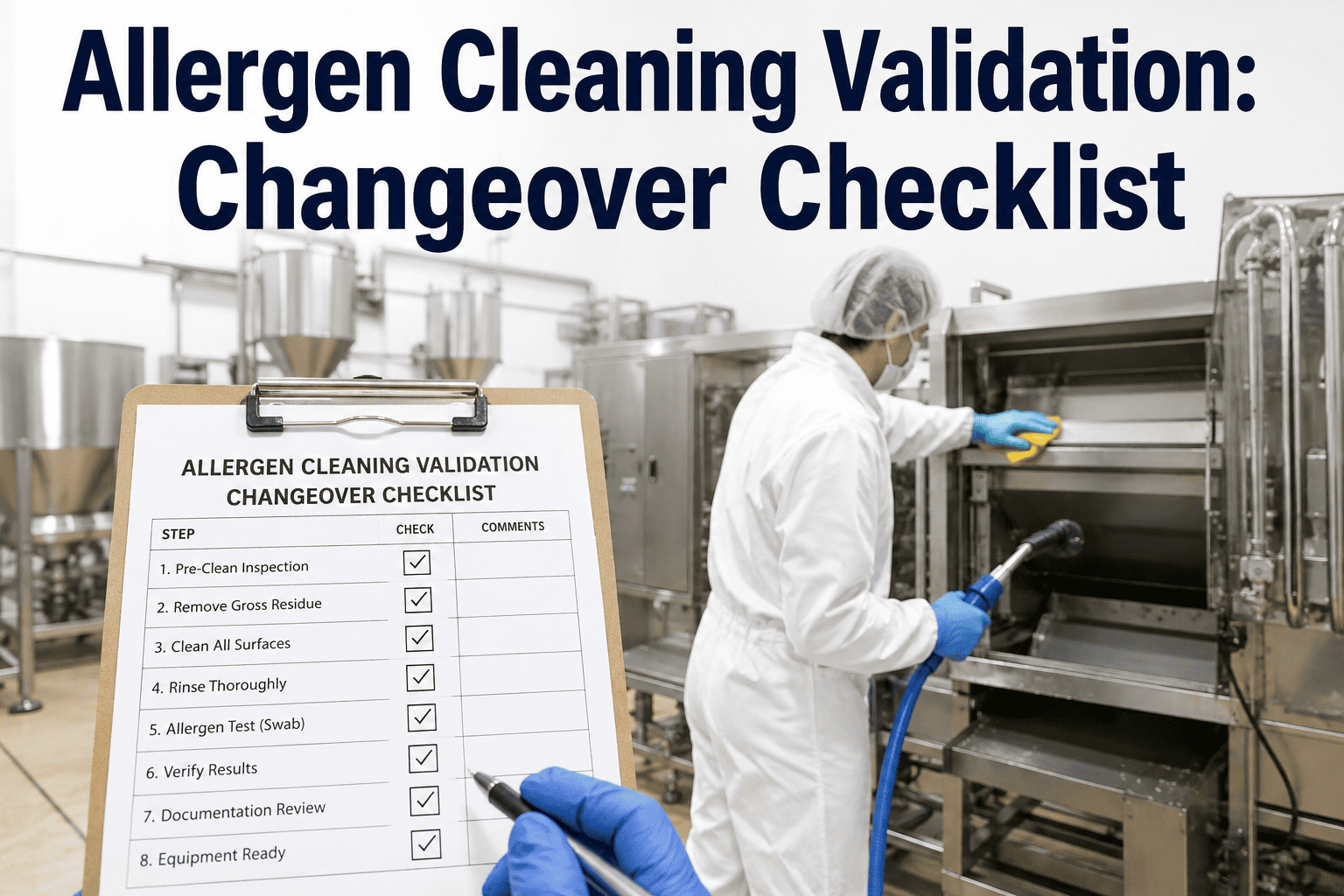
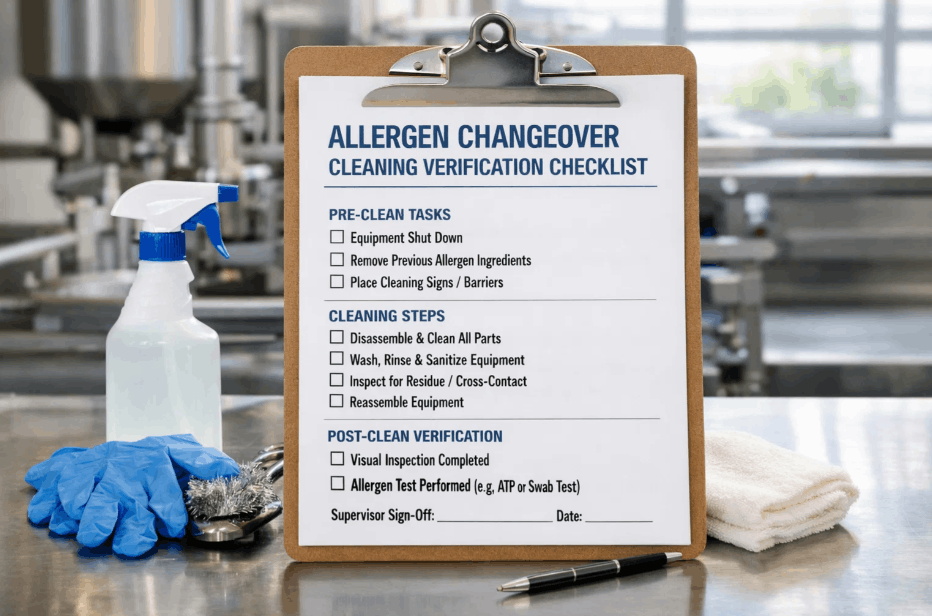
A well-designed allergen changeover checklist is not a single document — it is a hierarchical set of controls organized by zone, equipment, and verification method. The structure below represents best-practice allergen changeover protocol design for high-risk transitions (allergen-containing to allergen-free production) in a food or beverage manufacturing environment. Plants can Book a Demo to see how iFactory digitizes and enforces each layer of this protocol in a live production environment.
| Changeover Stage | Control Activity | Responsible Party | Verification Method | Documentation Required |
|---|---|---|---|---|
| Pre-Changeover | Allergen risk assessment — confirm incoming allergen, confirm next product allergen profile | Production Supervisor | Digital work order review | Changeover authorization form |
| Line Clearance | All product, packaging, labels, and rework removed; line physically cleared and confirmed empty | Operator + Supervisor | Visual inspection sign-off | Line clearance checklist with timestamp |
| Dry Clean | Vacuuming, brushing, and disassembly of product-contact parts; allergen debris removed before wet clean | Sanitation Team | Supervisor visual check | Step-level digital completion record |
| Wet CIP / Manual Wash | Validated cleaning procedure applied at correct concentration, temperature, and contact time per equipment SOP | Sanitation Team | CIP parameter log or manual record | CIP log with validated parameters |
| Rinse & Reassembly | Final rinse completed; equipment reassembled in correct sequence; all seals and gaskets verified | Sanitation Team | Supervisor sign-off | Reassembly checklist |
| ATP Swab Testing | ATP surface swabs collected at defined locations per environmental monitoring plan; results entered in system | QA Technician | ATP meter + digital entry | Swab result record linked to changeover |
| Allergen Swab Testing | Allergen-specific ELISA or lateral flow swabs at highest-risk contact points; results vs. action limit | QA Technician | Allergen test kit + digital entry | Allergen swab result record |
| Pre-Op Inspection | QA and production supervisor joint pre-operational inspection of all product-contact surfaces | QA + Supervisor | Joint visual inspection sign-off | Pre-op inspection record with timestamp |
| Production Release | All controls cleared; digital production release authorization issued; lot traceability record opened | QA Manager | System-enforced authorization | Digital release authorization record |
AI-Driven Work Order Automation for Allergen Changeover
The critical enabler of consistent allergen changeover execution is not the procedure itself — it is the system that delivers the procedure, enforces each step, captures evidence, and prevents production release when controls are incomplete. AI-driven work order automation transforms allergen changeover management from a paper-dependent process into a digitally enforced workflow that is consistent across every shift, every line, and every operator. For plants evaluating platforms, Book a Demo to see work order automation applied to your specific allergen product matrix.
How iFactory Automates Allergen Changeover Work Orders
When a production schedule change triggers an allergen transition, iFactory automatically generates a work order containing the correct cleaning procedure for that specific allergen pair and equipment set. The work order is pushed to the sanitation team's mobile device, step completion is captured with timestamps, and swab results are entered directly in the work order before supervisor sign-off is enabled. The entire record — from schedule trigger to production release — is stored as a single compliance package retrievable for any audit.
Automated Changeover Triggering
Production schedule changes automatically generate the correct allergen changeover work order — no manual communication required between scheduling, sanitation, and QA teams.
- Allergen pair determines cleaning scope
- Equipment-specific tasks assigned automatically
- Predicted cleaning time calculated by AI
Enforced Step Completion
Every cleaning step must be digitally completed before the next step unlocks. Skipping steps is architecturally impossible — eliminating the documentation-after-the-fact problem endemic to paper systems.
- Sequential step enforcement
- Photo capture at critical points
- Timestamp and operator ID on every step
Swab-Gated Production Release
ATP and allergen swab results must be entered and within limit before the production release authorization step becomes available. A positive result re-triggers re-clean and re-test — automatically.
- Results linked to the work order record
- Automatic re-clean dispatch on positives
- Trend reporting by equipment and allergen type
See Allergen Changeover Automation Live in Your Production Environment
Digital allergen cleaning protocols, swab-gated production release, AI changeover scheduling, and one-click BRCGS/SQF audit documentation — out of the box for food manufacturers.
Allergen Cross-Contamination Prevention: Beyond the Cleaning Step
Effective cross-contamination prevention in allergen changeover management extends beyond the cleaning procedure itself. Plants must control allergen risk at every stage of the production transition: scheduling, traffic flow, air handling, rework management, and packaging line changeover. A thorough allergen control program addresses all of these vectors — not just surface cleaning. For food manufacturers evaluating their current allergen program, Book a Demo to identify gaps in your current changeover control architecture.
Production Sequencing
Schedule allergen-containing products last in a production sequence where possible. When allergen-free products must follow allergen products, ensure sufficient changeover time is allocated — AI-predicted, not estimated.
Rework and Waste Control
Rework from allergen-containing products must be clearly labeled, segregated, and tracked with lot-level traceability. Any rework introduced into a subsequent run must be allergen-compatible and documented.
Dust and Airborne Transfer
Dry powder allergens — flour, milk powder, nut flours — present airborne transfer risk that surface cleaning alone cannot eliminate. HVAC management and settling time protocols must be part of the changeover procedure.
Label and Packaging Control
Allergen-related recalls frequently involve correct product in incorrect packaging — or vice versa. Line clearance and label verification must be a defined step in every allergen changeover work order.
BRCGS and SQF Requirements for Allergen Changeover Documentation
Both BRCGS Issue 9 and SQF Edition 9 place significant audit weight on allergen management programs, with specific requirements for changeover cleaning procedures, validation evidence, and production records. Understanding exactly what these standards require — and where manual systems typically fall short — is essential for food safety directors preparing for certification or surveillance audits.
BRCGS Issue 9 Allergen Control Requirements
BRCGS requires that allergen cleaning procedures are validated and that validation records are maintained and reviewed. The standard also requires that pre-operational allergen checks are completed before a production run starts following an allergen changeover, and that the results of those checks are documented. In 2026, BRCGS auditors increasingly expect to see digital records with user authentication and timestamps — paper sign-off sheets with illegible signatures no longer satisfy the intent of the standard. Plants using iFactory can generate a complete BRCGS-formatted allergen changeover package for any production day in minutes — Book a Demo to see how audit-ready documentation is produced on demand.
SQF Edition 9 Allergen Management Documentation
SQF Edition 9 Module 11 requires documented procedures for allergen management that include cleaning and changeover verification, allergen testing, and corrective action when verification fails. SQF auditors specifically look for evidence that the cleaning procedure was actually followed on the day in question — not just that a procedure document exists. Digital work order records with step-by-step completion timestamps are substantially more defensible under SQF audit than paper checklists completed after the fact. Manufacturers preparing for SQF certification can Book a Demo to walk through SQF Module 11 compliance workflows in a live food plant environment.
Allergen Changeover Management ROI: The Business Case for Digital Protocols
The return on investment for allergen changeover management automation is among the most straightforward calculations in food safety technology. A single undeclared allergen recall costs an average of $10M in direct expenses — before legal liability, brand damage, and lost distribution. The annual licensing cost of an AI-driven allergen management platform is recoverable many times over by preventing a single moderate recall event. Operations leaders building the internal business case can Book a Demo to receive a plant-specific ROI estimate based on your production volume and allergen product mix.
Recall Prevention
AI-enforced allergen cleaning protocols with swab-gated production release eliminate the execution gaps that cause undeclared allergen recalls. Plants with digital allergen changeover management report 60–70% fewer allergen-related customer complaints.
QA Administration Time
Food safety teams spend 8–12 hours per week compiling, filing, and locating allergen changeover records for internal reviews and audits. Digital work order systems reduce this to under 2 hours — freeing QA professionals for actual food safety improvement work.
GFSI Audit Grade Protection
Allergen control findings are among the most commercially damaging audit outcomes — retail and foodservice customers may delist or reduce orders following an allergen-related major nonconformance. Digital systems reduce audit findings by 73–94% in plants with previously manual allergen programs.
Changeover Time Optimization
AI-predicted changeover times allow production schedulers to plan realistic transitions — preventing both rushed changeovers that cut cleaning short and excessively conservative buffers that reduce utilization. Optimized allergen changeover scheduling improves line efficiency by 8–15% in multi-allergen facilities.
Frequently Asked Questions: Allergen Changeover Management
Implement AI-Driven Allergen Changeover Management with iFactory
In 2026, food and beverage facilities cannot afford to manage allergen changeover risk with static paper checklists and manual supervisor sign-offs. iFactory's AI-driven Work Order Automation platform delivers the complete allergen changeover management architecture food plants need: allergen-matrix-aware work order generation, equipment-specific validated cleaning checklists, swab-gated production release, and one-click BRCGS/SQF audit documentation — fully configured for food manufacturing from day one, with no custom development required. Book a Demo to evaluate iFactory against your facility's allergen product matrix and changeover complexity.
Validate Every Transition. Release Every Run with Confidence.
AI-driven protocols, swab-gated release, and audit-ready records — purpose-built for food manufacturing. Live in 10–14 weeks, no custom development required.