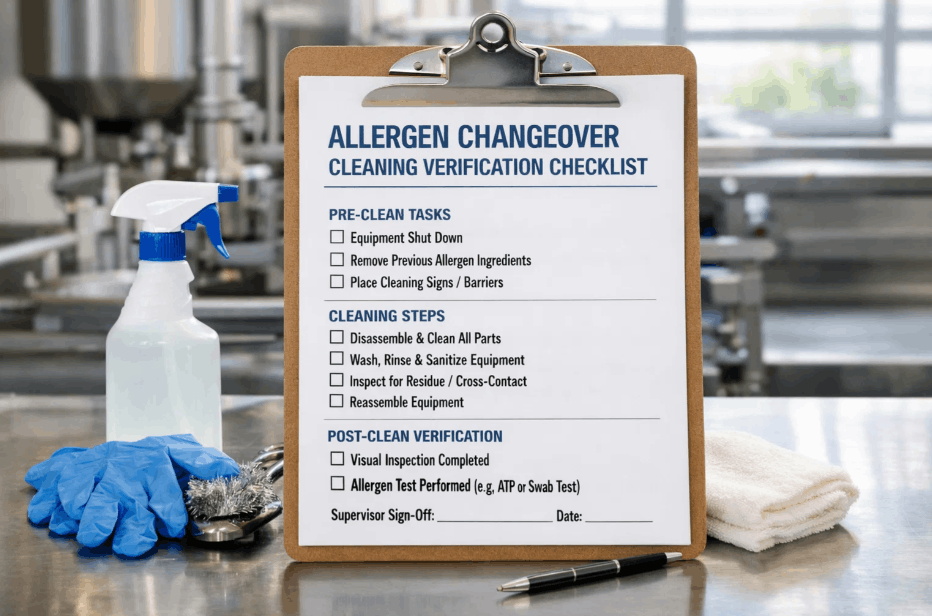
Most allergen cross-contact incidents don't come from a missing procedure — they come from a step inside an existing procedure that got skipped under time pressure, on a day the line was running behind and nobody wanted to be the person who slowed it down further. A checklist doesn't replace a validated cleaning method, but it does close the gap between what a procedure says on paper and what actually happens on the floor during a real changeover. This checklist walks through every phase of allergen changeover control, from validating a cleaning method for the first time through the exact conditions that should trigger a line release sign-off. If you want a second set of eyes on where your current process stands, a free changeover validation review can walk through it with you.
Food & Beverage · Allergen Control Checklist
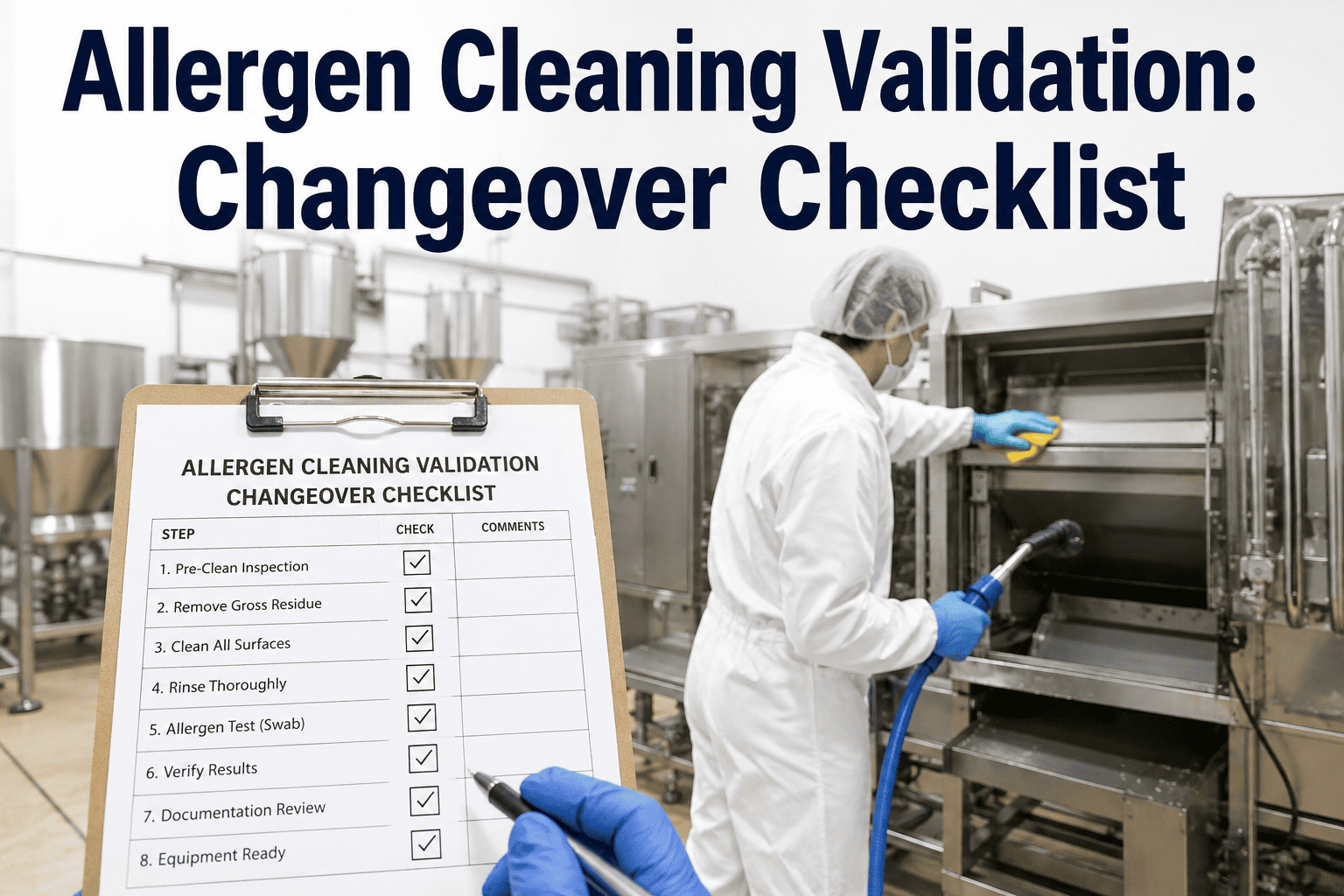
The Allergen Changeover Checklist: From Validation to Line Release
A step-by-step checklist covering validation, everyday verification, and the line release sign-off that turns a cleaning procedure into documented, defensible proof.
How to Use This Checklist
This checklist is organized into five phases that mirror the actual lifecycle of an allergen changeover program: setting up a validation study, running it, performing everyday verification between changeovers, making the line release decision, and responding correctly when a verification test fails. Work through each phase in order the first time you build a program, then use the individual checklists as a running reference during daily operations.
1Validation Setup
2Run the Study
3Daily Verification
4Line Release
5Failure Response
Phase 1: Validation Study Setup Checklist
Before any lab testing happens, confirm the study is designed to actually prove something. A validation study built on the wrong assumptions produces a result that looks reassuring but isn't defensible in an audit.
☐ Worst-case allergen-load product identified for the pre-changeover run
☐ Hardest-to-clean product configuration selected, not the easiest
☐ Exact production cleaning chemistry, timing, and equipment confirmed for the study
☐ Same personnel process used in daily production assigned to perform the study
☐ High-risk sample locations mapped — seams, gaskets, dead legs, hard-to-reach surfaces
☐ Lab identified for quantitative ELISA or equivalent allergen testing
☐ Number of repeat cleaning cycles for statistical confidence agreed in advance
Phase 2: Running and Locking the Validation Checklist
☐ Worst-case product run and changeover cleaning performed exactly as planned
☐ Samples collected from every mapped high-risk location, not just easy-access points
☐ Samples sent to lab for quantitative testing, results logged per location
☐ Study repeated across multiple cleaning cycles to confirm consistency
☐ All results fall within the acceptable threshold across every cycle and location
☐ Exact validated procedure documented in writing as the locked standard method
☐ Re-validation trigger conditions defined — new product, new chemistry, new equipment
Not sure your current validation study would hold up to this level of scrutiny? Talk to our team about reviewing it.
Everyday Verification Methods at a Glance
| Method | Speed | Sensitivity | Best Use |
|---|
| Visual inspection | Immediate | Low — misses invisible residue | First-pass check before further testing |
| ATP swab | Under 1 minute | General cleanliness, not allergen-specific | Quick overall cleanliness gauge |
| Rapid allergen lateral flow test | 5-15 minutes | Allergen-specific, qualitative | On-floor line release decisions |
| Lab-based ELISA | Hours to days | High, quantitative | Validation studies, periodic audits |
Phase 3: Daily Changeover Verification Checklist
This is the checklist that runs every single changeover, not just during a validation study. Skipping any item here is what turns a validated method into an unverified assumption on any given day.
☐ Locked validated procedure pulled and followed exactly — no shortcuts or substitutions
☐ Full cleaning time completed, not cut short to save minutes
☐ Same chemistry and concentration used as in the validated study
☐ Visual inspection performed as the first-pass check
☐ Rapid allergen test performed at the previously mapped high-risk locations
☐ Test result recorded against the defined pass threshold, not just "looked fine"
☐ Result and timestamp logged and tied to the specific line and changeover event
Still Tracking Changeover Verification on Paper Checklists?
Digital tracking closes the gaps that paper records tend to have — missing signatures, unclear timestamps, and no clean link back to the batch that was released.
Phase 4: Line Release Sign-Off Checklist
Line release is the single moment a documentation gap turns into an actual safety risk rather than a paperwork issue. None of the previous checklists matter if this final sign-off step gets treated as a formality instead of a real decision point.
☐ Validated cleaning procedure confirmed complete, start to finish
☐ Verification test performed at every required location
☐ Every result compared individually against the defined pass threshold
☐ No outstanding failed results anywhere on the line
☐ Named individual signs off with a date and time, not a verbal go-ahead
☐ Signed release record retained and linked to the production batch it releases
What Full Documentation Coverage Looks Like
Complete
Chain from validated method to daily verification record
Named
Sign-off tied to every line release decision, not a verbal pass
Traceable
Verification record linked directly to the batch it released
Phase 5: Verification Failure Response Checklist
A failed verification result is not a cue to simply re-clean and re-test until something passes. Treat it as a food safety deviation with its own investigation trail, the same way you would any other quality failure on the line.
☐ Failure documented immediately with location, result, and time
☐ Investigation opened into whether the validated procedure was actually followed
☐ Full validated cleaning method re-performed, not a partial re-clean
☐ Verification test repeated at the failed location and confirmed passing
☐ Line release withheld until a passing result is confirmed and recorded
☐ Repeat failures at the same location flagged for re-validation review, not just retraining
Seeing repeat failures at the same location? Talk to our team about whether your validated method needs a second look.
Frequently Asked Questions
Is this checklist a replacement for a full validation study?
No, this checklist is meant to structure and support a validation study and the daily verification process around it, not replace the lab-based testing that a real validation study requires. Think of it as the operational discipline that makes sure the validation you've already invested in actually holds up on the floor every day.
Our team can help you build the underlying validation study if you don't have one yet.
How often should the daily verification checklist actually be used?
Every single changeover where an allergen-containing product transitions to a non-allergen or different-allergen product should go through the full verification checklist, with no exceptions for time pressure or a line that looks visually clean. Skipping the checklist on a busy day is exactly the pattern that leads to undocumented, unverified line releases.
Who should be responsible for the line release sign-off?
The sign-off should come from a specific named individual with the authority and training to evaluate verification results against the defined threshold, typically a shift supervisor or quality technician rather than the line operator who performed the cleaning itself. Separating the person who cleans from the person who releases adds an important check into the process.
What triggers a re-validation instead of just continuing with the existing checklist?
Any change to the cleaning chemistry, equipment, timing, or the introduction of a new product with a higher allergen load than what the original study covered should trigger re-validation before the existing checklist and validated method are trusted going forward. Using an outdated validation against new conditions is a common audit finding.
Can this entire checklist process be tracked digitally instead of on paper?
Yes, and digital tracking is generally more defensible in an audit because it closes common paper-based gaps like missing signatures, unclear or backfilled timestamps, and a weak link between a verification record and the specific batch it released.
Book a demo to see how a digital version of this checklist could work on your lines.
Turn This Checklist Into a Documented, Defensible Process
Our team can help you build a validated allergen changeover program for your specific lines and allergens, starting with a free review of where you stand today.