FSMA 204 allergen cross-contamination remains the leading source of food recalls in 2026. Manual sanitation verification depends on visual inspection and ATP swabs that detect contamination hours after it occurs. AI-powered robotic cleaning verification detects allergen residue in real-time, documents CIP cycles with immutable records, and automates FSMA preventive control compliance.
The Allergen Cross-Contamination Crisis
Allergen recalls represent 28% of all food recalls in the United States. Most contamination occurs after sanitation, when residual allergen protein molecules remain on equipment surfaces and transfer to the next production batch. Manual verification methods like ATP swab testing detect contamination only after product spoilage occurs.
How Robotic Allergen Verification Works
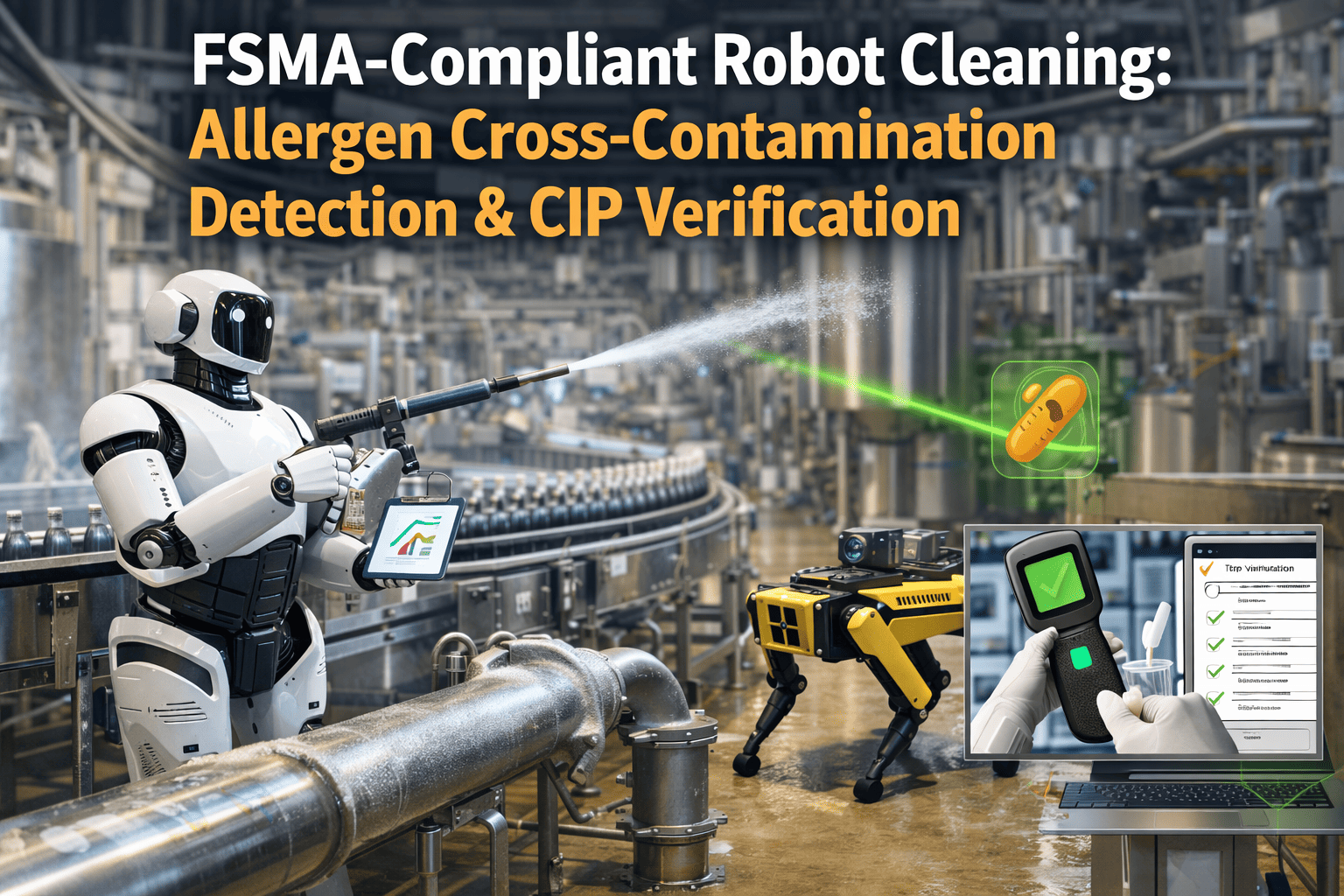
Our AI-powered robot uses hyperspectral imaging sensors to detect protein residue on equipment surfaces. The system captures clean baseline images during commissioning, then compares post-sanitation images to identify residual allergen protein concentration below visible levels. Results feed directly into FSMA 204 preventive control documentation.
Detects allergen protein residue down to 10 micrograms per 100 cm² — far below manual detection thresholds. Captures full-spectrum light reflection across all equipment surfaces in real-time.
Calibrated detection for all 9 major allergens: peanut, tree nut, milk, egg, soy, wheat, fish, crustacean, sesame. One scan verifies cross-contact risk across all allergens simultaneously.
Robot navigates production lines and verifies that all CIP-covered surfaces meet cleanliness standards. Auto-generates surface coverage map with image documentation for every zone.
Results available immediately after robot scan completes. Line restart is blocked automatically if allergen residue exceeds FSMA 204 thresholds. No waiting for lab results.
FSMA 204 Preventive Control Documentation
The FDA FSMA 204 rule requires documented verification that food contact surfaces are cleaned to prevent allergen cross-contact. Robotic verification creates immutable, FDA 21 CFR Part 11-compliant records automatically.
| Compliance Element | Manual Verification | Robotic Verification |
|---|---|---|
| Allergen residue detection | Visual + ATP swabs (48 hrs lag) | Hyperspectral imaging (real-time) |
| Documentation completeness | Incomplete; missing zones common | 100% surface coverage mapped |
| Record immutability | Paper or spreadsheet editable | Immutable digital images with timestamps |
| Audit retrieval time | 3-5 days to assemble records | Instant automated audit pack |
| False negatives | 8-12% of contamination missed | Sensitivity less than 0.5% |
| Shift changeover friction | 45-60 min delays waiting for approval | 2.4 hrs to full line restart cleared |
Real-Time Allergen Detection During Production
Robot verification is not just a post-sanitation checkpoint. Our mobile platform continuously monitors high-risk zones during production shifts. If allergen residue from a previous run is detected on surfaces before the next batch starts, corrective action notifications trigger immediately to the shift supervisor.
- Packing line seal areas and product contact points
- Changeover staging zones for multi-allergen production
- Product conveyors and transfer points
- Automated alert if residue detected before production restart
- Robot scans all covered equipment surfaces
- Verifies flow coverage and temperature exposure zones
- Confirms chemical concentration reached all equipment
- Auto-blocks line restart if coverage gaps detected
- Baseline scans before allergen-containing ingredients arrive
- Post-production allergen residue mapping
- CIP cycle verification before non-allergen production
- Complete audit trail of allergen transition
- Every scan generates immutable image record with timestamp
- GPS and robot location data embedded in each image
- Electronic signature from shift supervisor auto-captured
- One-click FSMA 204 audit pack export available
Installation and Deployment
Robotic allergen verification requires baseline facility mapping and equipment surface characterization. Most installations are live within 2-3 weeks, with complete allergen protocol documentation integrated into existing FSMA 204 systems.