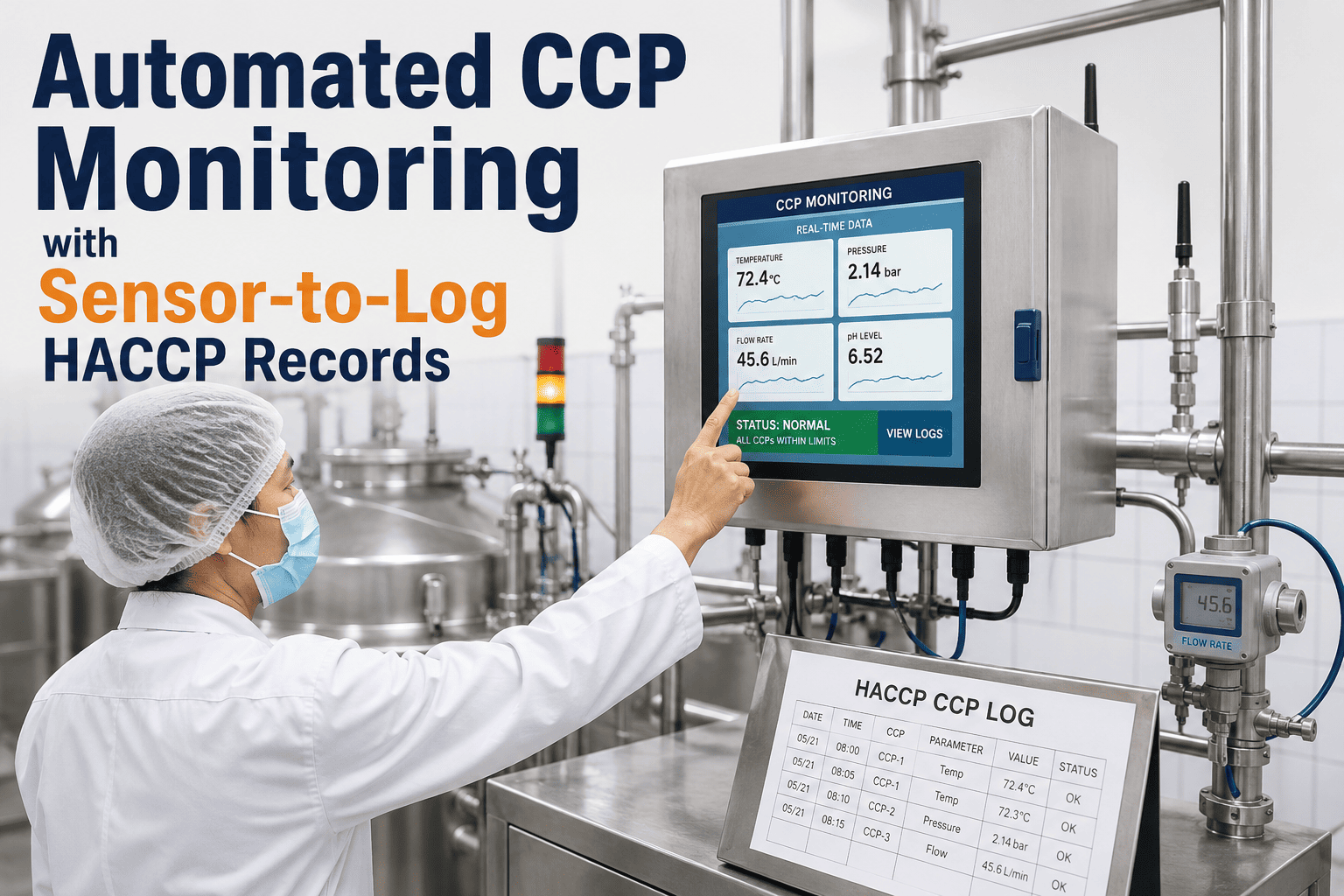
A thermocouple sitting on a pasteurizer already knows the temperature every second of the run. Yet in most food plants, that reading gets copied onto a clipboard every fifteen minutes by an operator who is also watching three other things, then transcribed again into a spreadsheet at end of shift, then filed in a binder nobody opens until an auditor asks for it. Two manual transcriptions sit between the sensor and the record an inspector will eventually trust. Closing that gap with automated sensor-to-log capture is possible today, and plants curious what it looks like on their own line can Book a Demo to see it running.
Every CCP Reading, Logged the Moment the Sensor Takes It
iFactory pulls temperature, time, and pressure readings straight from your existing sensors into the HACCP record — no clipboard, no re-typing, no gap between the reading and the log.
Where Manual CCP Logging Actually Fails
Manual CCP monitoring does not fail because operators are careless — it fails because the job asks a person to be a data logger and a line operator at the same time, and the line operator part always wins when the two compete for attention, especially during the exact moments when the line is running fastest and a data-logging distraction is least welcome. A reading taken thirty seconds late because the operator was mid-task on something else is common, harmless most of the time, and completely invisible in the record, because the record only shows the number that got written down, not when the sensor actually produced it.
The bigger risk shows up in the gaps between readings. A CCP that drifts out of limit for two minutes between scheduled fifteen-minute checks will never appear in a manual log at all, because nobody was looking at that exact moment. Continuous sensor capture removes that blind spot entirely, since the record reflects every reading the sensor produced, not just the ones a person happened to transcribe during a scheduled check.
There is also a quieter version of this problem that rarely gets discussed openly: the tendency, under production pressure, to write down the expected value rather than walk over and check the actual one carefully. This is not usually dishonesty in any deliberate sense — it is what happens when a person is asked to perform a repetitive check dozens of times a shift while also running the line, and muscle memory starts filling in the blanks. A sensor does not have muscle memory, and it does not get busy. It reports exactly what it measured, every time, which is precisely the property a HACCP record needs to hold up under scrutiny.
None of this is a criticism of the operators doing the checking. It is a structural problem with asking a human being to serve as the data acquisition system for a process running continuously, twenty-four hours a day, across multiple shifts and multiple people with varying levels of experience and attentiveness on any given day. Automating the acquisition step does not remove the operator's role in the process — it removes the one part of the role that a sensor was always better suited to handle.
How the Capture Pipeline Works
Automated CCP monitoring does not require replacing the sensors already installed on the line — it requires connecting the signal those sensors already produce to a system that can log it, check it, and act on it without a person in the middle. The pipeline below shows how a raw sensor signal becomes an audit-ready HACCP record.
Each stage in this pipeline is designed to be inspectable on its own, so a reviewer can trace a single reading all the way from the raw sensor value through the limit check to the final logged record without gaps, which is exactly the kind of traceability a robust food safety program depends on when a question comes up months after the reading was originally captured.
This distinction matters because it changes the conversation with engineering from a capital equipment project into an integration project, and those are very different conversations to have. A capital equipment project means new instrumentation, a revalidation cycle for the sensor itself, and a much longer approval process before anything can move forward. An integration project means tapping a signal that is already there, already calibrated, and already trusted by the process control system running the line today, which is a far smaller ask of engineering and a far faster path to a working, validated pilot.
Signal Tap
The existing thermocouple, pressure transducer, or flow sensor is tapped at the PLC or sensor output, with no changes to the physical monitoring equipment already validated on the line.
Continuous Sampling
Readings are captured on a continuous or high-frequency interval rather than a scheduled manual check, so no excursion between checks goes unrecorded.
Limit Check
Each reading is compared in real time against the critical limit defined in the approved HACCP plan for that specific CCP.
Immutable Log
The reading, timestamp, and pass/fail result are written to a record that cannot be edited after the fact, satisfying the audit trail requirement without a manual re-entry step.
Deviation Alert
Any reading outside the critical limit triggers an immediate alert to the responsible operator or supervisor, rather than waiting for the next scheduled review.
What Automated Capture Actually Replaces
It helps to be specific about what changes for the floor team, because automated CCP monitoring is often misunderstood as removing the operator from the process entirely. In practice, it removes the transcription step, not the operator's judgment. The operator still owns the corrective action decision when a deviation occurs, still signs off on verification, and still has full visibility into what the system is recording — the difference is that the number in the record came directly from the sensor rather than from memory of a reading taken a few minutes earlier.
Plants that have rolled this out across several CCPs consistently mention one unexpected benefit: operator trust in the system tends to increase, not decrease, once the automated log has been running long enough to prove itself against the manual process it replaced. Operators who once worried that automated monitoring would be used to second-guess their judgment tend to find the opposite is true — the record now backs them up with an objective timestamped history, rather than leaving their word as the only evidence of what actually happened during a given shift. The four CCP types below cover most of what a typical food or beverage plant needs to bring under continuous, automated capture.
Temperature CCPs
Cook, chill, and hold temperatures captured continuously from existing thermocouples rather than spot-checked on a schedule.
Time-Based CCPs
Dwell time within a process step calculated automatically from equipment cycle data instead of a manually started stopwatch.
Pressure & Flow CCPs
Retort pressure and flow rate readings captured from existing process control instrumentation without additional hardware.
pH & Water Activity
In-line probe readings logged automatically where continuous instrumentation exists, reducing reliance on manual spot sampling.
The Record an Auditor Actually Sees
The difference between a manual and an automated CCP record becomes obvious the moment an auditor asks a specific question: show me every reading for this CCP on this date, including anything outside the critical limit. A manual log answers that question by handing over a binder and hoping the relevant page is easy to find. An automated log answers it in seconds, with every reading timestamped, every deviation flagged, and every corrective action linked to the specific reading that triggered it.
Third-party audits under GFSI-benchmarked schemes increasingly expect exactly this level of retrieval speed, not because the standard explicitly mandates a specific technology, but because auditors have seen what fast, complete retrieval looks like at other facilities and now treat a slow, manual search as a signal worth probing further. A quality manager who can pull twelve months of a specific CCP's history in under a minute, filtered to just the deviations and their corrective actions, sends a very different signal about the maturity of the food safety program than one who needs to schedule time to dig through a records room.
The same speed matters even more during an actual recall investigation, when the question is rarely as clean as "show me one CCP on one date." Investigators typically need to trace a specific lot backward through every CCP it passed through, across a specific production window, cross-referenced against raw material lots and equipment used — a query that a connected digital record answers directly and a paper system answers only after days of manual reconstruction, time a genuine recall investigation does not have to spare.
Versus scheduled checks every 15 to 60 minutes under a manual monitoring program.
From an out-of-limit reading to a deviation alert reaching the responsible operator.
To pull a full CCP history for any date range during an audit or investigation.
Manual Logging vs. Sensor-to-Log Capture
The table below lines up the two approaches directly, factor by factor, using the same criteria a quality manager would actually weigh when deciding whether to invest in automated capture for a given CCP, from the source of the reading itself down to how long it takes to answer an auditor's question about it.
It is worth being honest that manual logging is not being replaced because it is inherently dishonest or careless — it is being replaced because it was never designed to keep pace with the volume and precision that modern food safety oversight now expects. A manual system built decades ago for periodic spot checks is simply being asked to do a job it was not designed for, at a scale and speed that continuous production and increasingly rigorous customer and regulatory scrutiny now demand.
| Factor | Manual Logging | Sensor-to-Log Capture |
|---|---|---|
| Reading source | Operator observation | Direct sensor signal |
| Frequency | Scheduled checks | Continuous |
| Between-check gaps | Unrecorded | Fully captured |
| Deviation detection | Next scheduled check | Real time, under 30 seconds |
| Record retrieval | Manual binder search | Instant digital query |
Where to Start on Your Line
Most plants do not automate every CCP on day one, and there is no need to. The highest-value starting point is usually the CCP with the tightest critical limit or the highest consequence if missed — a cook step or a pasteurization hold time, for example — where continuous monitoring closes the biggest existing risk gap first. Once that pilot proves out against the existing manual process, extending capture to additional CCPs on the same line is largely a matter of tapping the next sensor rather than redesigning the approach.
Choosing the pilot CCP deliberately, rather than simply picking whichever one is easiest to connect, tends to produce a much stronger internal case for expanding the program afterward. A pilot on a low-risk CCP with a generous critical limit rarely generates a deviation during the parallel comparison period, which means the team never actually sees the alerting and corrective-action workflow exercised for real before deciding whether to expand it further.
A typical pilot on a single CCP, from sensor tap to a fully validated automated log running alongside the existing manual process for a comparison period, takes two to three weeks. Most plants run the automated and manual logs in parallel for one to two weeks before retiring the manual check entirely, giving the quality team direct evidence that the automated readings match what the operator was recording by hand before making the switch permanent.
During that parallel period, it is common to find small, previously invisible discrepancies between the manual and automated readings — not because either record is wrong, exactly, but because a manual reading taken at a slightly different moment than the scheduled time will naturally differ from a continuous automated trace of the same period. Reviewing those discrepancies together with the quality team is a useful exercise in its own right, since it usually clarifies exactly how much variability existed in the manual process all along, information that was previously invisible because there was no continuous record to compare a spot check against.
Once the first CCP has been through this parallel validation and the manual check is retired, expanding to the next CCP on the same line is typically faster, since the underlying integration work — connecting the system to the plant's sensors and PLC — has already been done. Many plants find that a second and third CCP can be piloted in half the time the first one took, simply because the team already understands the workflow and the engineering groundwork is already in place.
Who Feels the Difference First
Different roles in the plant experience the shift to automated capture in different ways, and it is worth being specific about each, because the value is not identical for everyone and framing it correctly matters when building internal support for the change. Quality managers feel it most directly in how much faster audit preparation becomes, since the records they need to pull together for an internal review or an external audit are already assembled and searchable rather than scattered across binders that need to be physically located and cross-referenced by hand.
Plant floor supervisors feel it in how much earlier they learn about a problem. A deviation alert that reaches a supervisor within thirty seconds of an out-of-limit reading gives them a genuinely useful window to intervene before product moves further downstream, compared to a manual system where the same deviation might not surface until the next scheduled check, by which point significantly more product has already passed through the affected step.
Operators, once past the initial adjustment period, tend to feel relief more than anything else. The transcription burden — remembering to check, remembering to write it down, remembering to write down the actual number rather than the expected one under time pressure — is a real cognitive load that automated capture removes, freeing attention for the parts of the job that genuinely require a person's judgment rather than their memory. Plant managers and food safety directors, meanwhile, feel the difference most in board-level and customer-facing conversations, where being able to describe a continuous, sensor-verified monitoring program is a materially stronger claim than describing a well-run manual one, particularly when a major customer's own food safety team is doing the asking.
Frequently Asked Questions
Do we need to install new sensors, or can this use what we already have?
In the large majority of cases, the existing sensors already installed on the line are sufficient, since the system taps the signal those sensors already produce rather than requiring new instrumentation. The integration team reviews your current sensor types and PLC configuration during setup to confirm compatibility, and only recommends additional hardware where a CCP genuinely lacks any continuous monitoring capability today. This review typically takes a single site visit or a remote walkthrough of the control system documentation, and most plants are surprised how much of their existing instrumentation is already suitable once the review is complete.
What happens if the sensor connection drops during production?
A connection loss is logged as its own event in the record, with a clear timestamp showing exactly when monitoring capability was interrupted and when it fully resumed again, rather than silently producing a gap in the data with no explanation. Depending on the CCP and the plan's requirements, a connection loss can also trigger a fallback to manual monitoring for the duration of the outage, with that fallback period clearly flagged in the final record so a reviewer can immediately see which portion of the log was captured automatically and which portion reverted to a manual check during the interruption.
Can operators still see and interact with the readings in real time?
Yes, operators have full visibility into current and recent readings on the same terminal or tablet used for other line functions, and retain full control over the corrective action process when a deviation occurs. The system automates the transcription and comparison against the critical limit, not the operator's judgment about how to respond to a genuine deviation on the floor, and most plants configure the display so operators see a running trend rather than a bare number, making it easier to spot a slow drift toward a limit before it actually becomes a deviation.
How does this affect our existing verification and calibration procedures?
Sensor calibration and verification procedures continue exactly as your current program requires, since automated capture reads from the same sensors your verification program already checks. Calibration records can be linked to the sensor within the system so a reviewer can confirm a given reading came from a properly calibrated instrument, closing another common gap between calibration logs and monitoring records kept as entirely separate documents. If a sensor is found out of calibration during a scheduled check, the affected date range in the automated log can be flagged for review, giving the quality team a precise window to assess rather than questioning the entire monitoring history.
How do we get started piloting this on one CCP?
The iFactory Support team works with your engineering and quality leads to identify the sensor connection points on your highest-priority CCP and scope a pilot that runs alongside your existing manual process for direct comparison. Most teams find it useful to bring both an engineering representative and a quality representative to the initial scoping conversation, since the sensor integration and the HACCP record requirements are best planned together from the start. Teams ready to see the capture pipeline running on a live demo line can Book a Demo and walk through a real deviation alert end to end.
Stop Trusting a Reading That Was Written Down Twice.
Talk to iFactory about piloting sensor-to-log CCP capture on your highest-priority critical control point.