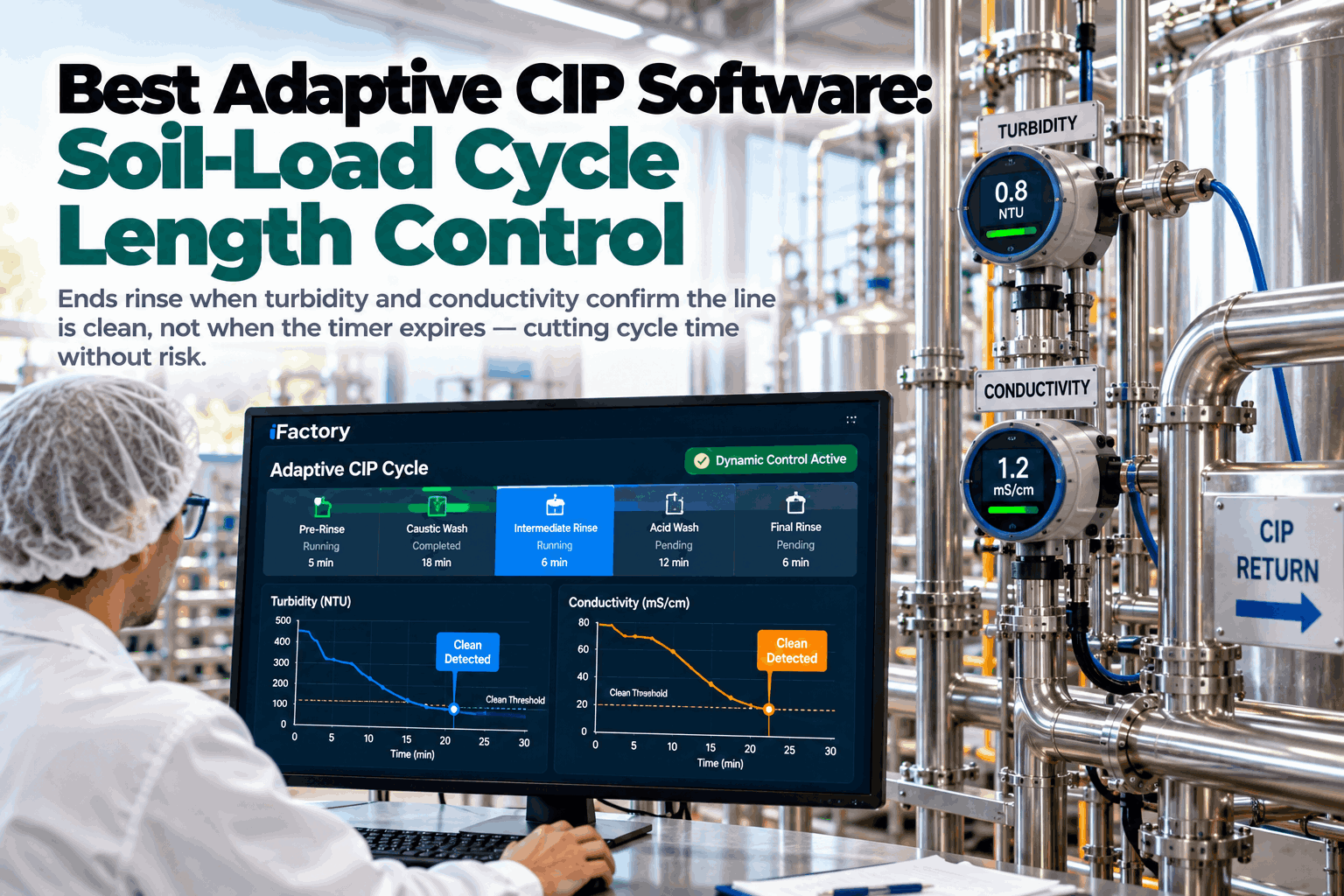
Most CIP cycles stop when a timer runs out, whether the line got clean in half the time or needed a little longer. Adaptive CIP lets the sensors decide instead. Each rinse ends once conductivity and clarity show it is done, and each wash follows the soil it actually meets. To see how much time your circuits could save, book an adaptive CIP review.
Adaptive CIP Software: Cycle Length Set by Soil Load
End each rinse when turbidity and conductivity confirm the line is clear, stretch the wash when soil is heavy, and keep every validated minimum in place so the clean never depends on luck.
- Which sensor ends which phase, and why
- Why adaptive can mean longer, not only shorter
- The guard rails that keep it safe
- Rinses: pre, intermediate, final
- Caustic wash
- Acid wash
Only the three rinses get shorter here. Caustic and acid keep their validated contact times. Ten minutes saved per cycle, about 19 percent, on this one circuit.
Why Timer-Led CIP Wastes Time
A timer knows the clock. It does not know the line.
Timers are set once, usually for the dirtiest day the line will ever see. On every lighter day, the rinse keeps running long after the water comes back clear. On the rare heavier day, the same timer may stop too soon. Adaptive control fixes both, by letting the return line, not the clock, decide when each rinse is finished. Our CIP support team can walk you through it on your own circuits.
Set for the worst case
Commissioning picks safe times for heavy soil, then nobody revisits them.
Blind to the run
A two-hour run and a twelve-hour run get the same cycle, even though their soil is nothing alike.
Blind to the product
Water-thin juice and sticky syrup get the same rinse, so one is over-rinsed and the other may be under-rinsed.
Blind to faults
A cool return or weak flow still "passes" once the clock runs out, and nobody sees it until a swab fails.
A fixed timer can hide a bad cycle. If flow was low or the caustic ran cool, the cycle still completes on time and looks normal. A sensor-led cycle notices, because it is watching the conditions, not the clock.
Signs a circuit would gain from adaptive control
Rinses run clear early
Return conductivity reaches fresh water well before the timer ends, cycle after cycle.
Run lengths vary a lot
Short and long runs share one recipe, so one of them is always cleaned wrongly.
Odd failures after heavy runs
Verification fails mostly after long or sticky runs, a hint the timer is too short for them.
How Adaptive CIP Decides When a Phase Is Done
Different phases need different signals. No single sensor does it all.
Conductivity tells you how much chemical is in the water. Turbidity tells you how much product or soil is in it. Temperature and flow tell you whether the wash is working at all. Adaptive CIP uses each where it is strongest. To match sensors to your phases, book a sensor planning call.
Conductivity is best for
- Knowing when a rinse has removed the chemical
- Confirming caustic and acid strength
- Spotting the switch between phases in seconds
Turbidity is best for
- Knowing when product has left the line
- Pre-rinses on milk, juice and sauce lines
- Seeing soil still coming off during a wash
Put probes on the return line, as close to the circuit as practical, so they measure what comes out of the equipment rather than what went in. Fit them where the pipe stays full, away from air pockets, and in a spot that is easy to reach for calibration.
Conductivity rises with temperature even when strength stays the same. Probes must be temperature-compensated, or a hot rinse will look dirtier than it is and a cold wash weaker than it is.
One End-Point Rule, Written Out
Adaptive control is not a black box. Every phase follows a written rule your QA team can read, challenge and sign. Here is one for a final rinse.
Soil Load: Longer When Needed, Shorter When Not
Adaptive does not only mean shorter. It means right for the soil.
Soil load changes with run length, product, temperature and even the season. A good adaptive system trims cycles after light runs and stretches them after heavy ones. That second half matters as much as the first, because it is where timer-led cycles quietly fail. Our engineers can help map soil load on your lines.
Short run, thin product
Rinses run clear fast. Rinse phases end early, washes keep their validated minimum. This is where most of the time comes back.
The everyday cycle
Rinses end on their signals. Washes run their validated time at strength and heat.
Long run, sticky product
The pre-rinse runs longer until clear. The wash can be extended, and the cycle flags for review so QA can see why it ran long.
Many plants start with a rough score per run: product type, run length and hours since the last clean. It is not perfect, but it lets the system expect a heavy cycle before it starts, and makes unusual cycles easier to spot.
What drives soil load
- Run length. Longer runs, more build-up.
- Product. Protein, sugar and fat behave differently.
- Heat. Heated surfaces foul faster.
- Hold time. Soil left to dry is harder to shift.
What the software learns over time
- Which products leave the heaviest soil
- How run length changes rinse-to-clear time
- Which circuits drift as equipment wears
- When a cycle looks unusual and needs a check
The Guard Rails That Keep It Safe
Shorter cycles are only worth having if the clean holds every time.
Adaptive CIP cuts time safely only inside firm limits. Washes keep their validated contact time, rinses keep a minimum, and any sensor doubt sends the cycle back to the full timer. Every change is trialled and verified first, on one circuit, before it reaches any other. To plan a first safe trial, book a trial planning session.
Validated minimums stay
Wash time, strength and temperature are never cut by the sensor logic alone.
Every rinse has a floor
A minimum time and a hold period before any rinse may end, so a brief clear patch cannot end it early.
Timer as fallback
If a signal never reaches its end point, the old timer still stops the phase and flags it.
Probe health checked
Calibration and drift checks on every probe. A failed check means the full timer.
Verification unchanged
ATP, swab or rinse checks continue as before, and are watched closely during trials.
Change control
New end rules are approved by QA and recorded before they go live.
How iFactory Brings Adaptive Control to Your CIP
Built on the skids you have, proven before it goes live.
iFactory reads conductivity, turbidity, temperature and flow from your CIP skids. It learns how long each phase really takes for each product and run length, then proposes end-point rules for your team to trial. Once QA approves a rule, it can run on the skid controller through your normal change process, with every cycle logged against it. Fit questions go to our support desk.
Watch
Read-only data from every cycle, split by phase, for four weeks or more. Nothing changes on the skid yet.
Learn
Time-to-clear for each phase, by product, run length and circuit.
Propose
Written end-point rules with minimums, maximums and fallbacks, in plain language QA can review.
Prove
Trials on one circuit, tracked against verification, before QA signs off.
What iFactory does
- Learns real time-to-clear for each phase
- Proposes end rules with clear limits
- Tracks trials against verification
- Flags cycles that look unusual
What it does not do
- Change a recipe without QA approval
- Cut validated wash contact times
- Override your skid's safety interlocks
- Replace your verification checks
iFactory's field work suggests many cycles run 20 to 40 percent longer than their soil needs, and that 15 to 45 minutes per circuit per day is often recoverable. Treat those as reasons to measure your own circuits, not as a promise.
Turnkey AI: Delivered, Connected and Live in 6–12 Weeks
You do not build this. It arrives ready.
iFactory ships as a pre-configured NVIDIA AI server, racked and ready, with the software pre-loaded. Rack it, plug in power and Ethernet, and the AI is live on your network.
Our team handles cabling, network setup, PLC and SCADA integration, operator training and 24×7 remote monitoring. The server sits inside your own network, so CIP and production data stay on site. For a scope matched to your plant, request a turnkey quote.
Ship, network and data
Server installed. CIP skids and sensors connected. Probe health checked on every circuit.
Model training and pilot
Time-to-clear learned per phase. First end-point rule trialled on one circuit with QA.
Go-live and training
Approved rules live on every trialled circuit. Sanitation and QA staff trained. 24×7 remote monitoring begins.
Frequently Asked Questions
What is adaptive CIP?
CIP where each phase ends on measured conditions rather than a fixed timer. Rinses stop when the return water is clear of chemical and product, and washes follow the soil they meet, always within validated limits. The aim is a cycle that fits the soil of the day, not the worst day the line has ever had.
Is it safe to end a rinse on conductivity?
Yes, with guard rails. Use temperature-compensated probes, a minimum rinse time, a short hold once the end band is reached, and the old timer as a fallback. Trial it on one circuit against your normal verification first, and keep the old recipe ready in case results slip.
Can adaptive CIP shorten the caustic wash too?
Not on sensor logic alone. Wash contact time, strength and temperature are part of your validated clean. They can be reviewed through a proper validation trial, but the software should never cut them by itself. What it can do is start the wash clock only once strength and temperature are actually in range, which makes the validated time more meaningful.
Do we need turbidity sensors?
Not always. Conductivity handles most rinse end points, and most skids already have it on the return line. Turbidity adds value on pre-rinses and final rinses where product carry-over matters, such as milk, juice and sauces. They are also useful for separating product from water at the start of a rinse, which saves product as well as time.
What happens if a sensor fails mid-cycle?
The phase falls back to its full timer and the cycle is flagged for review. A failed probe should never shorten a cycle. Probe health checks before each cycle reduce the chance of it happening at all, and repeated faults raise a maintenance work order.
Will cycles always get shorter?
No, and that is a good thing. Light runs get shorter cycles. Heavy runs may get longer pre-rinses or extended washes. Overall time usually falls, because most runs are lighter than the worst case the timer was set for. The bigger gain is that heavy runs finally get the clean they need.
Does adaptive CIP change our validation?
Any change to how a phase ends is a real change to your cleaning process, however small it looks, so it goes through your change control and is verified before use. iFactory keeps the trial data for that record. To discuss your process, contact our team.
Let the Line Tell You When It Is Clean
In thirty minutes we go through your CIP circuits and sensors, and show where sensor-led end points are most likely to save time safely. You keep the notes whether or not you go further with iFactory.
- 1CIP recipes with phase times
- 2A list of sensors on each skid
- 3A few weeks of skid trends
- 4Your verification method and limits
- 5Products with the heaviest soil