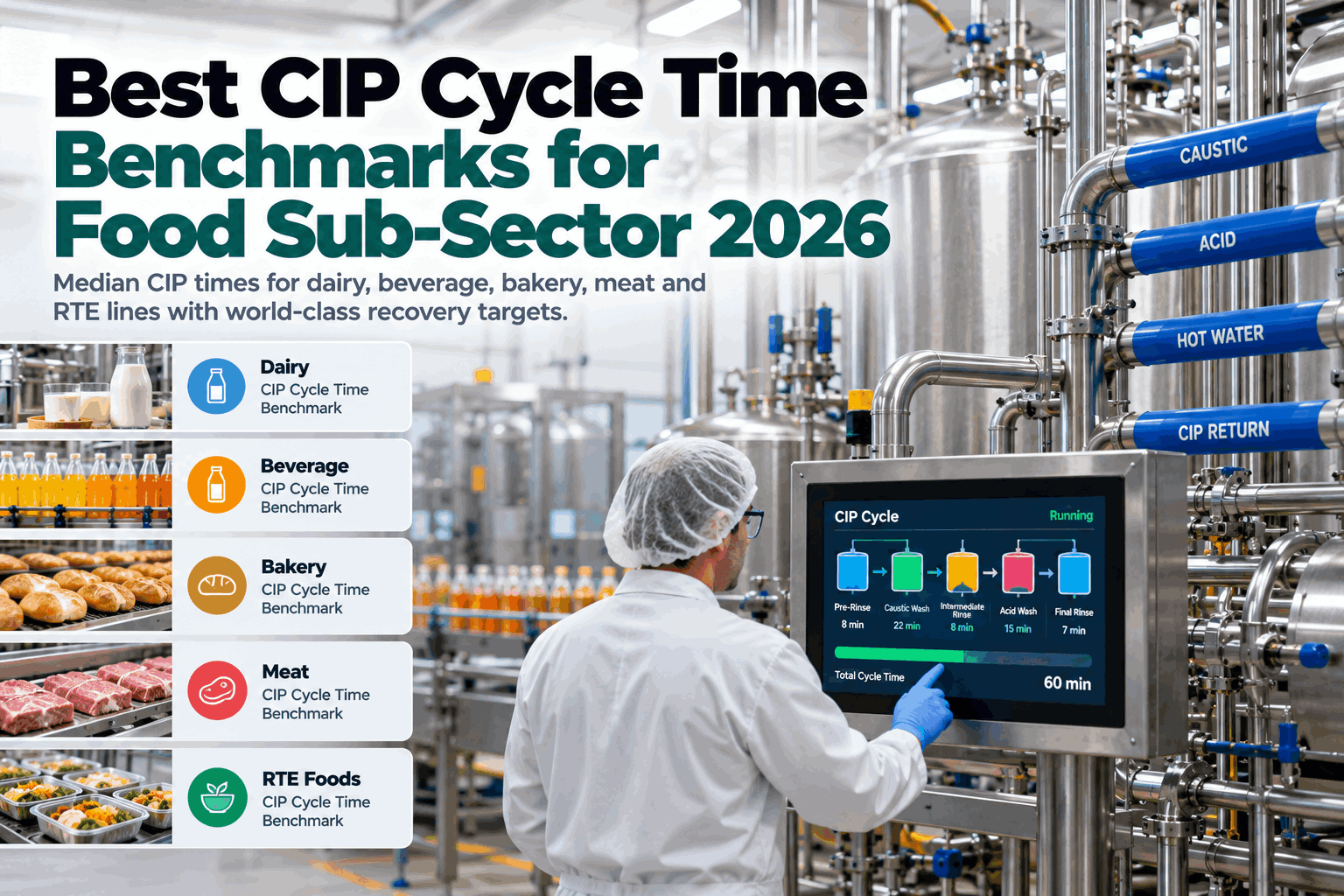
How long should a CIP cycle take in your plant? Most food sites can't say, because each cycle runs on a timer that was set at commissioning and never checked again. This guide gives working ranges for each food sub-sector and shows how to build a benchmark you can trust. To compare your own circuits, book a CIP benchmark review.
CIP Cycle Time Benchmarks for Every Food Sub-Sector
Working ranges for dairy, beverage, bakery, meat and ready-to-eat lines, the five numbers worth tracking, and a simple way to find the minutes your cycles spend cleaning what is already clean.
- Typical cycle ranges by sub-sector and soil
- Why a published "median" rarely fits your line
- How to set a recovery target you can defend
Our working ranges, built from published CIP recipes and typical plant practice. They are not survey medians: no public dataset of CIP times by food sub-sector exists. Use them as a starting point, then replace them with your own numbers.
Why CIP Time Is the Hidden Shift Loss
Cleaning is necessary. Cleaning longer than necessary is not.
A CIP cycle is planned time, so it rarely shows up as a problem. But a plant that runs four circuits twice a day spends many hours a week cleaning. If each cycle carries even ten spare minutes, that is real production time gone, along with water, chemicals and steam. Our CIP support team can help you size it for your own site.
Timers set for the worst day
Most recipes were set at commissioning for the heaviest soil the line could ever see, then left alone.
Nobody owns the minutes
Production sees CIP as sanitation's job. Sanitation sees it as fixed. So the time is never questioned.
Data sits in the skid
Flow, temperature and conductivity are already measured, but rarely trended cycle by cycle.
Waits hide inside the cycle
Tank fills, heat-up and drains can take as long as the cleaning itself, and they never appear in the recipe.
Four circuits, two cycles a day, ten spare minutes each: 80 minutes a day. Over 250 production days, that is about 333 hours a year, before counting water and chemicals.
What Sets CIP Time in Each Sub-Sector
Soil type decides the cycle. Sub-sector is only a rough guide to soil.
Milk heated on a plate gives tough protein and mineral deposits. Sugar syrup dissolves in warm water. Fat and protein from meat need heat and caustic. That is why one food plant can hold three very different benchmarks. To map your own soils to cycles, book a soil mapping call.
Sub-sector notes: where the minutes usually hide
Watch the heated surfaces
Raw milk tanks and lines clean fast. Pasteurisers, evaporators and UHT plants hold the long cycles. Check heat-up waits and rinses on those first, and leave caustic contact time alone until a trial says otherwise.
Rinses and changeovers
Sugar soils come off easily, so rinses often run far past clear. Flavour and allergen changes are the exception: there, extra verification is time well spent, not waste.
Dead legs and sticky soils
Batter and cream systems often have long pipe runs and branches that trap product. A good pre-rinse push to recover product shortens everything after it.
Temperature at the return
Fat sets in cold pipes. If the return temperature lags, the wash is weaker than the recipe thinks. Measure the return, not just the supply.
Allergens and kettles
Kettles and sauce lines carry mixed, cooked-on soils and frequent allergen changes. Split allergen cleans from routine cleans so each has its own benchmark.
Fills, drains and waits
Whatever the sub-sector, tank fills, heat-up and drains can rival the cleaning steps themselves. Time them apart, or they hide inside every benchmark.
Where CIP does most of the work
- Dairy and beverage. Closed tanks, pipes and fillers built for CIP.
- Liquid RTE lines. Sauces, soups and dressings.
- Brewing. Fermenters, bright tanks and transfer lines.
Where CIP is only part of the story
- Bakery. Most equipment is dry cleaned. CIP covers liquid systems.
- Meat. Most cleaning is foam, rinse and clean-out-of-place.
- Dry RTE. Wet cleaning is limited on purpose.
One Circuit, Measured Phase by Phase
A benchmark becomes useful when it shows which phase holds the spare minutes. Here is one dairy pasteuriser circuit, compared with its own best clean cycles.
The Five CIP KPIs Worth Benchmarking
One number is not enough. Five simple ones tell the whole story.
Track these per circuit, per cycle, and compare each circuit with itself first. Comparing with another plant only works when soil, equipment and recipe match. If you want help pulling them from your CIP skid data, our team can help.
Median cycle time
Start of pre-rinse to end of final rinse, including fills, heat-up and drains. Use the median, not the average, so one bad cycle does not skew it.
Best clean cycle
The shortest cycle that still passed verification. The gap between median and best is your first recovery target.
Phase overrun
Minutes each rinse keeps running after return conductivity or clarity reaches its end point.
Heat-up wait
Time from caustic start to reaching set temperature at the return. Long waits point to steam, heat exchanger or tank problems.
First-time pass rate
Share of cycles that pass verification without a re-clean. Speed means nothing if this number falls. Track it next to time on the same screen, so nobody looks at one without the other.
Never trade KPI 5
Any time saving that lowers the first-time pass rate is not a saving. It moves time into re-cleans and risk.
Benchmarks fall apart when one shift starts the clock at the first valve and another at the first pump. Agree one rule for the whole site: start at the first pre-rinse flow, stop when the circuit is released back to production. Log hold-ups, such as waiting for an operator, as their own reason so they never hide inside cleaning time.
Setting a World-Class Recovery Target
World-class is your own best clean cycle, repeated every time.
Industry "world-class" CIP numbers are hard to compare, because no two plants clean the same soil with the same kit. A better target comes from your own data: the cycles that ran shortest and still passed. Close the gap to them step by step. For a target set from your skid data, book a target-setting session.
A defensible target, in three steps
- Baseline. At least four weeks of cycles per circuit.
- Gap. Median minus the best quarter of passing cycles.
- Target. Close half the gap first, then re-check.
What a target must never change
- Validated wash temperature and strength
- Minimum contact time for each wash
- Verification method and its limits
One unusually short cycle may have followed a short run or a light product. The best quarter of passing cycles is a steadier target, because it reflects normal running on a good day rather than a lucky one.
How iFactory Builds Your Own Benchmark
Your best benchmark already exists, inside your CIP data.
iFactory reads the flow, temperature, conductivity and valve signals your CIP skids already record. It splits every cycle into phases, finds where each one ends in practice, and shows the spare minutes circuit by circuit. Changes are proposed, never pushed: your team trials them and validates them first. Questions on fit with your skids go to our support desk.
Connect
Read-only links to CIP skid PLCs and SCADA. No change to recipes.
Split
Every cycle cut into phases, with fills, heat-up and drains shown apart.
Compare
Each circuit against its own best clean cycles, and against similar circuits.
Trial
Shorter rinses tested on one circuit, with verification results tracked alongside.
iFactory's own field work suggests many cycles run 20 to 40 percent longer than their soil needs. Treat that as a reason to measure, not as a promise for your plant.
Turnkey AI: Delivered, Connected and Live in 6–12 Weeks
You do not build this. It arrives ready.
iFactory ships as a pre-configured NVIDIA AI server, racked and ready, with the software pre-loaded. Rack it, plug in power and Ethernet, and the AI is live on your network.
Our team handles cabling, network setup, PLC and SCADA integration, operator training and 24×7 remote monitoring. The server sits inside your own network, so CIP and production data stay on site. For a scope matched to your plant, request a turnkey quote.
Ship, network and data
Server installed. CIP skids and verification records connected. Circuits and soils listed.
Model training and pilot
Baseline built for every circuit. First rinse trial on one circuit, checked by your QA team.
Go-live and training
Benchmarks live for all circuits. Sanitation and QA staff trained. 24×7 remote monitoring begins.
Frequently Asked Questions
What is a good CIP cycle time for a dairy plant?
For tanks and lines, many dairy cycles fall somewhere between about 60 and 90 minutes. Pasteurisers and UHT plants usually need longer, because heated surfaces build tougher deposits. The right number for you is your own best cycle that still passes verification.
Is there an official CIP benchmark by food sub-sector?
Not that we know of. Equipment makers publish example recipes, and suppliers publish case studies, but there is no public survey of median CIP times by sub-sector. That is why this guide gives working ranges and urges you to build your own baseline.
Which part of a CIP cycle is easiest to shorten?
Usually the rinses. They often run long after the return water is already clear. Wash steps need more care, because their time, temperature and strength are part of your validated cleaning, and should only change after a proper trial.
Should we compare our CIP times with other plants?
Only when soil, equipment and recipe are close. A raw milk tank and a UHT plant are both dairy, but their cycles will never match. Compare each circuit with its own history first, then with similar circuits on your own site.
How much CIP data do we need for a benchmark?
Four weeks of cycles per circuit is a sensible minimum. That covers different products, run lengths and shifts. More data helps for circuits that clean several products with very different soils. If a circuit cleans after both short and long runs, split the baseline by run length as well, since longer runs leave heavier soil.
Will shorter cycles put food safety at risk?
Not if you protect the first-time pass rate. Every change should be trialled on one circuit and checked against your normal verification, such as ATP, swabs or rinse checks, before it becomes the new standard. Keep the old recipe on file so you can switch back at once if results slip.
Do we need new sensors to start?
Usually not. Most CIP skids already measure flow, temperature and conductivity. Turbidity sensors can help later, on rinses with product carry-over. To check what your skids record today, contact our team.
Find the Minutes in Your CIP
In thirty minutes we go through your CIP circuits, compare them with typical ranges for your sub-sector, and point out where spare time is most likely hiding. You keep the notes whether or not you go further with iFactory.
- 1Your list of CIP circuits and what each cleans
- 2Current recipes with step times and temperatures
- 3A few weeks of CIP skid trends or reports
- 4Your verification method and pass limits
- 5Your last three re-cleans and their causes