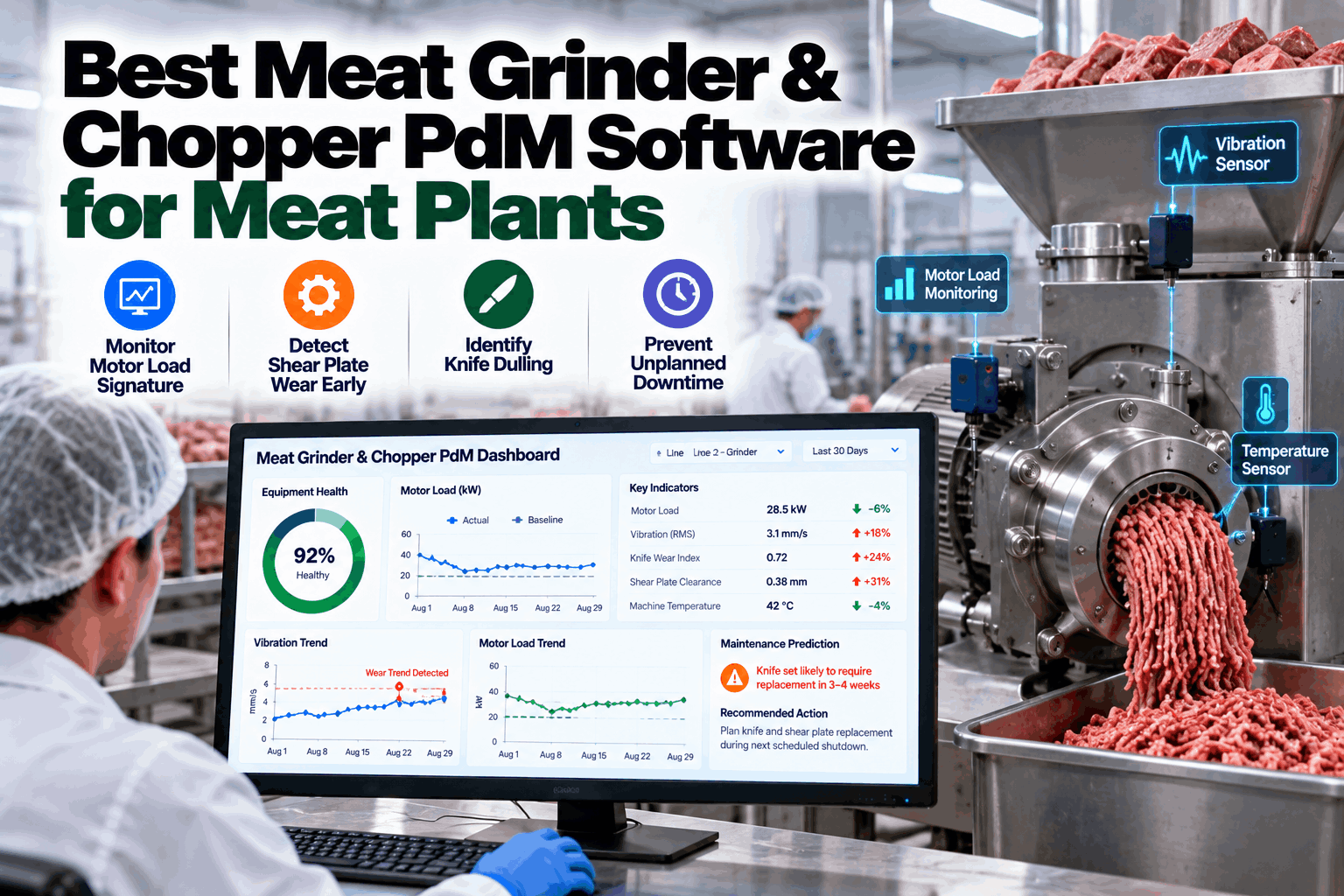
In a meat plant, the grinder and the bowl chopper do the hardest work on the floor, and they tell you when they are tiring if you know how to listen. A dull knife pulls more current for the same kilograms. A worn plate opens the cutting gap, so the motor load starts to ripple and the product warms and smears. A failing bearing adds vibration weeks before it seizes. And when worn parts touch metal on metal, the result is not just downtime but a foreign-material risk. This article explains how motor load signature analytics catch shear plate wear and knife dulling early, and our engineers can show the same signals on your equipment.
Meat Grinder and Chopper Predictive Maintenance: Catch Plate Wear and Knife Dulling Before Failure
Motor load signatures, specific energy per kilogram and bearing health tracked on every run, so knives, plates and augers are serviced on evidence, not on the calendar.
Why Grinders and Choppers Fail on the Worst Shift
Grinders, bowl choppers and emulsifiers work against frozen blocks, sinew, fat and bone fragments all day. The cutting set, meaning the knife and plate on a grinder or the knife head on a chopper, dulls and wears continuously. The feed screw wears too, and the motor, gearbox and bearings carry shock loads every time a frozen block hits the auger. Most plants manage this with fixed schedules: sharpen knives every so many hours, resurface plates weekly, rebuild gearboxes every year.
Fixed schedules miss the real variability. A week of frozen trim wears a cutting set far faster than a week of fresh product, and a change in fat content or temperature changes the load on everything. The result is a mix of parts replaced too early and parts that fail mid-shift, often on the busiest production days. A short pilot on one grinder is usually enough to show the difference.
Anatomy of Wear in Grinders, Choppers and Emulsifiers
| Component | Failure mode | What changes first | Best data source |
|---|---|---|---|
| Grinder knife | Edge dulling, chipping | More energy per kilogram, warmer product, smearing | Motor current or power, product temperature |
| Grinder plate | Face wear, growing knife-to-plate gap | Load ripple rises; tearing instead of cutting | High-rate current signature |
| Feed screw (worm or auger) | Flight wear, barrel clearance growth | Lower throughput per revolution at the same speed | Throughput and screw speed |
| Chopper knife head | Dulling, imbalance after regrind | Vibration at running speed; longer cycle time to reach texture | Vibration, cycle time, bowl temperature |
| Emulsifier cutting set | Rotor and stator wear | Temperature rise across the head; power per kilogram | Inlet and outlet temperature, power |
| Bearings and gearbox | Fatigue, lubrication loss | Vibration at defect frequencies; oil temperature | Accelerometers, oil temperature |
| Motor | Bearing, stator or rotor faults | Current signature changes; temperature rise | Current signature, winding temperature |
Most of these signals come from two places: the motor current the drive already measures, and a pair of accelerometers on the bearing housings. Our specialists confirm what each machine already exposes.
Motor Load Signature: The Grinder’s Health Record
The single most useful signal on a grinder is how much energy it uses per kilogram of product. A sharp knife on a flat plate shears meat cleanly. As the edge dulls or the plate wears, the motor has to push and tear rather than cut, and energy per kilogram rises. Tracking raw amps is not enough, because load also changes with throughput, product temperature and fat content. Normalizing for those turns motor current into a wear gauge.
Illustrative numbers; each grinder learns its own baseline. The pattern matters more than the absolute value: a steady climb in specific energy on the same recipe is dulling, while a jump in ripple after a plate change points to set-up or gap problems. We can walk through a live example.
The Detection Window for a Cutting-Set Failure
Bearings follow a slower curve. Vibration at bearing defect frequencies appears weeks or months before a bearing fails, and oil temperature on gearboxes rises as lubrication degrades. These signals give maintenance time to plan a rebuild into a sanitation window rather than tearing a machine down mid-production. Ask our team how warning thresholds are set per machine.
Why Worn Cutting Sets Are a Foreign-Material Risk
Metal fragments are one of the most serious hazards in ground and emulsified products. Worn or damaged knives and plates, a feed screw rubbing its barrel, or a failing bearing can all introduce metal. FSIS public health alerts for metal pieces in ground beef continue to appear, including one in March 2026 prompted by consumer complaints. Not every event is traced to grinding equipment, but worn cutting sets are one of the sources food safety teams watch closely.
Metal detection and X-ray inspection remain the critical control points. Predictive maintenance adds a layer before them: it flags the conditions that make metal contamination more likely, such as sudden high-frequency vibration, current spikes from metal-to-metal contact, or a plate gap closing to zero, so the machine can be stopped and inspected before fragments reach the detector.
Food safety and maintenance teams usually review these alerts together; our support team can show how that workflow runs.
Bowl Choppers and Emulsifiers Need Different Signals
High knife speeds make imbalance after a regrind show up immediately in vibration. Dulling shows up as longer cycle times to reach the same texture and a faster temperature rise in the bowl.
Temperature rise across the cutting head and power per kilogram climb together as the set wears. Both are easy to measure continuously.
Mixing load and grinding load trend separately, so a failing mixer gearbox is not mistaken for a dull knife.
On choppers, the product temperature curve during each batch is especially useful, because emulsion stability depends on it. A cutting set that heats the batch more to reach the same texture is costing quality as well as energy. We can review your batch data to show the effect.
Sharpening on Schedule Versus Sharpening on Evidence
- Knives and plates changed every fixed number of hours
- Frozen weeks wear sets out before the change is due
- Fresh weeks throw away sets with life left
- Bearing and gearbox faults found when they fail
- No record linking wear to product or recipe
- Sets changed when energy per kilogram says they are worn
- Change intervals adapt to product, temperature and recipe
- Sharpening shop workload planned days ahead
- Bearing faults found weeks early from vibration
- Every change records the signal that triggered it
The U.S. Department of Energy’s O&M Best Practices Guide puts savings from predictive maintenance at 8–12% over preventive programs and more than 30–40% over reactive maintenance. In meat plants, the added prize is fewer quality and foreign-material incidents. Your case can be sized with our engineers.
From Load Alert to Planned Changeover
Normalized energy per kilogram, ripple or vibration moves outside its learned band for long enough to count.
The alert separates cutting-set wear from auger wear, bearing faults or a product change.
A change of knife and plate, or a bearing inspection, is proposed for the next sanitation window.
The work order names the machine, the likely part and the evidence.
After the change, energy per kilogram returns to baseline and the alert closes.
The same workflow can be tested on your grinders in a guided demo.
How iFactory Solves Grinder and Chopper Reliability
Energy per kilogram normalized for product, temperature and recipe.
Load ripple and spikes that reveal plate gap and metal contact.
Vibration and oil temperature trends with defect-frequency analysis.
Metal-contact conditions flagged to maintenance and QA together.
Cutting-set changes scheduled days ahead from wear rates.
Alerts become planned work with evidence and parts attached.
It covers grinders, bowl choppers, emulsifiers and mixer-grinders from different makers on one platform. Ask our team about your mix.
See the Wear Signature of Your Own Grinders
Share a few weeks of drive current and production data. We show how energy per kilogram, ripple and vibration trend on your machines, and when each cutting set really needs changing.
Amps per kilo rising at the same throughput and product temperature climbing at the plate. Cutting set is dulling.
How Deployment Works
iFactory ships as a pre-configured NVIDIA AI server, racked and ready with the grinder, chopper and emulsifier models loaded. Rack it, plug in power and Ethernet, and the AI is live on your network. Our scope covers sensor and PLC/SCADA integration, cabling and network setup, operator and technician training, and 24×7 remote monitoring.
Server installed, sensors and controllers connected, historical work orders and failure history loaded.
Baselines learned per asset, alerts piloted on the first line with your maintenance team reviewing every finding.
Rollout to the agreed assets, technician training, CMMS hand-off and 24×7 remote monitoring in place.
Washdown areas need hygienic sensor choices: IP69K-rated accelerometers, stainless mounting and cable routing that does not create harbourage points. Current and power usually come from the drive or motor control centre, so no sensor has to touch the product zone. Most plants start with the grinding room, then extend to mixers, formers and packaging. Plan it on a scoping call.
What Evidence-Based Maintenance Is Worth
Downtime cost differs by plant and product, so treat the FMCG average as a starting point. Most meat plants find that a single avoided mid-shift failure on a primary grinder pays for monitoring the whole grinding room. Our specialists can build the case with your data.
Frequently Asked Questions
As knives dull and plates wear, the motor needs more energy per kilogram to cut the same product, and current ripple increases as the cutting gap opens. Normalizing for product and throughput turns these changes into a wear signal. See it in a demo.
No. Motor current and power come from the drive or motor control centre, and accelerometers mount on bearing housings outside the product zone, using IP69K-rated sensors in washdown areas. Get a sensor plan.
It adds an early layer before metal detection. High-frequency vibration and current spikes from metal-to-metal contact are flagged so the machine can be stopped and inspected. Metal detection and X-ray remain the critical controls. Ask our team.
Models normalize for product temperature, fat content, recipe and feed rate, so a frozen batch is not mistaken for a worn set. Each machine learns its own baseline. Our engineers can explain the method.
Yes. Choppers are monitored mainly through vibration, batch cycle time and bowl temperature; emulsifiers through power per kilogram and temperature rise across the head. See a walkthrough.
Typical programs go live in 6–12 weeks, starting with the grinding room. Current-based monitoring often starts in the first month using data the drives already record. Talk to our support team.
Change Cutting Sets When They’re Worn, Not When the Calendar Says
iFactory reads the load signature of every grinder and chopper, warns before bearings fail and flags metal-contact risk before it reaches the detector.
Motor load per kilo is the main signal, backed by temperature and vibration.