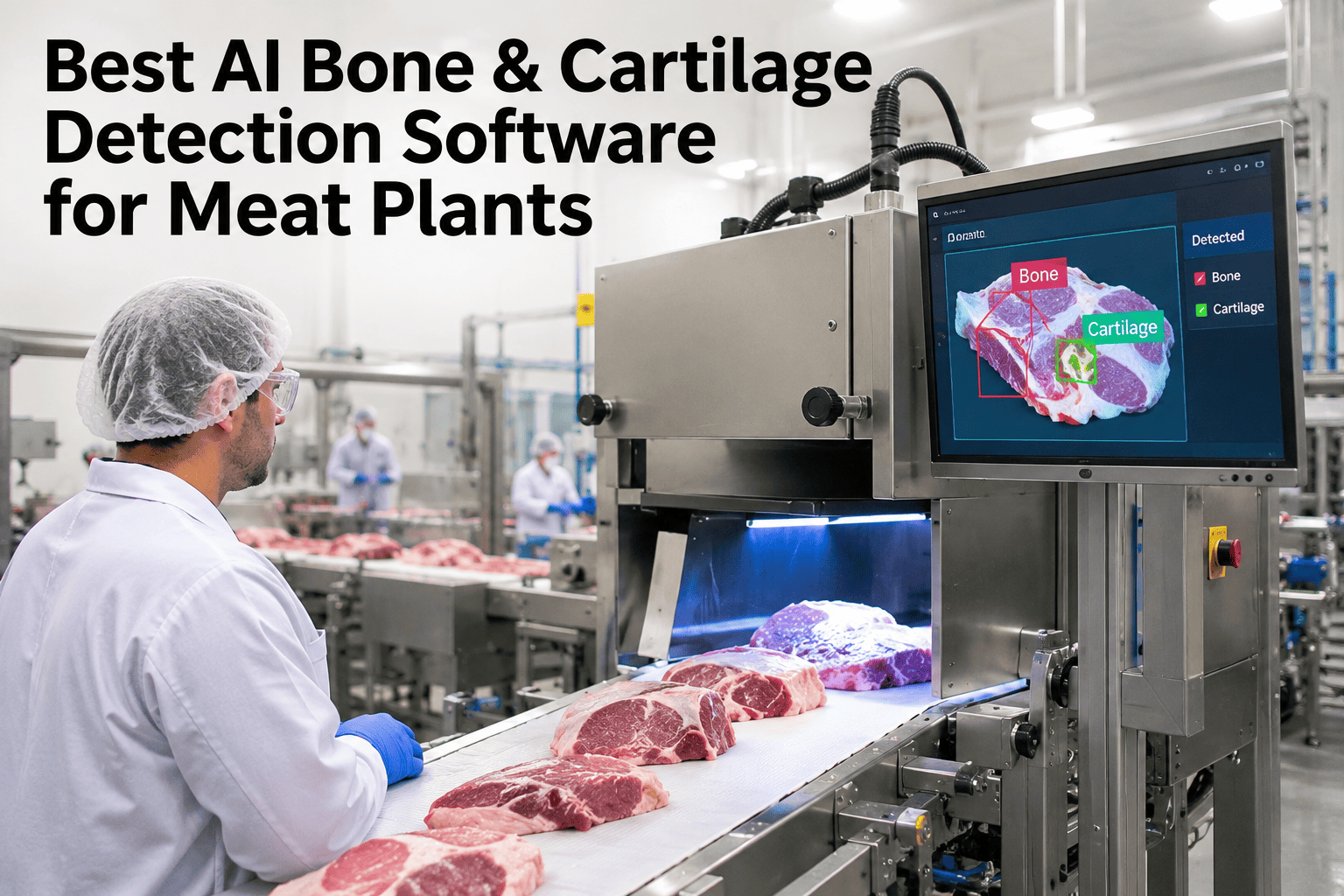
A single bone fragment on a boneless line can trigger a full-shift hold while the quality team traces how far back the contamination goes, and by the time the product reaches a metal detector, bone and cartilage are both already invisible to it — they are not conductive and present too little density contrast once they are small and embedded in trimmed meat. X-ray combined with AI vision closes that specific gap, reading density differences metal detection cannot see and flagging fragments a human eye misses in a fast-moving trim line. You can see this run against your own X-ray imagery with our team.
Meat Plant Bone-In Prevention, 2027
Metal Detectors Don't See Bone. This Does.
iFactory, an on-premise AI platform for AI vision inspection, combines X-ray imaging with AI density analysis to catch bone and cartilage fragments on boneless lines, cutting recalls from a bone-in miss toward near zero across a full shift.
Metal detector
Cannot detect bone — not a conductive material
X-ray alone
Can miss small or thin fragments without AI-assisted reading
X-ray + AI
Reads density patterns and flags fragments consistently
What it is
Why Bone and Cartilage Need X-Ray, Not Vision Alone
Standard camera-based vision inspects the surface of a product. Bone and cartilage fragments are frequently embedded inside trimmed meat, invisible from the surface entirely, which is exactly why this detection category depends on X-ray's ability to read density differences through the product, not just its appearance.
AI's role here is reading the X-ray image reliably at line speed — distinguishing a genuine bone or cartilage density signature from normal product density variation, fat pockets, or packaging artifacts that a simple threshold-based X-ray system tends to over-flag or under-flag.
Where it matters most
Four Points on a Boneless Line Where This Matters Most
Post-deboning
Immediately after the deboning station, before fragments travel further downstream.
Pre-grind
Before product enters a grinder, where a fragment becomes far harder to isolate.
Pre-pack
A final check before product is sealed into its finished package.
Rework lines
Reprocessed trim carries elevated risk and deserves the same scrutiny as primary cuts.
How it works
Four Steps From X-Ray Image to a Reject Decision
1
Capture an X-ray image of each product unit as it passes the inspection point.
2
Run the image through an AI model trained specifically on bone and cartilage density signatures for your product type.
3
Flag units where the density pattern matches a known bone or cartilage profile, distinct from normal fat or tissue variation.
4
Reject the flagged unit and log the event with product, line and shift data for trend review.
Comparison
Threshold-Based X-Ray vs AI-Assisted X-Ray Reading
| Dimension | Threshold-based X-ray | AI-assisted X-ray |
|---|
| Decision basis | A fixed density cutoff for all products | Learned density signature per product and bone type |
| False rejects | Higher — fat pockets can trigger a fixed threshold | Lower — model distinguishes normal density variation |
| Small fragment sensitivity | Limited, depends on threshold tuning | Tuned specifically for small, thin bone fragments |
| Adapts to new product | Requires manual threshold recalibration | Retrains on new product's density profile |
Expert review
What a Meat Plant Quality Manager Would Check First
Holds up
X-ray as the correct base technology for internal, non-metallic contaminants like bone and cartilage is well established; AI's contribution is improving the reliability of the read, not replacing the hardware.
Watch for
A model trained on one cut or species applied to a different one without retraining — bone density and shape vary enough across products that a direct transfer underperforms.
Do next
Start with your highest-volume boneless SKU, since that is both where the recall risk is largest and where a false-reject reduction pays back fastest.
FAQ
What Meat Plants Ask About Bone and Cartilage Detection
Why can't a metal detector catch bone fragments?
Metal detectors work by disrupting an electromagnetic field, which requires a conductive material. Bone and cartilage are not conductive, so they pass through a metal detector completely undetected regardless of size.
Review your current detection coverage with our team.
Does AI replace the need for X-ray hardware?
No — AI improves how reliably the X-ray image is interpreted, but the X-ray hardware itself is still what captures the density information needed to see inside the product in the first place.
How does this reduce false rejects compared to a fixed threshold?
A fixed density threshold cannot distinguish a genuine bone fragment from a normal fat pocket or product variation that happens to sit near the same density, which is where a trained model's learned signature performs better than a single cutoff value.
Ask about false-reject reduction for your product.
Does the model need retraining for different cuts or species?
Yes — bone density, shape and typical fragment size vary enough across cuts and species that a model trained on one product generally needs retraining or fine-tuning before it performs reliably on another.
Discuss multi-product coverage with our team.
Where on the line should inspection points be placed?
Post-deboning, pre-grind and pre-pack are the three points where catching a fragment prevents it from traveling further downstream or becoming harder to isolate, with pre-grind being especially important since a fragment is far harder to find once ground.
Map inspection points for your line layout.