Aging equipment failure, operator error, and maintenance time gaps together account for 74% of food-plant downtime hours — and nearly all of that is preventable, not through new capital equipment, but through a maintenance discipline that catches root causes instead of firefighting the same failure over and over. A breakdown report that stops at "fixed it, line running again" never closes that loop, and the failure simply waits to reappear, often on the exact same asset, weeks or months later. iFactory's closed-loop breakdown workflow captures the full chain — mobile report, root cause, parts consumed, and a follow-up PM task — in one connected record, so the same failure has to actually stop recurring before the loop is considered closed.
A Breakdown Report That Ends at "Repaired" Isn't Closed. It's Paused.
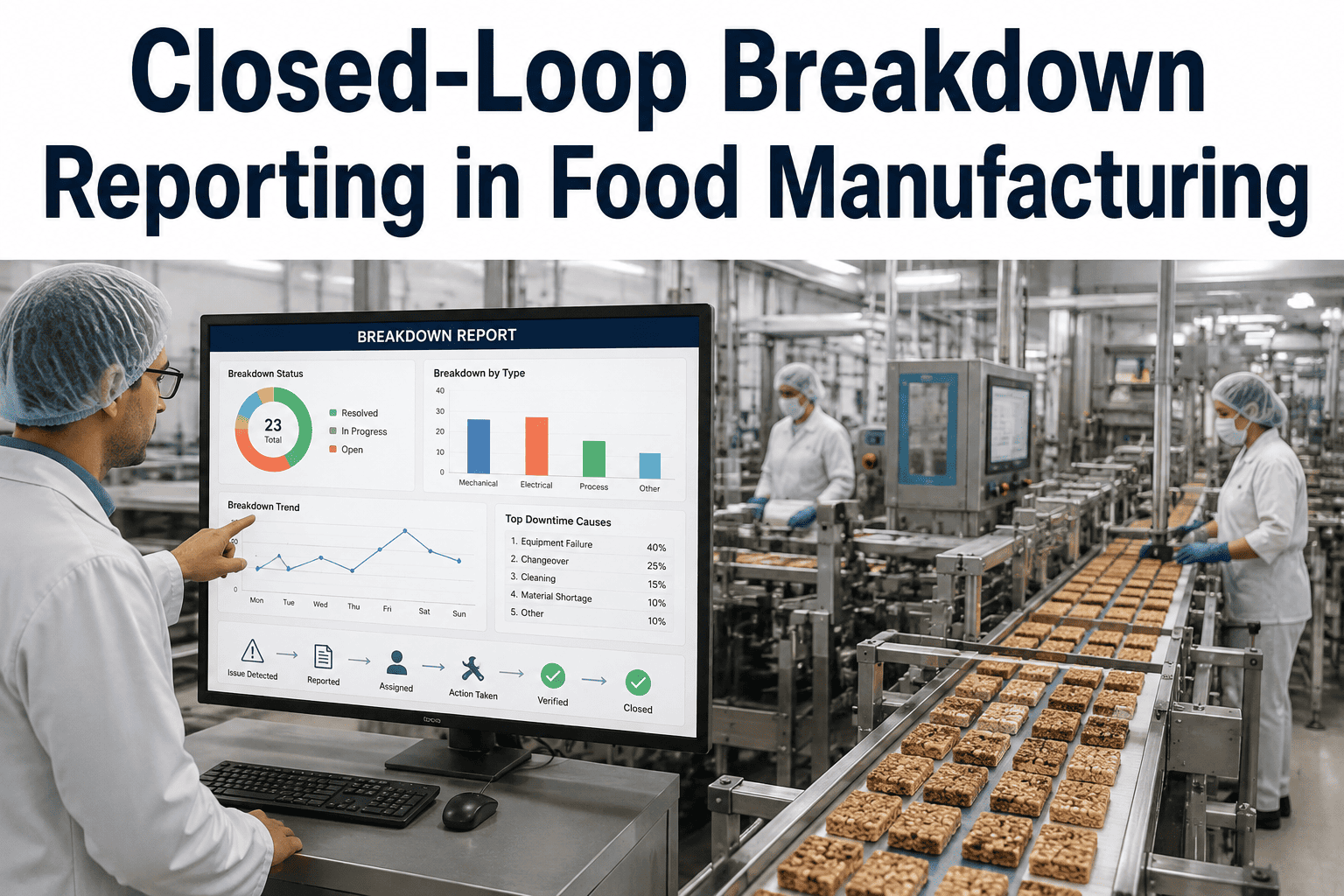
Five stages connect a mobile breakdown report to a genuinely prevented recurrence. Skip any one of them and the loop stays open — quietly, until the same asset fails again.
What "Closed-Loop" Actually Means in Breakdown Reporting
The term gets used loosely across the industry, so it's worth being precise about what actually distinguishes a closed-loop process from a standard breakdown log that simply looks thorough on the surface.
An open-loop breakdown report ends the moment the line restarts — a technician logs what broke, fixes it, and moves to the next call. A closed-loop report doesn't consider the event finished until the underlying cause has been identified, the corrective action has been scheduled, and someone has verified the same failure mode hasn't recurred. The difference sounds procedural, but it's the entire gap between a maintenance team that fixes the same asset three times a quarter and one that eliminates a failure mode permanently — the same difference between treating a symptom repeatedly and actually addressing the disease once.
The Five Fields a Food Plant Breakdown Report Needs Beyond the Basics
A generic breakdown form built for discrete manufacturing misses several fields that matter specifically in a food production environment, where sanitation, allergen control, and CCP monitoring equipment carry compliance weight that a standard work order doesn't capture. Adapting a generic template for a food plant isn't simply a matter of renaming a few fields — it requires understanding which specific data points actually matter to a food safety audit and building those in as required entries, not optional afterthoughts left to individual technician discretion.
| Field | What It Captures | Why It Matters in Food Manufacturing |
|---|---|---|
| Food-Contact Surface Flag | Whether the failed asset or repair touched a food-contact surface | Directly relevant to sanitation validation and allergen cross-contact risk |
| CCP Equipment Indicator | Whether the asset is tied to a Critical Control Point in the HACCP plan | A CCP monitoring failure (temperature probe, metal detector) carries food safety documentation requirements a routine breakdown doesn't |
| Washdown / CIP Context | Whether the failure occurred during or immediately after a cleaning cycle | Washdown-related damage is a distinct, recurring failure category in food plants worth tracking separately |
| Root Cause (Five Whys) | The underlying mechanical, operational, or systemic driver — not just the symptom | Required before the work order can close, forcing the investigation that a rushed reactive repair skips |
| Follow-Up PM Reference | The specific preventive task generated from this failure's root cause | Converts a one-time repair into a permanent change to the asset's maintenance plan |
Parts Consumed: The Field Most Breakdown Reports Get Wrong
Recording which parts were consumed during a repair sounds like a formality, but in practice it's one of the most inconsistently captured fields in breakdown reporting — and one of the most valuable when it's captured correctly. A technician under production pressure grabs whatever spare is on hand, completes the repair, and moves on without formally logging the part against the work order, leaving inventory records to drift out of sync with what's actually been consumed on the floor, sometimes for months before anyone reconciles the discrepancy.
Informally Tracked Parts
A spare grabbed from the shelf and used without a formal log entry leaves inventory counts wrong, cost attribution incomplete, and no data trail connecting the repair's true cost to the asset it was performed on.
Formally Logged Parts
A part scanned or selected directly against the work order updates inventory automatically, ties the true repair cost to the specific asset, and builds the cost history a bad-actor or reliability analysis eventually depends on.
Over enough repair cycles, accurate parts-consumed data becomes the foundation for identifying which assets are quietly consuming a disproportionate share of the maintenance budget — the same kind of pattern that a criticality or bad-actor analysis relies on, except built automatically from routine breakdown records instead of a separate, manually assembled cost study conducted once a year by someone pulling invoices and work orders together after the fact.
A Composite Scenario: The Cooling Unit That Failed Three Times
Picture a dairy processing plant where an auxiliary cooling unit failed and was repaired three separate times over a single quarter, each time logged as an isolated event by whichever technician happened to be on shift. Each repair replaced a failed component and restarted the unit within the shift's target window — a reasonable, production-focused response under time pressure, but one that never asked why the same component kept failing on the same asset.
When the plant's reliability lead finally pulled all three work orders together after the third failure, the pattern was immediate: none of the three reports had captured a root cause, because the work order template didn't require one to close. Digging deeper into the CMMS configuration itself revealed the actual systemic gap — the cooling unit had never been assigned a criticality rating, which meant its work orders sat in the same priority queue as routine, non-critical tasks. The unit's repairs kept getting deprioritized behind higher-visibility jobs, delayed just long enough each time that a minor issue progressed to full failure before anyone addressed it. The three "unrelated" breakdowns were, in fact, the same systemic gap manifesting three separate times — a gap that a closed-loop process, requiring root cause capture before closure, would have surfaced after the very first incident rather than the third. The fix that finally stuck wasn't a different part or a more careful technician; it was a criticality rating added to the asset record and a root cause field the work order template genuinely wouldn't let anyone skip.
Why Mobile Capture Speed Determines Whether Root Cause Data Exists at All
Most plants still track breakdowns manually: an operator pauses production, walks to a terminal, opens a spreadsheet, types a reason code, and returns to the line — a process that typically takes four to twelve minutes per event and produces data that sits in that spreadsheet until a supervisor compiles it at shift end. By the time a maintenance manager sees the pattern the next morning, the fix gets scheduled for next week, and the root cause investigation — if it happens at all — is reconstructed from memory rather than captured in the moment, with all the detail loss that memory-based reconstruction inevitably introduces.
Delayed, End-of-Shift Logging
Details fade fast — the specific sound, the sequence of events, the exact fault code — between the moment a breakdown happens and the moment someone finally writes it down hours later.
Mobile, In-the-Moment Capture
A technician logs the fault, timestamp, and initial observation directly from the floor, on the equipment, while the failure mode is still fresh — producing meaningfully richer root cause data than a reconstruction hours later.
This isn't simply a convenience improvement — it's the difference between root cause data that's genuinely usable for pattern detection and root cause data that's too vague or delayed to support it. A closed-loop process depends on the root cause field actually being filled with something specific and accurate, and that specificity depends heavily on how quickly and easily the capture happens after the failure occurs. A technician standing at the machine, still able to see and hear exactly what happened, captures a fundamentally different quality of detail than the same technician trying to recall the event from memory an hour or more later.
Building a Review Cadence Around Closed-Loop Data
Collecting structured breakdown data is only valuable if someone actually reviews it on a regular schedule, looking specifically for the patterns it's designed to surface. A closed-loop process that generates rich root cause data nobody systematically reviews delivers only a fraction of its potential value — the data exists, but the pattern detection that justifies the extra discipline never actually happens in practice.
Weekly Recurring-Fault Review
A short, regular review of any asset that has generated more than one breakdown in the past several weeks, checking whether the root cause fields point to a common underlying driver worth escalating beyond a routine repair.
Monthly Criticality Audit
A periodic check confirming every asset generating repeat breakdowns has an accurate, current criticality rating — closing exactly the kind of gap that let the cooling unit scenario repeat three times before anyone noticed the systemic cause.
Neither review needs to be elaborate or time-consuming to be effective. What matters is that it happens consistently, on a defined schedule, rather than only occurring reactively after a failure becomes visible enough to prompt an investigation — the entire premise of closing the loop is catching the pattern before the third or fourth incident, and that only works if someone is actually looking on a regular basis rather than waiting to be prompted by another breakdown. A plant that builds this review into an existing weekly maintenance meeting, rather than treating it as a separate new obligation, tends to sustain the discipline far longer than one that tries to stand up an entirely new recurring review from scratch.
Facilities that skip this step entirely tend to discover the gap only when a customer audit or a corporate reliability review asks a pointed question the plant can't answer with data — forcing a rushed retrospective reconstruction that a consistent review cadence would have made unnecessary. Building the habit before it's demanded from outside is considerably less painful than building it under pressure after the fact.
Detecting Recurring Fault Patterns Before the Third Incident
The value of consistently structured breakdown data compounds over time. A single closed-loop report tells you what happened once. A connected history of closed-loop reports, searchable by asset, fault type, and root cause, tells you which assets are trending toward chronic failure — often after the second incident, not the third or fourth, which is exactly the earlier warning window that made the difference in the cooling unit scenario described above.
Root Cause Fields Left Optional
A CMMS that allows a breakdown work order to close without a root cause entry guarantees the field will be skipped under production pressure — exactly when the investigation matters most.
No Asset Criticality Assigned
Without a criticality rating, a genuinely important asset's repairs sit in the same priority queue as routine, non-critical work — the exact systemic gap that let the cooling unit scenario repeat three times.
Follow-Up PM Never Actually Created
Identifying a root cause without generating a corresponding preventive task means the investigation produced a document, not a change to how the asset is actually maintained going forward.
Breakdown History Not Searchable by Asset
If a plant can't quickly pull every prior breakdown for a specific asset in one view, a recurring pattern stays invisible even when all the underlying data technically exists somewhere in the system.
The Second Failure Should Be the Warning, Not the Third or Fourth
iFactory automatically flags assets with recurring fault patterns as soon as they emerge — so your team sees the trend forming, not just the growing pile of repair invoices after the fact.
What Closing the Loop Is Actually Worth
The figures below come from independent industry research on food and beverage manufacturing maintenance programs, and they consistently reinforce the same underlying point: the value of closing the loop is not theoretical, it shows up directly in reduced unplanned events and reduced chronic failures.
Structured preventive maintenance programs implemented through a food plant CMMS consistently achieve 30-50% reductions in unplanned maintenance events within 18 months of deployment.
Plants that log root cause findings to closure in a CMMS, rather than leaving them in a paper logbook, report substantial reductions in chronic, repeat equipment failures over time.
Industry research consistently finds a large majority of food-plant downtime hours are preventable — not through new capital equipment, but through a maintenance discipline that catches root causes rather than firefighting symptoms.
Food processing equipment downtime costs manufacturers between $50,000 and $500,000 per hour depending on facility throughput and product value — making every prevented recurrence a meaningful, measurable saving.
Who Owns Closing the Loop: Maintenance, Quality, or Both?
In a food manufacturing environment specifically, maintenance and quality functions overlap more than they do in most other industries — a reliable machine runs steady, a steady machine produces consistent quality, and consistent quality reduces waste and spoilage risk. That overlap makes closed-loop breakdown reporting a shared responsibility rather than a purely maintenance-department initiative, and treating it as belonging to only one function tends to leave gaps the other function would have caught.
Maintenance & Reliability
Owns the technical investigation — capturing root cause, generating the follow-up PM task, and tracking whether the corrective action actually held across the next operating cycle.
Quality & Food Safety
Owns the compliance dimension specifically — verifying that any breakdown touching a food-contact surface or a CCP-tied asset generates the documentation required under FSMA and the facility's HACCP plan.
Without clear coordination, a breakdown involving a CCP monitoring instrument can get treated as a routine equipment repair by a maintenance team focused purely on restoring production, missing the food-safety documentation trail that quality needs for audit purposes. A shared workflow — where the breakdown report itself flags CCP or food-contact relevance automatically — removes the dependency on any individual technician remembering to loop in quality manually, every single time, under production pressure and the natural instinct to just get the line running again as quickly as possible.
Frequently Asked Questions
The questions below reflect what maintenance and quality leaders most commonly ask as they move from ad hoc breakdown logging toward a genuinely closed-loop reporting discipline that survives production pressure rather than getting abandoned the first time a line needs to restart quickly.
Does requiring root cause capture before closing a work order slow down emergency repairs?
No — the recommended structure is a two-track response: immediate containment and line restoration happen first, exactly as they do today, while a mandatory root cause investigation is triggered as a required follow-up step before the work order can be marked fully closed. Production restoration is never delayed waiting for root cause analysis; the requirement simply prevents the record from disappearing once the line is back up. Visit support to see how the two-track workflow is configured.
How much detail does a root cause entry actually need to be useful?
A specific, measurable problem statement is far more useful than a vague one — "conveyor belt slipped" tells a future investigator almost nothing, while "conveyor belt on Line 3 slipped four times in 72 hours during high-speed operation" gives a structured investigation something concrete to work from. Many teams apply a Five Whys approach directly within the work order, prompting the technician past the first, most obvious explanation toward the systemic cause. Book a demo to see the guided root cause prompts in practice.
Can mobile breakdown reporting work on the plant floor in a washdown or wet environment?
Yes — mobile capture is designed to work from a rugged handheld device directly on the production floor, including washdown-adjacent areas, so a technician can log a fault, timestamp, and initial observation in the moment rather than waiting until returning to a fixed terminal. Capturing details while the failure mode is still fresh is what produces genuinely useful root cause data instead of a memory-based reconstruction hours later.
How does closed-loop breakdown reporting connect to FSMA and food safety documentation requirements?
Maintenance activity tied to food safety preventive controls — CCP monitoring equipment, temperature control systems, allergen contact surfaces — needs corrective action records linked to the preventive control plan. A closed-loop breakdown report that flags whether an asset is CCP-tied and requires root cause and corrective action documentation before closure produces exactly the audit trail this compliance requirement expects. Contact support for details on food-safety-specific field configuration.
How is a recurring fault pattern actually flagged before it becomes a chronic problem?
A connected breakdown history, searchable by asset and fault type, allows the same failure mode on the same asset to be flagged automatically as soon as it recurs a second time — rather than relying on a maintenance manager happening to notice the pattern after reviewing several months of separate paper logs. Catching the pattern after the second incident, instead of the third or fourth, is what actually prevents a failure from becoming chronic.
Stop Logging Breakdowns. Start Closing Them.
iFactory connects mobile capture, root cause, parts consumed, and follow-up PM into one closed-loop workflow — so every food plant breakdown ends in a genuine fix, not just a restarted line.