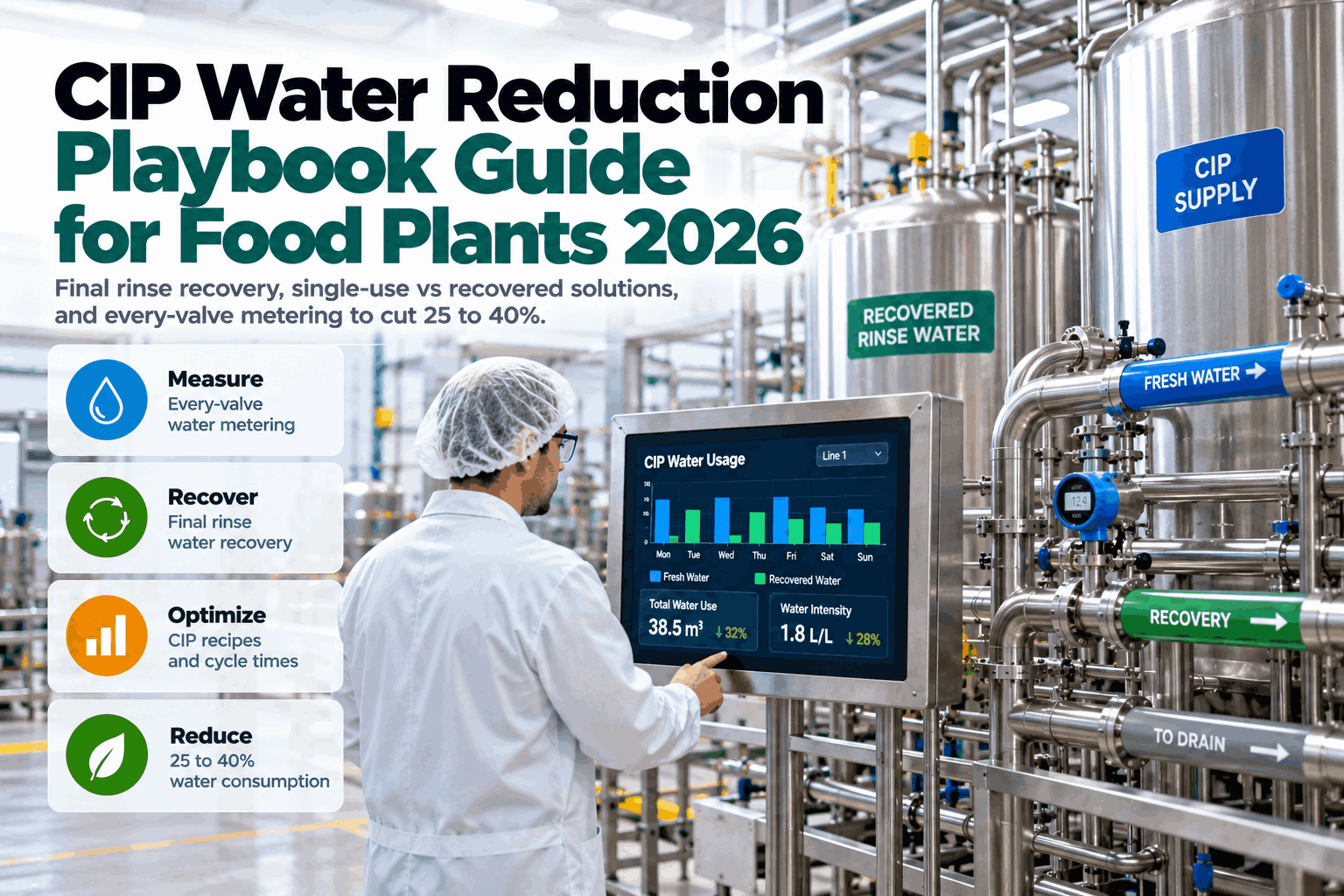
CIP is often the biggest single user of water in a food plant, yet most sites only see one monthly meter reading for it. This playbook sets out seven plays that cut CIP water without weakening the clean, roughly in the order most plants should try them. To size the savings for your own circuits, book a CIP water review.
The CIP Water Reduction Playbook for Food Plants
Final rinse recovery, single-use versus recovered solutions, rinse end points and metering on every circuit: what each play saves, what it costs, and where food safety draws the line.
- Where CIP water actually goes, phase by phase
- Seven plays, from quick wins to bigger projects
- The food safety rules for reusing water
- Pre-rinse · 30% · can come from recovered final rinse
- Caustic make-up · 15% · can be reused on the right circuits
- Intermediate rinse · 15% · often runs past clear
- Acid make-up · 10% · can be reused on the right circuits
- Final rinse · 30% · the cleanest water, often sent to drain
Shares vary widely by plant and circuit. The point holds almost everywhere: rinses, not washes, use most of the water.
Step Zero: See the Water Before You Cut It
You cannot cut what you only see once a month.
Most plants know their total water bill. Few know how many litres each circuit uses per cycle, or which phase uses them. So start with a short water audit and a meter on every circuit. It takes weeks, not months, and usually points straight at the worst circuit. Our CIP support team can help you plan where meters go.
List every circuit
What it cleans, how often, and whether it runs single-use or recovered solutions.
Meter supply and return
A flow meter on each circuit's supply, logged per phase, is the backbone of every play that follows.
Log litres per cycle
For each circuit and phase, over at least four weeks of normal running.
Set a water intensity KPI
Litres of CIP water per tonne or litre of product, so savings stay fair when volumes change.
Published dairy studies put total plant water use at roughly 1 to 3.4 litres per litre of milk processed, depending on the plant. Your CIP share of that number is the first figure to pin down.
Litres per cycle
Per circuit, split by phase. The number every play is measured against.
Water intensity
CIP litres per tonne or litre of product. Fair across busy and quiet months.
Rinse overrun
Litres that flow after the rinse has already reached its end point.
Recovery rate
Share of pre-rinse water that comes from recovered final rinse.
First-time pass rate
Cycles that pass verification without a re-clean. A re-clean wastes a full cycle of water.
Watch KPI 5 first
If the pass rate slips, stop and review. A saving that causes re-cleans is not a saving.
The Seven Plays, in Order
Start with what is cheap and safe. Leave the capital projects until the data says they pay.
Each play below says roughly what it saves, how much effort it takes, and what to watch. Savings are typical directions, not promises: the real figure depends on your circuits. To rank the plays for your plant, book a playbook session.
Push product out first
Recover product from lines with a pig, air or a measured water push before CIP starts. Less soil means a shorter, cleaner pre-rinse.
End rinses on conductivity
Stop each rinse when return conductivity matches fresh water, plus a small margin, instead of running a fixed timer.
Add turbidity where product carries over
A turbidity sensor shows when rinse water runs clear of product, which conductivity alone can miss. Most useful on milk, juice and sauce lines.
Recover the final rinse
Send final rinse water to a recovery tank and use it as the next cycle's pre-rinse. Size the tank after plays two and three. Usually the largest single saving.
Reuse wash solutions where safe
Return caustic and acid to their tanks, top up strength, and use again on circuits with no allergen or other conflict.
Fix flow and dead legs
Right-size pumps and pipes, and remove dead legs. Aim for flow fast enough to scour the pipe wall. Pipes that clean properly need less rinsing to prove it.
Shorten the runs
Long pipe runs from a central CIP set mean more water to fill and flush, and more heat lost on the way. Moving or adding a local set can nearly halve that volume.
Plays one to three make each cycle cleaner and shorter before you spend money. Recovery tanks sized after those changes can be smaller, because there is less rinse water to store. Doing it the other way round often means paying for a tank sized for water you were about to stop using.
One Circuit, Before and After
Here is one filler circuit with three plays applied: conductivity end points on both rinses and final rinse recovery. Caustic and acid stay single-use.
Single-Use or Recovered Solutions?
Recovery saves water and chemicals. Single-use keeps every cycle separate.
Neither is right everywhere. Many plants run both. A common split is recovered solutions on general circuits, single-use where allergens, aseptic lines or very heavy soils make reuse risky. If you need a second opinion on a circuit, our engineers can help.
Rules for reusing rinse water
- Final rinse only. It is the cleanest water in the cycle.
- Pre-rinse only. Never reuse it as a final rinse.
- Short hold. Store it briefly, then dump and refill.
- Check it. Set limits for conductivity and microbes.
Where reuse needs a hard look
- Circuits that switch between allergen and allergen-free
- Aseptic and extended shelf life lines
- Circuits with very heavy or mixed soils
- Anywhere a customer standard says no
How Much Can You Really Save?
A 25 to 40 percent cut is a fair stretch goal. It is not a starting promise.
Single circuits can do better than that: the Nestlé Canada circuit above fell by about 62 percent. Whole plants usually do less, because some circuits cannot use every play. iFactory's own sustainable CIP programme quotes water cuts of up to 25 percent as typical. Set your target after the audit, not before. For a target built on your own meters, book a savings estimate.
Weeks
Conductivity end points and trimmed rinses. Little or no capital, results visible within a month. The best place to build trust with QA before bigger changes.
Months
Final rinse recovery, turbidity sensors and product push. Some piping and a tank, often paid back by water and effluent savings.
A year or more
Solution recovery, local CIP sets and pipe changes. Bigger savings, but they need a business case and a shutdown. Plan them around your annual maintenance stop.
Savings that follow the water
- Effluent. Less volume to treat or pay for.
- Heat. Less water to warm for hot rinses.
- Time. Shorter rinses free up the line sooner.
- Chemicals. Reused solutions need only topping up.
Things to tell other teams first
- QA. Every change to a rinse or reuse rule.
- Effluent. Stronger, smaller flows to drain.
- Production. Trial cycles on their lines.
- Sustainability. How savings will be counted.
How iFactory Runs the Playbook
From one meter reading a month to litres per phase, per cycle.
iFactory reads the flow meters, conductivity, temperature and valve signals your CIP skids already record, and adds new meters where there are none. It works out litres per phase for every cycle, spots rinses running past clear, and tracks each play's savings against your baseline. Changes are trialled by your team, never pushed to the skid. Fit questions go to our support desk.
Baseline
Litres per phase, per circuit, per cycle, plus water intensity per unit of product.
Rank
Plays ranked by litres saved, effort and food safety risk, circuit by circuit.
Trial
One play on one circuit, with verification results tracked next to water use.
Report
Monthly water savings in litres and money, ready for sustainability reporting.
Savings figures quoted on this page come from published supplier and case reports for individual plants. They show what is possible, not what your plant will get.
Turnkey AI: Delivered, Connected and Live in 6–12 Weeks
You do not build this. It arrives ready.
iFactory ships as a pre-configured NVIDIA AI server, racked and ready, with the software pre-loaded. Rack it, plug in power and Ethernet, and the AI is live on your network.
Our team handles cabling, network setup, PLC and SCADA integration, operator training and 24×7 remote monitoring. The server sits inside your own network, so CIP and utility data stay on site. For a scope matched to your plant, request a turnkey quote.
Ship, network and data
Server installed. CIP skids and water meters connected. Missing meters listed and fitted.
Model training and pilot
Water baseline built. First play trialled on one circuit, checked by your QA team.
Go-live and training
Water tracking live for all circuits. Utilities and QA staff trained. 24×7 remote monitoring begins.
Frequently Asked Questions
Is it safe to reuse CIP final rinse water?
Yes, for the next cycle's pre-rinse, with controls. Hold it only briefly, check its quality against limits your QA team sets, and never use it as a final rinse. Circuits with allergen changes or aseptic duties need a separate review. Write the rules into your sanitation procedures so every shift applies them the same way.
What is the quickest CIP water saving?
Ending rinses on conductivity instead of a timer. Most skids already have the sensor, so it is mainly a recipe change, trialled on one circuit and checked against your normal verification before you roll it out. Keep a small margin after the end point at first, then narrow it once results stay steady.
Do we need a meter on every CIP circuit?
It helps a great deal. Without it you can only guess which circuit or phase uses the most water. Many skids already have a supply flow meter, and iFactory can log it per phase without new hardware. Where a circuit has no meter, a clamp-on flow meter is often enough to start.
Is single-use CIP worse for water?
It uses more water and chemicals per cycle, because nothing is reused. But it keeps cycles fully separate, which matters for allergens and aseptic lines. Most plants are best served by a mix of both, chosen circuit by circuit rather than for the whole site at once.
How should we report CIP water savings?
As litres per cycle and as water intensity, for example litres of CIP water per tonne of product. Intensity stays fair when production volumes change, which makes it the better number for sustainability reports. Keep the baseline period and method on record so auditors can follow the savings claim.
Does cutting rinse water affect effluent?
Usually for the better. Less water means less effluent volume. Strength per litre may rise a little, so tell your effluent team before big changes, especially if your discharge is charged on strength.
Can we start without new sensors?
Often, yes. Supply flow and return conductivity are on most skids already. Turbidity sensors and extra meters come later, where the data shows they will pay. To check what your skids record today, contact our team.
Find the Water in Your CIP
In thirty minutes we go through your CIP circuits, estimate water per cycle, and rank the plays most likely to pay for your plant. You keep the shortlist whether or not you go further with iFactory.
- 1Your list of CIP circuits and cycles per day
- 2Recent water and effluent bills
- 3Any CIP flow meter or skid data
- 4Which circuits run allergen changes
- 5Your water or sustainability targets