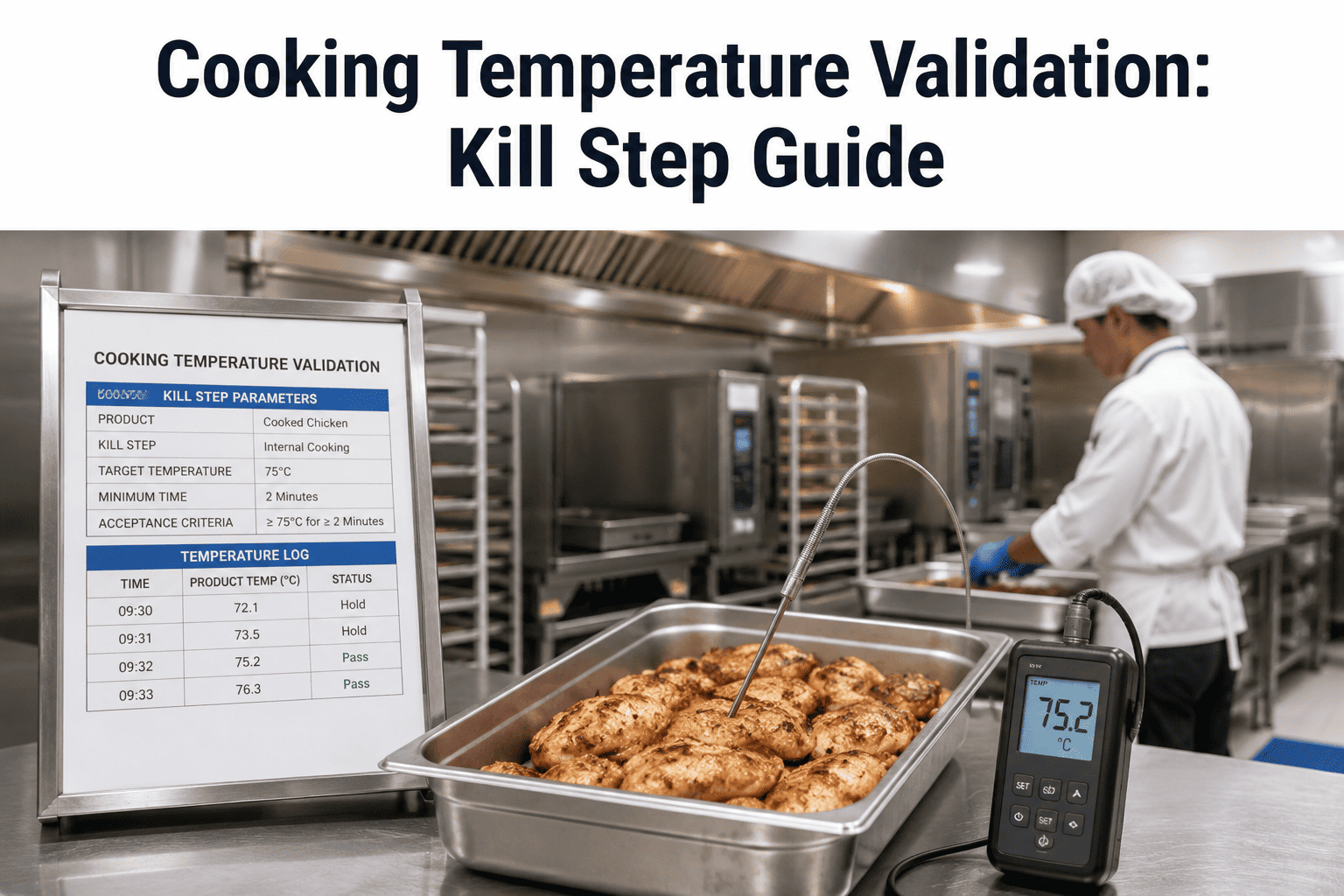
A kill step is only as good as the validation behind it, and validating a cooking process means proving — with actual data, not assumption — that the specific time and temperature combination used achieves the required pathogen reduction in the worst-case product a plant will ever run through that process. Many facilities set a cook temperature based on a general industry reference or a recipe passed down from a previous facility manager, without confirming that value actually achieves adequate lethality for their specific product thickness, formulation, and equipment. That gap between an assumed-safe cook step and a validated one is exactly where the most serious food safety risk in a thermal process typically hides, because everything downstream of cooking depends on the pathogen reduction actually having occurred as intended. Cooling, packaging, and shelf-life decisions all assume the product entering them is already pathogen-reduced to the intended level, so an unvalidated or under-validated cook step quietly undermines the safety logic of every step that follows it, even though those later steps may each be executed correctly on their own terms. The sections below cover how lethality is calculated, why worst-case product selection matters more than average conditions, and how ongoing verification keeps a validated process valid over time, with more detail available in iFactory's support documentation.
01 / What Cooking Validation Actually Proves
Cooking validation is a documented study, typically involving temperature data loggers placed at the coldest point of the product, that demonstrates a specific process achieves a target log reduction of the relevant pathogen under defined conditions. It is fundamentally different from routine cook temperature monitoring, which simply confirms the process is running at the validated setpoint during ongoing production — validation establishes that the setpoint itself is correct in the first place, while monitoring confirms the plant is actually hitting that setpoint shift after shift. A facility can monitor cook temperatures perfectly and still have an unsafe process if the underlying validation was never done correctly or was based on the wrong worst-case assumptions. This is why an audit that only checks whether monitoring records exist, without confirming the validation study behind the monitored setpoint is sound, can miss the most significant risk in the entire cook process. A thorough review always starts by asking what the validation study actually covered — what product, what conditions, what equipment — before moving on to whether daily monitoring records are being kept consistently against that validated baseline.
02 / How Time-Temperature Lethality Calculations Work
Pathogen destruction during cooking is not simply a function of reaching a peak temperature — it is a function of the cumulative time spent at and above a series of temperature thresholds, since higher temperatures achieve lethality faster while lower temperatures require considerably longer holding times to achieve the same effect. This relationship is what allows a plant to validate multiple time-temperature combinations for the same product rather than being locked into a single fixed setpoint, giving operations more flexibility to match the process to specific equipment capabilities without compromising safety. The calculation itself accounts for the fact that come-up time — the period during which the product is heating toward the target temperature but has not yet reached it — contributes some lethality as well, though this contribution is typically conservative and often excluded from the credited lethality total specifically to build in a safety margin rather than relying on a portion of the process that is harder to measure precisely across every unit in a batch.
| Internal Temperature | Typical Hold Time Range | Practical Implication |
|---|---|---|
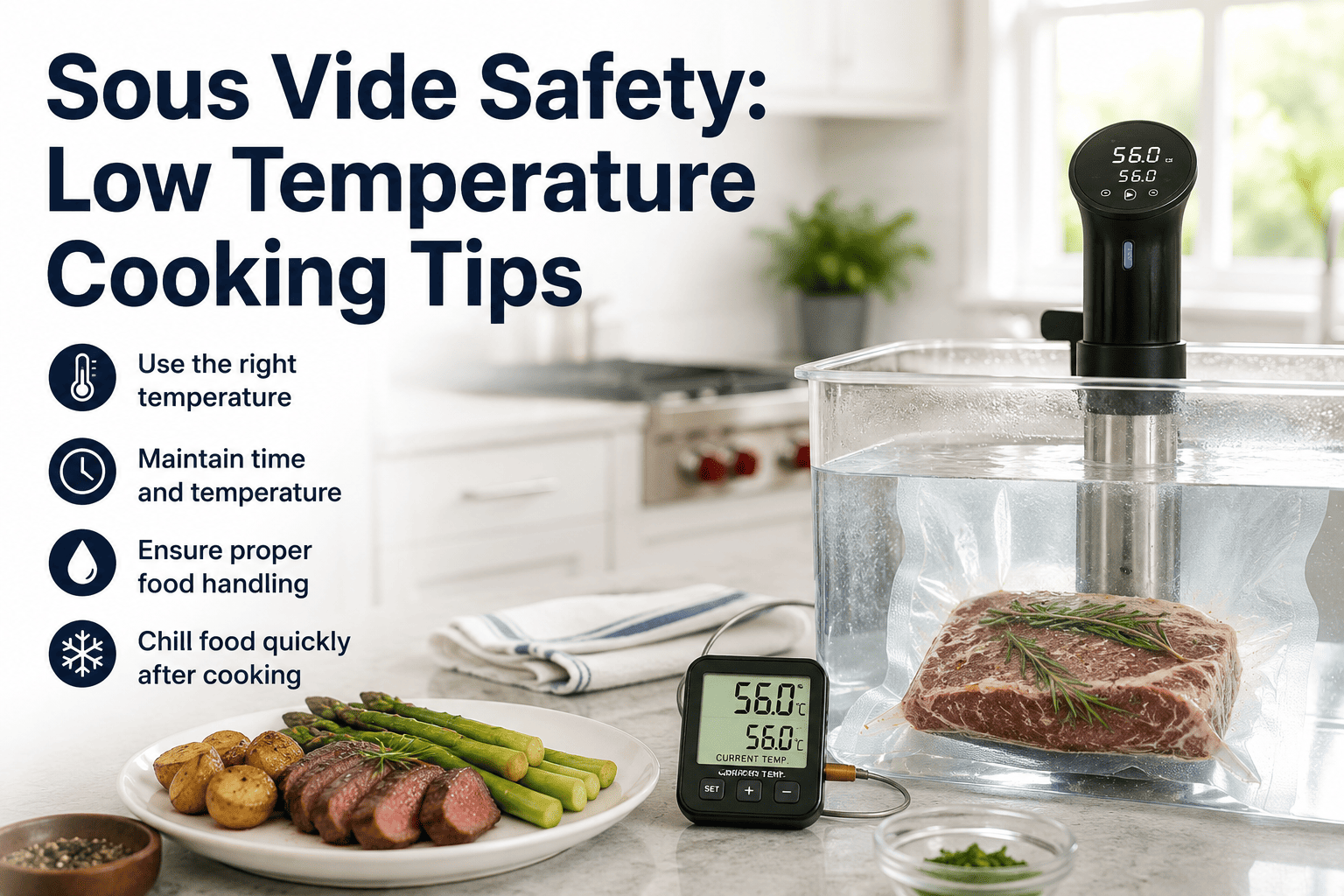
| Lower Threshold | Longer hold required | Suited to slow-cook or sous vide style processes |
| Mid Threshold | Moderate hold required | Common for standard batch and continuous cook lines |
| Higher Threshold | Brief hold required | Suited to fast-cycling high-throughput cook processes |
03 / Why Worst-Case Product Selection Determines the Real Validation
A validation study run on an average, ideally sized product tells a plant almost nothing about whether the process is safe for the thickest, densest, or most cold-starting version of that product it will ever run — and it is that worst-case version, not the average one, that actually determines whether the validated setpoint is adequate. Selecting the wrong reference product for a validation study is one of the most consequential and most common mistakes in kill step validation, because the study looks complete and rigorous while actually understating the real risk the process needs to cover. This mistake is particularly easy to make when a product line expands over time — a validation study run years earlier on the original product size may no longer represent the worst case once a larger or differently formulated variant is added to the same production line, yet the original study often continues to be cited as covering the entire product family without anyone re-checking whether that is still accurate.
04 / Running a Cook Validation Study Step by Step
A rigorous cook validation study follows a defined sequence rather than an informal temperature check, and skipping steps in this sequence is what most often produces a study that will not hold up under regulatory or customer audit scrutiny. Involving a food safety professional with specific thermal processing expertise in designing the study, rather than relying solely on production or engineering staff, also tends to produce a more defensible result, since the statistical and microbiological assumptions behind lethality calculations require specialized knowledge that general production expertise does not automatically cover.
05 / Keeping a Validated Process Valid Over Time
A validation study is a snapshot of a specific process configuration, and any meaningful change to that configuration — a new oven, a reformulated product, a change in product size, or even a change in packaging that affects heat transfer — can invalidate the original study without anyone realizing it until a subsequent audit or, worse, an actual food safety incident exposes the gap. Building a formal change-control step into new product development and equipment procurement, where cook validation is explicitly reviewed before the change goes into production, is the most reliable way to catch this before it becomes a live risk. Many facilities formalize this by requiring a documented sign-off from food safety or quality assurance before any new product, reformulation, or equipment change is approved for production, specifically to force the validation question to be asked at the point where it is cheapest and easiest to address rather than after the change is already running at full production volume.
06 / Ongoing Verification of a Validated Cook Process
Once a process is validated, day-to-day verification confirms the plant is actually operating within those validated parameters on every batch, not just during the original study. This typically combines continuous temperature and time logging on the cook equipment itself with periodic internal product temperature spot checks, giving both a continuous record of equipment performance and a direct confirmation that the product itself is reaching the required internal temperature. The two data sources serve different purposes and neither fully substitutes for the other — equipment logging can miss a localized cold spot within a densely loaded oven, while product spot checks alone cannot capture a brief equipment fluctuation that occurred between check intervals, which is why a strong verification program deliberately combines both rather than relying on just one.
07 / Conclusion — Validation Is the Foundation the Rest of the Plan Depends On
Every downstream food safety control in a cooked product's process assumes the kill step actually achieved the pathogen reduction it was designed to achieve, which makes a rigorous, worst-case-based cook validation study one of the highest-leverage food safety investments a plant can make. Getting worst-case product selection right, running the validation study with proper replication and cold-point measurement, and maintaining ongoing verification and change control afterward is what keeps that foundation solid over the life of the product. None of this needs to be treated as a one-time compliance exercise completed only when a new product launches — the facilities that manage kill step risk most effectively build validation review into their standard product development and equipment procurement processes, so the question of whether a change affects lethality is asked automatically rather than depending on someone remembering to raise it. Book a demo to review your current cook validation approach against these standards.
Frequently Asked Questions — Cooking Temperature Validation
Worst-case determination starts by reviewing the full range of product formats, formulations, and starting conditions that will run through the process, then identifying which combination presents the greatest challenge to reaching adequate lethality at the coldest point of the product. This is typically the thickest or largest unit, combined with the coldest realistic starting temperature and the densest formulation in the product range, run under maximum equipment load rather than a lightly loaded test condition. Getting this selection right is arguably more important than the temperature measurement itself, since a technically well-executed study on the wrong reference product still produces a validation that does not cover the plant's actual risk.
While specific requirements vary by regulatory framework and customer expectations, most defensible validation studies run a minimum of three replicate trials under the identified worst-case conditions, and some processes with higher variability warrant additional replicates to build confidence that the results are consistent rather than a single favorable outcome. Running only one trial leaves a plant unable to demonstrate the process reliably achieves lethality rather than having gotten a lucky result on that particular day, which is a common finding when third-party auditors review thinly supported validation files. Some processes with especially high batch-to-batch or unit-to-unit variability, such as those involving irregularly shaped or hand-portioned products, warrant additional replicates specifically to characterize that variability rather than assuming a small trial count adequately represents the full range of conditions the process will encounter in ongoing production.
Yes, in many cases it does, because packaging materials and formats affect how heat transfers to the product during cooking — a change from an open format to a sealed or vacuum-packed format, for instance, can meaningfully change the time required to reach the same internal temperature at the cold point. This is one of the most commonly overlooked triggers for revalidation, since packaging changes are often driven by marketing or logistics considerations without food safety review built into that decision process. Building cook validation review into the packaging change approval workflow closes this gap. iFactory's support documentation covers a standard checklist of changes that should trigger revalidation.
Validation is the study that proves a specific process design achieves adequate lethality under worst-case conditions, typically performed once when the process is established and again after any significant change. Verification is the ongoing activity that confirms the validated process is actually being followed correctly, often through periodic internal product temperature checks compared against the validated parameters. Routine monitoring is the continuous, shift-by-shift tracking of cook equipment temperature and time as production runs, which feeds into verification but does not by itself prove the process was ever adequately validated in the first place.
Yes — because lethality is a function of the cumulative relationship between time and temperature rather than a single fixed value, it is entirely possible to validate multiple combinations for the same product, giving operations flexibility to choose the combination best suited to a specific piece of equipment or production schedule. Each combination needs its own dedicated validation study using the same worst-case product and conditions, since a shorter, higher-temperature process and a longer, lower-temperature process can both achieve equivalent lethality but are not automatically interchangeable without separate validation of each. Book a demo to discuss validating multiple process combinations for your product range.