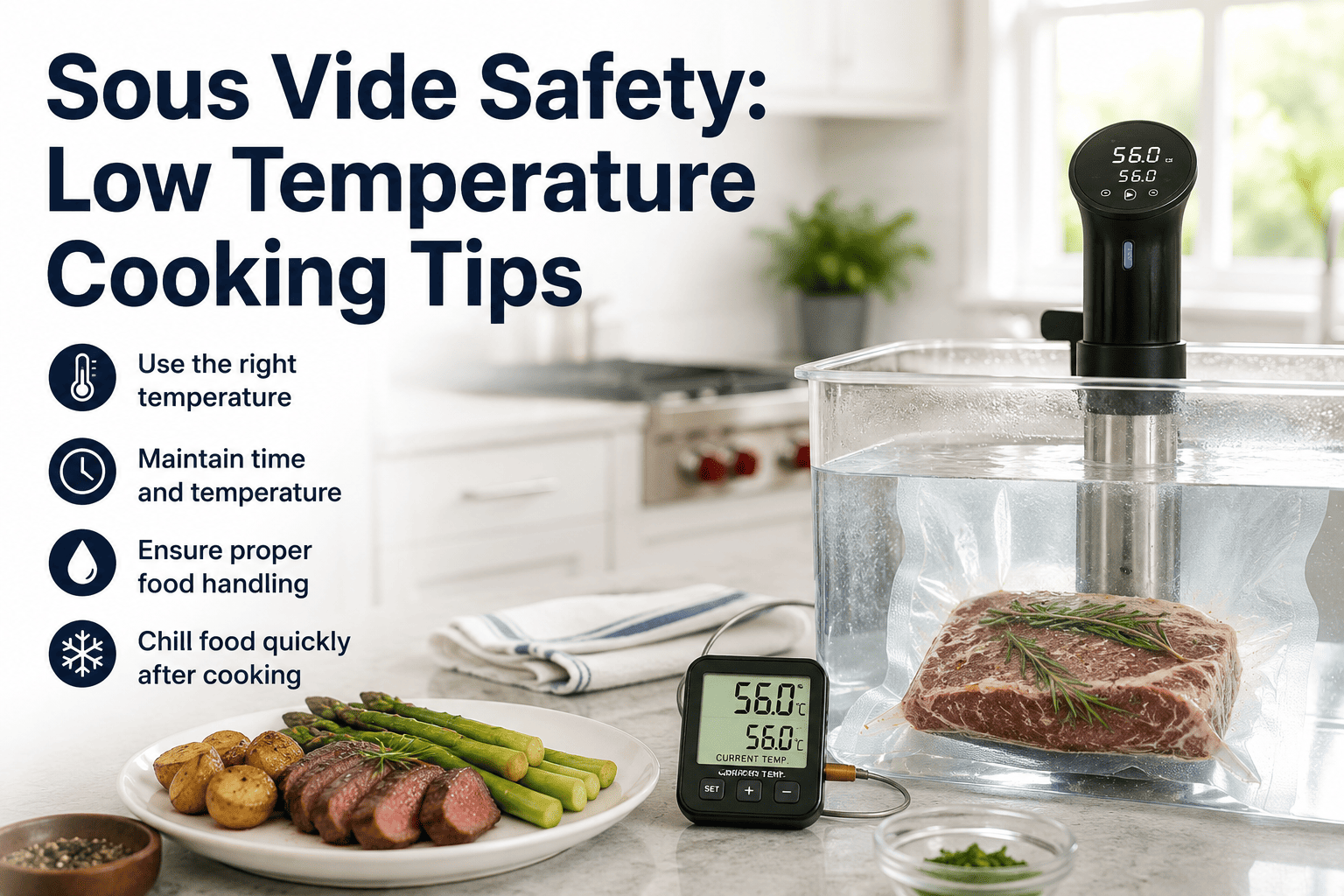
Sous vide cooking breaks one of the oldest rules in food safety on purpose, holding protein at temperatures far below the traditional 165°F kill step for hours at a time, and it gets away with it because time and temperature together achieve the same pasteurization result that a quick high-heat sear cannot match at the core of a thick cut. The catch is that the entire safety case for sous vide rests on the water bath actually holding its set temperature for the entire calculated duration, and a bath that drifts even briefly, or a vacuum seal that fails partway through the cook, quietly breaks the pasteurization math that makes low-temperature cooking safe in the first place. See how continuous AI monitoring validates every sous vide and low-temperature cook when you book a demo.
FOOD SAFETY · SOUS VIDE · LOW-TEMPERATURE COOKING VALIDATION
Time and Temperature Together Are the Kill Step in Sous Vide, Not Temperature Alone
iFactory's AI validates water bath temperature and cook duration continuously against pasteurization equivalence tables, confirming every batch actually achieved a safe outcome rather than assuming it.
Protein Pouch
Protein Pouch
Protein Pouch
131°F
Water Bath · Holding Steady
THE SCIENCE BEHIND LOW-TEMPERATURE SAFETY
Why 131°F Held for Hours Can Be as Safe as 165°F for Seconds
Pathogen destruction is a function of both temperature and time, and pasteurization equivalence tables published by food safety authorities quantify exactly how long a given temperature must be held to achieve the same log reduction as a traditional high-heat kill step. A steak held at 131°F for over an hour achieves comparable pathogen reduction to searing at a much higher temperature for a few seconds, but only if that 131°F is genuinely maintained throughout the entire required duration, not approximated by a bath that drifts up and down around the target.
Time × Temp
The two variables that together determine pasteurization equivalence, neither of which is sufficient on its own.
±0.5°F
Typical precision immersion circulators are rated to hold, though real-world drift can exceed this without monitoring.
Core Temp
The measurement that actually matters for pasteurization, not just the surrounding water bath reading.
Vacuum Seal
Integrity requirement that, if broken mid-cook, can introduce contamination the time-temperature calculation never accounted for.
WHERE SOUS VIDE SAFETY BREAKS DOWN
The Points in the Process Where Validation Actually Matters
Most sous vide safety failures are not dramatic equipment breakdowns, they are small deviations from the assumed process that go unnoticed because the finished product still looks and tastes correct even when the underlying safety math has quietly failed.
Bath Temperature Drift
Immersion circulators can drift from their set point due to overcrowded tanks, insufficient water circulation, or sensor fouling, and a bath running even a few degrees below target requires significantly more time to achieve the same pasteurization result the original recipe calculation assumed.
Overcrowded Water Baths
Packing too many pouches into a single bath restricts water circulation around each item, creating cold spots where individual pouches take significantly longer to reach and hold target temperature than the bath's overall reading would suggest.
Vacuum Seal Failures
A compromised seal allows water intrusion or air pockets that change how heat transfers into the product, and in some cases can introduce contamination that the time-temperature process was never designed to address in the first place.
Inconsistent Product Thickness
Pasteurization time calculations depend heavily on product thickness, and a batch with inconsistent cut sizes means thinner pieces are over-processed while thicker pieces may not reach the required core temperature within the calculated time window.
Confirm Every Batch Actually Achieved Pasteurization, Don't Assume It
iFactory continuously monitors bath temperature stability and validates cook duration against pasteurization equivalence requirements, flagging any batch that fell short before it ever reaches a plate.
VALIDATION WORKFLOW
How Continuous Monitoring Confirms a Safe Cook
A properly validated sous vide process tracks the full cook from setup through completion, rather than relying on a single temperature check at the start of the cycle.
1
Bath Setup Verification
Confirm the bath has reached its target set point and stabilized before pouches are added, since starting the timer on an unstable bath undermines the entire pasteurization calculation.
2
Continuous Bath Monitoring
Track bath temperature continuously throughout the cook, flagging any drift outside the tolerance needed to preserve the calculated pasteurization outcome.
3
Duration Tracking Against Recipe
Automatically compare elapsed cook time against the required duration for the specific product thickness and target temperature combination, rather than relying on staff to track timers manually across multiple simultaneous cooks.
4
Completion Validation
Confirm the full required time was achieved at the correct temperature before flagging the batch as validated, generating a record that documents pasteurization equivalence was actually met.
PASTEURIZATION EQUIVALENCE REFERENCE
Example Time Requirements at Common Sous Vide Temperatures
The table below illustrates how required hold time changes across common sous vide target temperatures for poultry, based on published pasteurization equivalence guidance. Always validate specific times against your governing food safety authority and product type.
| Target Temperature |
Approximate Required Hold Time |
Typical Application |
| 136°F |
Under 1 hour |
Tender poultry cuts |
| 131°F |
Approximately 1.5 to 2 hours |
Steaks, tender cuts |
| 140°F |
Approximately 30 minutes |
Faster turnaround poultry |
| 145°F |
Under 15 minutes |
Standard low-temperature protein |
FREQUENTLY ASKED QUESTIONS
What Kitchens Ask About Sous Vide Safety Validation
Is checking the water bath temperature enough, or does the product's internal temperature also need to be verified?
Bath temperature alone is not sufficient because pasteurization depends on the product's core reaching and holding the target temperature, and thicker items or overcrowded baths can leave the core lagging well behind the surrounding water for a meaningful portion of the cook. Verifying both bath stability and confirming the product had sufficient time to reach core temperature is necessary for a complete validation.
Book a demo to see combined bath and product-level validation.
What should happen if a bath temperature drop is detected partway through a cook?
A detected drop should trigger a recalculation of remaining required time based on the actual temperature achieved, or in cases of a significant drop, restarting the timing calculation entirely once the bath has recovered to target, since the original planned duration was calculated for a stable target temperature that was not maintained.
Contact our support team for guidance on handling mid-cook temperature deviations.
How does product thickness actually change the required cook time?
Heat transfer into the core of a thicker product takes measurably longer than into a thin one, so the pasteurization time calculation must account for thickness specifically, not just the target temperature, and using a single blanket time across products of varying thickness risks under-processing the thicker items in the batch.
Book a demo to see thickness-adjusted timing calculations for your typical product mix.
Can immersion circulators fail without any visible warning sign?
Yes, a circulator can continue running and displaying its set point on the unit's own screen while the actual water temperature has drifted due to sensor fouling, uneven circulation, or overcrowding, which is precisely why independent temperature verification separate from the circulator's own display provides a meaningfully more reliable safety check.
Contact our support team for independent bath monitoring setup details.
What documentation does a validated sous vide batch produce for food safety records?
A validated batch record includes the continuous bath temperature log for the full cook duration, the required and achieved hold time, and a confirmation of whether the pasteurization equivalence target was met, giving kitchens a defensible, timestamped record rather than a single starting temperature check and a trust that nothing changed afterward.
Book a demo to see an example validated batch record.
Sous Vide Safety Depends on a Process, Not Just a Temperature Setting
iFactory validates bath stability and cook duration continuously against pasteurization equivalence, giving every batch a documented, defensible safety record. Book a demo and see it running on your process.