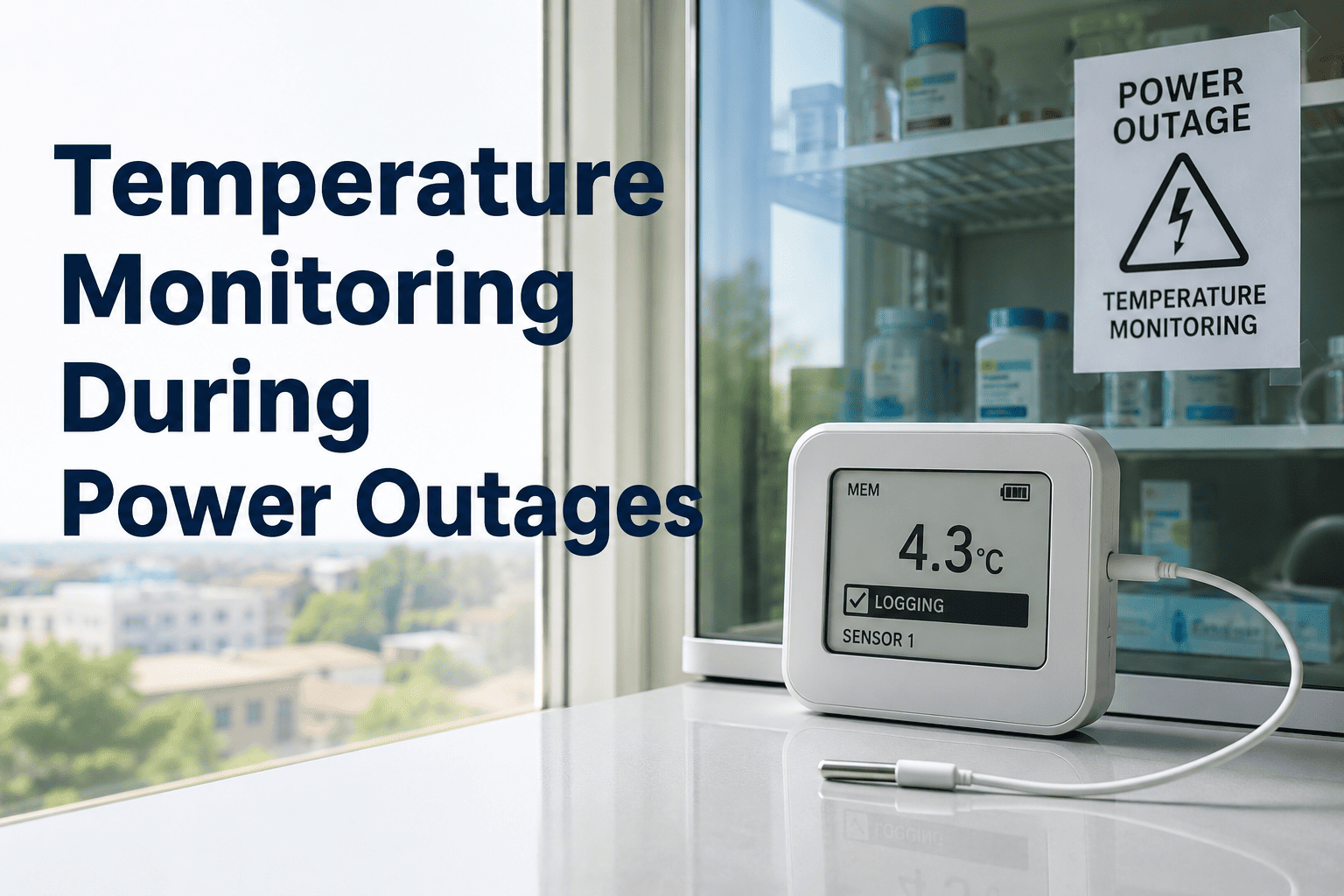
The power goes out at 02:14 on a Saturday. Nobody is on site. By the time the morning shift arrives at 06:00, the walk-in cooler has been without power for nearly four hours — and the question the shift lead has to answer in the next ten minutes is not "is the food safe," it is "can I prove what happened during those four hours." Without continuous temperature monitoring that kept logging through the outage, that question has no defensible answer, and the safe default becomes discarding product that may have been perfectly fine. Book a demo to see how continuous monitoring survives a power event and gives you the data to make that call correctly.
TEMPERATURE MONITORING · POWER OUTAGE RESPONSE
Temperature Monitoring During a Power Outage — Backup Systems, Product Disposition Rules, and Recovery Documentation
A power outage does not have to become a total loss event. Battery-backed sensors keep logging through the blackout, generator protocols buy time, and FDA Food Code time-temperature rules give a defensible framework for deciding what stays and what goes — provided the data exists to apply them.
4 Hr
Cumulative Time TCS Food Can Sit 41–70°F Before Mandatory Discard
32°F
Frozen Product Threshold — Any Rise Above Means "Thawed," Not Refreezable
72+ Hr
Battery Backup Duration on a Properly Specified Monitoring Sensor
WHY THE DATA MATTERS MORE THAN THE OUTAGE
The Real Risk in a Power Outage Is Not the Temperature Rise — It Is Not Knowing How Long It Lasted
Every walk-in cooler, freezer, and hot holding unit will eventually warm up if the power stays off long enough. That is expected and survivable. What turns an outage into a total-loss event is the absence of a continuous, timestamped record of what happened to the product temperature during the event. Without that record, a food safety manager cannot apply the FDA Food Code's time-temperature rules with any confidence — and the only defensible response is to discard everything, even product that was almost certainly still safe.
This is why battery-backed, cellular-connected temperature monitoring is not optional infrastructure — it is the asset that turns an outage from a guaranteed total loss into a documented, defensible, and often much smaller loss. A sensor that keeps logging through a power failure, on cellular connectivity independent of the facility's own network, is the single highest-leverage investment a food plant makes against outage risk.
THE OUTAGE RESPONSE SEQUENCE
What Happens in the First Hours of a Power Outage — and What Has to Be True at Each Stage
A well-prepared facility does not respond to a power outage improvised. The sequence below is the standard response pattern, with the monitoring and documentation requirement built into each stage.
Minute 0
Outage Detected & Logged Automatically
Battery-backed sensors continue logging temperature on cellular connectivity the instant grid power fails. The outage start time is recorded automatically — not reconstructed later from memory or a security camera timestamp.
Minute 5
Alert Fires to the On-Call Team
SMS and push notification reach the facility manager and maintenance lead simultaneously. If the facility is unstaffed overnight, the alert reaches whoever is on the emergency contact list — this is the moment that determines whether generator response happens in 20 minutes or 6 hours.
Minute 20–30
Backup Generator Engages or Manual Start Confirmed
Automatic transfer switch engages the generator, or on-call staff arrive to manually start it. This window is why generator load testing matters — a generator that has never been tested under load is a generator that may not actually engage when it counts.
Ongoing
Doors Stay Closed, Temperature Continues Logging
Every door opening during an outage accelerates warming. Standard protocol is doors closed except for genuine emergency access, with every reading during the outage still recording to the cloud log via cellular backup.
Power Restored
Recovery Confirmed, Disposition Decision Begins
Power restoration does not end the event. The temperature log from outage start to power restoration — plus the recovery curve back to safe operating range — is the evidence set the disposition decision runs against.
PRODUCT DISPOSITION RULES
The FDA Food Code Time-Temperature Rules That Actually Decide What Gets Discarded
The disposition decision is not a judgment call — it follows specific, documented thresholds under the FDA Food Code. Applying them correctly requires the temperature data from the outage; without it, the only safe assumption is the worst case. The table below is the working reference most food safety teams use during an outage response.
| Product Category |
Threshold Rule |
Disposition |
| TCS Food (Meat, Dairy, Cut Produce) |
≤41°F required; 41–70°F allowed up to 4 cumulative hours |
Discard beyond 4 cumulative hours above 41°F |
| Frozen TCS Food |
Must remain ≤32°F throughout |
Thawed product must be cooked immediately or discarded — never refrozen |
| Frozen Product — Ice Crystals Present |
No liquid pooling, no soft surface on packaging |
May remain in inventory if verified by multi-SKU probe check |
| Hot Holding Food |
Must remain ≥135°F |
Discard if below 135°F for any duration without documented reheat to 165°F |
| Shelf-Stable / Low-Risk Items |
Uncut produce, dry-cured meats, unopened jams and hard cheese |
Generally safe through extended outage — visual inspection only |
| Intact Eggs in Shell |
≤45°F for up to 7 days per USDA guidance |
Evaluate against cumulative time above threshold |
"Cumulative" Is the Rule Most Facilities Get Wrong — and It Only Works With Continuous Data
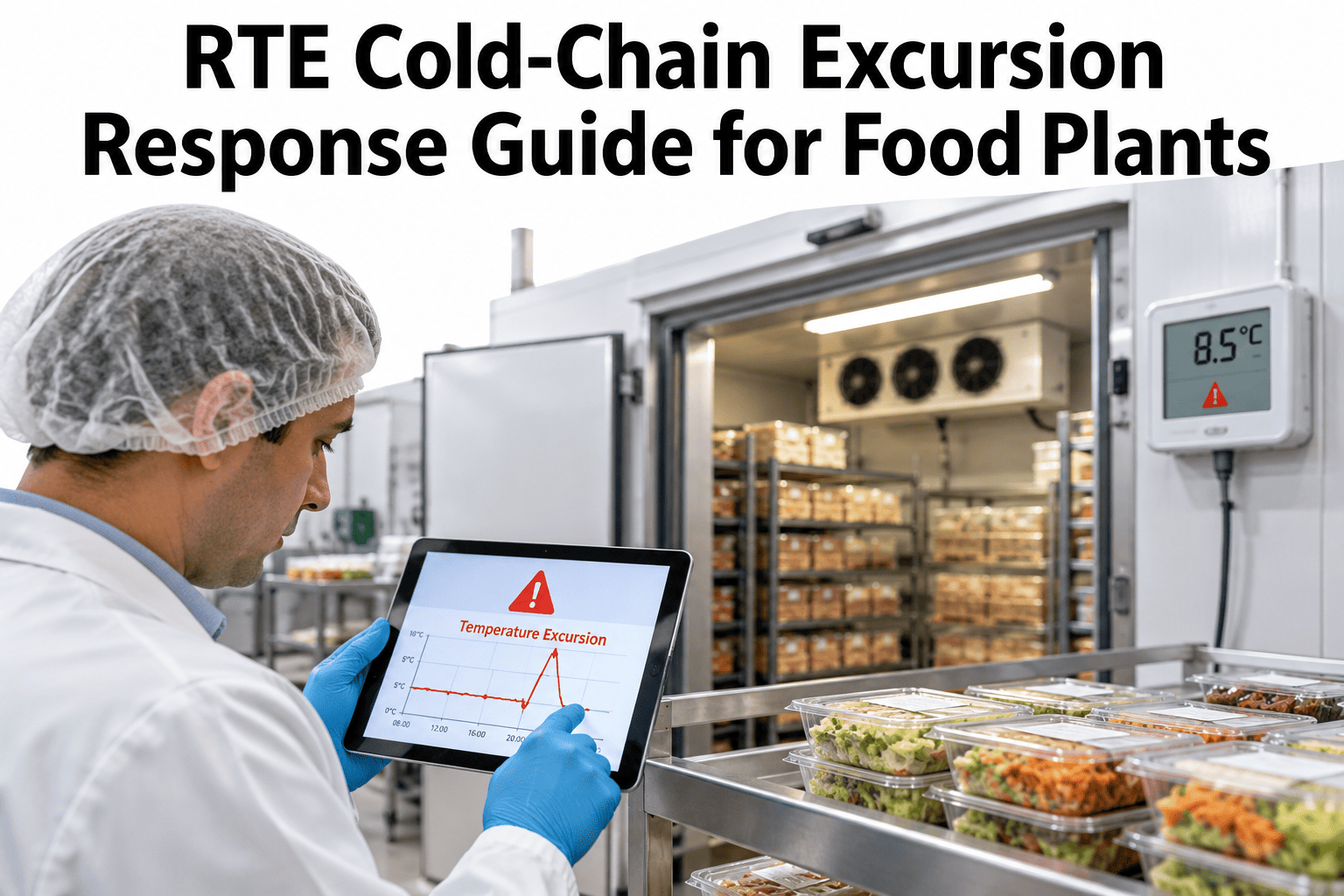
Four cumulative hours means exactly that — two hours during one outage plus three hours during a second event later the same day is five cumulative hours, not two separate four-hour allowances. Only a continuous log proves which side of that line you are on.
CORE VS SURFACE TEMPERATURE
Why the Same Air Temperature Reading Means Different Things in Different Equipment
The 41°F threshold applies to the product, not the case air — and this distinction is where facilities most often make the wrong disposition call in either direction. Equipment type and product density change how fast the air temperature reading actually reflects the product's internal temperature during an outage.
Closed Walk-In, High Load
A walk-in cooler that warmed to 50°F air for three hours likely still has product cores under 45°F if cases stayed closed and the load was dense. Thermal mass buys time — verify with a probe before discarding on air temperature alone.
Open Multi-Deck Case
An open multi-deck display case that warmed to 50°F air for three hours has product surfaces at or above 50°F already, because there is no thermal inertia protecting the product. Air temperature and product temperature converge almost immediately.
Densely Packed Freezer
A tightly packed chest or reach-in freezer resists warming far longer than a lightly stocked one — the same outage duration can leave one freezer's contents solid and another's partially thawed depending purely on load density.
Individual Product Probing
When air temperature data alone is ambiguous, a calibrated probe inserted into the geometric centre of the largest or most exposed items in each affected unit gives the actual answer the disposition decision needs.
GENERATOR PROTOCOLS
What "Generator Ready" Actually Means — Five Verification Points Most Facilities Skip
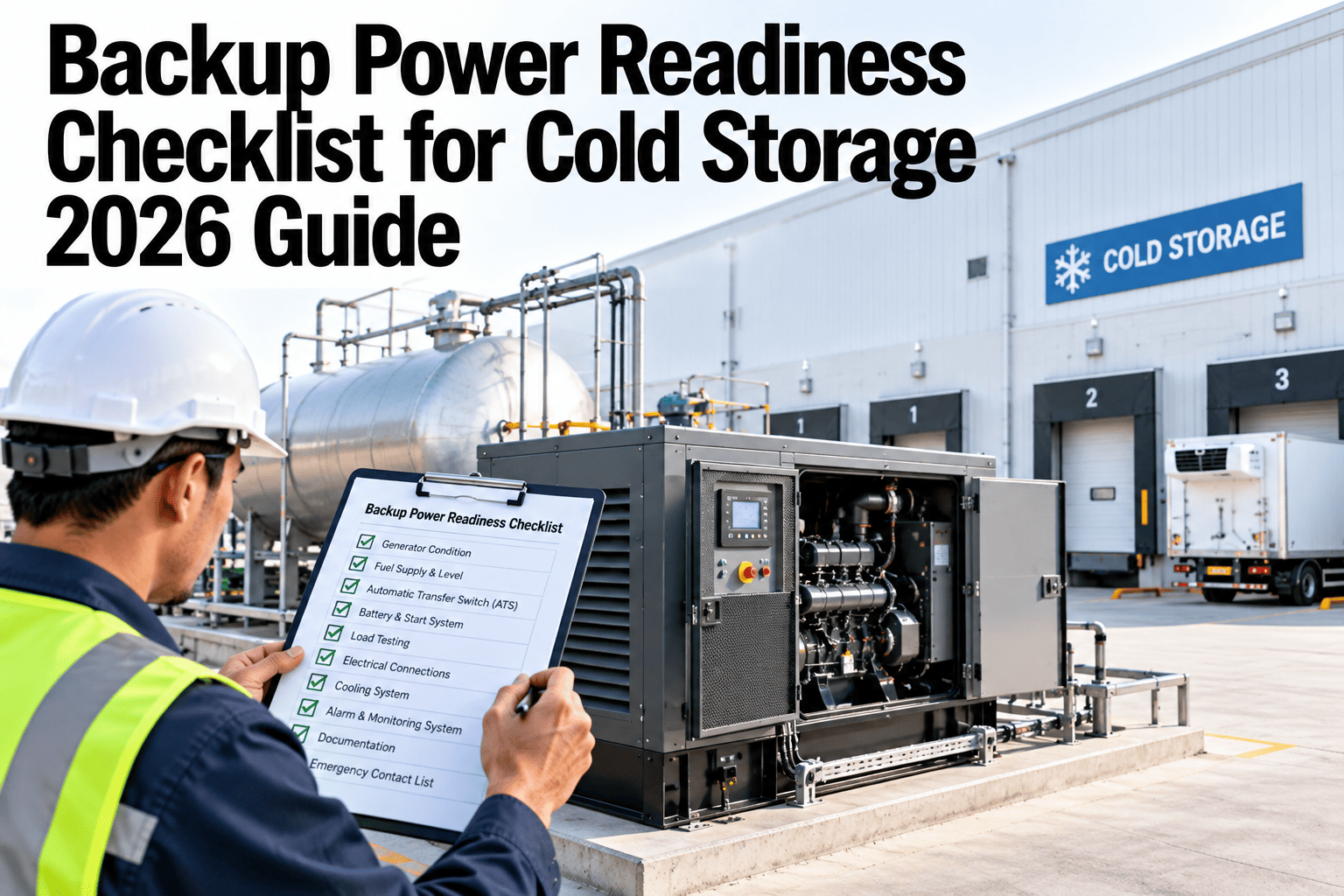
A generator that has not been tested under real electrical load is a generator whose readiness is unverified. The gap between "we have a backup generator" and "our backup generator will actually engage and hold the facility's full refrigeration load" is where most outage response plans fail in practice, not in theory.
1
Load-Tested Monthly, Not Just Started
A no-load start test confirms the engine runs. It does not confirm the generator can carry the facility's actual refrigeration and lighting load without tripping. Monthly load tests at realistic capacity are the only real verification.
2
Automatic Transfer Switch Cutover Time Measured
The gap between grid failure and generator power reaching the refrigeration circuits should be documented in seconds, not assumed. A slow or failed transfer switch is functionally the same as having no generator at all.
3
Fuel Supply Sized to the Longest Regional Outage
Fuel capacity should cover the longest historical outage the region has experienced, plus contingency — not just a standard eight-hour tank that assumes the grid comes back quickly.
4
Monitoring Stays Live Independent of Generator Power
Temperature sensors and the gateway that transmits their readings should be on battery and cellular backup independent of the generator circuit — so monitoring continues even if the generator itself fails partway through the outage.
5
Refuelling Contract With a Documented Response SLA
For outages that exceed on-site fuel capacity, a standing refuelling agreement with a guaranteed response time is the difference between a generator that runs for the duration and one that goes silent at hour nine of a fourteen-hour outage.
FREQUENTLY ASKED QUESTIONS
Food Safety Managers' Questions About Power Outage Temperature Response
If our monitoring system loses power along with the facility, how do we know what happened during the outage?
This is exactly the gap a properly specified monitoring deployment closes. Sensors and gateways should run on battery backup rated for 72 or more hours, transmitting over cellular connectivity that is independent of the facility's own power and internet — so the temperature log continues recording through the exact event it needs to document. A monitoring system that goes dark when the facility loses power is not providing outage protection, only normal-operations monitoring.
Book a demo to review battery and connectivity specifications for outage resilience.
Can we refreeze product that partially thawed during an outage if it refroze before we discovered the problem?
No. FDA guidance is unambiguous on this point: frozen TCS food that thaws — meaning it rises above 32°F even briefly — must be cooked immediately or discarded. It cannot be refrozen for sale, even if it appears to have refrozen solid by the time the outage is discovered. The working verification signal is whether ice crystals are still present with no liquid pooling and no soft surface on packaging; if any of those fail, the product is discarded regardless of its current frozen state.
Contact temperature monitoring support to build a disposition checklist for your product mix.
How do we document a power outage event well enough to satisfy an FDA inspector or insurance claim?
Complete documentation includes the outage start and end time, ambient air temperature readings throughout, product core temperature verification where applicable, the specific disposition decision made for each affected product category, and the corrective action taken. Continuous digital monitoring generates the timestamped log automatically; the disposition decisions and corrective actions should be logged manually against that data the same day, while the details are fresh. This combined record is what both FDA inspectors and insurance adjusters expect to see.
Book a session to structure an outage documentation template for your facility.
Does a short outage — under an hour — still need to be documented the same way as a longer one?
Yes, and this is where the cumulative-time rule matters most. A one-hour outage on its own is well within the 4-cumulative-hour allowance for TCS food between 41 and 70°F. But if that facility experiences a second outage later the same day, the two events combine — and without a documented record of the first, shorter outage, there is no way to correctly calculate the cumulative exposure for the second. Every outage gets logged, regardless of duration.
Talk to temperature monitoring support to confirm your logging captures every event automatically.
What should a facility do differently for a multi-day outage versus a short one?
A multi-day outage shifts the priority from monitoring accuracy to product relocation and generator fuel logistics. Once on-site fuel capacity is exhausted, the choice becomes running the refuelling contract's response SLA against the facility's remaining product shelf life, or arranging emergency transport to a backup temperature-controlled facility. This decision should already be documented in the contingency plan before the outage happens — a multi-day outage is not the moment to be identifying backup facility options for the first time.
Book a session to review multi-day outage contingency planning for your facility.
DON'T LET AN OUTAGE MAKE THE DECISION FOR YOU
Give Your Facility the Continuous Data That Turns an Outage From a Guaranteed Total Loss Into a Documented, Defensible Decision
Battery-backed monitoring, cellular connectivity independent of the facility network, and automated alerts to the right people at the right time — the infrastructure that makes the FDA's time-temperature rules actually usable when they matter. Book a working session to review outage readiness for your facility.