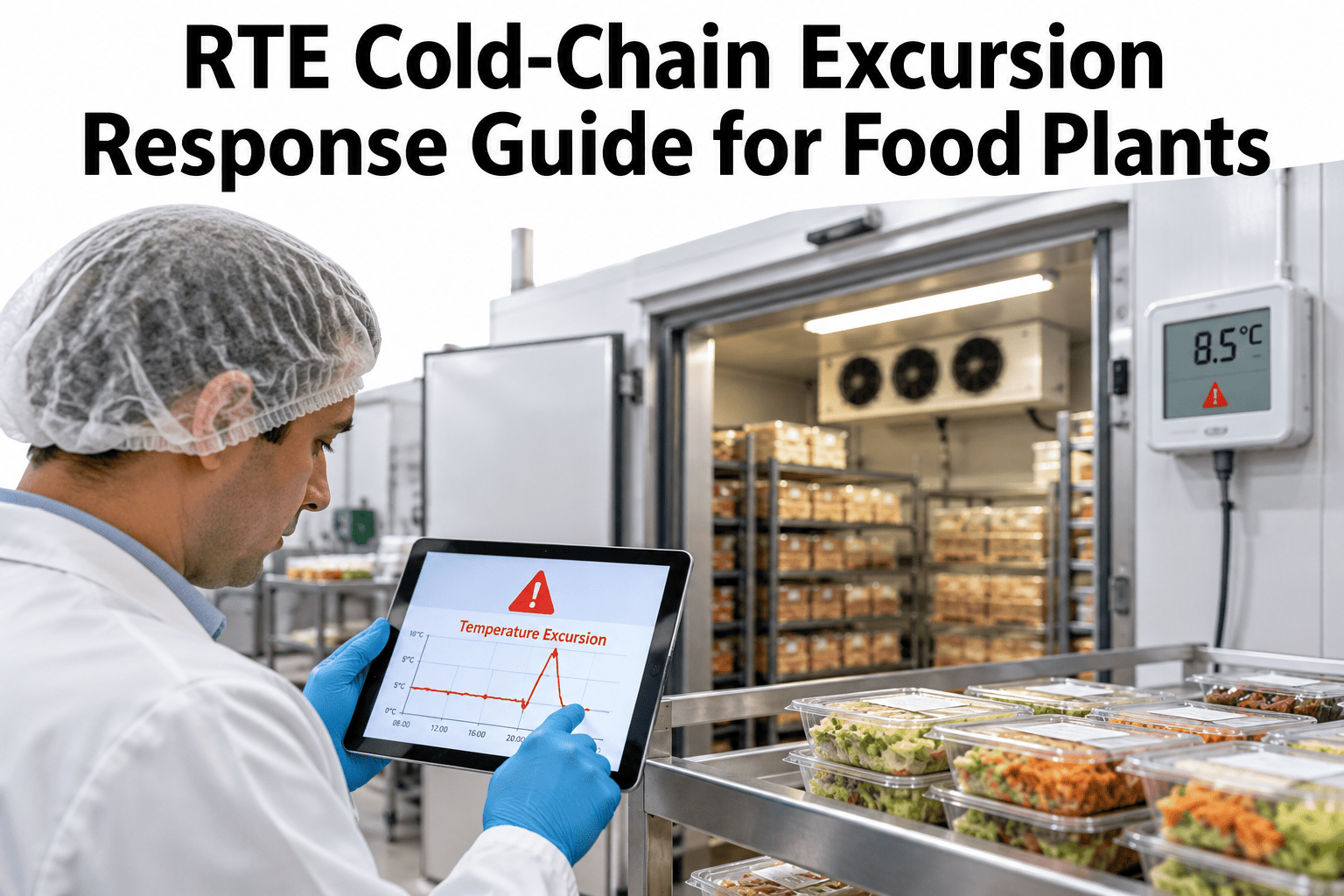
When ready-to-eat product sits above its safe temperature, the window for a good decision starts to shrink. Some bacteria can grow even at refrigeration temperatures, so the longer product is held too warm, the harder the decision becomes. A clear excursion response guide helps teams choose between hold, retest, reprocess and destroy quickly and consistently, using criteria from the plant food safety plan. It does not replace your food safety team, but it keeps their decisions fast and documented. To see how this could work in your plant, you can review an excursion decision flow with our team.
Cold-chain food safety for ready-to-eat products
Make Fast, Consistent Decisions When RTE Product Goes Above Temperature
iFactory AI timestamps every excursion, tracks cumulative exposure by batch and guides teams through hold, retest, reprocess or destroy decisions.
Four outcomes after an excursion
Hold
Retest
Reprocess
Destroy
Why speed mattersThe Window for a Good Decision Shrinks With Time
Many chilled ready-to-eat foods are expected to stay at or below about five degrees Celsius, and some regions set their own limits. Check the limits in your plan and in local rules.
Excursion starts
Temperature rises above the limit
Exposure builds
Time above the limit accumulates
Decision needed
The safe options narrow
Record kept
Evidence supports the decision later
This guide is general information and not food safety advice. Decisions must follow your HACCP plan, your food safety team and local regulations.
What informs the decisionFour Layers of Information Behind Every Call
Product risk
What the product is and how it supports microbial growth.
Exposure
How warm it got and for how long, including cumulative time.
Validated criteria
Limits and actions set in your food safety plan.
Evidence
Data, tests and records that support the choice.
A decision made on these four layers is easier to defend than one made on instinct under pressure.
The response flowFive Steps From Alarm to Recorded Decision
1
Contain
Stop movement and identify the affected product and batches.
2
Measure exposure
Establish temperature and duration for each batch.
3
Assess
Compare with the limits in your food safety plan.
4
Decide
Hold, retest, reprocess or destroy, as the plan allows.
5
Record
Document data, decision, approver and follow-up.
Speed comes from preparation. Teams that practise the flow handle real events more calmly.
Prepare Your Excursion Decisions Before the Next Alarm
Share your excursion procedure and see how iFactory AI would timestamp exposure, link it to batches and record every decision.
Decision guideIllustrative Responses for Typical Scenarios
The table shows the kind of structure many plants use. Your own criteria must come from your validated food safety plan.
| Scenario | Typical first action | Who decides | Evidence to gather |
|---|
| Brief, small rise with known duration | Hold and review against plan limits | Food safety lead | Temperature log and duration |
| Longer or higher rise | Hold and escalate | Food safety lead and QA manager | Exposure history and any testing |
| Unknown duration | Treat as higher risk and hold | Food safety lead with senior approval | Reconstruction from data and logs |
| Packaging damage or other concern | Hold and assess separately | QA manager | Inspection records and photos |
| Product already shipped | Start traceability and customer contact steps | Recall or incident team | Shipment and batch records |
Risk gridExposure and Product Risk Together
Event profile
Low-risk product
Higher-risk product
Short exposure
Review
Check against plan and record
Escalate early
Higher-risk product needs prompt review
Long exposure
Likely hold or test
Longer exposure on lower-risk product
Highest concern
Treat with the greatest caution
Higher-risk products, such as those supporting growth of pathogens, deserve the most conservative approach.
Data you needBring Temperature, Batch and Time Together
A fast decision depends on data that is already linked.
Room and product temperatureBatch and location recordsAlarm and response log
Excursion record by batch
Exposure summaryDecision workflowAudit evidence
Who decidesClear Authority at Each Level
Operator
Contain, report and record the facts.
Food safety lead
Assess and recommend a decision under the plan.
Senior approver
Approve higher-risk or customer-impacting decisions.
Name backups for each role, so nights and weekends are covered. To map decision rights, ask our team for an excursion authority template.
DocumentationFive Records Every Excursion Should Leave Behind
1
Temperature history
The full curve, not only the peak.
2
Affected batches and quantities
Linked to storage locations.
3
Decision and reason
Who decided and on what basis.
4
Test results
If retesting was part of the decision.
5
Follow-up actions
Cause analysis and preventive steps.
PracticeDrill the Response Before It Is Needed
1
Pick a scenario
Choose a realistic excursion for a drill.
2
Run the flow
Walk the team through each step.
3
Time the steps
Measure how long containment and data gathering take.
4
Find the gaps
Note missing data, unclear roles and slow steps.
5
Fix and repeat
Update the procedure and run another drill.
Temperature limits and actions in the food safety plan
Alarm contacts verified for every shift
Batch location records linked to temperature data
Exposure calculation method agreed
Decision criteria written and approved
Named backups for each decision role
Records stored for each excursion
Drills run at least twice a year
Expert reviewWhat a Food Safety Manager Would Check First
Expert review
Fast decisions come from preparation. Plants that agree criteria in advance, link data to batches and practise the flow decide faster and with fewer regrets.
VerdictStrong when criteria come from the validated plan and every decision is recorded.
Watch forDecisions made on gut feeling because exposure data is incomplete.
Do nextRun one tabletop drill and see how long it takes to know what is affected.
Frequently asked questionsWhat Food Plants Ask About RTE Excursion Response
Who should decide whether to hold or destroy product?
The decision should follow your validated food safety plan and involve your food safety lead, with senior approval for higher-risk cases. Operators contain and record, but should not decide alone. Regulations and customer requirements also apply.
Review decision roles.
How do we calculate exposure time?
Use logged temperature data to find when product went above the limit and when it returned, and consider cumulative time across several events. Your food safety plan should define the method.
Ask about exposure calculation.
What if we do not know how long the excursion lasted?
Treat it as higher risk and follow the conservative path in your plan, while trying to reconstruct the timeline from data, logs and staff accounts. Strong monitoring prevents this situation.
Discuss reconstruction methods.
Can retesting always resolve the question?
Not always. Testing has limits, and results may not cover the whole batch. Your plan should say when testing is appropriate and how results are interpreted.
Ask about testing in decisions.
How do we keep decisions consistent across shifts?
Write the criteria down, make the data available to everyone and use a standard flow with named backups. Practice drills build the same habits across teams.
Plan a drill programme.
Prepared, consistent, documented
Decide Faster When Temperature Goes Wrong
Book a session with iFactory AI to link temperature data to batches, build your excursion flow and prepare your team before the next alarm.