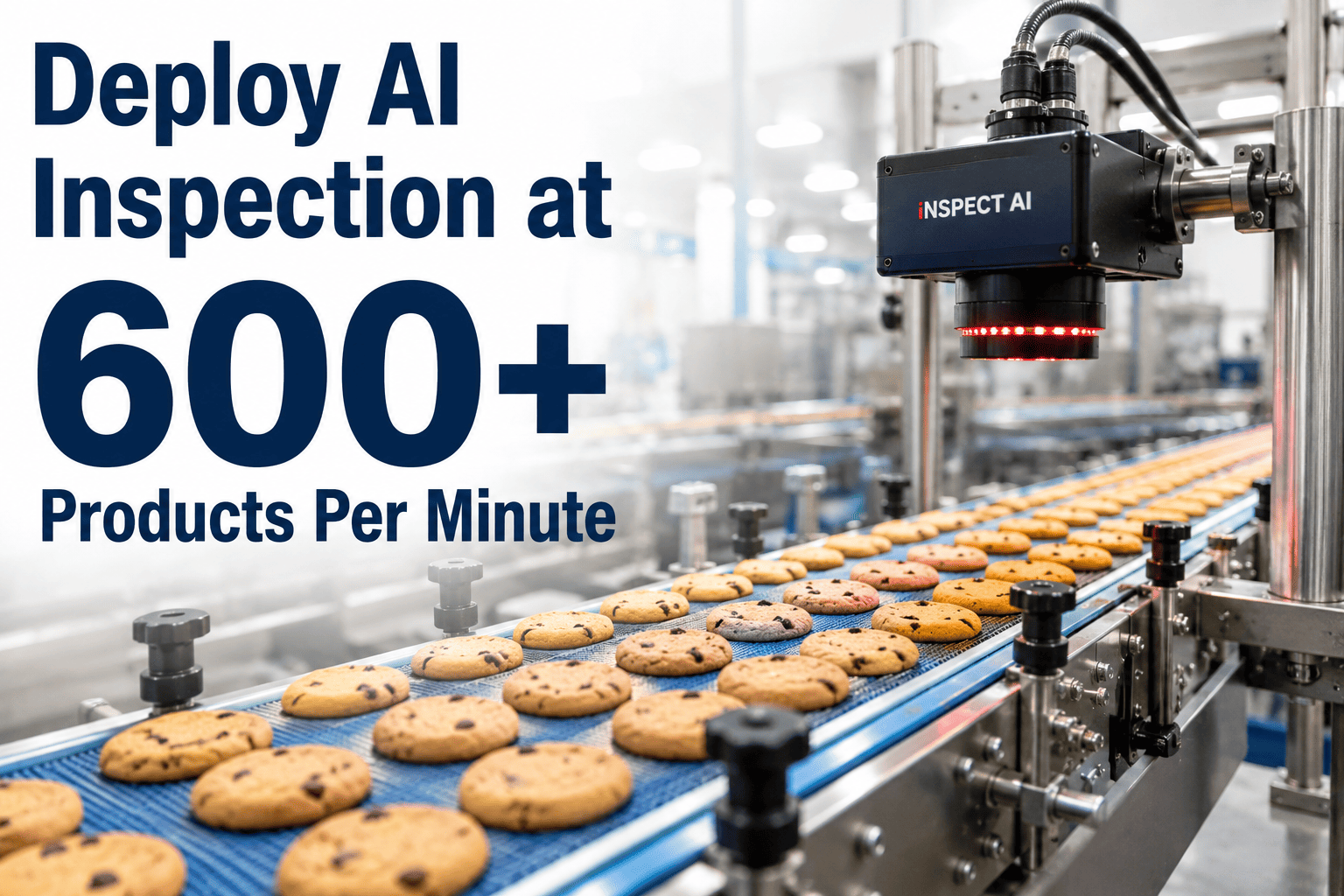
Six hundred products a minute means an inspection system has roughly one-tenth of a second to capture an image, run it through a model, and make a pass or reject decision before the next item arrives. Most vision systems that work perfectly well in a lab or on a slower line start dropping frames or lagging behind the moment they're asked to run at real packaging-line speed, and the failure usually isn't the model's accuracy, it's the hardware and inference pipeline underneath it that can't keep pace. Getting AI inspection to hold up at this speed is a hardware and edge-compute problem as much as it is a machine learning one. iFactory's engineering team tunes both sides together rather than treating them separately.
Keep AI Inspection Accurate Even When the Line Runs at 600+ Products Per Minute
Hardware selection, edge compute placement, and inference tuning built specifically for high-speed packaging lines, so accuracy doesn't degrade the moment the line hits full production speed.
Why Speed Breaks Vision Systems That Work Fine in Testing
A vision model tested at low line speed in a controlled setting almost always looks accurate, because there's enough time between items for the camera, the network, and the inference engine to each do their job without contention. Push the same setup to full production speed and three things start competing for the same fraction of a second: image capture has to be fast enough to avoid motion blur, the inference engine has to return a decision before the item moves out of reach of the reject mechanism, and the network connecting the camera to the compute has to move that image without adding latency. Any one of these being slightly too slow doesn't just miss occasional items, it can cascade into a growing backlog that eventually forces the line to slow down anyway.
The Hardware Decisions That Actually Matter
The inference engine gets most of the attention in these conversations, but the camera, lighting, and edge compute placement are just as likely to be the bottleneck once the line reaches full speed. A camera without a fast enough global shutter introduces motion blur that no model can compensate for. Edge compute placed too far from the camera, relying on a shared plant network, adds latency that a dedicated local connection would avoid entirely.
Run a Speed Validation on Your Specific Packaging Line
Tell us your current line speed and existing camera setup. We'll walk through what a full time-budget breakdown looks like for your specific configuration.
Tuning Inference Without Sacrificing Accuracy
The instinct when inference is too slow is to shrink the model until it's fast enough, which often trades away exactly the accuracy the inspection system was built to deliver. A better approach optimizes the inference pipeline itself — batching decisions efficiently, using hardware acceleration suited to the specific model architecture, and reserving the heaviest computation only for items the lighter first-pass check flags as uncertain, rather than running the full model on every single item regardless of how obviously it passes.
| Technique | What It Does | Accuracy Trade-off |
|---|---|---|
| Tiered inference | Fast first-pass check, full model only on uncertain cases | Minimal, if thresholds are tuned correctly |
| Hardware acceleration | Runs inference on hardware matched to the model architecture | None, purely a speed gain |
| Batched capture | Groups image processing to reduce per-item overhead | None if buffer sizing is correct |
| Model size reduction | Shrinks the model to run faster | Can reduce accuracy if done without validation |
Validating Before Going Live at Full Speed
Skipping a proper speed validation is the single most common way these deployments go wrong. A system that looks accurate at half speed can behave very differently once the full time budget is in play, so testing has to happen at the actual production speed the line will run, not an approximation of it.
Want a time-budget breakdown for your specific line speed and camera setup before committing to hardware changes? Send us your current specs and we'll map it out.
What High-Speed Deployments Report Once Tuned Correctly
Plants that go through a proper speed validation process consistently report that the accuracy achieved at full production speed matches what was seen in initial low-speed testing, which is the actual goal — not a faster system, but one that doesn't quietly lose accuracy the moment real production volume hits it.
Common Mistakes at High Line Speeds
The most frequent mistake is validating the system at a lower test speed and assuming performance will scale linearly, which it rarely does once network and inference contention start compounding. A second common mistake is shrinking the model to hit a latency target without validating the resulting accuracy against the original test set, which can quietly reintroduce the exact defects the system was deployed to catch. Speed and accuracy have to be validated together, not traded off based on assumption.
Frequently Asked Questions
Get AI Inspection That Actually Holds Up at Full Production Speed
Send us your current line speed and hardware setup. We'll map out the time budget and show you exactly where the gains are available.