The phrase "21 CFR Part 11" tends to make quality teams genuinely nervous the moment it comes up in a software evaluation, usually because it gets treated as a vague, sweeping legal requirement rather than a specific, checkable list of technical and procedural controls. The regulation is narrower and considerably more practical than its intimidating reputation suggests, and once a plant understands exactly what it requires for HACCP electronic records and signatures, meeting it becomes a matter of careful configuration rather than guesswork. Quality and IT teams working through this evaluation together can Book a Demo to see the specific controls in place.
Electronic Signatures That Hold Up Under an FDA Records Request
iFactory's HACCP electronic records are built around the specific Part 11 controls — unique credentials, audit trails, signature manifestation — instead of a generic e-signature bolt-on.
What Part 11 Actually Covers for a Food Plant
21 CFR Part 11 applies whenever a food company chooses to keep records electronically that are required by FDA regulation, or chooses to use an electronic signature instead of a handwritten one to satisfy a signature requirement. For a HACCP program, that means the moment a plant moves CCP monitoring, corrective action documentation, or verification sign-offs from paper into a digital system, Part 11 governs how those electronic records and signatures need to be controlled to remain legally equivalent to the paper version they replaced.
A useful way to think about the regulation is that it exists to answer one core question in a way that holds up to scrutiny: if a record shows a specific reading, a specific corrective action, and a specific approval, can the plant prove that record is exactly what was originally entered, by exactly the person it claims, and has not been altered without a visible trace of the change. Everything else in the regulation is really in service of being able to answer that single question with confidence, for any record, at any point after it was created.
It is worth being clear about what Part 11 does not require, because a surprising amount of vendor marketing implies the regulation demands specific technology — blockchain, biometrics, particular software architectures — that it does not actually specify. Part 11 is technology-neutral. It defines a set of controls a system must demonstrate, not a specific way of achieving them, which means the right question for a plant to ask a vendor is not "are you Part 11 compliant" as a marketing claim, but "show me exactly how each specific control is implemented."
This distinction matters more than it might first appear, because "Part 11 compliant" as a marketing phrase has been applied loosely enough over the years that FDA itself has published guidance clarifying that it does not certify or endorse specific software products as compliant. Compliance is a property of how a system is configured and used within a specific quality environment, not a badge a vendor can simply attach to a product listing. A plant that treats a vendor's compliance claim as sufficient due diligence, without reviewing the actual configuration against the specific controls the regulation describes, is taking on more regulatory and operational risk than the marketing language on a product page would ever suggest.
The practical implication is that the evaluation conversation with any vendor should move quickly past whether they claim compliance and into specifics: how is a unique credential enforced, what does the audit trail actually capture, how is signature meaning recorded, and can the vendor walk through a live example of each rather than pointing to a whitepaper. A vendor who welcomes that level of scrutiny and can answer it directly with a working demonstration is a far better signal than one who prefers to keep the conversation at the level of a compliance checklist.
The Core Controls, One at a Time
Rather than treating Part 11 as one large requirement, it breaks down into a specific, finite list of controls. Each one below is a genuine regulatory requirement, explained in terms of what it actually looks like inside a working HACCP record system.
Working through each control individually, rather than treating the regulation as one undifferentiated mass of legal text, is what turns a Part 11 evaluation from an intimidating exercise into a manageable checklist. Most quality teams find that once they see the five controls broken out this way, several of them are already substantially covered by procedures they have in place for other reasons — access control policies, existing training records, change management — and the real gap analysis narrows down to a much smaller, more specific set of questions about how the software itself behaves.
Unique User Identification
Every person entering data or applying a signature must have their own unique username and credential — shared logins or generic station accounts do not satisfy this requirement under any circumstances. Each electronic record needs to be traceable to the specific individual who created or signed it, not just to "the line 3 operator" as a role, because the regulation is specifically concerned with individual accountability for each entry in the record.
Signature Manifestation
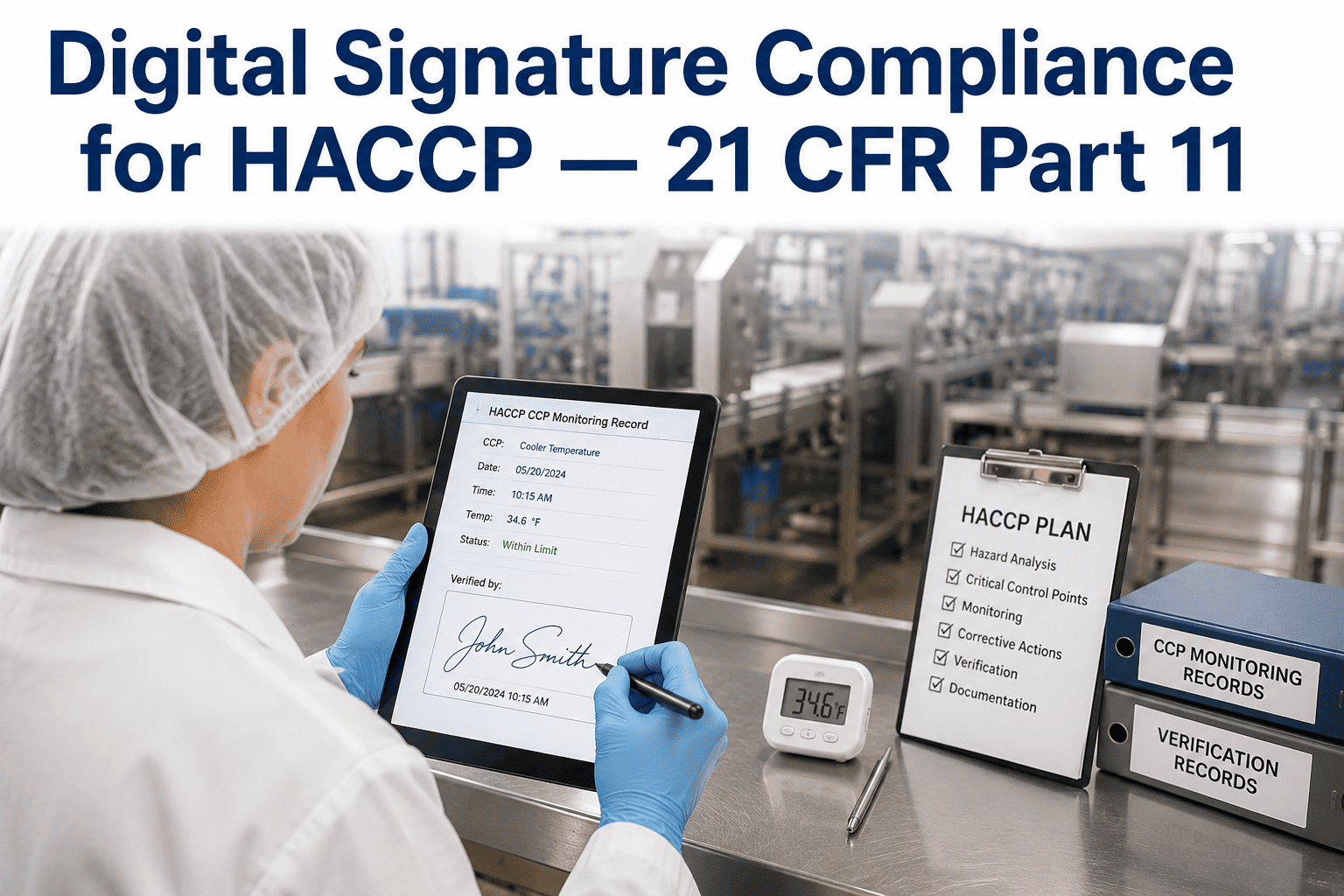
When a record is signed electronically, the printed or displayed version of that record must show the signer's full name, the date and time of signing, and the meaning of the signature — approval, review, or authorship, for example — rather than just a checkbox or a generic "signed" flag with no context attached to what the signature was actually attesting to at the moment it was applied.
Secure, Time-Stamped Audit Trails
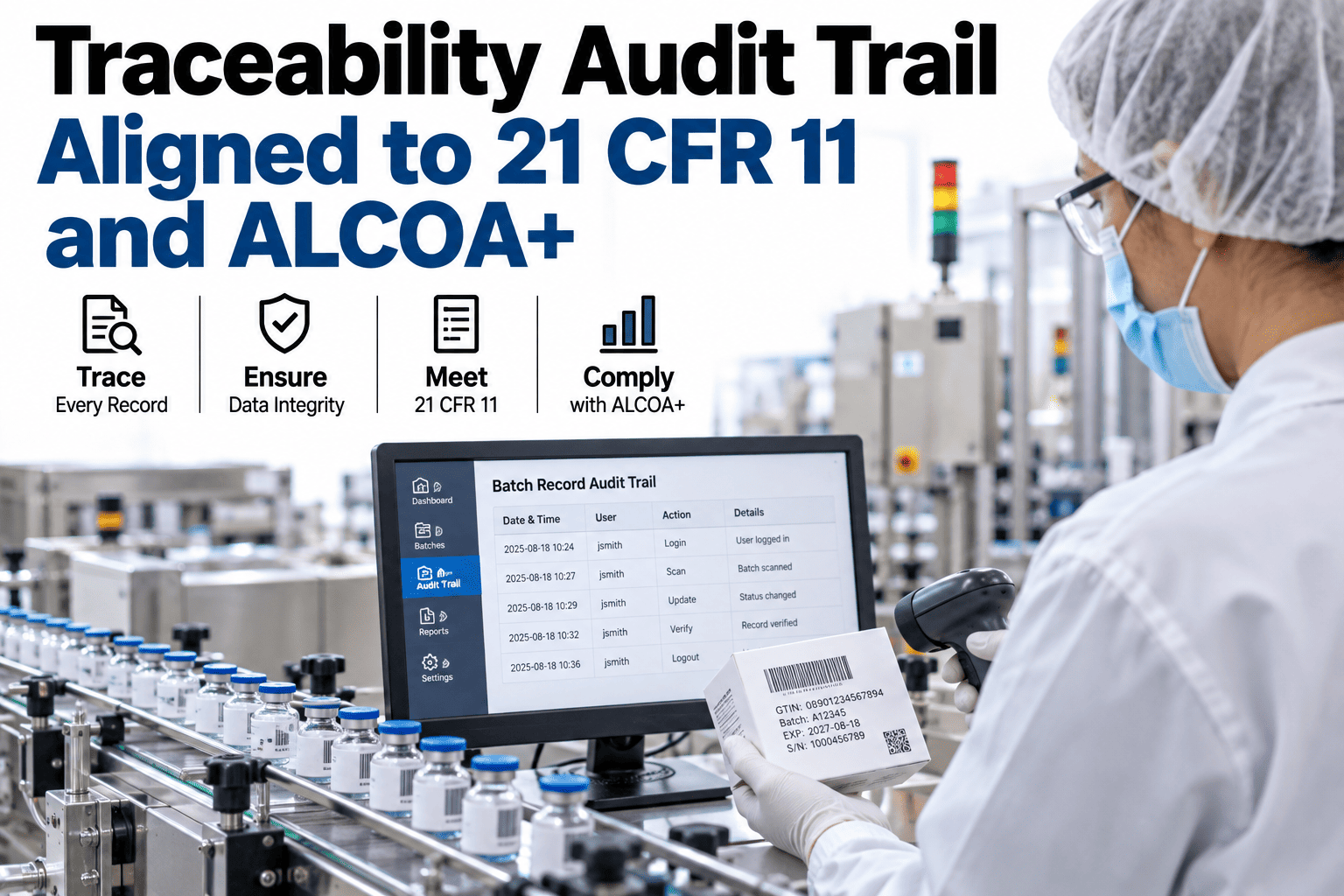
Any change to an electronic record after it is first saved must be captured in a secure audit trail that records what changed, who changed it, and when, without obscuring or overwriting the original entry. The original value has to remain visible alongside the correction, which is exactly what distinguishes a genuine audit trail from a system that simply lets a record be edited in place with no history retained whatsoever.
Two Distinct Signature Components
An electronic signature that is not biometric must be made up of two distinct identification components — typically a unique username plus a password — and both must be required each time a signature is applied within a single continuous session, not just once at login and then assumed for every subsequent action for the remainder of the entire shift.
System Access and Operational Controls
The system must limit access to authorized individuals, enforce sequencing where steps genuinely need to happen in order, and use validated checks to confirm the authenticity and integrity of the data being recorded, rather than relying entirely on procedural policy with no technical enforcement mechanism behind it on the floor.
Where Plants Get This Wrong
The most common Part 11 gap is not a missing feature — it is a feature that exists but is not actually being used the way the regulation requires. A system with individual login credentials that a plant configures with one shared password across an entire shift technically has unique identification available, but the way it is actually operated defeats the purpose of the control entirely. The same applies to audit trails that exist in the software but are disabled by default, or signature meaning fields that are present but left blank because nobody configured the workflow to require them.
This is exactly why a Part 11 evaluation needs to include a review of how the system is actually configured for your specific HACCP workflow, not just a checklist confirming the vendor's software has the right features somewhere in its capability list. A control that exists in the software but is not enforced in your actual configuration provides no more protection than not having it at all, and an FDA investigator reviewing your electronic records during an inspection is going to test the actual behavior of the system in front of them, not the vendor's published feature list.
A useful exercise for any quality team preparing for this kind of review is to walk through a single record end to end — from the moment an operator enters a monitoring reading, through any correction that might occur, to the final supervisor sign-off — and ask at each step exactly which control is protecting the integrity of that record at that moment. If the answer at any step is "we trust the operator to do it right" rather than "the system enforces it," that step is worth a closer look before an external reviewer finds the same gap.
Paper Signatures vs. Compliant Electronic Signatures
| Requirement | Paper Signature | Compliant Electronic Signature |
|---|---|---|
| Individual accountability | Handwriting, easily forged | Unique credential per user |
| Signature meaning | Often implied, not stated | Explicitly recorded |
| Change history | Cross-outs, initials | Full audit trail, timestamped |
| Tamper resistance | Low, easily altered | System-enforced integrity |
| Retrieval for audit | Manual binder search | Instant digital query |
Implementing Signatures Without Slowing the Floor Down
A common and reasonable concern from operations leadership is that adding proper electronic signature controls will slow down the floor, since every signing event now requires entering a username and password rather than a quick initial on a paper form. In practice, well-designed implementations minimize this friction by keeping the signing session active for a defined period during a shift, requiring full re-authentication only when the meaning of the signature genuinely changes — moving from a routine monitoring entry to a corrective action approval, for example — rather than on every single entry throughout the day.
Biometric authentication, where a plant's hardware supports it, can also satisfy the two-component signature requirement with less friction than typing a password repeatedly, since a fingerprint or badge tap combined with the underlying unique credential meets the same regulatory bar. The right balance depends on your specific floor environment, glove use, and terminal placement, which is exactly the kind of configuration decision worth working through with your integration team before rollout rather than defaulting to whatever the software ships with out of the box.
It also helps to separate, in your own thinking, the friction that is genuinely required by the regulation from friction that is simply how a particular vendor chose to implement it. Part 11 requires that both components of a signature be present each time a signature is applied within a session — it does not specify how long a session can remain active before re-authentication is required, or exactly what interface pattern is used to collect the second component. Vendors have real latitude here, and a well-designed implementation uses that latitude to minimize disruption on the floor while still satisfying the letter of the requirement.
Plants running multiple shifts with different floor conditions sometimes find that different terminals warrant different authentication methods — a badge tap at a clean, dry office-adjacent terminal used for supervisor sign-off, and a longer session window with periodic re-authentication at a wet, glove-heavy line-side terminal used for routine monitoring entries. Configuring this per terminal, rather than applying one blanket policy across every station in the plant, tends to produce the best balance between security and practical usability.
Preparing for an FDA Records Request
The real test of a Part 11 implementation is not the initial validation — it is what happens the day an FDA investigator asks to see the electronic records supporting a specific CCP over a specific date range, including any corrections made and who made them. A properly configured system produces that answer directly: the original entries, any subsequent changes with the prior value preserved, the identity of everyone who touched the record, and the meaning of every signature applied, all without a scramble to reconstruct history from memory or fragmented paper backups.
Plants that have been through this scenario consistently describe the same experience: the difference between a well-configured system and a poorly configured one is invisible on a normal day and becomes glaringly obvious the moment someone actually needs to pull a complete, defensible record under time pressure. That is precisely why the configuration review matters more during implementation than at any later point — problems found during a live records request are far more costly than problems found during setup.
It is also worth preparing for the version of this scenario that is more common than an actual FDA inspection: an internal audit, a corporate quality review, or a major customer's own food safety team asking to see the same thing. These reviews happen far more often than a formal regulatory records request, and a system that performs well under them builds the kind of internal confidence that makes the eventual regulatory scenario far less stressful when it does arrive, because the team has already exercised the retrieval process successfully multiple times under lower-stakes conditions.
Running a mock records request internally, on a schedule, is a practical way to build that confidence rather than waiting to find out how the process performs the first time it genuinely matters. Many quality teams incorporate this into their existing internal audit calendar, treating a simulated FDA data request as one of the standard checks performed during a routine internal review, alongside the more traditional physical walkthrough of the plant floor.
Validation and Documentation Requirements
Part 11 compliance is not a one-time software feature check — it is an ongoing responsibility that includes validating the system for its intended use, maintaining documentation of that validation, and having written policies that hold individuals accountable for actions taken under their electronic signature. This is where the software vendor and the plant's own quality system meet: the vendor is responsible for building a system capable of the required controls, and the plant is responsible for validating it for their specific process and maintaining the procedural documentation that makes the technical controls enforceable in practice.
A typical validation project for a HACCP electronic records system includes an installation qualification confirming the system is set up correctly, an operational qualification confirming each Part 11 control functions as intended, and a performance qualification confirming the system performs reliably under real production conditions over a defined period. Budgeting time for all three stages, rather than treating validation as a formality to complete quickly, is what actually produces documentation that holds up when it is reviewed later.
The performance qualification stage in particular tends to get shortchanged under project timeline pressure, since the installation and operational qualifications can often be completed in a controlled test environment over a few days, while a genuine performance qualification requires observing the system under real production conditions for long enough to have confidence it behaves correctly across normal shift variation, occasional network interruptions, and the full range of users who will actually interact with it. Plants that rush this stage sometimes discover configuration issues months later that a longer performance qualification period would have caught during implementation, when they were far cheaper and less disruptive to fix.
Documentation produced during validation should be treated as a living reference the quality team returns to, not a one-time deliverable filed away and forgotten. Whenever the system is updated, whenever a new terminal is added to the floor, or whenever a new category of user is introduced, the original validation documentation is the starting point for assessing what additional testing, if any, that change requires.
Frequently Asked Questions
Does every HACCP record need an electronic signature under Part 11?
Only records where your existing procedures require a signature under handwritten paper processes need an equivalent electronic signature once digitized — Part 11 does not create new signature requirements that did not already exist in your paper-based HACCP plan. The regulation governs how you implement a signature requirement electronically, not whether a particular record needs one in the first place, so the starting point is always your own approved HACCP plan and quality procedures, reviewed together with your quality team before any signature workflow is configured in the system.
Can we use badge taps or biometrics instead of typed passwords?
Yes, as long as the two-component requirement is still satisfied and the method reliably ties the signature back to a unique individual. Many plants combine a badge tap or fingerprint scan with an underlying unique credential already assigned to that person, which satisfies the regulatory requirement while reducing friction for operators wearing gloves or working in wet environments where typing a password repeatedly is genuinely impractical during a shift.
What happens if an operator makes a mistake and needs to correct an entry?
The correction is entered as a new event in the audit trail, with the original value preserved and visible alongside the corrected one, along with who made the change and when. This is fundamentally different from simply overwriting the original entry, since a proper Part 11 audit trail must never obscure or delete the original data, only append the correction with full context attached to it.
Do we need to revalidate the system every time software updates?
A risk-based approach is generally accepted, where the scope of revalidation matches the scope of the change — a minor interface update typically requires far less revalidation effort than a change to the underlying signature or audit trail logic itself. Your quality team's change control procedure should define this approach in advance, and the iFactory Support team provides documentation of what changed with each release specifically to support that review.
How do we get a walkthrough of the specific Part 11 controls before committing?
Teams evaluating a system for Part 11 compliance can request a demonstration that specifically walks through each control — unique identification, signature manifestation, audit trail behavior, and the two-component signature process — rather than a generic product overview. Book a Demo and bring your quality and IT leads to see exactly how each requirement is implemented and configured for your specific HACCP workflow.
Stop Guessing Whether Your Electronic Records Would Hold Up.
Talk to iFactory about validating your HACCP electronic records and signatures against the specific Part 11 controls that matter.