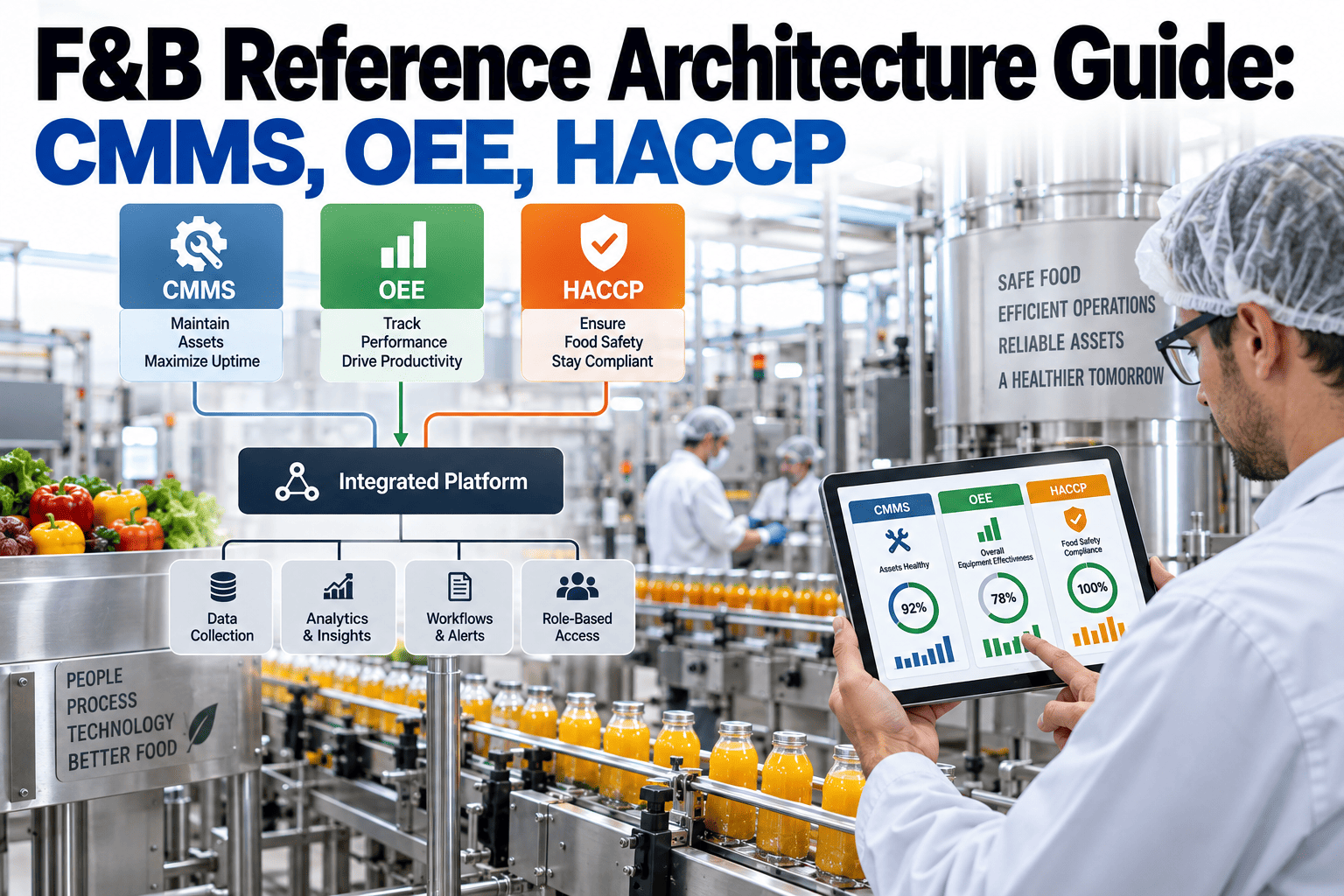
Ask five different people at a food manufacturing plant who owns the data behind a single finished-goods pallet — its raw material lot, its machine run history, its quality disposition, its OEE performance during the shift it was made — and you will likely get five different answers pointing at five different systems, none of which fully agree with each other. This is not a data problem so much as an architecture problem: CMMS, OEE, HACCP, and traceability systems were adopted at different times, for different reasons, by different departments, and nobody was ever assigned to draw the map of how they should connect. A reference architecture fixes this by defining, explicitly, which system owns which data, how information flows between them, and where the seams that cause the most confusion actually sit. If your plant's system map only exists in one engineer's head, book a demo to see a documented reference architecture built for a plant like yours.
Somebody Should Be Able to Draw Your System Map From Memory. Can They?
A reference architecture defines exactly which system owns which data across CMMS, OEE, HACCP, and traceability — and how information flows between them — so the map isn't locked inside one engineer's head.
Why Undefined Ownership Is the Root of Most Integration Pain
Most food manufacturing plants did not design their system architecture — it accumulated. A CMMS was purchased to manage maintenance work orders. An OEE tool was added later to track line performance. A HACCP or quality system came from a compliance mandate. A traceability solution was bolted on to satisfy a customer or regulatory requirement. Each system solved its own problem well. None of them were designed with a shared understanding of who owns what data when two systems both touch the same event.
A downtime event might be logged independently in both the OEE tool and the CMMS, with no defined rule for which record is authoritative when they disagree.
A quality disposition recorded in the HACCP system may never reach the traceability system, leaving a gap in the record for exactly the event a recall investigation would need.
Without an explicit architecture, it is unclear whether production schedule data should flow from ERP to MES or from MES to ERP, and different integrations sometimes assume both.
The actual map of how systems connect often exists only in the memory of whichever engineer built the original integrations, creating a single point of failure when that person leaves.
The Four-Layer Reference Architecture
A workable reference architecture for food manufacturing generally organizes around four layers, each with a clear responsibility, rather than treating every system as a peer with equal claim to every type of data.
Field and Equipment Layer
Sensors, PLCs, and machine controllers generate the raw data — cycle counts, temperatures, speeds — that everything above it depends on for accuracy.
Execution Layer — MES, CMMS, OEE
Systems that manage what is happening on the floor right now — work orders, line performance, downtime causes — owning real-time operational data.
Quality and Compliance Layer — HACCP, QMS
Systems that own food safety and regulatory data — critical control point monitoring, corrective actions, audit records — with authority over disposition decisions.
Business and Traceability Layer — ERP, Genealogy
Systems that own lot genealogy, inventory, and financial data, consuming events from the layers below to maintain a complete, traceable business record.
See a Reference Architecture Mapped to Your Actual Systems
Bring your current CMMS, OEE, HACCP, and traceability vendor names and we'll show you where the ownership boundaries should sit for your specific stack.
Data Ownership Table: Who Owns What
The single most valuable artifact a reference architecture produces is a simple table stating, unambiguously, which system is the authoritative source for each category of data. When two systems both hold a copy, this table defines which one wins.
| Data Category | System of Record | Consumers |
|---|---|---|
| Machine downtime cause | OEE system | CMMS, production reporting |
| Work order and repair history | CMMS | OEE (for context), ERP (for cost) |
| Critical control point monitoring | HACCP / QMS | Traceability, ERP (for hold status) |
| Lot genealogy and disposition | Traceability system | ERP, QMS, customer-facing reports |
| Production schedule | ERP or MES (defined per plant) | OEE, CMMS, traceability |
Five Common Integration Pitfalls in F&B System Design
These patterns show up repeatedly across food manufacturing plants attempting to connect CMMS, OEE, HACCP, and traceability systems without a documented architecture guiding the effort.
Two systems both trying to be authoritative for the same data can create sync loops where updates bounce back and forth, occasionally producing duplicate or conflicting records.
Nightly batch syncs between systems mean a same-day quality hold might not reach the traceability system until the next morning, too late for a same-shift decision.
Different systems using different lot, batch, or serial numbering conventions make automated cross-referencing unreliable without manual translation tables.
A one-off custom field added to solve an immediate problem in one system, with no documentation, becomes a silent dependency nobody remembers when that system is eventually replaced.
Without one person or team accountable for the overall architecture, each new integration project makes locally reasonable decisions that collectively drift the system further from a coherent design.
What Undefined Ownership Cost During a Recall Investigation
A mid-size beverage manufacturer facing a potential contamination event needed to trace every unit produced from a specific raw material lot across three production lines and two shifts. The traceability system held the lot genealogy, but the specific quality disposition decisions tied to that lot lived in a separate HACCP system that had never been fully integrated — the two systems synced weekly rather than in real time, and the sync had failed silently two weeks prior without anyone noticing.
Reconstructing the complete, accurate record required a quality engineer to manually cross-reference paper corrective action logs against the traceability system's genealogy report, a process that took four days instead of the few hours it should have taken with a properly architected data flow. The recall itself was ultimately narrow in scope, but the investigation delay meant potentially affected product remained in distribution longer than it needed to. The fix that followed was not a new system — it was defining, explicitly, that the HACCP system's disposition data would flow to traceability in real time via event trigger rather than weekly batch, closing exactly the kind of silent gap that only becomes visible during a crisis.
A Starting Checklist for Documenting Your Own Architecture
Building a reference architecture doesn't require a multi-month consulting engagement to start. These questions surface the biggest gaps quickly.
For each of CMMS, OEE, HACCP, and traceability, can you name the one person or team accountable for that system's data accuracy?
When two systems both hold a version of the same data point, is there a documented rule for which one is authoritative?
Do integrations between systems trigger in real time on the relevant event, or only on a scheduled batch sync?
Is there one consistent lot, batch, or serial identifier standard used across every system that needs to reference the same physical unit?
If the engineer who built your current integrations left tomorrow, could someone else accurately reconstruct the system map from existing documentation?
Has anyone actually tested tracing a single lot end to end through every system it should touch, timing how long it takes?
Frequently Asked Questions
Do we need to replace our existing CMMS, OEE, HACCP, and traceability systems to build a proper reference architecture?
Not necessarily — a reference architecture is primarily a documentation and integration design exercise, defining ownership boundaries and data flow rules for the systems you already have, rather than a mandate to replace them. In some cases, the exercise reveals that one system's role should shift, or that a specific integration needs rebuilding from batch to event-driven, but wholesale replacement is usually not the first recommendation. The exception is when a specific system architecturally cannot support real-time integration at all, in which case replacement becomes a longer-term consideration rather than an immediate requirement. For an assessment of whether your current systems can support a proper architecture, contact our support team.
Who should own the reference architecture once it's documented?
Most plants assign architecture ownership to a cross-functional role — often a senior quality or operations engineer with visibility across departments — rather than leaving it solely with IT, since the ownership boundaries defined in the architecture directly affect quality, maintenance, and production workflows. IT typically owns the technical implementation of data flows, while the architecture owner is accountable for keeping the documented ownership rules current as new systems or requirements are introduced. Without a named owner, architecture documentation tends to go stale within a year of being created. For guidance on structuring this role for your organization, book a demo with our team.
How do we handle a data ownership disagreement between two departments who each believe they should own a specific data category?
This is common, particularly around downtime cause data that both maintenance and production feel ownership over, and the resolution generally comes down to which system captures the data closest to its original source with the least manual entry involved. In the downtime example, the OEE system typically wins as system of record since it captures the event automatically, while the CMMS becomes a consumer that receives the downtime cause to generate a work order. Documenting this reasoning, not just the decision, helps the resolution hold up when questioned later. Our team can facilitate this kind of ownership mapping exercise — reach out to support to schedule one.
How often should a reference architecture be reviewed and updated?
An annual review is a reasonable baseline, but the architecture should also be revisited any time a new system is introduced, an existing system is replaced, or a significant process change alters which department owns a particular workflow. Treating the architecture document as a living reference rather than a one-time project deliverable is what keeps it accurate — plants that document it once and never revisit it typically find it drifted out of sync with reality within eighteen months. For a template review cadence that fits your specific system change frequency, schedule a session with our team.
Can a unified platform simplify this reference architecture work compared to a multi-vendor stack?
Yes, meaningfully — a unified platform covering CMMS, OEE, HACCP, and traceability functionality within one connected data model largely eliminates the ownership ambiguity that arises between separate vendor systems, since data ownership is defined natively within the platform's own data structure rather than negotiated across integration points. This doesn't eliminate the need for clear internal accountability for data accuracy, but it removes an entire category of technical integration risk. For a comparison of how this applies to your specific current stack, book a demo to see it directly.
Document the Map Before You Need It in a Crisis
A reference architecture is cheap to build and expensive to be missing during a recall investigation. See how iFactory approaches data ownership across CMMS, OEE, HACCP, and traceability.