Food Manufacturing Equipment Lifecycle: From Procurement to Decommission

By Josh Turley on April 9, 2026

food-manufacturing-equipment-lifecycle-from-procurement-to-decommission

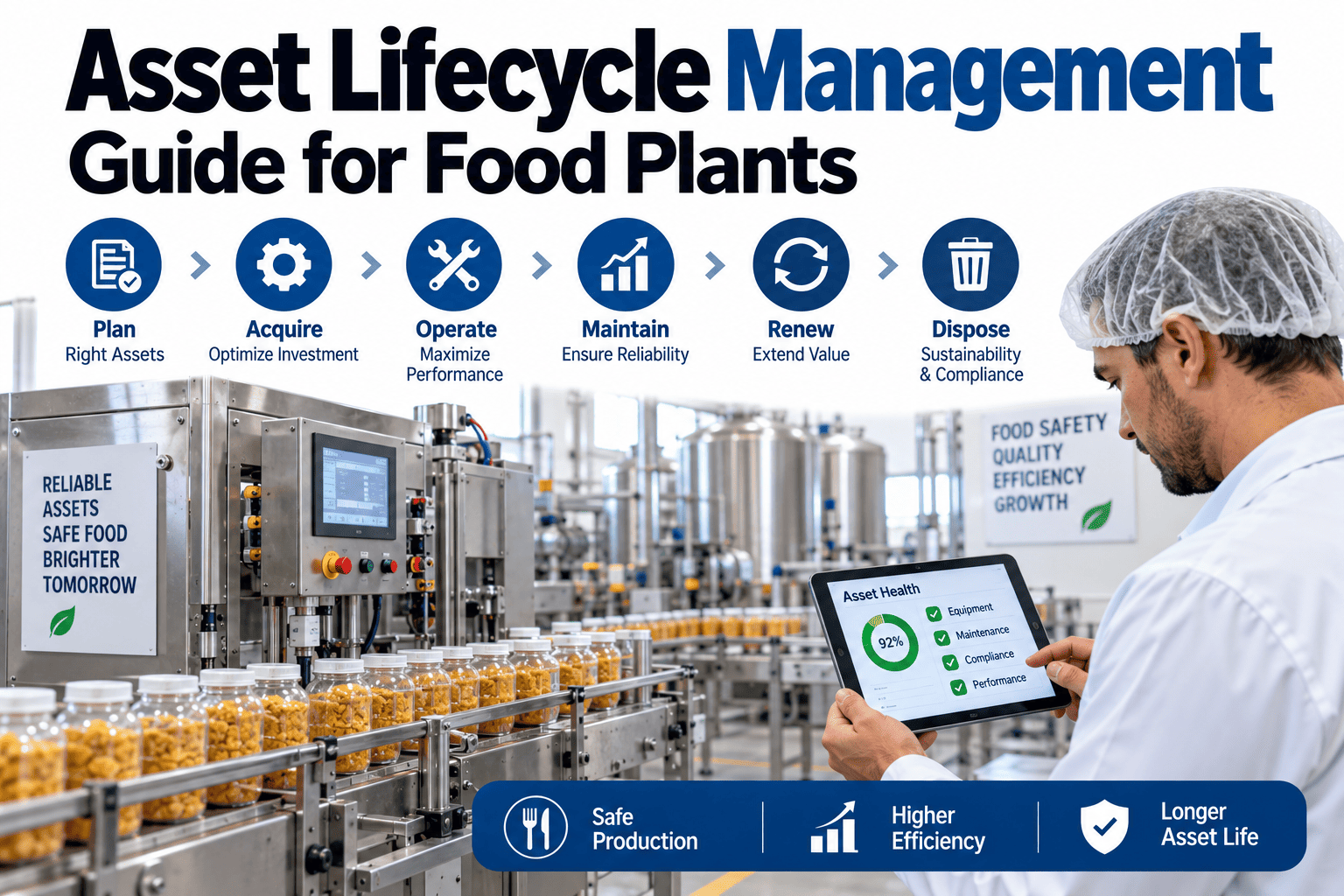
Food manufacturing equipment lifecycle management is no longer just a maintenance checklist — it is a strategic discipline that directly impacts food safety, production uptime, regulatory compliance, and capital efficiency. From the moment a piece of equipment is specified and procured to the day it is decommissioned and replaced, every phase of the food equipment lifecycle carries financial and operational consequences that compound over time. For food plant managers, engineering directors, and CapEx planners in the US, UK, Canada, Germany, and the UAE, mastering asset lifecycle management is the difference between reactive firefighting and predictive, data-driven operations.

AI-DRIVEN PLATFORM · ASSET LIFECYCLE MANAGEMENT
Automate Your Food Plant Asset Lifecycle Program
iFactory tracks every asset from procurement through decommission — eliminating manual records and delivering audit-ready documentation on demand.

What Is Food Manufacturing Equipment Lifecycle Management?

Food equipment lifecycle management is the structured process of overseeing every stage of an asset's life — from procurement and commissioning through operation, optimization, refurbishment, and final decommissioning. **[Book a Demo](https://calendly.com/contact-ifactoryapp/30min)**. Unlike general industrial asset management, food manufacturing introduces additional layers of complexity: sanitary design requirements, food safety regulations (FSMA, BRC, SQF, FSSC 22000), allergen control, and material traceability.

Procurement & Specification
Sanitary design evaluation, supplier qualification, Total Cost of Ownership (TCO) modeling.
Commissioning & Validation
IQ/OQ/PQ protocols, baseline performance benchmarking, CCP mapping.
Operation & Optimization
Continuous monitoring, predictive maintenance, OEE tracking, calibration management.
Refurbishment & Extension
ROI-based rebuild decisions, compliance re-validation, component-level replacement planning.
Decommissioning
Food-safe disposal, regulatory documentation, asset depreciation finalization.
Capital Planning
CapEx forecasting, replacement scheduling, risk-based prioritization across the plant.
Stage One

Equipment Procurement: Sanitary Design Evaluation and Total Cost of Ownership

Poor procurement decisions create problems that persist for the entire asset life — sometimes 15 to 20 years. The most costly mistake food manufacturers make is evaluating equipment on purchase price alone, ignoring Total Cost of Ownership (TCO) which includes energy consumption, cleaning chemical costs, maintenance labor, spare parts availability, and regulatory compliance risk.

Sanitary Design Evaluation Criteria

Before any food plant asset is approved for procurement, it should be evaluated against established sanitary design principles — particularly those outlined by EHEDG and 3-A Sanitary Standards. Equipment that fails sanitary design criteria becomes a persistent food safety liability regardless of how well it is maintained.

Smooth, crevice-free internal surfaces — no bacterial harborage points
Full drainability — no pooling water or product accumulation
Accessibility for inspection, cleaning, and maintenance without disassembly
Food-grade material certification for all product-contact components
Compatibility with cleaning-in-place (CIP) and sterilization-in-place (SIP) systems
Documented cleanability validation from the equipment manufacturer

Food Plant Capital Planning: Beyond the Purchase Price

A rigorous CapEx planning process should model a 10-year TCO that accounts for installation, commissioning validation, annual maintenance costs, expected downtime events, regulatory compliance re-certification, and end-of-life disposal. Food manufacturers in Germany and the UK operating under BRC and IFS standards face particularly high documentation requirements during equipment commissioning.

Stage Two

Equipment Commissioning in Food Plants: IQ, OQ, PQ Protocols

Commissioning is where equipment specification meets operational reality. In food manufacturing, commissioning is not complete until the asset has been validated against food safety, regulatory, and production performance requirements. Inadequate commissioning documentation is one of the most common findings in SQF and BRC audits.

Installation Qualification (IQ)

Documents that the equipment was installed correctly — utilities connected, safety systems functional, and all components present per specification. IQ records form the baseline for all subsequent maintenance and calibration activities.

Operational Qualification (OQ)

Confirms that the equipment operates within specified parameters across its full operating range. OQ data sets the critical limits that feed directly into your HACCP plan.

Performance Qualification (PQ)

Demonstrates consistent equipment performance under actual production conditions over a defined trial period. PQ validation is particularly critical for thermal processing, metal detection, and checkweighing equipment used as critical control points.

Baseline Documentation

At commissioning, establish the equipment's baseline performance record — energy consumption, OEE starting point, calibration baseline, and maintenance interval schedule. This baseline is the reference point against which all future performance will be measured.

Need help digitizing your commissioning records? Book a Demo to see how iFactory captures IQ/OQ/PQ documentation automatically.

Stage Three

Operational Phase: Analytics-Driven Equipment Optimization

The operational phase — typically spanning 10 to 20 years for major food plant assets — is where lifecycle management creates the most measurable value. Equipment that is actively monitored, maintained according to data-driven schedules, and continuously optimized delivers significantly better OEE, food safety performance, and energy efficiency than equipment managed reactively.

Predictive Maintenance vs. Preventive Maintenance

Traditional preventive maintenance schedules are based on manufacturer recommendations and elapsed time. Predictive maintenance uses real-time sensor data to identify degradation patterns before they cause failures — optimizing maintenance spend and eliminating unnecessary part replacements.

Food Plant Asset Management: Maintenance Strategy Comparison
Dimension Reactive Preventive Predictive AI-Driven Lifecycle
Unplanned DowntimeHighModerateLowMinimal
Maintenance CostHighestModerateLowerOptimized
Food Safety RiskVery HighModerateLowLowest
Documentation QualityPoorAdequateGoodExcellent
CapEx ForecastingImpossibleLimitedBetterPrecise
Regulatory ComplianceHigh riskModerate riskGoodContinuous

OEE Tracking for Food Manufacturing Assets

OEE combines availability, performance, and quality rate into a single figure that tracks how effectively each asset converts scheduled production time into good product. **[Book a Demo](https://calendly.com/contact-ifactoryapp/30min)**. Food manufacturers in Canada and the UAE use OEE trending to trigger maintenance interventions before performance degradation affects output or product quality.

AI Integration

How AI Vision Enhances Food Equipment Lifecycle Management

AI Vision — computer vision powered by artificial intelligence — is transforming how food manufacturers monitor, maintain, and optimize equipment across the full asset lifecycle. AI Vision captures visual data from cameras throughout the plant and uses machine learning to identify patterns, anomalies, and degradation indicators that no human inspection program can match for consistency or coverage.

01
Visual Equipment Condition Monitoring
Cameras continuously inspect equipment surfaces, seals, belts, and components for signs of wear, corrosion, or damage — flagging anomalies days before they cause failures or food safety events.
02
Automated Cleaning Verification
After every CIP cycle, AI Vision cameras verify that equipment surfaces meet visual cleanliness standards — providing timestamped evidence for every cleaning verification in allergen and Listeria control programs.
03
Foreign Object and Contamination Detection
AI Vision monitors product streams and equipment interiors for foreign objects and contamination events in real time — triggering immediate alerts and generating corrective action evidence automatically.
04
Packaging and Seal Integrity Inspection
100% inline inspection of seal integrity, label placement, and package completeness at production speeds — with performance trends feeding directly into the equipment lifecycle model.
05
Workforce Safety and PPE Compliance
AI Vision monitors that personnel entering high-care zones wear required PPE — providing continuous documentation of hygiene compliance across all production shifts automatically.
06
Throughput and Flow Analysis
Visual production flow data identifies bottlenecks and throughput anomalies caused by equipment degradation — connecting visual data to asset health for more accurate lifecycle planning.

Food manufacturers in the UK, Germany, and Canada are deploying AI Vision as a core component of their food safety management systems. Book a Demo to see AI Vision integration in action.

Stage Four

Equipment Refurbishment: Extend Asset Life or Replace?

When food plant assets approach end of planned operational life, the refurbishment-versus-replacement decision is one of the most consequential CapEx choices a manufacturing leader will make. A well-executed refurbishment program can extend asset life by 5 to 10 years at 30 to 50 percent of replacement cost.

Refurbish When:
Core structural components remain sound
Replacement parts are readily available
Refurbishment cost is below 40% of new equipment cost
Post-refurbishment performance meets current production requirements
Sanitary design can be brought to current standards
Replace When:
Sanitary design cannot be upgraded to GFSI scheme requirements
Spare parts are obsolete or from single suppliers
Energy consumption significantly exceeds modern equivalents
Downtime frequency is increasing despite maintenance investment
New technology offers step-change food safety improvement

Food Asset Depreciation and CapEx Planning

When assets are tracked in a digital asset management system with real operational data — actual maintenance costs, downtime events, energy consumption trends, and OEE history — depreciation calculations reflect true asset condition rather than arbitrary accounting schedules. **[Book a Demo](https://calendly.com/contact-ifactoryapp/30min)**. This allows CapEx planners to build replacement schedules driven by asset health data, not just elapsed years.

Stage Five

Food-Safe Equipment Decommissioning: Protocols and Documentation

Equipment decommissioning in food manufacturing is not simply a matter of removing machinery. Food plant assets contain residual product, allergens, cleaning chemicals, and lubricants that require managed disposal — and regulatory documentation requirements must be met to properly close the asset's compliance record.

1
Pre-Decommissioning Cleaning and Validation
All product residues, allergens, and cleaning chemicals must be removed and verified before decommissioning begins. A final cleaning validation record closes the food safety compliance history of the asset.
2
HACCP Plan and CCP Record Update
If the decommissioned asset was identified as a CCP in your HACCP plan, the plan must be formally revised and re-validated. This is a mandatory BRC and FSSC 22000 requirement.
3
Asset Record Closure
The asset's complete lifecycle record — commissioning documentation, maintenance history, calibration records, corrective action history, and decommissioning date — should be archived for the minimum period required by your certification scheme.
4
Disposal and Environmental Compliance
Documentation of compliant disposal protects the facility from environmental liability and supports ESG reporting requirements increasingly required by major retail customers in the UK and Germany.
5
Financial Asset Write-Off
The formal decommissioning date triggers the final depreciation calculation and asset write-off in the fixed asset register — eliminating phantom assets that inflate the balance sheet.
Technology

Asset Lifecycle Management Software for Food Plants

The right asset lifecycle management platform for a food manufacturer must integrate food safety compliance documentation, calibration management, corrective action workflows, and CapEx planning into a single system that supports both operational excellence and GFSI audit readiness.

Food Plant Asset Management Platform Comparison
Capability Generic CMMS ERP Asset Module iFactory AI-Driven Platform
Food Safety IntegrationNoneLimitedNative — CCP, HACCP, calibration integrated
GFSI Audit DocumentationManual exportPartialAutomated — scheme-mapped reports
Predictive MaintenanceNot availableBasic rule-based alertsAI-driven — sensor data + pattern recognition
Calibration ManagementBasic schedulingScheduling + certificatesFull history, auto-reminders, audit-ready
CapEx Lifecycle PlanningMinimalFinancial modeling onlyCondition-based replacement forecasting
AI Vision IntegrationNot availableNot availableNatively supported
Decommissioning RecordsManual close-outFinancial write-off onlyFull food safety + financial closure
ROI and Benefits

The Business Case for Structured Food Equipment Lifecycle Management

Food manufacturers that implement structured equipment lifecycle management — supported by a purpose-built AI-powered platform — consistently achieve measurable improvements across operational efficiency, food safety performance, regulatory compliance, and capital planning accuracy.

30–50%
Reduction in Unplanned Downtime
Predictive maintenance and real-time monitoring eliminate surprise failures — the most costly downtime events in food production.
95%
Faster Audit Preparation
Automated documentation reduces pre-audit assembly from 40–80 hours to 2–4 hours across SQF, BRC, and FSSC 22000 requirements.
15–25%
Maintenance Cost Reduction
Condition-based maintenance scheduling eliminates unnecessary PM activities and optimizes parts and labour spend.
10–20%
Extended Asset Life
Data-driven refurbishment decisions and proactive maintenance extend average asset operational life — deferring CapEx and improving return on assets.
Zero
Documentation Nonconformities
Continuous automated record capture eliminates the documentation gaps that cause audit findings and certification delays.
100%
CapEx Visibility
Condition-based forecasting gives finance and operations complete visibility into asset replacement timelines for accurate multi-year planning.
Common Challenges

Lifecycle Management Challenges in Food Plants — and How to Solve Them

Documentation scattered across paper, spreadsheets, and disconnected systems
Centralize all asset records in a single AI-powered platform with automated data capture from connected sensors and equipment.
Inability to forecast CapEx accurately because asset condition data does not exist
Deploy real-time asset health monitoring from commissioning. Condition trend data provides the factual basis for accurate long-range CapEx planning.
Calibration records incomplete or difficult to retrieve during audits
Implement automated calibration tracking with built-in reminders, digital sign-off workflows, and instant report generation for auditors.
Refurbishment decisions made on intuition rather than data
Use lifetime maintenance cost data, OEE trends, and failure rate analysis to build evidence-based refurbishment-versus-replacement recommendations.
Decommissioning creates compliance gaps in HACCP plans and food safety records
Integrate decommissioning workflows into the asset management system — automatically triggering HACCP plan review and cleaning validation documentation.
Food safety and maintenance systems operate in silos
Deploy a platform that natively integrates maintenance management with CCP monitoring, corrective action tracking, and GFSI audit documentation.
Best Practices

Best Practices for Food Plant Asset Lifecycle Management

01
Start the lifecycle record at procurement, not commissioning
Sanitary design evaluation scores, supplier qualification records, and TCO modeling should be captured in the asset record before the equipment arrives — creating a complete lifecycle history from day one. **[Book a Demo](https://calendly.com/contact-ifactoryapp/30min)**.
02
Link every asset to its food safety function
Every piece of food manufacturing equipment should be classified by its relationship to food safety — CCP, prerequisite program, or general support — with that classification driving maintenance priority, calibration frequency, and audit documentation requirements.
03
Review asset health data quarterly — not just at audit time
Quarterly asset health reviews using OEE trends, maintenance cost data, and failure frequency analysis allow proactive intervention before performance degradation affects production or food safety.
04
Build a rolling 5-year CapEx replacement schedule
Use condition data to maintain a live, 5-year capital replacement forecast for all major food plant assets — avoiding the year-end CapEx scramble that results from reactive replacement planning.
05
Treat AI Vision as infrastructure, not a pilot
Food manufacturers in the UAE and Canada who have deployed AI Vision at scale report that the technology delivers its highest value when integrated across the full production environment — not limited to a single line or process area.
FAQ

Frequently Asked Questions

What is food equipment lifecycle management?
It is the end-to-end process of overseeing an asset from compliance-focused procurement to safe decommissioning. It guarantees that strict regulatory hygiene rules are met alongside robust operational efficiency.
How does TCO differ from purchase price?
Purchase price is merely your starting capital cost, while Total Cost of Ownership (TCO) adds long-term hidden expenses like utility usage and intensive cleaning. Prioritizing TCO saves you from costly downstream compliance and maintenance issues.
When should we refurbish instead of buying new machinery?
Refurbishment is highly advantageous when the core machinery remains solid and sanitary standards can be suitably modernized. It becomes a prime option when rebuilding expenditures remain efficiently below 40% of standard replacement costs.
How does AI improve equipment asset tracking?
AI supplies automatic visual condition monitoring that spots very early mechanical wear or unhygienic surface anomalies instantly. This effectively safeguards against critical failures or harmful contamination occurrences before they can fully develop.
Transform Your Asset Lifecycle This Quarter
iFactory — AI-Driven Asset Lifecycle Management for Food Manufacturers

From procurement evaluation and commissioning validation through operational optimization, refurbishment planning, and food-safe decommissioning — iFactory manages the complete food equipment lifecycle in a single AI-powered platform. Every maintenance event, calibration record, corrective action, and CapEx decision is documented automatically.
Automated CCP and HACCP compliance documentation across all assets
Predictive maintenance with real-time IoT sensor integration
Calibration management with automated schedules and audit-ready records
AI Vision integration for visual condition monitoring and cleaning verification
Data-driven refurbishment and replacement decision support
Rolling CapEx forecasting built from real asset health data

Share This Story, Choose Your Platform!