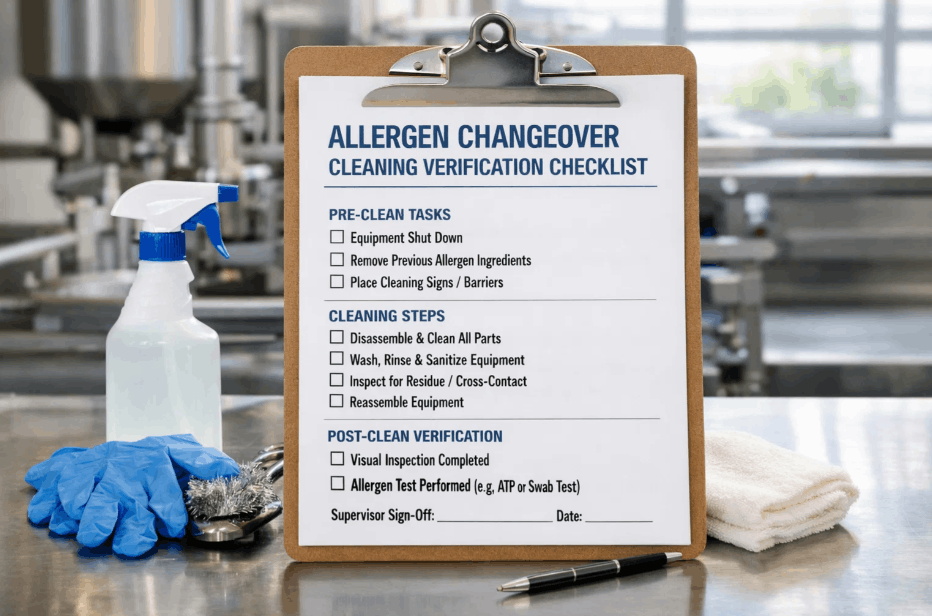
Food-grade conveyor and material handling systems are critical control points in food safety compliance. When belt condition deteriorates, sanitary design fails validation, or cleaning verification is incomplete, the risk of product contamination escalates across production lines. A structured conveyor hygiene checklist ensures every belt, roller, motor, and transfer point is inspected, cleaned, and documented for FSMA, SQF, and BRCGS audit readiness. If your facility relies on manual belt inspection logbooks, book a demo to see how automated conveyor hygiene monitoring and preventive analytics eliminate missed inspections and compliance gaps across all material handling circuits.
1. Conveyor Belt Condition & Surface Integrity Assessment
Conveyor belt surface condition directly impacts food safety — degraded rubber, cracks, and exposed weld seams harbor pathogens and product residue. Visual and tactile inspection of belt underside, topside, and edge clearances must occur before every production run. For facilities managing multiple parallel conveyors, book a demo to see automated belt condition trending and defect photography in a single compliance dashboard.
2. Sanitary Design Verification & Dead-Leg Elimination Audit
Conveyor design flaws — exposed screw heads, sharp corners, open seams, and inaccessible internal zones — create permanent harborage for bacterial biofilm that cannot be eliminated by cleaning. During pre-production inspection, every structural element must be evaluated for sanitary compliance. For plants retrofitting legacy conveyors, schedule a demo to document design gaps and track remediation progress across all conveyor equipment.
3. Conveyor Cleaning Verification & Post-CIP Residue Testing
Conveyor cleaning efficacy depends on the CIP circuit design, chemical contact time, and flow velocity across all belt zones and roller surfaces. Standard foam or spray cleaning alone is insufficient for belts with embedded residue or complex geometry. Post-CIP verification must include ATP testing, visual inspection, and verification of drainage before equipment returns to production. For complex conveyor trains, book a demo to deploy inline sensors and automated post-cleaning release workflows.
4. Roller, Pulley & Transfer Point Inspection & Wear Assessment
Rollers and pulleys are the load-bearing components of a conveyor system and their condition directly affects product integrity and belt life. Worn or corroded rollers create uneven belt run, product damage, and contamination transfer. Roller end-play (axial movement) and bearing noise are the primary condition indicators. For facilities with multiple parallel conveyor lines, systematic roller replacement schedules prevent unplanned downtime. Regular inspection enables predictive maintenance to outpace reactive bearing failures. Schedule a demo to track roller condition trends and automate preventive replacement scheduling across all conveyor circuits.
5. Lubrication Schedule Compliance & Food-Grade Oil Verification
Conveyor lubrication is essential for bearing life and friction control — but lubricant contamination is a direct food safety and product adulteration risk. Only NSF H1-approved food-grade lubricants are permitted in food manufacturing conveyors. Lubrication intervals, oil type, and application location must be documented and traced to NSF-certified product certs. Unauthorized lubricant or over-lubrication that allows oil migration to the product zone is a critical non-conformance.
6. Conveyor Belt Tension & Tracking Alignment Measurement
Belt tension controls contact pressure between belt and rollers — insufficient tension causes slippage and uneven product transfer, while excessive tension accelerates bearing wear and creates product damage. Belt tracking (lateral centering on the rollers) must be verified to ensure even wear and product stability. Tension and tracking must be measured at ambient temperature and recorded for baseline documentation.
7. Conveyor Equipment Monitoring & Preventive Analytics Compliance
Conveyor hygiene compliance is only as strong as its documentation and trend monitoring. Every inspection, cleaning cycle, lubrication event, and repair must be captured in a retrievable, searchable system that enables rapid response to equipment degradation. Preventive analytics trending of belt condition, bearing noise, and cleaning verification results identifies performance drift before catastrophic failure. Facilities with comprehensive equipment monitoring reduce unplanned downtime by 40–60% and pass regulatory audits with complete compliance records. Facilities transitioning from reactive maintenance to predictive conveyor health can schedule a demo to explore automated conveyor condition monitoring, maintenance scheduling, and audit-ready compliance documentation.