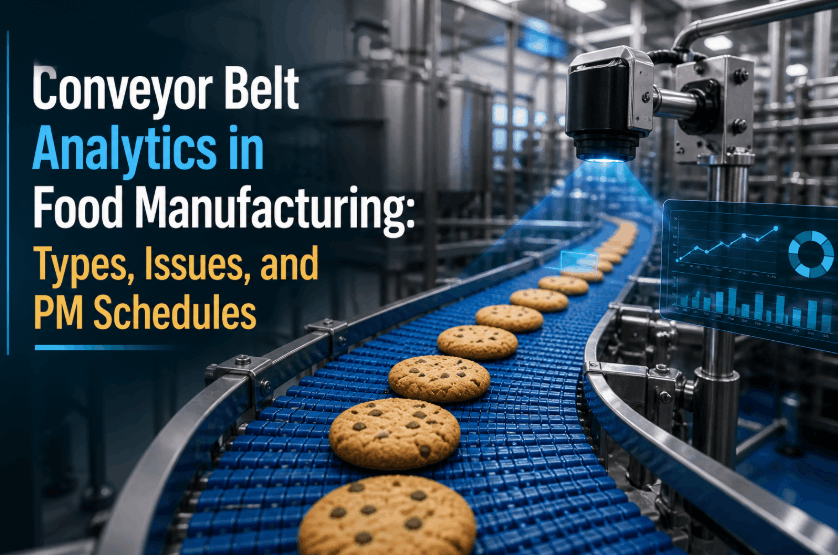
Food-grade conveyor systems and material handling equipment are the circulatory system of any food processing plant — moving raw ingredients, semi-finished goods, and packaged products through every critical stage of production. Yet these same systems are among the most contamination-prone assets in a food facility. Without a structured, hygiene-first preventive maintenance strategy backed by real-time analytics, conveyor belts, drive components, and transfer points become vectors for microbial growth, allergen cross-contact, and costly product recalls. iFactory's AI-driven preventive analytics platform gives food plant managers complete visibility into conveyor health, cleaning protocol compliance, and sanitation-driven PM scheduling — all in one unified system. Book a Demo to see how food plants cut contamination risk and unplanned downtime simultaneously.
iFactory tracks belt wear, cleaning cycles, sanitation intervals, and regulatory compliance across your entire material handling network — automatically.
Why Conveyor Analytics Is Non-Negotiable in Food Processing Plants
Food plant conveyors operate in demanding environments: high-pressure washdowns, temperature extremes, constant loading cycles, and strict regulatory scrutiny under FSMA, HACCP, and GFSI standards. Traditional paper-based PM schedules and reactive maintenance models fail to account for the dynamic contamination risks that emerge between scheduled inspections. A belt with early-stage fraying, a bearing running 8°C above baseline, or a transfer point with inadequate drainage all represent active food safety hazards — yet none of these conditions trigger a work order under conventional maintenance systems.
AI-driven conveyor analytics changes this equation fundamentally. By continuously monitoring sensor data from drives, bearings, belt tension systems, and washdown stations, iFactory generates condition-based PM triggers that align maintenance activity with actual equipment state rather than arbitrary calendar intervals. The result: fewer contamination events, fewer emergency shutdowns, and full audit-ready documentation for every inspection and cleaning cycle.
iFactory's conveyor analytics platform automates hygiene-first PM scheduling for food-grade material handling systems: real-time belt wear monitoring, AI-triggered cleaning protocol alerts, sanitary design inspection checklists, and regulatory compliance tracking — all linked to your CMMS and audit documentation workflows.
The Hidden Costs of Reactive Conveyor Maintenance in Food Plants
When a conveyor belt fails mid-shift in a food processing plant, the impact extends far beyond the cost of the belt itself. Production lines halt, downstream equipment sits idle, and perishable product in transit faces spoilage risk. In worst-case scenarios, a failed conveyor carrying open food product creates a contamination event requiring line sanitisation, product quarantine, and potential regulatory notification. iFactory customers report that a single unplanned conveyor failure in a high-throughput food line costs between $18,000 and $65,000 in direct losses — before accounting for regulatory investigation costs or customer penalties.
Beyond equipment failure, inadequate conveyor sanitation creates a parallel risk stream. Food residue accumulating in belt seams, conveyor frames, and drive housing creates ideal conditions for Listeria, Salmonella, and mould growth. iFactory's sanitation tracking module links every washdown event to the specific conveyor asset, records chemical concentration, contact time, and temperature data, and flags any deviation from your validated sanitation procedure automatically. Book a Demo to see how sanitation compliance tracking works in a live food plant environment.
Sanitary Design Inspection: What AI-Driven Analytics Tracks
Sanitary design principles require that every conveyor and material handling component be inspectable, cleanable, and drainable without disassembly. Over time, even purpose-built food-grade conveyors develop sanitary design failures: cracked plastic side guards, worn belt edges that create harborage points, corroded frame welds, and damaged bearing seals that allow ingress of cleaning chemicals. iFactory's structured inspection module delivers digital sanitary design checklists mapped to each conveyor asset, capturing photographic evidence of every inspected element and triggering work orders automatically when deficiencies are identified.
Track belt tension, surface wear, splice integrity, and edge damage in real time. AI models predict replacement intervals based on actual loading patterns, not fixed schedules.
Vibration and temperature sensors on drive motors and tail pulleys detect early-stage bearing degradation before it causes belt tracking failures or seizure events.
Every CIP and manual washdown event is logged against the conveyor asset record with chemical type, concentration, water temperature, and operator ID for full audit traceability.
Transfer chutes, hoppers, and infeed zones are tracked as individual sub-assets with their own inspection intervals and sanitary design compliance records.
Conveyors in allergen-controlled zones receive dedicated cleaning verification workflows with colour-coded swab result tracking and automatic hold alerts on non-compliant results.
Full inspection and sanitation history exportable in FSMA-compliant format for FDA, BRC, SQF, and customer audits — no manual report compilation required.
Food-Grade Conveyor Belt Replacement Schedules: Moving Beyond Fixed Intervals
Traditional conveyor belt replacement schedules in food plants are built on conservative fixed intervals — replace every 6 months, every 12 months, regardless of actual belt condition. This approach consistently produces one of two outcomes: premature belt replacement that wastes maintenance budget and creates unnecessary line downtime, or extended belt service beyond safe limits that creates contamination and failure risk. Neither outcome is acceptable in a high-compliance food manufacturing environment.
iFactory's condition-based belt replacement model uses continuous sensor data — belt tension variation, surface scan anomaly detection, splice gap monitoring, and load cycle counting — to generate a dynamic belt replacement forecast for every conveyor in the facility. Maintenance planners see a rolling 90-day replacement outlook updated daily, enabling belt procurement, installation scheduling, and line time allocation to be planned proactively. Book a Demo to see how the belt replacement forecast module works.
AI-Driven PM Scheduling for Material Handling Systems: How iFactory Works
iFactory's preventive analytics engine ingests data from multiple sources across the material handling network: IoT sensors on drives and bearings, PLC production counters tracking belt cycles, SCADA temperature and speed data, manual inspection inputs from mobile devices, and sanitation system records. Machine learning models trained on food industry conveyor failure patterns analyse this combined dataset continuously, generating PM recommendations calibrated to each specific conveyor's operating conditions, product contact risk, and sanitary design classification.
Conveyor Cleaning Protocols in Food Plants: Compliance Tracking That Works
FSMA Preventive Controls rules require food manufacturers to implement, monitor, and verify environmental monitoring and sanitation procedures as preventive controls. For conveyors handling ready-to-eat products, this means documented evidence that every cleaning event met the validated procedure — correct chemical, correct concentration, correct temperature, correct contact time, correct post-clean verification. Manual paper logs create audit gaps, transcription errors, and unverifiable compliance claims. iFactory's digital sanitation tracking eliminates these gaps entirely.
The platform's mobile-first operator interface guides washdown teams through the validated procedure step by step, capturing digital confirmation at each stage. Chemical dispensing system integrations log concentration data automatically. Temperature sensors at washdown stations record water temperature throughout the cycle. ATP swab results are entered directly into the asset record, with automatic alerts if results fall outside acceptance criteria. Every data point is timestamped, operator-attributed, and immutably stored for audit access. Book a Demo to see the sanitation compliance module in action.
iFactory vs Conventional Maintenance Systems for Food Conveyor Management
| Capability | iFactory | Legacy CMMS | Paper-Based PM | Generic EAM |
|---|---|---|---|---|
| Condition-based belt replacement forecasting | AI-driven, rolling 90-day outlook | Fixed intervals only | Manual estimate | Calendar-based |
| Real-time bearing & drive health monitoring | Continuous sensor analytics | Not available | Not available | Add-on required |
| Sanitation event logging with verification | Digital, step-by-step, audit-ready | Manual entry only | Paper log | Basic log |
| FSMA / HACCP compliance documentation | Automated, export-ready | Manual compilation | Manual only | Custom configuration |
| Allergen zone cleaning verification | Dedicated workflow + ATP tracking | Not available | Not available | Not available |
| Sanitary design inspection checklists | Asset-mapped, mobile, photo-capture | Generic checklist | Paper form | Configurable |
Based on publicly available product documentation as of Q1 2025. Verify capabilities directly with each vendor.
Measurable Results: What Food Plants Achieve with iFactory Conveyor Analytics
Frequently Asked Questions: Food Conveyor Preventive Analytics
iFactory manages food-grade conveyor PM from real-time condition monitoring through hygiene-first maintenance scheduling to FSMA-compliant documentation. On-premise. Secure. Food-safety ready.